PIC W9 L2 intersections and exclusions
 Call Kai
 Learn
Learn Practice Test
 Spaced Repetition
 Match
Match Flashcards
 Knowt Play
1/23

Earn XP
Description and Tags
identity and exclusion
Name | Mastery | Learn | Test | Matching | Spaced | Call with Kai |
|---|
No analytics yet
Send a link to your students to track their progress
24 Terms
Exclusions through identity:
- A poem that migrates through tongues – femi Nylander
- There are many ways that exclusion takes shape, often fall into one, or more, of these four categories (adapted from Pain et al., 2001)
Exclusion through legal mechanism
o such as the right to access jobs, the right to vote, the right to get married, right to access a space
Exclusion through the ideologies of ‘Othering’ –
o where ‘everyday’ attitudes of majority groups discriminate against minority groups
- Exclusion through denial of social capital –
o norms of society, value from our social connection and care for each other – exclusions arise as a refusal to acknowledge needs to reduce inequalities
- Exclusion through poverty and economic marginalisation –
o where patterns of economic disadvantage and exclusion exist and may be perpetuated from one generation to the next
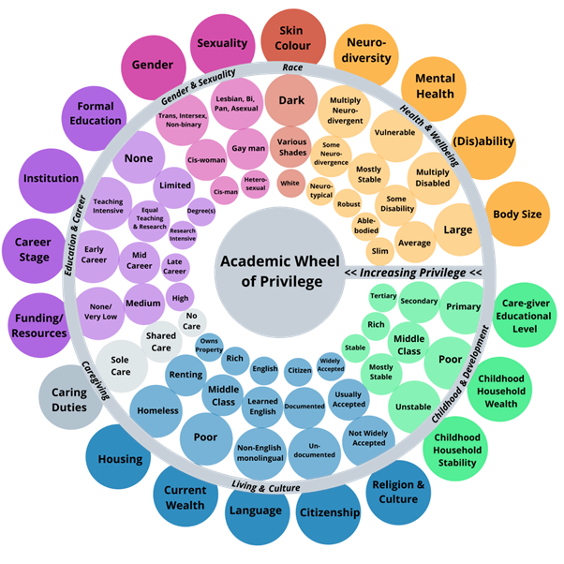
Intergenerational change and advantage:
- State support changing - education
- Women gaining status in society
- Statue supported care/health
Sitting with the discomfort or advantage/ privilege and using it to find connection:
- “It is uncomfortable to know that you benefit from a system premised on structurally disadvantaging others symbolically, discursively and materially. Discomfort proposes an important politics because it works to unseat people from a position of comfort and privilege so that a new order can be imagined. However, a politics of discomfort holds different demands depending on your place within the racial terrain – giving up the white privileges which you have inherited versus risking hard-fought privileges by refusing to be silent about the racist structures that continue to shape yours and others experiences even when you appear to be a beneficiary … An intersectional analysis may be recuperative by drawing connections between social experiences rather than divisions between them, and expanding our gaze so that we might ask a different question: who benefits from sharpening oppositions between differentially oppressed people within the British population? In order to be recuperative, there needs to be an understanding of ‘white’ as a racial category and how whiteness as a system operates through interlocking oppressions, where the white heterosexual able-bodied male functions as the norm; the seat of white privilege. This would provide greater understanding of how privilege and oppression operate in complex ways which defy us/them logics.”
o MADELAINE-SOPHIE ABBAS (2020, 218 & 216).
The importance of learning about the history of self and other, of the legacies of colonialism and the harms… but a danger of causing more harm, of creating disconnection, of guilt, of defensiveness:
- “In 1950, the United Nations Educational, Scientific and Cultural Organization (UNESCO) issued a statement asserting that all humans belong to the same species and that "race" is not a biological reality but a myth. This was a summary of the findings of an international panel of anthropologists, geneticists, sociologists, and psychologists…. If races do not exist as a biological reality, why do so many people still believe that they do? In fact, even though biological races do not exist, the concept of race obviously is still a reality, as is racism. These are prevalent and persistent elements of our everyday lives and generally accepted aspects of our culture.”
o Robert Wald Sussman, introducing his book, ‘The Myth of Race, The troubling of an unscientific idea’ (2014, Harvard) in an online article ‘There is no such thing as race’, 11/8/14, Newsweek
Layla saad – me and white supremacy, 2020:
- This idea that white supremacy applies to the so-called ‘bad ones’ is both incorrect and dangerous, because it reinforces the idea that white supremacy is an ideology that is only upheld by a fringe group of white people. White supremacy is far from fringe. In white-centred societies and communities, it is the dominant paradigm that forms the foundation from which norms, rules, and laws are created
o LAYLA SAAD (2018, 13).
Expressions of racism:
- White fragility is a state in which even a minimum amount of racial stress becomes intolerable, triggering a range of defensive moves. These moves include an outward display of emotions such as anger, fear, and guilt, and behaviours such as argumentation, silence, and leaving the stress-inducing situation. These behaviours, in turn, function to reinstate white racial equilibrium
o ROBIN DIANGELO (2011, 54 LINK).
Windrush realities everyday racism & ‘Black British’ identity:
- “[After] this [Windrush] turning point in Britain’s historical entanglements with its colonies, which Louise Bennett famously coined as ‘Colonization in Reverse’, … it was the experience of institutional racism and other forms of violence and discrimination (as well as the first political efforts at developing inclusive multicultural policies) that emphasised the relevance of articulating and bringing visibility to the interrelated terms ‘black’ and ‘British’. The changing political landscape, anti-immigration rhetoric, and the racism of Enoch Powell and the National Front in the 1970s, followed by Thatcherism with its politics of exclusion and institutional racism in the 1980s, brought into sharp focus the task of representing and claiming a place for black subjects in Britain – a task that remains incomplete, as starkly revealed by the 2018 scandal of state derecognition for Windrush descendants.”
o ALISON DONNELL (2020, 201).
Recognising the experience of the violence of difference
- “Socialized to believe in the fantasy, that whiteness represents goodness and all that is benign and nonthreatening, many white people assume that this is the way black people conceptualise whiteness. They do not imagine that the way whiteness makes its presence felt is black life, most often as terrorising imposition, a power that wounds, hurts, tortures, is a reality that disrupts the fantasy of whiteness as representing goodness.”
o BELL HOOKS (1997, 169).
Radical rest/ self care is:
- … all about love (bell hooks)
- Especially if you are an activist, have lived experience which is exhausting
Insight, solidarity and personal growth/ change is…:
- ‘Racial microaggressions are brief and commonplace daily verbal, behavioural, and environmental indignities, whether intentional or unintentional, that communicate hostile, derogatory, or negative racial slights and insults to the target person or group . … These exchanges are so pervasive and automatic in daily conversations and interactions that they are often dismissed and glossed over as being innocent and innocuous’
o DERALD SUE IN SHANGRILA JOSHI, PRISCILLA MCCUTCHEON & ELIZABETH SWEET (2015, 304-5).
Decolonising our minds is:
- While anti-colonialism had focused on the expulsion of the colonial powers and the creation of new political nations, the postcolonial project was to decolonise the mind, to dismantle the racial hierarchies which were one of the most pernicious legacies of colonialism and, as Bob Marley put it, to ‘free ourselves from mental slavery’.
- The damage that had been done by colonialism was not only political and economic, it was also cultural, shaping minds and subjectivities.
- Marley’s powerful and evocative lyrics were intended for his own people, the oppressed and the exploited, whose sense of self had been damaged and deformed by colonial power. …
- But it was not only the colonised who needed to dismantle their minds, it was also the colonisers, those who had assumed power and superiority over subordinated subjects, whose culture was built on the disavowal of violence and conquest, whose ‘imperial dispositions’ were embedded in everyday practices”
o CATHERINE HALL, NICHOLAS DRAPER & KEITH MCLELLAND (2015, 1 LINK
Reclaiming away from a deficit model:
- Geographies of hope
- Geographies of love
- Geographies of connection
- Geographies of belonging
- Compassionate geographies
- Non-violent geographies
- Empathetic geographies
- Just geographies
- These are the geographies
- being written
- They make visible and address the systemic challenges… but they are about hopeful futures and positive action
-