Medical case Module 7 & 7b: Optical Aberrations and Retinal Image Quality
 Call Kai
 Learn
Learn Practice Test
 Spaced Repetition
 Match
Match Flashcards
 Knowt Play
1/11

There's no tags or description
Looks like no tags are added yet.
Name | Mastery | Learn | Test | Matching | Spaced | Call with Kai |
|---|
No analytics yet
Send a link to your students to track their progress
12 Terms
Find the powers of the lenses necessary to create and achromatic doublet with a total power of +20 D. The Abbe number for the positive lens of the doublet is 55.4, the abbe number for the negative lens is 26.6.
P1: + 38.47 D, P2: - 18.47 D
The eye has positive chromatic aberration (that means that short wavelengths will focus in front of the retina and long wavelengths will focus behind the retina). Professor Arthur Bradley from Indiana University measured the value of the chromatic aberration of the eye and obtained a value of +1.82 D. Calculate how far away from the retina are short and long wavelengths focused. You can assume that the yellowish colors produce a sharp image at the retinal plane, that the reddish colors will focus 0.91 D (60 - 0.91) behind the retina and the blueish colors will focus 0.91D (60 + 0.91) in front of the retina.
Short Wavelength: - 0.33 mm in front of the retina. Long Wavelength: + 0.344 mm behind the retina
What is the effective power of a -12.00 D polycarbonate lens (n=1.586) that is mounted in a frame that has a pantoscopic tilt of 12 degrees?
- 12.16 esf, - 0.54 cyl at 180
A patient with a prescription of +5.00 D selects a frame with a face form angle (FFA) of 17 degrees. If the lens is made of polycarbonate (n=1.586), what is the effective power that the patient experiences.
+ 5.13 esf + 0.46 cyl at 090
What is stray light?
Both:
Optical measuring instruments that work with monochromatic light, such as spectrophotometers, define stray light as light in the system at wavelengths (colors) other than the one intended.
Light in an optical system that was not intended on the design. The light may be from the intended source, but follow paths other than intended, or it may be from a source other than the intended source. This light will often set a working limit on the dynamic range of the system; it limits the signal-to-noise ratio or contrast ratio, by limiting how dark the system can be.

Calculate the RMS value for the following set of Zernike coefficients.
0.489592 µm
Calculate the Strehl Ratio for an optical system where the diffraction-limited peak is 0.8 and the aberrated value is 0.6.
0.75
What is the definition of the Line Spread Function?
It is the result of convolving an object with the form of a line with the PSF of the system.
The higher the value of the RMS:
The lower the optical quality, the lower the MTF values, and the larger the spread of the PSF.
The higher the peak of the PSF corresponds to:
Higher optical quality, higher MTF values, and smaller spread of the PSF.
The higher the value of the RMS means:
Lower contrast on the retina and larger spread of the PSF.
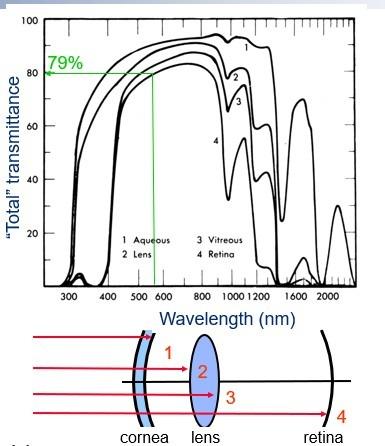
What is the average transmittance of the eye for the visible range?
80