organic chemistry practical mistakes
 Call Kai
 Learn
Learn Practice Test
 Spaced Repetition
 Match
Match Flashcards
 Knowt Play
1/24

There's no tags or description
Looks like no tags are added yet.
Name | Mastery | Learn | Test | Matching | Spaced | Call with Kai |
|---|
No analytics yet
Send a link to your students to track their progress
25 Terms
Differences between reflux and distillation
distillation separates chemicals / products from mixture
Reflux keeps all chemicals inside of reaction vessel
How to purify a solid / recrystallisation (5)
Add just enough hot solvent, that solute isn’t soluble in at rtp, to solid, to form saturated solution
Filter hot solution to remove impurities, using gravity filtration
Leave filtered sample to cool
Sample crystalises, and impurities stay in solution, because their concentration is much lower
Crystals removed by filtration and washed in ice cold solvent
How to purify liquid
shake (invert) and leave in separating funnel
tap off aqueous layer and collect (usually bottom layer) organic product
dry with anhydrous salt eg Ca2Cl
Redistill and refraction at boiling point of product
Using TLC to monitor course of reaction
Take samples at regular intervals from reaction and run on TLC plate with reactants (and product)
Confirm identity of aldehyde / ketone using 1 test
Add 2-4 DNPH
Orange precipitate = aldehyde or ketone
Filter out and recrystallise precipitate
Melt and compare melting points to known / library values
Why is phenol more easier to nitrate than benzoic acid
Lone pair in O of alcohol is partially donated to delocalised pi electron system
Increasing electron density in the ring / making the ring more susceptible to electrophillic attack
COOH is an electron withdrawing group
Reduction of nitrobenzene to phenyl amine conditions
Sn / concentration HCl
How to turn carboxylate to carboxylic acid
H+ from acid protonates with carboxylate to form carboxylic acid
How to use neutralising agent in purifying liquid and example
when an acid catalyst is used
after separating funnel, use neutralising agent on organic layer
eg sodium carbonate
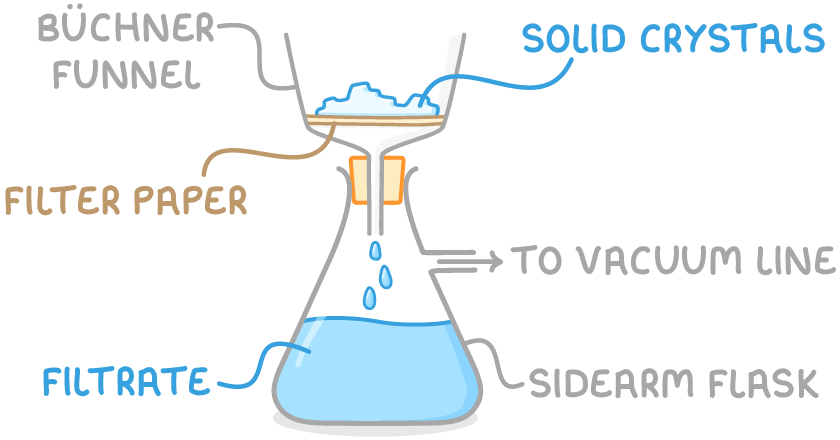
Draw the apparatus for filtration under reduced pressure / vacuum filtration (2)
Ways waste polymers can be disposed usefully (2)
Combusted to generate energy / electricity
used as chemical / organic feedstock
recycling
butanol to butanoic acid equation (2)
CH3CH2CH2CHOH + 2[O] → CH3CH2CH2COOH + H2O
Why don’t we use a beaker, stand, and bunsen burner to oxidise butanol to butanone, and what else could we use? (2)
alcohol is flammable / will evaporate away
heat under reflux with pear shaped flask instead
type of reaction of alcohol to alkene (1)
dehydratoin / elimination
Tests for carboxylic acids (3)
Reactive metal: H2 gas / fizzing
Metal carbonate / CO2 / fizzing
Universal indicator: pH of weak acid
Do you use neutralising agent before or after the seperating funnel
After
How can the purity of a solid be checked
Melt a sample and compare melting point to known / database values
A reaction in aqueous solution forms a salt that is soluble in water. How to form and separate the acid that is soluble in water
Add acid and then use separating funnel
How to purify a liquid acid
Distillation
How to check aqeuous vs organic layer
Add water. Layer that increases in volume is organic layere
Name all parts of distillation apparatus (6)
thermometer
anti bumping granules
pear bottomed / shaped flask
still head
condenser
receiver / beaker
Which way does water flow in distillation
Water comes out nearer the flask, from the top of the condenser
Water enters nearer the receiver, on the bottom of the condenser
Quick test for Aldehyde
Add Tollens reagent and heat
Silver mirror precipitate: aldehyde
What test for haloalkane also identifies the hallide with colours
Add AgNO3 (aq) and ethanol as the solvent
White ppt: cl, cream: br, yellow: I
If the organic layer’s density is less than 1 g per cm, is it on top or bottom layer of seperating funnel
less dense than water, so top