(7) Theories of Romantic Relationships: Rusbult's Investment Model
 Call Kai
 Learn
Learn Practice Test
 Spaced Repetition
 Match
Match Flashcards
 Knowt Play
1/10

There's no tags or description
Looks like no tags are added yet.
Name | Mastery | Learn | Test | Matching | Spaced | Call with Kai |
|---|
No analytics yet
Send a link to your students to track their progress
11 Terms
What does the model look like?
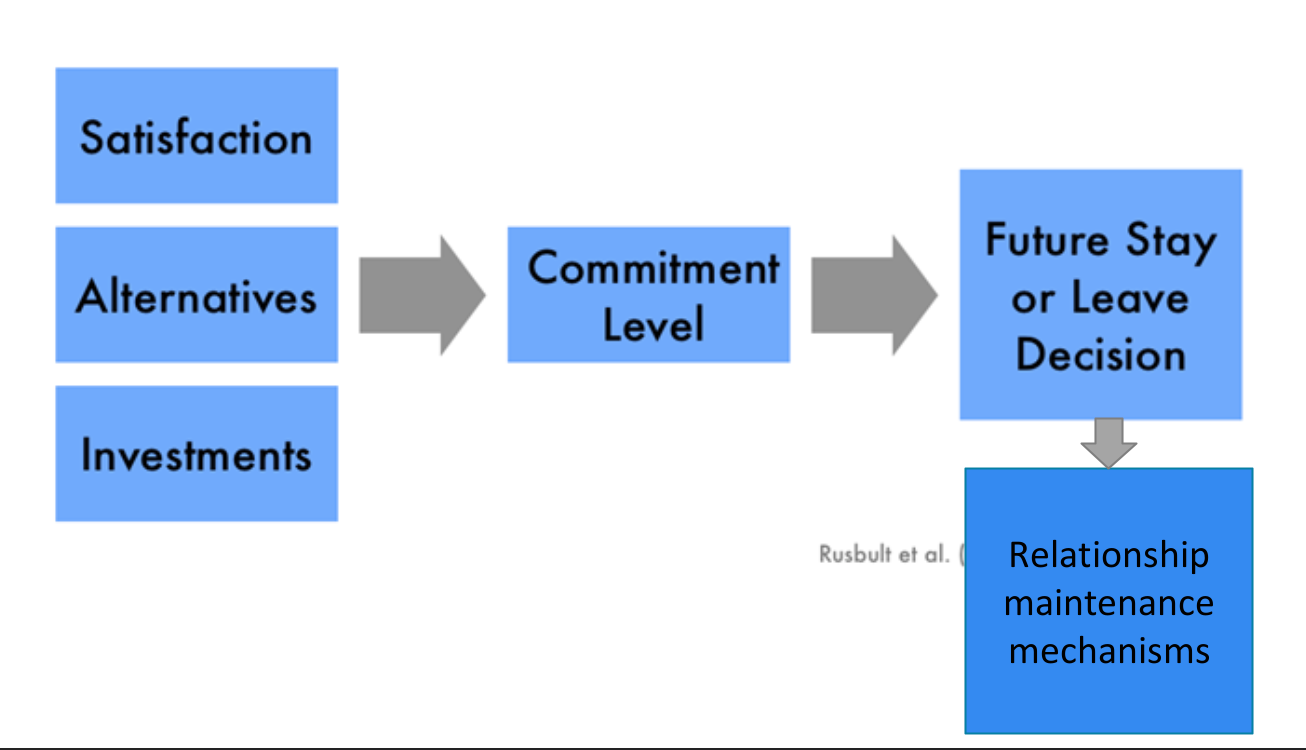
According to Rusbult (2011) commitment to a relationship depends on three different factors.
Satisfaction Level
Comparison with Alternatives
Investment Size
Satisfaction level and quality of alternatives
Satisfaction relates to the Social Exchange theory and is the product of rewards and costs.
people will have a high level of satisfaction with relationships if they have more rewards (companionship, attention, emotional support) and fewer costs (arguments, time).
Comparison with alternatives
the idea that if there is an attractive alternative then this will weaken a person's commitment to the relationship and they are more likely to leave their current relationship
however, if a better alternative is not available, then they may maintain their current relationship by being unrealistically positive about partner's qualities which is known as positive illusion or by ridiculing alternatives - this is when a partner minimises the advantages of potential alternatives and views them in a negative light.
What investment is
‘anything a person puts into a relationship that will be lost if they leave it’. This may include things such as possessions, children’s welfare and emotional energy.
two types of investments
Intrinsic Investment – any resources put directly into a relationship
E.g. money, possessions, energy, emotion, self disclosure
Extrinsic Investment – and resources that didn’t feature before but are now closely associated with the relationship
E.g. mutual friends, memories, children
Commitment
The likelihood that involvement will persist
Commitment is high with high levels of satisfaction and anticipation of high levels of loss (investments high and quality of alternatives low)
Commitment is a consequence of increasing dependence.
Relationship maintenance mechanisms
Putting their partners interests first (willingness to sacrifice), and forgive them for any serious offences (forgiveness).
A03 – Supporting evidence
There is strong research support from Le and Agnew (2003) who conducted a meta-analysis about the importance of commitment as an indicator of relationship stability.
⊙They analysed data from 52 studies and found that satisfaction, comparison with alternatives and investment size all predicted relationship commitment. Relationships in which commitment was greatest were the most stable and lasted the longest, whereas a lack of commitment was a particularly strong predictor of whether a relationship would break up.
These findings were true for both men and women across all cultures in the analysis and for homosexual and heterosexual couples. This suggests the ujiversality of the investment model as it applies to a wide range of relationships and cultures.
A03- Explains abusive relationships
The investment model is thought to be particularly valid and useful explanations of relationships involving Intimate Partner Violence (IPV).
Rusbult and Martz (1995) applied the investment model to abusive relationships.
They asked women living in refuges why they had stayed with their abusive partners instead of leaving them as soon as the abuse began.
As predicted by the model, women had felt the greatest commitment to their relationship when their economic alternatives were poor and their investment was great.
Investments (time and effort) were the most important predictor of whether to stay with a violent partner.
A03- Reductionism/ Holism
There is more to investment than the resources you have put in.
Investments can be made to future plans.
The model fails to recognise the true complexity of investment