AP 1 Lecture Exam 1
 Call Kai
 Learn
Learn Practice Test
 Spaced Repetition
 Match
Match Flashcards
 Knowt Play
1/84

There's no tags or description
Looks like no tags are added yet.
Name | Mastery | Learn | Test | Matching | Spaced | Call with Kai |
|---|
No analytics yet
Send a link to your students to track their progress
85 Terms
posterior (dorsal) aspect
contains cavities encased in bone, subdivided into 2 cavities: cranial cavity and vertebral canal
fate of pyruvate
depends on oxygen availability
enough O2: pyruvate enters mitochondria
low O2: pyruvate converted to lactate
product of glycolysis
product of intermediate stage
pyruvate
Acetyl CoA
ventral cavity
anterior aspect split by thoracic diaphragm into superior thoracic cavity and inferior abdominopelvic cavity
appendicular
upper and lower limbs
axial
along the central axis of the body, consists of: skull, vertebral column, sternum, and ribs
thoracic cavity
contains mediastinum, plueral cavity, and pericardial cavity
abdominopelvic cavity
contains abdominal cavity and pelvic cavity
abdominopelvic regions
umbilical, epigastric, right/left hypochondriac, hypogastric, right/left lumbar. right/left iliac
homeostasis
an organisms ability to maintain consistent internal environment in response to external conditions
the 4 part system of homeostasis
stimulus, receptor, control center, effector
negative feedback
resulting reaction will always be opposite direction of the stimulus, activate biological processes to return conditions to set point
ex: pancreas relasing insulin when bloode glucose increases above set point
positive feedback
increase variable in same direction until climactic event occurs then body returns to homeostasis
ex: breastfeeding, baby suckles and stimulates breast to eject breast milk
abdominopelvic quadrants
right/left upper, right/left lower
pericardium:
what are the outer and inner layers called
what is the cavity called inbetween layers called
what fluid does it contain
2-layered serous membrane that encloses heart
(outer) parietal pericardium and (inner) visceral pericardium
pericardial cavity
contains serous fluid
metabolism:
what processes does it consist of
sum of all chemical reactions within the body
anabolism and catabolism
anabolism
building up or synthesizing, increased size (growth) and increased specialization related to form and function (development)
catabolism
breaking down or decomposition, this happens to get nutrients body needs
homeostatic imbalance
disease
covalent bonds
within a molecular compound it is formed between 2 or more atoms by sharing electrons, occurs when both atoms require electrons
ex: CO2, H2O
ionic bonds
cations and anions bound by electrostatic interactions, a.k.a salts
ex: NaCl, MgCl2
characteristics of a radioisotope
when an element has an unbalanced ratio of protons to neutrons in its nucleus, unstable form of an element, experience radioactive decay relesing excess energy in the form of electromagnetic waves or particles
structure of an atom
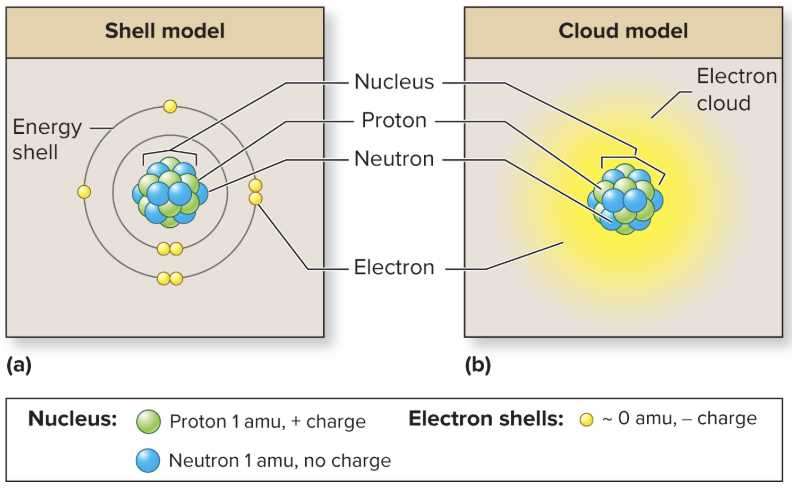
3 forms of matter
solid, liquid, gas
ion
atoms with a positive (cation) or negative charge (anion), produced from loss or gain of one or more electrons
cation
positive charge
ex: Na+, H+
anion
negative charge
ex: Cl-, HCO3-
atomic number
number of protons in an atom of the element, above symbol name, number of electrons is same as number of protons
atomic mass number
mass of protons and neutrons, neutron number = atomic mass - atomic number [(p+n)-p]
phospholipids: structure
amphipathic molecules, gycerol with a phosphate group (hydrophilic: polar) head and fatty acid (hydrophobic: nonpolar) tails
phospholipids: function
serves as chemical barriers for cell membranes
ampipathic
chemical or molecule that posses both polar and nonpolar properties
functions of liquid water
transports, lubricates, cushions, and excretes wastes
what is pH
measure of the relative amounts of H+ (hydrogen ions) a neutral, acidic, or basic solution has, number between 0 (very acidic) and 14 (very basic/alkaline)
optimal range of pH for enzymes
6-8, or 7.45
acid
dissociates in water to produce H+ and an anion, it is a proton donor, which increases concentration of free H+, more dissociation of H+ with strong acids, less dissociation with weaker acids
base
decreases concentration of free H+, more absorption of H+ with stronger bases, less absorption with weaker bases
what is a protein structure
what kind of bonds link them together
one or more strands of amino acid monomers
linked by peptide bonds
4 types of protein structures
primary, secondary, tertiary, and quaternary
primary structure
linear sequence of amino acids
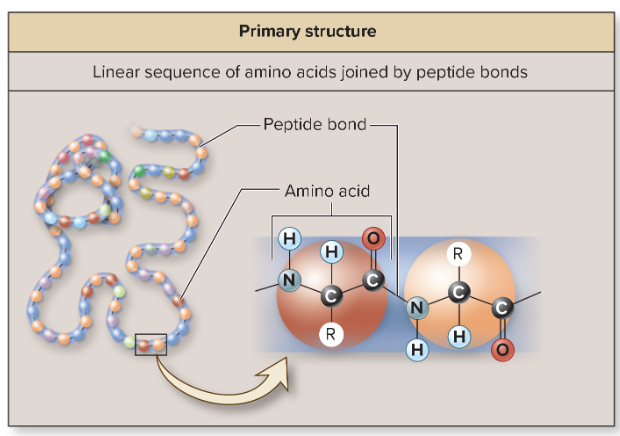
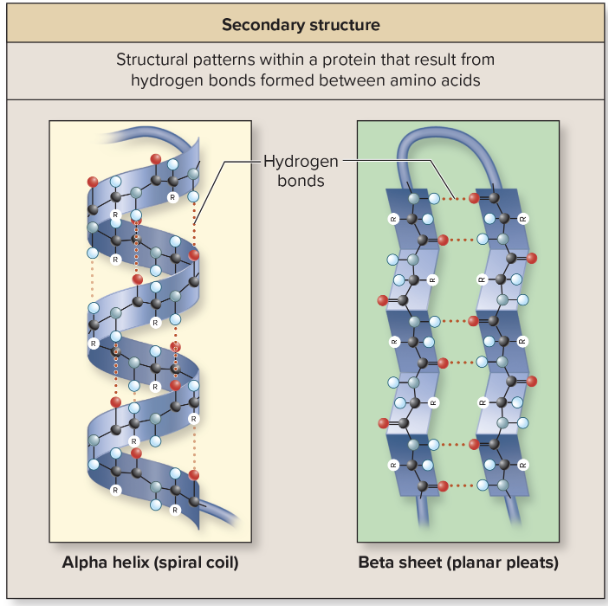
secondary structure
patterns that repeat several times
2 types: alpha helix (spiral coil), beta sheet (planar sheet arrangement)
tertiary structure
3d shape of a poly-peptide chain
2 types: globular proteins (fold into compact shape), fibrous proteins (extended linear molecules)
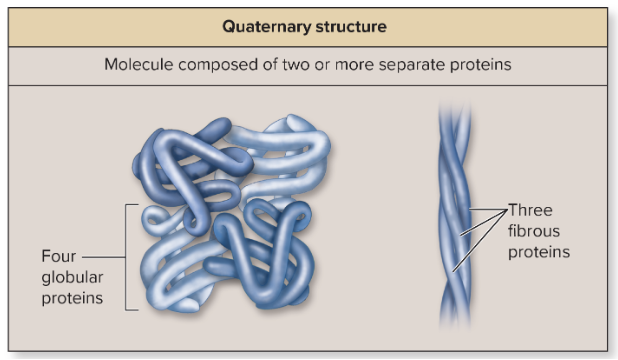
quaternary structure
present in proteins with 2 or more polypeptide chains
ex: hemoglobin
types of lipids
triglycerides, phospholipids, steroids, eicosanoids
triglycerides: function and structure
long term energy storage, formed by glycerol and 3 fatty acids
3 types fatty acids
each type has how many double bonds
saturated: lacks double bonds, unsaturated: one double bond, polyunsaturated: 2 or more double bonds
steroids: function and structure
composed of hydrocarbons, regulate growth, development, and reproduction
eicosanoids: function and structure
local signaling molecules, inflammatory response and nervous system communication, modified 20-Carbon fatty acids
4 classes of eicosanoids
prostaglandins, prostacyclins, thromboxanes, and leuotrienes
nucleic acids: function
what are the 2 classes
store and transfer genetic information
deoxyribonucleic acid (DNA) and ribonucleic acid (RNA)
DNA and RNA are polymers composed of waht type of monomers
what covalent bond links them
nucleotide
phophodiester bonds
what are the nucleotide monomers made up of
sugar: 5-Carbon pentose, phosphate group, and nitrogenous base
what are carbohydrates (CH2O)n
what are the 3 types of carbohydrates
body’s primary source of fuel
monosaccharides (glucose, fructose, ribose, deoxyribose) = 1, disaccharides (sucrose, lactose, maltose) = 2, polysaccharides = 3 or more
kinetic energy
energy of motion
glucose
glycogen
provides energy to cells
many glucose molecules
potential energy
energy of position or stored energy
phosphodiester bonds
strong covalent bond that links 2 sugars and a phosphate group
what is ATP composed of
nitrogenous base adenine, ribose sugar, and 3 phosphate groups
what is ATP
nucleotide, it is the central molecule in transfer of chemical energy within a cell
descibe an amino acid
organic compounds that combine to form proteins
structural formula
indicates the arrangement of atoms within a molecule
molecular formula
indicates the number of atoms
endergonic reactions
synthesis, reactants with less energy than products, energy supplied, net increase in potential energy
exergonic reactions
decomposition, reactants with more energy than products, energy released, net decrease in potential energy
redox reactions (oxidation-reduction)
exchange reaction where electrons are moved from one chamical structure to another, ionic bonding is redox, redox reactions always occur together
thermodynamics
study of heat transfer
1st and 2nd laws of thermodynamics
energy can neither be created or destroyed it can only change form
when energy is transformed some energy is lost to heat
enzymes
biolgically active catalysts that accelerate chemical reactions, decrease activation energy of cellular reactions
activation energy
energy required to break existing chemical bonds (determines the reaction rate) activation energy barrier must be overcome to start reaction
what does induced fit create
a highly stable enzyme-substrate complex and an optimal transition state that accerletaes chemical reactions
enzyme-substrate complex
temporary molecular structure formed when a substrate molecule binds to the active site of an enzyme
what suffix is associated with enzymes
-ase
optimal pH for enzymes
6-8
what feedback mechanism that enzymes are regulated by
negative feedback
phosphorylation
addition of a phosphate group
enzyme that carries out phosphorylation
kinase or phosphorylases
dephosphorylation
what is the enzyme that carries this out
removal of phosphate group
phosphatases
what is the common way that ATP is produced
aerobic cellular respiration
cellular respiration steps
glycolysis, intermediate stage, citric acid cycle, electron transport chain
what is another name for cellular respiration
glucose oxidation
what are the products of cellular respiration
ATP (30 net, 38 gross), water and carbon dioxide
what are the products of citric acid cycle for 2 turns
2 ATP, 6 NADH, 2 FADH2
what happens at rest with muscle tissue
uses steady supply of oxygen to break down fatty acids instead of glucose
irreversible reaction
net loss of reactants and net gain in products
reversible reaction
reaction moves in both ways, no net change in concentration of either reactants or products (equilibrium)