23.4 - carbon cycle
 Call Kai
 Learn
Learn Practice Test
 Spaced Repetition
 Match
Match Flashcards
 Knowt Play
1/8

There's no tags or description
Looks like no tags are added yet.
Name | Mastery | Learn | Test | Matching | Spaced | Call with Kai |
|---|
No analytics yet
Send a link to your students to track their progress
9 Terms
what element makes up all living things
carbon
why is carbon cycle important
as there is only a finite supply of carbon on the planet it must be recycled so there is enough for these biological molecules e.g. proteins, lipids, carbohydrates to be formed
what are decomposers
saprophytic organisms e.g. fungi feed on dead organic matter by extracellular digestion
» secret enzymes onto dead organic matter e.g. cellulose into small organic molecules e.g. glucose which the microorganism reabsorbs
why do decomposers perform extracellular digestion
dead organic matter is large and insoluble so cannot pass through fungal cell membrane so extracellular digestion breaks down into small soluble molecules
what does decomposer do with the soluble organic molecules
as fungus digests these soluble organic molecules for its own growth and respiration, excess is released as inorganic ions back into the soil e.g. ammonium ions
what are detritivores
e.g. maggots or lice feed on dead organic matter by internal digestion which increases SA of food = speeds up decomposition
what does the carbon cycle demonstrate
the movement of carbon between biotic and abiotic components
outline carbon cycle
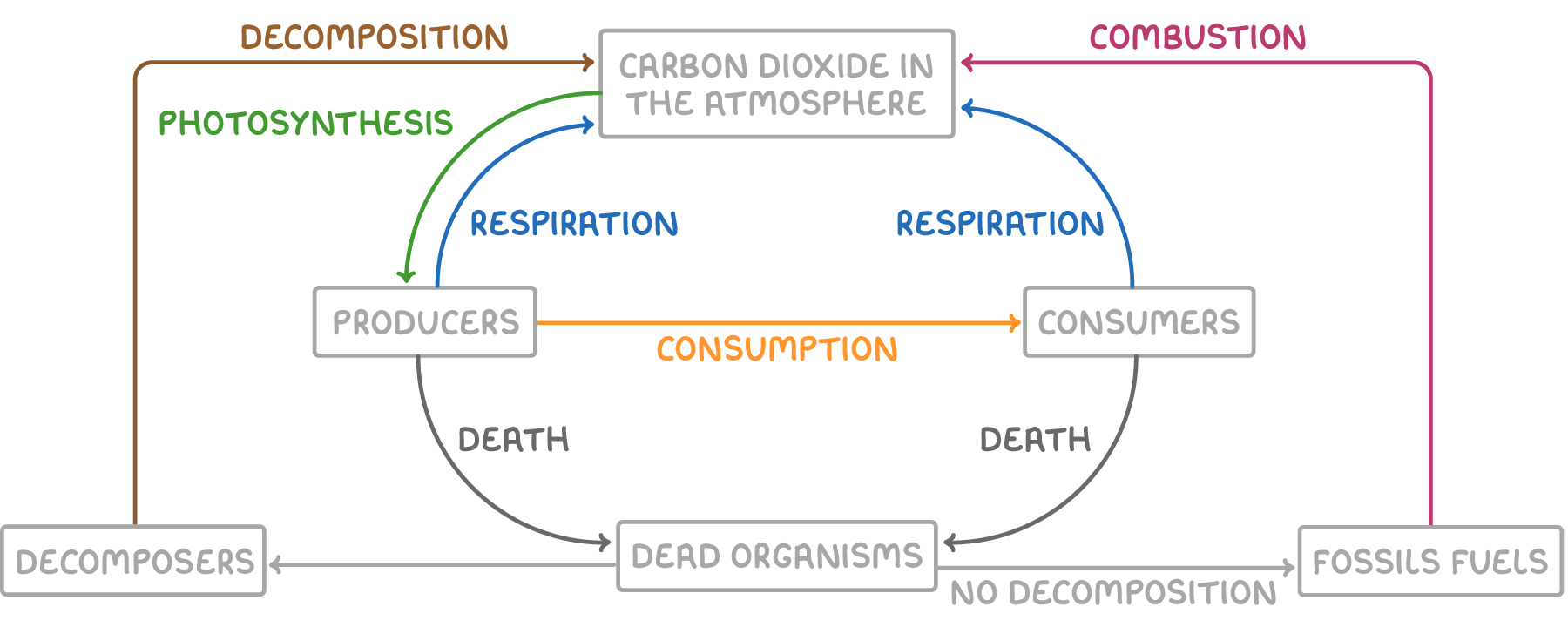
outline the key processes involved in carbon cycle
respiration - organisms use oxygen and carbohydrates to release energy, releasing CO2 back into the atmosphere
photosynthesis - producers absorb CO2 from atmosphere and convert into organic molecules increasing biomass
consumption - carbon transferred through food chains as organisms consume other organisms with carbon trapped in its biomass
decomposition - dead organic matter plants/ animals broken down by detritivores which release CO2 as they respire
fossil fuels - carbon in dead organic matter plants/ animals that doesnt decompose over years transforms into fossil fuels e.g. coal, oil
combustion - fossil fuels are harvested and used e.g. fuel for combustion engines like cars releasing CO2 into atmosphere