Stellar Structure and Evolution
 Call Kai
 Learn
Learn Practice Test
 Spaced Repetition
 Match
Match Flashcards
 Knowt Play
1/13

Earn XP
Description and Tags
Name | Mastery | Learn | Test | Matching | Spaced | Call with Kai |
|---|
No analytics yet
Send a link to your students to track their progress
14 Terms
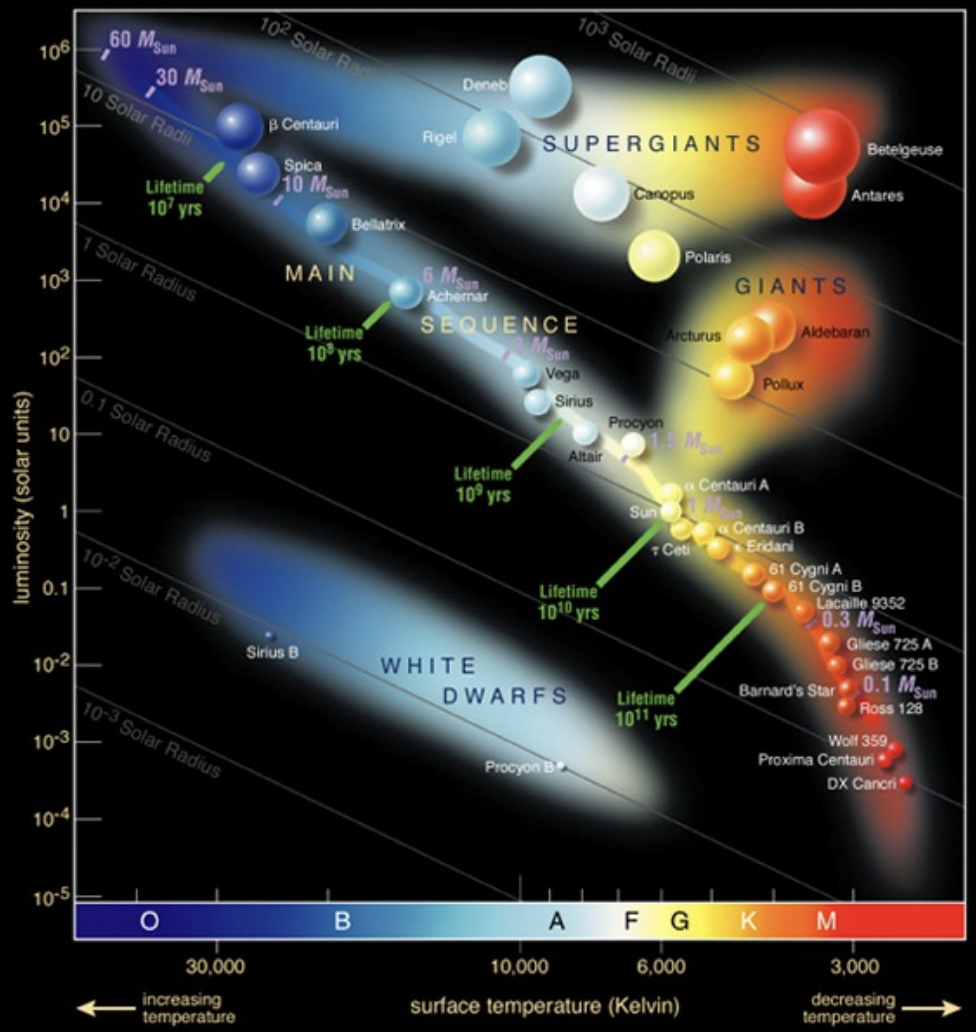
draw an HR diagram and label parts and scales along axes
formula for luminosity of a star
L = 4𝝅R²𝝈T4
what do spectral linewidths tell us about a star’s luminosity, density, and pressure?
narrower lines - typically brighter supergiant stars, lower density and lower pressure. energy levels undisturbed
broader lines - typically less bright main sequence stars, higher density and pressure, many collisions within the star’s gas
what is the mass luminosity relation for average main sequence star?
L = M4 or M3.5
how can we estimate the age of a cluster?
fitting stellar evolutionary models and observing where its MS turnoff point is - the lower the turn off point the older the cluster is (less MS stars present)
how can we determine the distance to a cluster?
main sequence fitting techniques (detailed description in lecture 1 slides)
illustrate the differences between globular and open clusters
open clusters:
distributed in the galactic disc
Population I stars - metal rich
younger - slightly older stars
lower stellar density - more spread out
globular clusters:
around galactic halo and nucleus
Population II stars - metal poor
very old
high stellar density - stars are close together
what is stellar structure generally governed by?
mass, age, and initial chemical composition
mass equation
dM(r)/dr = 4𝜋r2𝜌(r)
derived by mass, volume, density relationship!
define hydrostatic equilibrium
the balance between inward gravitational forces and outward pressure forces
equation of hydrostatic equilibrium - with the aid of a diagram
dP(r)/dr = -GM𝜌 / r2
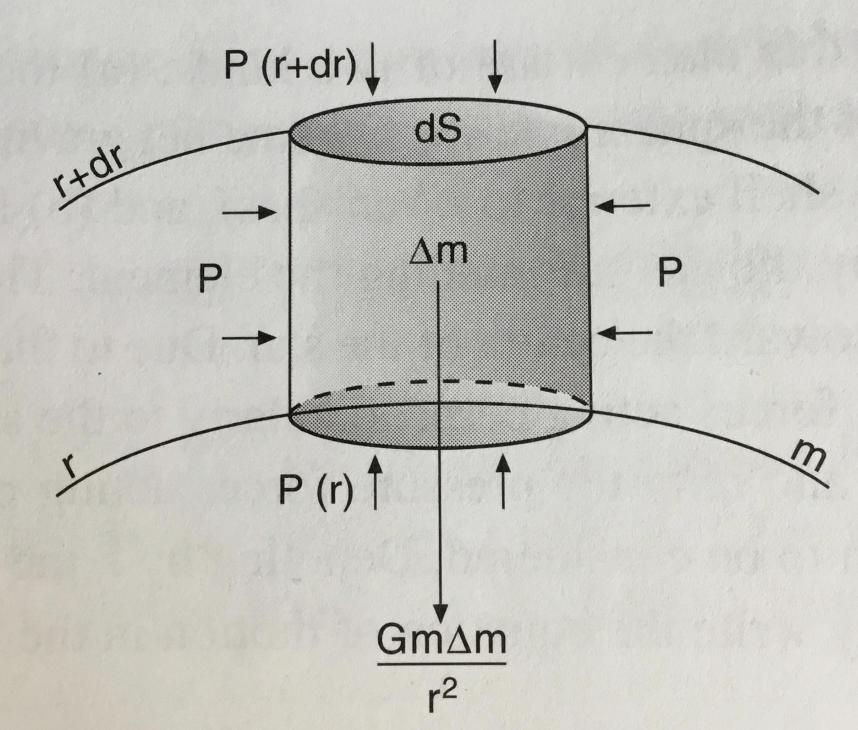
essentially equating pressure gradient (force) with gravitational force
dynamic timescale - definition and equation
dynamic timescale:
timescale over which a star responds to deviations in hydrostatic equilibrium
time it would take for a star to completely collapse if pressure forces were removed
tdyn = √2R3 / GM
equation of state + its components
this is basically just the equation of gas pressure!
P = 𝜌kBT / 𝜇mo = 𝜌kBT / 𝑚
𝜇 = mean molecular weight (amu)
𝑚 = average mass of particle in gas
mo = amu conversion