Human Phys Exam 1
 Call Kai
 Learn
Learn Practice Test
 Spaced Repetition
 Match
Match Flashcards
 Knowt Play
1/28

There's no tags or description
Looks like no tags are added yet.
Name | Mastery | Learn | Test | Matching | Spaced | Call with Kai |
|---|
No analytics yet
Send a link to your students to track their progress
29 Terms
Which of the following is/are NOT completely true regarding resting membrane potential?
Two of these answers
The sodium potassium pumps contribute to the resting membrane potential because they pump more potassium into the cell than the amount of sodium they pump out
A common value in neurons would be around -70mV
The resting membrane potential is closer to the potassium equilibrium potential than to the sodium equilibrium potential
At rest, the membrane is more permeable to potassium and thus positive charges are leaking out, making the inside of the membrane seem relatively more negative
The sodium potassium pumps contribute to the resting membrane potential because they pump more potassium into the cell than the amount of sodium they pump out
Which of the following are NOT true about fat metabolism in our cells?
The breakdown of fatty acids to make energy takes place in the mitochondria; unlike glycolysis, which takes place in the cytoplasm
All of these ARE true
The process by which we break down fatty acids to make energy is called beta oxidation
Two of these
Fatty acids are broken down to make pyruvate, which can then enter the citric acid cycle
Fatty acids are broken down to make pyruvate, which can then enter the citric acid cycle
Which of the following enzymes is matched with the wrong metabolic pathway/process?
Complex IV: electron transport chain
two of these answers
hexokinase: citric acid cycle
isocitrate dehydrogenase: citric acid cycle
citrate synthase: citric acid cycle
ATP synthase: oxidative phosphorylation
phosphofructokinase: glycolysis
hexokinase: citric acid cycle
Which of the following is/are related to the activity of the electron transport chain?
it is how we make NADH and FADH2
Three of these answers
it is how we break down fatty acids to AcCoA
it is how we break down glucose to pyruvate and make ATP
the energy from transferring electrons from one carrier to the next is used to drive the pumping of hydrogen ions from the matrix of the mitochondria to the intermembrane space
the energy from transferring electrons from one carrier to the next is used to drive the pumping of hydrogen ions from the matrix of the mitochondria to the intermembrane space
The following are parts of the cerebral cortex involved in movement. Which is matched with the wrong description?
none of these are mismatched
Premotor cortex - coordination of complex movements
Somatosensory cortex - proprioreception (awareness of body position)
Primary motor cortex - decision to move, planning voluntary activity
Supplementary motor cortex - programming of complex movements
Primary motor cortex - decision to move, planning voluntary activity
Hearing, speaking and language functions are especially associated with the ___ lobe of the cerebral cortex.
temporal
frontal
parietal
cerebellum
occipital
temporal
PFK catalyzes the rate limiting step of which of the following processes?
None of the above
Glycogenesis
Glycogenolysis
Glycolysis
Gluconeogenesis
Glycolysis
Which part of the cerebellum is involved in maintaining muscle tone and coordinating skilled movements?
supplementary motor area
none of these
cerebrocerebellum
spinocerebellum
vestibulocerebellum
spinocerebellum
Which of the following would NOT tend to increase the conduction velocity of an axon?
a decrease in length of the axon
all of these answers would increase conduction velocity
an increase in diameter
an increase in temperature
an increase in myelin
a decrease in length of the axon
The autonomic nervous system is an important regulator of many homeostatic functions in the body. The responses of our organs and tissues to autonomic stimulation are determined by the specific neurotransmitter released and the specific neurotransmitter receptors that are found in those locations. Which of the following is/are NOT true about autonomic nervous system neurotransmitters and neurotransmitter receptors.
alpha-adrenergic receptors have lower affinity for epinephrine than norepinephrine
muscarinic receptors bind with acetylcholine from parasympathetic postganglionic nerve fibers
Beta-2-adrenergic receptors have greater affinity for epinephrine than norepinephrine
all of these ARE true
Beta-1-adrenergic receptors have equal affinity for epinephrine and norepinephrine
alpha-adrenergic receptors have lower affinity for epinephrine than norepinephrine
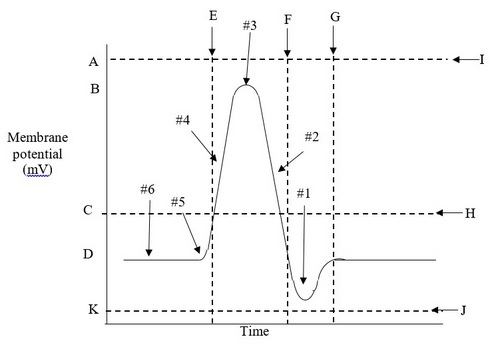
G
no term
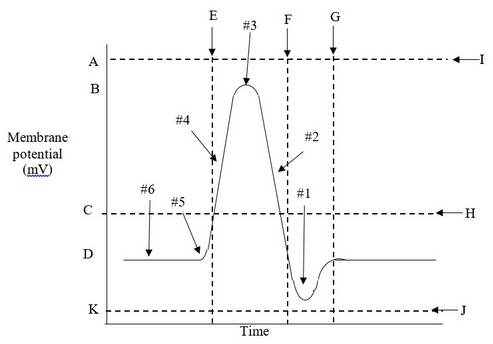
F
End of the absolute refractory period
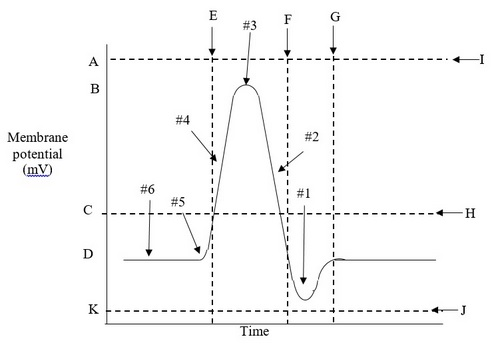
#2
repolarization
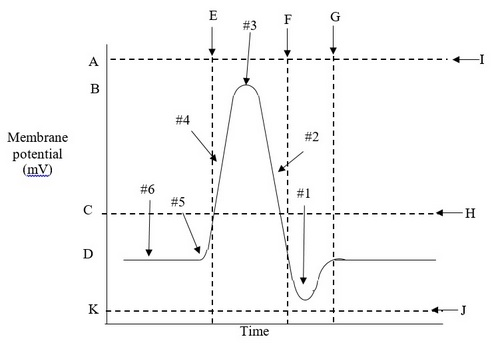
J
K+ Equilibrium potential
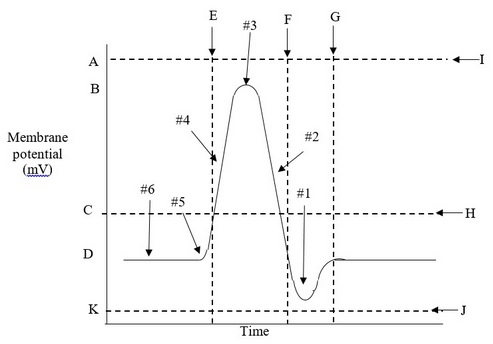
H
Threshold
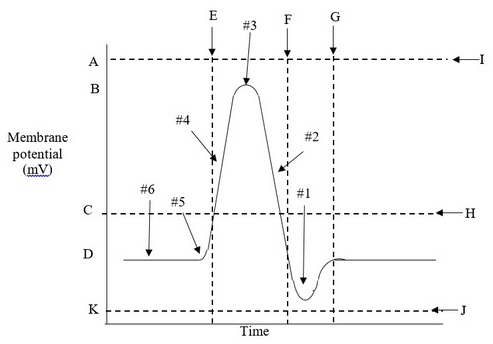
#4
Na+ influx
Which part of the cerebellum is involved in initiating and planning voluntary activity?
vestibulocerebellum
cerebrocerebellum
supplementary motor area
spinocerebellum
none of these
cerebrocerebellum
In skeletal muscle, when an action potential spreads down the T tubles it activates ____________________, which serve as _____________; this plays an important role in the release of calcium.
Ryanodine receptors, voltage sensors
IP3, Calcium release signal
Dihyrdopyridine receptors, voltage sensors
Dihyrdopyridine receptors, calcium channels
SERCAs, Calcium pumps
Dihyrdopyridine receptors, voltage sensors
What type of communication do we call it when a cell secretes an extracellular messenger that acts on itself (the same cell that secreted the chemical messenger)?
gap junctions
autocrine
endocrine
temporaroy cell-cell linkup
paracrine
neural
autocrine
In skeletal muscle, which of the following is/are true about calcium serving as a signal for contraction.
Most of the calcium comes from the extracellular fluid
IP3 causes calcium release from the sarcoplasmic reticulum
Ryanodine receptors release calcium from the sarcoplasmic reticulum
SERCAs release calcium from the sarcoplasmic reticulum
Dihyrdopyridine receptors release calcium
Ryanodine receptors release calcium from the sarcoplasmic reticulum
Which of the following is/are NOT properties of the parasympathetic nervous system?
norepinephrine is released by its postganglionic nerve fibers
long pre-ganglionic nerve fibers
acetylcholine is released by its postganglionic nerve fibers
it acts on target tissues via muscarinic cholinergic receptors
short post -ganglionic nerve fibers
short pre-ganglionic nerve fibers
it acts on target tissues via adrenergic receptors
acetylcholine is released by its preganglionic nerve fibers
leaves CNS via cervical and sacral spinal segments
leaves CNS via lumbar and thoracic spinal segments
long post-ganglionic nerve fibers
it acts on target tissues via nicotinic cholinergic receptors
norepinephrine is released by its postganglionic nerve fibers
short pre-ganglionic nerve fibers
leaves CNS via lumbar and thoracic spinal segments
long post-ganglionic nerve fibers
it acts on target tissues via nicotinic cholinergic receptors
Which of the following would likely increase the rate of net diffusion the most?
An increase in distance
A decrease in concentration gradient
An increase in surface area
A decrease in lipid solubility
a higher molecular weight
An increase in surface area
Which of the following would help us to determine if a perceived sensation was stronger or weaker (e.g. stronger taste/weaker tase, dim light/bright light, soft sound/loud sound)?
frequency coding
spatial summation
law of specific nerve energies
population coding
law of projection
temporal summation
law of adequate stimulus
frequency coding
population coding
During the hyperpolarization phase of an action potential, whitch of the following is/are NOT true?
potassium ion channels are open
All of the above ARE true
a second action potential can occur, but only if there is an extra strong simulus
potassium ions are leaving the cell
the membrane potential is becoming more negative
All of the above ARE true
Which of the following is/are true about sodium (Na+) and nerve cells?
all of these answers are true
Na+ is found in higher concentrations outside the cell
at rest, the membrane is more permeable to sodium than potassium
if sodium ion channels open, we would expect Na+ to enter the cell
only two of these answers are true
only two of these answers are true
Several diseases, drugs, toxins and venoms influence neuromuscular transmission at the neuromuscular junction, for example, ________________ binds with nicotinic receptors and thus prevents acetylcholine binding
botulinum toxin
organophosphates
Myasthenia Gravis
Curare
Black Widow Spider Venom
Curare
The central dogma of biology illustrates how our genes encode for proteins.Which words would make this phrase correct: DNA →__________→mRNA →__________→protein.
Which processes by which DNA results in mRNA and mRNA results in protein are
translation, transcription
transcription, translation
mitosis, meiosis
two of these are correct
initiation, elongation
transcription, translation
Which of the following is caused by the parasympathetic nervous system (PNS)?
an increase in heart rate
all of these ARE caused by the PNS
a decrease in gastrointestinal motility and secretion
dilation of airways
breakdown of stored triglycerides in adipose cells
increase in sweating
breakdown of glycogen in muscle and liver
three of these answers
constriction of pupils in the eyes
constriction of pupils in the eyes
In order to make a protein, DNA must first be _______________ into mRNA.
transcribed