Exam 3
 Call Kai
 Learn
Learn Practice Test
 Spaced Repetition
 Match
Match Flashcards
 Knowt Play
1/134

Earn XP
Description and Tags
14-19 adolescences
Name | Mastery | Learn | Test | Matching | Spaced | Call with Kai |
|---|
No analytics yet
Send a link to your students to track their progress
135 Terms
puberty
The time between the first onrush of hormones and full adult physical development.
usually lasts three to five years. Many more years are required to achieve psychosocial maturity.
menarche
A girl’s first menstrual period, signaling that she has begun ovulation. Pregnancy is biologically possible, but ovulation and menstruation are often irregular for years after.
spermarche
A boy’s first ejaculation of sperm. Erections can occur as early as infancy, but ejaculation signals sperm production. may occur during sleep (in a “wet dream”) or via direct stimulation.
pituitary gland
A gland in the brain that responds to a signal from the hypothalamus by producing many hormones, including those that regulate growth and sexual maturation.
adrenal glands
Two glands, located above the kidneys, that respond to the pituitary, producing hormones
HPA (hypothalamus–pituitary–adrenal) axis
A sequence of hormone production originating in the hypothalamus and moving to the pituitary and then to the adrenal glands.
HPG (hypothalamus–pituitary–gonad) axis
A sequence of hormone production originating in the hypothalamus and moving to the pituitary and then to the gonads
estradiol
A sex hormone, considered the chief estrogen. Females produce much more estradiol than males do.
testosterone
A sex hormone, the best known of the androgens (male hormones); secreted in far greater amounts by males than by females.
circadian rhythm
A day–night cycle of biological activity that occurs approximately every 24 hours.
secular trend
The long-term upward or downward direction of a certain set of statistical measurements, as opposed to a smaller, shorter cyclical variation.
As an example, over the past two centuries, because of improved nutrition and medical care, children have tended to reach their adult height earlier and their adult height has increased.
growth spurt
The relatively sudden and rapid physical growth that occurs during puberty. Each body part increases in size on a schedule: Weight usually precedes height, and growth of the limbs precedes growth of the torso.
body image
A person’s idea of how their body looks. Adolescents become obsess about this
primary sex characteristics
The parts of the body that are directly involved in reproduction, including the vagina, uterus, ovaries, testicles, and penis.
secondary sex characteristics
Physical traits that are not directly involved in reproduction but that indicate sexual maturity, such as a man’s beard and a woman’s breasts
child sexual abuse
Any erotic activity that arouses an adult and excites, shames, or confuses a child, whether or not the victim protests and whether or not genital contact is involved. Adolescents are most frequent victims of this
sexually transmitted infection (STI)
A disease spread by sexual contact; includes HPV, gonorrhea, genital herpes, chlamydia, and HIV. Teens at highest risk
adolescent egocentrism
A characteristic of adolescent thinking that leads young people (ages 10 to 13) to focus on themselves to the exclusion of others.
rumination
To think obsessively about something, perhaps to the point that a past experience or current fantasy captures the mind, making further action difficult.
imaginary audience
The other people who, in an adolescent’s egocentric belief, are watching and taking note of their appearance, ideas, and behavior. This belief makes many teenagers very self-conscious.
personal fable
An aspect of adolescent egocentrism characterized by an adolescent’s belief that their thoughts, feelings, and experiences are unique, more wonderful, or more awful than anyone else’s.
invincibility fable
An adolescent’s egocentric conviction that they cannot be overcome or even harmed by anything that might defeat a normal mortal, such as unprotected sex, drug abuse, or high-speed driving
formal operational thought
In Piaget’s theory, the fourth and final stage of cognitive development, characterized by more systematic logical thinking and by the ability to understand and systematically manipulate abstract concepts.
hypothetical thought
Reasoning that includes propositions and possibilities that may not reflect reality.
deductive reasoning
Reasoning from a general statement, premise, or principle, through logical steps, to figure out specifics. (Also called top-down reasoning.)
inductive reasoning
Reasoning from one or more specific experiences or facts to reach (induce) a general conclusion. (Also called bottom-up reasoning.)
dual processing
The notion that two networks exist within the human brain, one for emotional processing of stimuli and one for analytical reasoning.
intuitive thought
Thought that arises from an emotion or a hunch, beyond rational explanation, and is influenced by past experiences and cultural assumptions.
analytic thought
Thought that results from analysis, such as a systematic ranking of pros and cons, risks and consequences, possibilities and facts.
______ depends on logic and rationality.
secondary education
Literally, the period after primary education (elementary or grade school) and before tertiary education (college). It usually occurs from about ages 12 to 18, although there is some variation by school and by nation.
high-stakes test
An evaluation that is critical in determining success or failure. If a single test determines whether a student will graduate or be promoted, it is a high-stakes test
stereotype threat
The thought a person has that one’s appearance or behavior will be misread to confirm another person’s oversimplified, prejudiced attitudes.
growth mindset
An approach to understanding intelligence that holds that intelligence grows incrementally, and thus can be increased by effort. Those who subscribe to this view believe they can master whatever they seek to learn if they pay attention, participate in class, study, complete their homework, and so on.
fixed mindset
An approach to understanding intelligence that sees ability as an innate entity, a fixed quantity present at birth. Those who hold this view do not believe that effort enhances achievement.
identity versus role confusion
Erikson’s fifth stage of development, when people wonder “Who am I?” but are confused about which of many possible roles to adopt
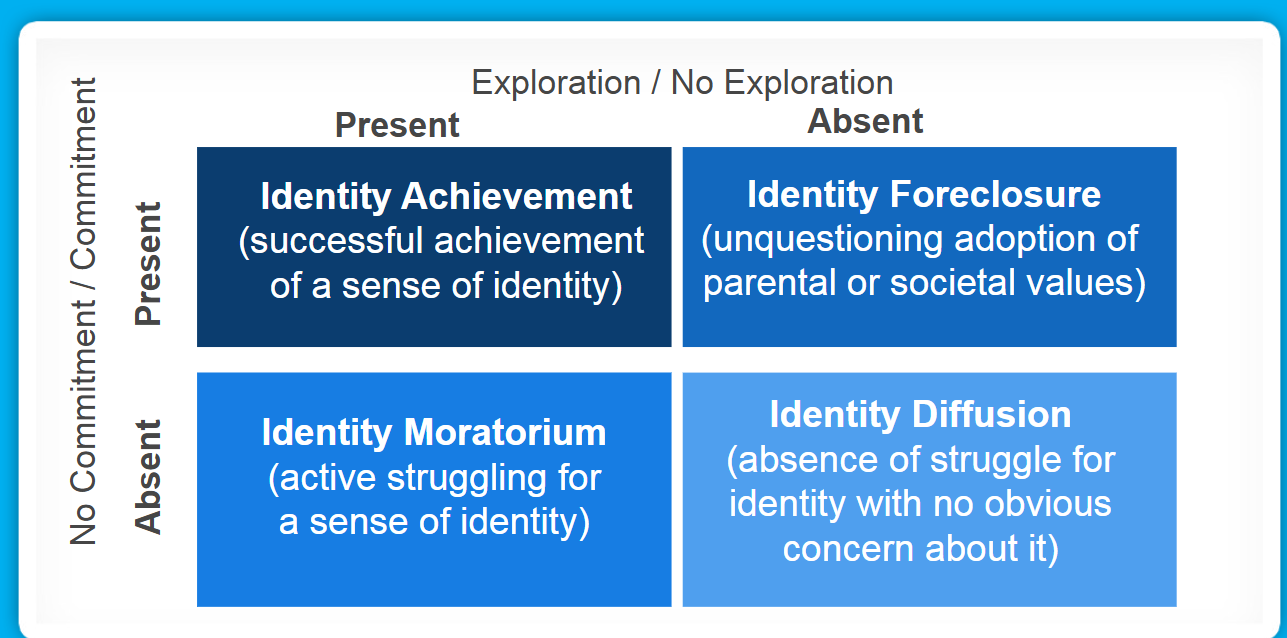
identity achievement
Erikson’s term for the attainment of identity, when people know who they are as unique individuals, combining past experiences and future plans
role confusion
When adolescents have no clear identity, but fluctuate from one persona to another. (Sometimes called identity diffusion or role diffusion.)
foreclosure
Erikson’s term for premature identity formation, when adolescents adopt their parents’ or society’s roles and values without questioning or analysis.
moratorium
A socially acceptable way to postpone achieving identity.
Going to college or joining the military are examples.
gender binary
The idea that gender comes in two — and only two — forms, male and female
transgender
Someone who identifies as a gender other than the one they were assigned at birth.
cisgender
Someone whose gender identity is the same as the sex they were assigned at birth
LGBTQIA+
People who are lesbian, gay, bisexual, transgender, queer (or questioning), intersex, asexual, and more
parental monitoring
Parents’ ongoing knowledge of what their children are doing, where, and with whom.
familism
The belief that family members should support one another, sacrificing individual freedom and success, if necessary, in order to preserve family unity and protect the family.
peer pressure
Encouragement to conform to friends or contemporaries in behavior, dress, and attitude. Adolescents do many things with peers that they would not do alone
sexual orientation
A person’s romantic or sexual attraction, which can be to others of the same gender, another gender, or every gender.
sexting
Sending sexual messages or photographs (usually of one’s naked body) via phone or computer.
cyberbullying
When people try to harm others via electronic means, such as social media, cell phone photos, or texts.
major depression
Feelings of hopelessness, lethargy, and worthlessness that last two weeks or more.
parasuicide
Any potentially deadly self-harm that does not result in death. (Also called attempted suicide or failed suicide.)
cluster suicides
Several suicides committed by members of a group within a brief period
adolescence-limited offender
A person who breaks the law as a teenager but whose criminal activity stops by age 20.
life-course-persistent offender
A person whose criminal activity begins in adolescence and continues throughout life; a “career” criminal
emerging adulthood
The period of life between the ages of 18 and 25. _____ is now widely thought of as a distinct developmental stage.
WEIRD
An acronym for Western, Educated, Industrialized, Rich, Democracy that refers to emerging adults. The criticism is that conclusions about human development based on people in such nations may not apply to most people in the world, who do not live in WEIRD nations.
organ reserve
The capacity of organs to allow the body to cope with stress, via extra, unused functioning ability.
homeostasis
The adjustment of all of the body’s systems to keep physiological functions in a state of equilibrium. As the body ages, it takes longer for these homeostatic adjustments to occur, so it becomes harder for older bodies to adapt to stress.
allostasis
A dynamic body adjustment, r to homeostasis, that affects overall physiology over time. The main difference is that homeostasis requires an immediate response, whereas allostasis requires longer-term adjustment.elated
allostatic load
The stresses of basic body systems that burden overall functioning, such as hypertension.
anorexia nervosa
An eating disorder characterized by distorted body image, severe calorie restriction, and intense fear of weight gain. Affected individuals voluntarily undereat or binge and purge, depriving their vital organs of nutrition. Anorexia can be fatal.
bulimia nervosa
An eating disorder characterized by binge eating and subsequent purging, usually by induced vomiting and/or use of laxatives.
binge eating disorder
An eating disorder common in adolescence, which involves compulsive overeating.
drug abuse
A condition of drug dependence in which the absence of the given drug in the individual’s system produces a drive — physiological, psychological, or both — to ingest more of the drug.
drug use
Use of any drug in a harmful way, damaging a person’s physical, cognitive, or psychosocial well-being.
drug addiction
When the body adjusts to a drug, requiring more to experience an effect, and causing withdrawal when the drug is absent.
postformal thought
A proposed adult stage of cognitive development, following Piaget’s four stages:
that goes beyond adolescent thinking by being more practical, more flexible, and more dialectical
(i.e., more capable of combining contradictory elements into a comprehensive whole).
dialectical thought
The most advanced cognitive process, characterized by the ability to consider a thesis and its antithesis simultaneously and thus to arrive at a synthesis. Dialectical thought makes possible an ongoing awareness of pros and cons, advantages and disadvantages, possibilities and limitations
thesis
A proposition or statement of belief; the first stage of the process of dialectical thinking.
antithesis
A proposition or statement of belief that opposes the thesis; the second stage of the process of dialectical thinking.
synthesis
A new idea that integrates the thesis and its antithesis, thus representing a new and more comprehensive level of truth; the third stage of the process of dialectical thinking.
Defining Issues Test (DIT)
A series of questions developed by James Rest and designed to assess respondents’ level of moral development by having them rank possible solutions to moral dilemmas
massification
The idea that establishing institutions of higher learning and encouraging college enrollment can benefit everyone (the masses).
intimacy versus isolation
The sixth of Erikson’s eight stages of development. Adults seek someone with whom to share their lives in an enduring and self-sacrificing commitment. Without such commitment, they risk profound loneliness and isolation.
linked lives
Lives in which the success, health, and well-being of each family member are connected to those of other members, including those of another generation, as in the relationship between parents and children.
helicopter parents
The label used for parents who hover over their emerging-adult children. The term is pejorative, but parental involvement is sometimes helpful.
snowplow parents
Parents who try to remove any impediments in the way of their children. This term is pejorative; it implies that parents do not allow children to learn how to overcome obstacles on their own
hookup
A sexual encounter between two people who are not in a romantic relationship. Neither intimacy nor commitment is expected.
choice overload
Having so many possibilities that a thoughtful choice becomes difficult. This is particularly apparent when social networking and other technology make many potential romantic partners available.
cohabitation
An arrangement in which a couple lives together in a committed romantic relationship but are not formally married.
situational couple violence
Fighting between romantic partners that is brought on more by the situation than by the deep personality problems of the individuals. Both partners are typically victims and abusers.
intimate terrorism
A violent and demeaning form of abuse in a romantic relationship, in which the victim (usually female) is frightened to fight back, seek help, or withdraw. In this case, the victim is in danger of physical as well as psychological harm.
Adolescence (11-17 Years)
• Puberty & Growth
• Processing speed & Reaction time
• PFC, LS, & dopamine
• Sexual activity
• Psychopathology
Adolescent Neurological Development
• faster reaction time
• increased myelination & maturation
• Limbic system before PFC
• increased dopamine
Adolescent Neurological Development: hormones
Hormone Changes Impact Sleep
• Hypothalamus & Pituitary Gland regulate homeostasis
• Shift in circadian rhythm for sleep cycle
Puberty Timing: early & late
(↓ age 8) early
(↑ age 14) late
Puberty Timing: girls
____ earlier than ____
• ↑ Body weight, stress
• ↓ Self-esteem & body satisfaction
• ↑ Depression & abusive relationships
Puberty Timing: boys
___ later than ___
• Early: ↑ Aggression, criminal behavior, & substance use
• Late: ↑ Anxiety & depression
Sexual Orientation & Eating Disorder Sx...
• RQ: To examine sexual orientation disparities in
adolescent eating disorder Sx in the UK
• Descriptive data collected across 2 time points
(~ages 14 & 16), via questionnaires – those
identifying as completely or mostly gay, lesbian,
bisexual, or heterosexual – and eating behaviors
• Findings:
- Eating disorder Sx were ↑ common for those not
self-identifying as completely heterosexual
inductive vs deductive reasoning (practice sheet in ch.15)
Inductive reasoning: Specific to general.
Observes patterns or examples to form a general conclusion.
Example: "All the teens I know love music, so most teens probably do."
Deductive reasoning: General to specific.
Starts with a general rule or premise and applies it to a specific case.
Example: "All humans need sleep. Jake is human, so Jake needs sleep."
Psychosocial Growth: Adolescence, Ages 11-17 Years
• Industry → Identity
• Identity Statuses
• Friendships & Peer Pressure
• Delinquency & Defiance
• Substance Use & Suicidality
• Parental Influence
Adolescence & The Search For Identity stage 5
Identity Versus Confusion
Who am I & where am I going?
Through self-awareness & new experiences, we seek to develop a stable consistent self-view.
Peers: Relationships & Peer Pressure
• PP: Younger > older
• Selection of friends → Facilitates behaviors
• Helpful > Harmful
Identity Statuses... Who am I? (Identity vs. Role Confusion) chart
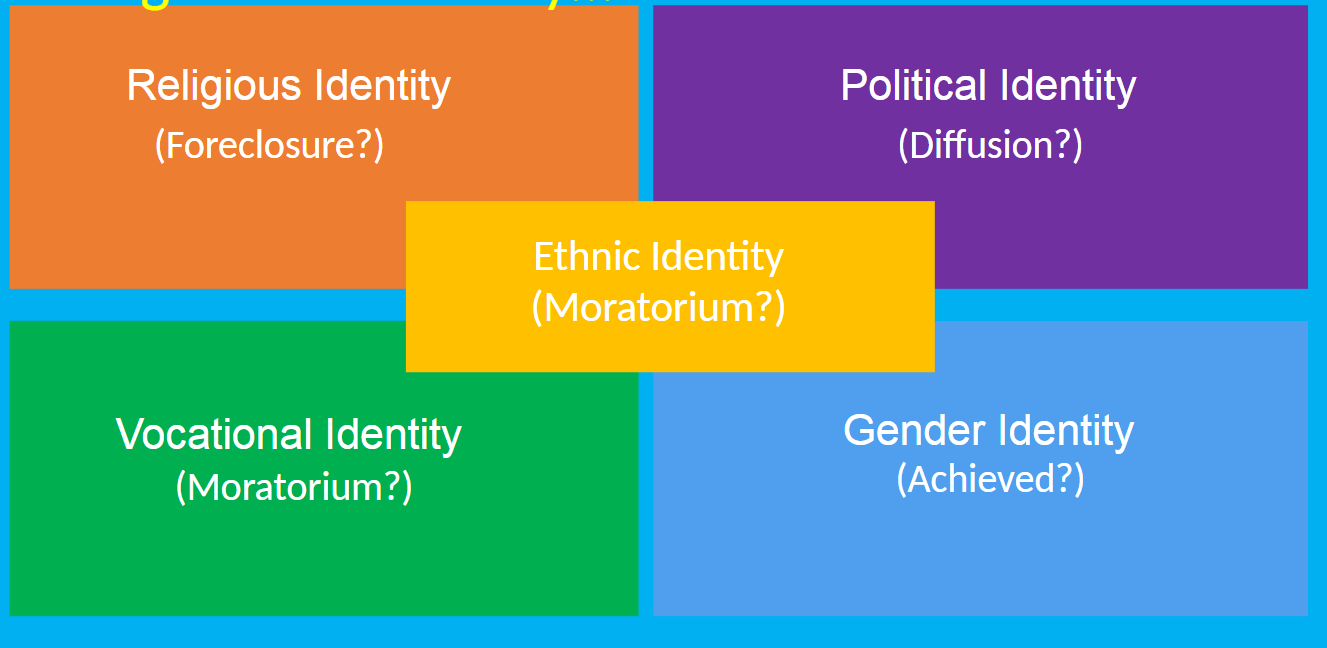
Categories of identity chart
Adolescent Development: Thus Far...
T/F?
• Between the ages of 11 and 17, the prefrontal cortex is maturing, but it is
still not yet fully developed.
• The egocentric nature of thought among adolescents allows them to see
themselves as similar to everybody else.
• Although Erikson’s theory for psychosocial development suggests that
adolescents develop a sense of identity, identity can/does change across
the life span.
• If adolescents are identity-achieved in one area, they are identity-achieved
in all areas.
chat gpt to check answers
Defiance
to rebel
Delinquency
to break the law
Virtually every adolescent breaks the law at least once before age 20