week 3 (L1 muscle + neurons)
 Call Kai
 Learn
Learn Practice Test
 Spaced Repetition
 Match
Match Flashcards
 Knowt Play
1/34

There's no tags or description
Looks like no tags are added yet.
Name | Mastery | Learn | Test | Matching | Spaced | Call with Kai |
|---|
No analytics yet
Send a link to your students to track their progress
35 Terms
what are the 3 types of muscle
skeletal, cardiac, smooth
what are the 2 major classes of muscle (based on appearance)
striated
smooth
main role of muscles
specialised connective tissue
responsible for body movement
controls shape + size of organs
what is striated muscle
appearance of stripes or striations
there is two types (skeletal + cardiac)
which two types of muscles are striated in appearance
skeletal
cardiac
what is cardiac muscle
heart muscle
what is skeletal muscle
attached to bone
what is smooth muscle + appearance
no cross striation
arranged in sheets
primarily in the walls of hollow organs (maintain shape) eg. iris, ciliary body
for subtle, sustained, or rhythmic actions
what cells produces the extracellular matrix in collagen
fibroblasts
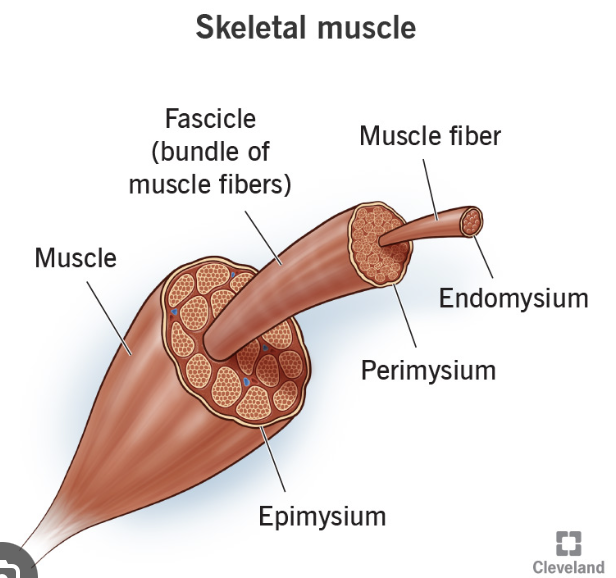
what is a fascicle
a bundle of muscle fibres
what is the epimysium
connective tissue that wraps around a bundle of fascicles
how much of our body weight to muscles contribute to
40%
what is connective tissue
tissue that
connects
supports
binds or separates other tissues or organs
eg. sclera, limbus, cornea
what is the 3 main layers of connective tissue of skeletal muscle
“EEPI = EPE = (from inside) Endomysium, perimysium, epimysium
endomysium = tissue that surround individual muscle fibres
perimysium = thicker irregular tissue that surround a bundle of muscle fibers (fascicle)
epimysium = denser irregular tissue that surrounds a bundle of fascicles (forming outer layer of muscle)
categories of skeletal muscle fibres (by diameter + natural colour)
red fibers (slow twitch)
white fibres (fast twitch)
intermediate fibers (medium twitch)
what are red fibres
a type of skeletal muscle fiber
red fibers are:
rich in myoglobin, cytochromes and mitochondria
small
slow twitch (sustained activity eg. marathon running)
what are white fibres
a type of skeletal muscle fiber
white fibres are:
poor in mitochondria, cytochromes and myoglobin
large
fast twitch (rapid, powerful bursts of activity eg. sprinting)
what are intermediate fibres
a type of skeletal muscle fiber
intermediate fibers are:
medium thickness
a third type of muscle fibre that sits between red and white
Not as slow as red, not as explosive as white
what are extraocular muscles
seven specialised skeletal muscles
controlling eye movement, alignment + eyelid elevation
3 muscle types + their control
skeletal
voluntary
eg. moving arm, blinking (to an extent)
smooth
involuntary
found in organs eg. ciliary muscle, iris
cardiac
involuntary
eg. heart pumping
what are the 2 categories of smooth muscle
visceral (single unit)
all cells contract together as one joined by gap junctions
sim} a crowd doing a wave together
for bulk movement
📍 Example:
Food moving through intestines
👉 you don’t need accuracy, just movement
multi unit
Each cell works independently, no gap junction
sim} people working individually
for precise control
📍 Example:
Changing pupil size slightly
Focusing on near vs far objects
what is thyroid eye/ graves disease
autoimmune disease where immune cells attack the thyroid gland resulting in an excess secretion of thyroid hormone
immune cells also attack the skeletal muscle and connective tissue = swelling + inhibits movement
what is an autoimmune disease
where the body's immune system mistakenly attacks healthy cells, tissues, and organs instead of protecting them, causing chronic inflammation and damage
what is the bulging of the eye (graves disease) called
proptosis
what are neutrons
specialised cells that pass on information from dendrite to axon terminal (one end to another)
what is myelin sheath
fatty insulation around a neuron fiber
signals travel faster with it
some neurons don’t have it = slower signals
Speed needs:
Myelinated neurons = signals need to be fast
Example: moving your hand away from something hot
Unmyelinated neurons = speed isn’t critical
Example: temperature signals (taking off jacket when hot)
three main categories of neurons (according to function)
S = Sensory → brings info in to CNS (afferent) (add)
M = Motor → sends info out of CNS (efferent) (eff off)
I = Interneuron → inside CNS, connects the two
(sexy men icky!!)
what are synapses
tiny gap between two neurons
“message handover area”
what are neurotransmitters
the chemical messengers that convey messages across the gap (synapse)
neuron-synapse analogy?
🧩 Analogy:
Neuron 1 = person with a message
Synapse = empty space / gap between desks
Neurotransmitter = note that carries the message to the next person (Neuron 2)
Neuron 2 = person recieving the message
what are glial cells
helpers or caretakers of neurons — neurons do the signaling, glial cells do the maintenance
types of glial cells
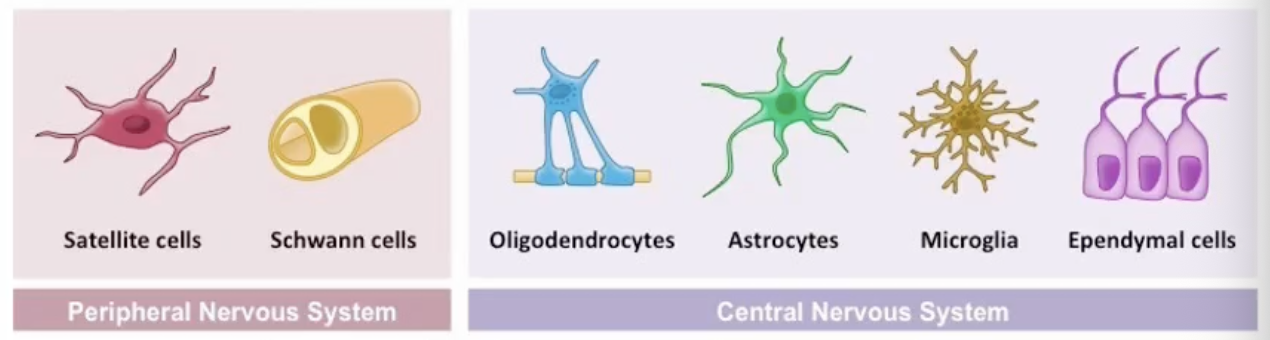
“(PNS) Sexy Sisters // (CNS) Excite Any Old Men”
function of different types of glial cells
CNS
• Astrocytes: maintain blood brain barrier and extracellular homeostasis
• Oligodendrocytes: myelinate axons
• Ependymal cells: production of cerebrospinal fluid
• Microglia: macrophages-like, clear cell debris and dead neurons
PNS
• Swann cells: myelinate PNS axons
• Satellite cells: maintain extracellular homeostasis
what is the visual pathway
“R O C O L O”
R = Retina
O = Optic nerve
C = Chiasm
O = Optic tract
L = LGN
O = Occipital cortex
what is optic neuritis
autoimmune disease
inflammation of optic nerve
causes: MS, infection, other immune diseases
symptoms: pain in eye movement, acute vision loss, colour vision abnormality