Microbiology Unit 1 Overview: Key Concepts and Terms
 Call Kai
 Learn
Learn Practice Test
 Spaced Repetition
 Match
Match Flashcards
 Knowt Play
1/285

There's no tags or description
Looks like no tags are added yet.
Name | Mastery | Learn | Test | Matching | Spaced | Call with Kai |
|---|
No analytics yet
Send a link to your students to track their progress
286 Terms
Pathogen
Disease causing microbes
Parasite
Lives on or in the body of another organism called the host and causes damage to the host.
Commensal
Provides benefit to one party and neither harm nor benefit to the other.
Symbiont
Provides benefit to both parties.
Heterotroph
Relies on consuming other organisms, cannot synthesize its own sources of food.
Bacteria
Unicellular, prokaryotic microorganisms that can be found virtually everywhere.
Fungus
Eukaryotic organism that can be unicellular (yeasts) or multicellular (molds, mushrooms) and decomposes organic material.
Virus
Acellular entities made of RNA or DNA enclosed in a protein coat that require a host.
Protozoa
Eukaryotic, unicellular organisms that are mobile, live in water, and are disease causing.
Helminths
Eukaryotic, multicellular worms.
Binomial nomenclature
The correct method of writing scientific names of organisms, which should be underlined.
Normal microbiota
Microorganisms that should be found in the skin, GI tract, mouth, respiratory tract, and outer reproductive organs.
Beneficial functions of microorganisms
Food Production, Biotechnology & Genetic Engineering, Bioremediation, Nutrient Cycling.
Louis Pasteur
Conducted an experiment using Swan Neck flasks to show that bacteria does not just appear from thin air.
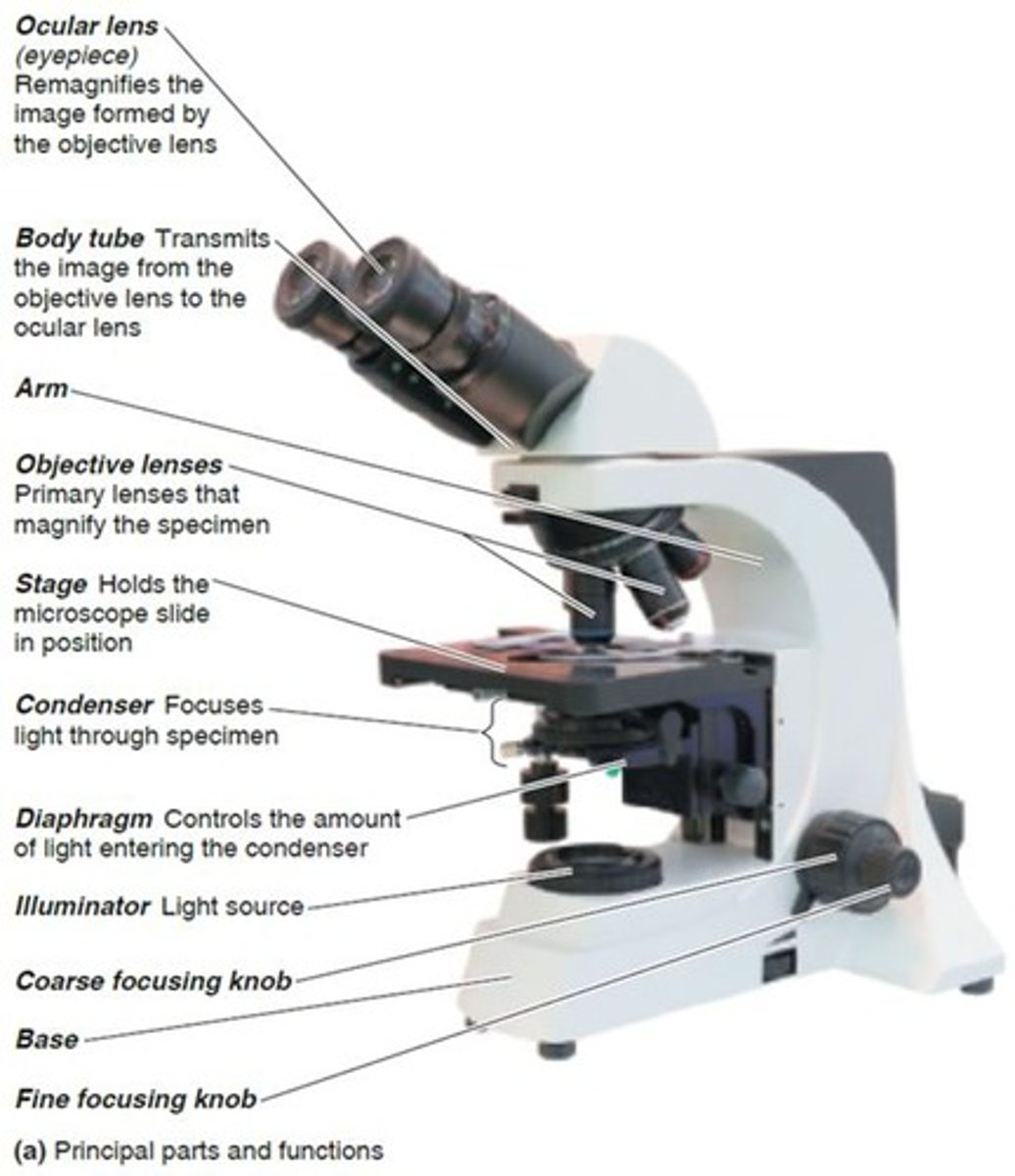
Koch's Postulates
1. Causative agent must be found in every case and absent from healthy hosts. 2. Agent must be isolated and grown outside host. 3. When agent is introduced to healthy host, the host gets sick.
Van Leeuwenhoek
Improved the microscope lens and was the first to observe and describe bacteria, protozoa, sperm cells, and red blood cells.
Germ Theory of Disease
The theory that microbes cause disease and spoilage and fermentation.
Pasteurization
Technique invented by Pasteur to kill harmful bacteria in food and drink.
Nutrient Cycling
The process involving decomposers that recycle nutrients in the environment.
Bioremediation
Using organisms to remedy an environmental problem, such as oil spills.
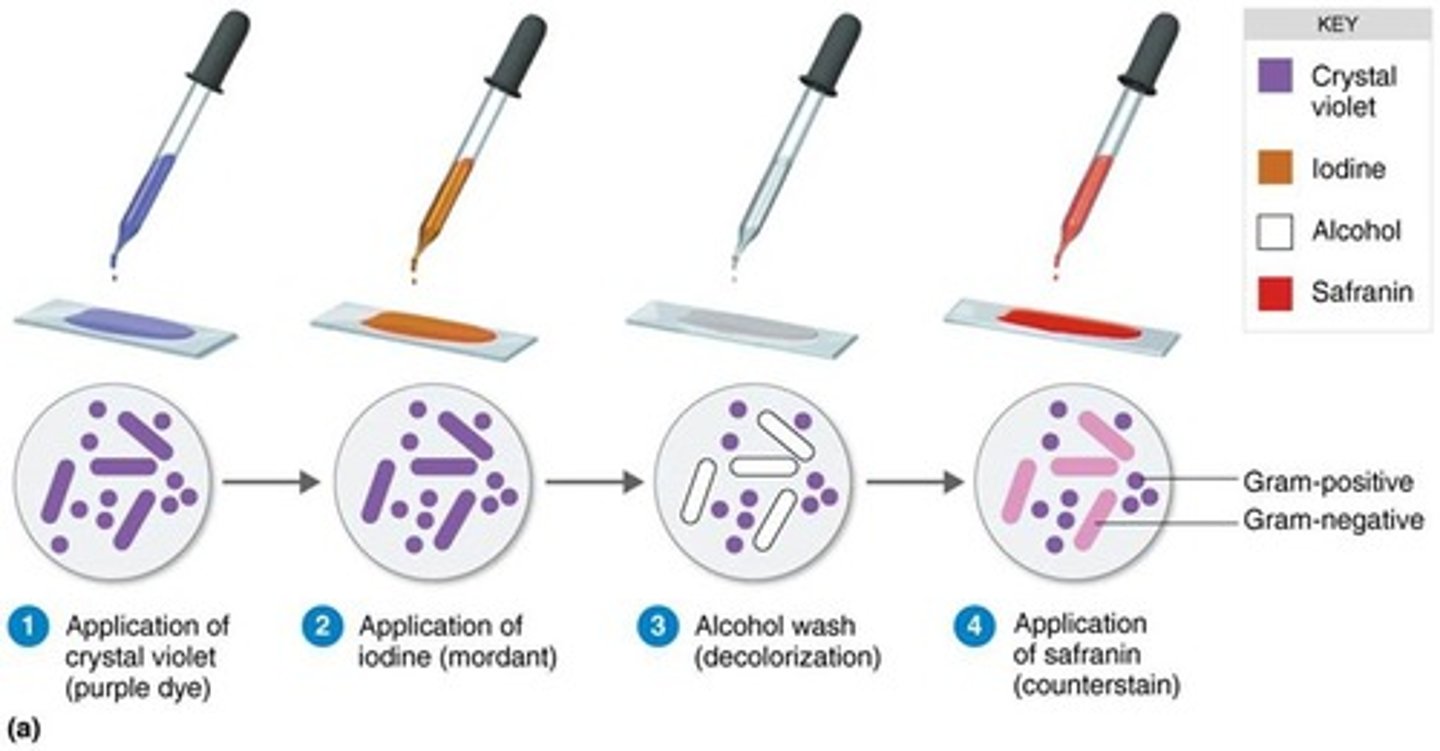
Gram
Developed Gram Stain
Gram-Positive stain
Purple
Gram-negative stain
Pink
Semmelweis
Handwashing to help prevent Puerperal fever
Lister
Antiseptic techniques
Handwashing before surgeries
A practice to reduce infection rates
Disinfecting surgical wounds with carbolic acid
Reduced mortality rates from surgical infections from 45% to 15% in 4 years
Nightingale and Nursing
Introduced idea of cleaning hospitals, bedding, and patients
Jenner
Edward Jenner's Vaccine
Cowpox
Used to prevent deadly smallpox
Immunology
Launched field of immunology and vaccination
Atoms
The smallest chemical units of matter
Nucleus
Structure containing protons and neutrons
Neutrons
Uncharged particles
Protons
Positively charged particles
Electrons
Negatively charged particles circling the nucleus
Valence electrons
Electrons in the outermost shell that interact with other atoms to form chemical bonds
Chemical Bonds
Form when atoms share or transfer valence electrons
Covalent Bond
Sharing a pair of electrons by two atoms (very strong bond)
Nonpolar Covalent Bond
Shared electrons spend an equal amount of time around each nucleus
Polar Covalent Bond
Unequal sharing of electrons due to different electronegative (pull on the electrons)
Ionic Bond
Occurs when 2 atoms with different electronegative come together and transfer electrons
Hydrogen Bonds
Weak forces that occur with polar covalent bonds
Metabolism
The sum of all chemical reactions in an organism
Anabolic
Involve the formation of larger, more complex molecules
Endothermic
Requires an input of energy
Dehydration Synthesis
Removal of -OH from one molecule and -H from another to form a new bond, producing water as a byproduct
Decomposition Reactions
Break bonds within larger molecules by adding water to form smaller substances.
Hydrolysis
A catabolic reaction that involves breaking down larger molecules by adding water.
Exothermic
Reactions that release energy.
Cellular Respiration
The process of breaking down substances to make ATP.
Digestion
The process of breaking down food into smaller components.
Fat Breakdown
The process of decomposing fats into smaller molecules.
Water
A substance with special characteristics that are critically important in living organisms.
Polar Covalent Bonds
Bonds that involve the unequal sharing of electrons between atoms.
Hydrogen Bonds
Weak attractions between a hydrogen atom and an electronegative atom.
Cohesive Molecules
Molecules that give strong surface tension due to their cohesive properties.
Solvent
A substance that can dissolve other substances due to its polarity.
pH
The negative log of hydrogen ions; a measure of acidity or alkalinity.
Acid
Substances that release H+ (hydrogen ions) and one or more anion when dissolved in water.
Base
Substances that bind to H+ when dissolved in water; some release cations and OH- (hydroxide ions).
Buffers
Solutions that resist pH level changes when small amounts of acid or base are added.
Functional Groups
Groups of atoms that contain carbon, hydrogen, and sometimes nitrogen and sulfur, contributing to the chemical properties of organic molecules.
Hydroxyl Group
A functional group (-OH) that increases solubility in water, found in ethanol and sugars.
Carbonyl Group
A functional group (-C=O) where a carbon atom is double bonded to an oxygen atom, found in acetone and formaldehyde.
Carboxyl Group
A functional group (-COOH) that acts as an acid by donating H+, found in acetic acid (vinegar).
Amino Group
A functional group (-NH2) that acts as a base, essential to the structure of amino acids and proteins.
Sulfhydryl Group
A functional group (-SH) that helps to stabilize protein structure, found in cysteine.
Phosphate Group
A functional group (-PO4^3-) that contributes to energy transfer in cells, found in ATP.
Methyl Group
A functional group (-CH3) that affects gene expression, found in methylated DNA.
Macromolecules
Large molecules made up of smaller units called monomers, essential for biological functions.
Macromolecules
Polymers made from monomers.
Monomers
The basic building blocks of macromolecules.
Carbohydrates
Composed of carbon, hydrogen, and oxygen.
Monosaccharides
Simple sugars such as glucose and fructose.
Disaccharides
Sugars composed of two monosaccharides, like sucrose and lactose.
Polysaccharides
Complex carbohydrates such as starch, cellulose, and chitin.
Energy sources
Primary function of carbohydrates.
Proteins
Composed of carbon, hydrogen, oxygen, nitrogen, phosphorus, and sulfur (CHONPS).
Amino Acids
Building blocks of proteins, containing a central carbon, amino group, carboxyl group, hydrogen atom, and R group.
Enzyme Catalysis
The process by which enzymes speed up chemical reactions, exemplified by lactase.
Lipids
Hydrophobic molecules primarily made of carbon and hydrogen.
Glycerol
A component of lipids.
Fatty Acids
Building blocks of lipids.
Triglycerides
A type of lipid formed from glycerol and fatty acids.
Saturated fat
A fat with no double bonds between carbon atoms.
Unsaturated fat
A fat with one or more double bonds between carbon atoms.
Nucleic Acids
Biopolymers essential for all known forms of life, composed of nucleotides.
Nucleotides
Building blocks of nucleic acids, consisting of phosphate, sugar, and nitrogenous bases.
DNA
Deoxyribonucleic acid, a molecule that carries genetic instructions.
RNA
Ribonucleic acid, involved in protein synthesis.
ATP
A nucleotide that serves as a short-term, recyclable energy supply for cells.
Peptide Bond
The bond formed between amino acids in proteins.
Glycosidic Bond
The bond formed between monosaccharides in carbohydrates.
Ester Bond
The bond formed between glycerol and fatty acids in lipids.
Phosphodiester Bond
The bond that links nucleotides in nucleic acids.
Unsaturated Fatty Acids
One or more double bond.
Saturated Fat
NO double bond.
Phospholipid
Molecule with a hydrophilic head (polar) and a hydrophobic tail (non-polar), making it amphipathic.
Hydrophilic Head
Part of a phospholipid that is attracted to water, consisting of a nitrogen group, phosphate group, and glycerol.