Macro Economics
 Call Kai
 Learn
Learn Practice Test
 Spaced Repetition
 Match
Match Flashcards
 Knowt Play
1/96

There's no tags or description
Looks like no tags are added yet.
Name | Mastery | Learn | Test | Matching | Spaced | Call with Kai |
|---|
No analytics yet
Send a link to your students to track their progress
97 Terms
What are the main macroeconomic objectives?
TIGERS
Trade - balanced
Inflation - low and stable
Growth - high, strong, sustained
Employment - low unemployment
Redistribution of wealth - fair
Stability
What data is used to assess economic performance?
Real GDP (total value of output in a year, adjusted for inflation)
Real GDP per capita (Real GDP / population)
CPI / RPI (measure changes in the price level)
Unemployment measures (Claimant count - people receiving benefits, and Labour Force Survey)
Productivity (output per worker / per hour logged)
Balance of payments on current account (difference between value of exports and imports)
What are the 4 factors of production?
land, labor, capital, entrepreneurship
What is capital?
Man made assets that are used to produce more wealth
What is land?
Anything derived from the natural world
What is labour?
Work / effort done by people
What is the difference between positive and normative statements?
Positive are based on stats and facts - verifiable
Normative are based on opinion or judgement - cannot be verified
What are the 4 main economic agents?
Households
Firms
Government
Central banks
What are injections into the circular flow of income?
Anything that adds to the eg. government spending
What are the withdrawals from the circular flow of income?
Anything that takes away from the economy, eg. putting savings into the bank
Explain the circular flow of income between households and firms
Households give FoPs to firms
Firms in exchange provide goods and services
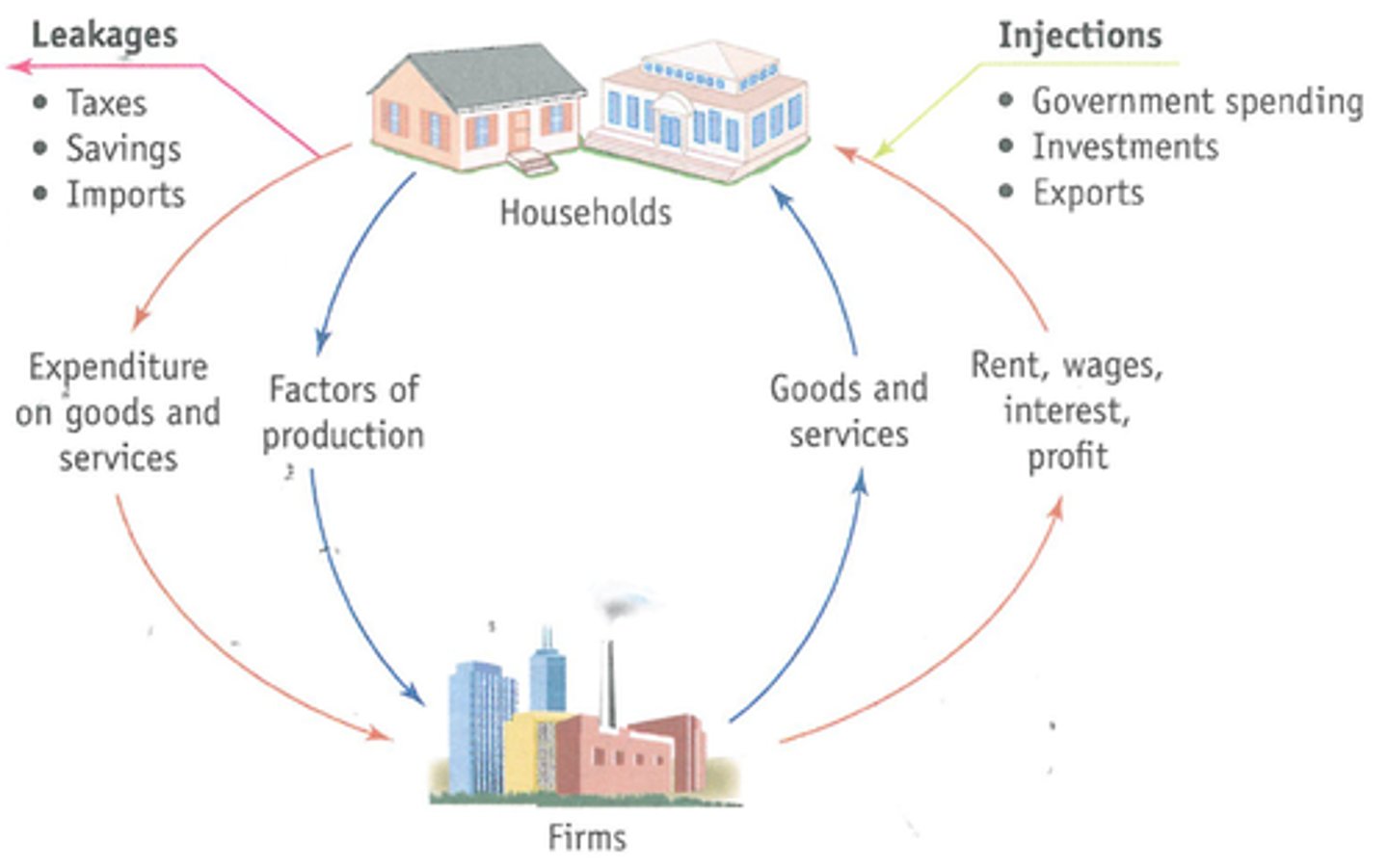
Give 3 examples of injections into the circular flow of income
Government spending (by government)
Investment (by banks)
Exports (by world trade)
IXG = INJECTIONS
Give 3 examples of leakages from the circular flow of income
Tax (by government)
Savings (households putting into banks)
Imports (by world trade)
TSM = LEAKAGES
What does it mean if total injections > total leakages?
Economic growth rises
What does it mean if total injections < total leakages?
Economic growth decreases
What does it mean if total injections = total leakages?
You would be in macroeconomic equilibrium
What are the 3 GDP methods?
Income method
Output method
Expenditure method
How do you calculate GDP using the income method?
By adding up ALL the factor incomes earned in an economy in a year
All wages and salaries, profit, interest, rent
How do you calculate GDP using the output method?
By adding up the final value of ALL goods and services produced in an economy in a year
How do you calculate GDP using the expenditure method?
By adding up a countries total expenditure in a year
C + I + G + (X - M) - aggregate demand
What is true about income, output, and expenditure in the circular flow of income?
income = output = expenditure
What is national income?
A measure of the total monetary value of the flow of goods and services produced within an economy over a specific period, usually one year
What is real national income?
National income adjusted for inflation
INDICATOR OF ECONOMIC PERFORMANCE
What's the difference between real and nominal GDP?
Real GDP is adjusted for inflation
Nominal GDP is not
How do you calculate real GDP?
(Nominal GDP/Price Index) x 100
What is MPC?
Marginal propensity to consume: the willingness of a household to spend any extra income that they earn
What are index numbers?
A figure reflecting price or quantity compared with base year value
The base year has an index of 100
How do you represent short run economic growth?
Rightward shift of AD
How do you represent long run economic growth?
Rightward shift of LRAS
How do you represent demand side shocks?
A shift in AD
Can EITHER be rightwards (positive demand shock) or leftwards (negative demand shock)
Example: financial crisis (cuts C and I)
How do you represent supply side shocks?
A shift in SRAS
Can EITHER be rightwards (positive supply shock) or leftwards (negative supply shock)
Example: oil prices spiking > SRAS left
What is aggregate demand?
The total demand for a countries good and services at a given price level in a given time period.
It is a measure of total expenditure on a countries goods and services
What are the components of AD?
AD = C + I + G + (X-M)
consumption, investment, government spending, net exports
What is on the x and y axis of a AD diagram?
x: real GDP (Y)
y: price (P)
Why does the AD curve slope downward?
Wealth effect
Trade effect
Interest effect
Inverse relationship between price level and real GDP
What is the wealth effect?
When price level falls, consumers are essentially 'richer', and so consumers are more likely to spend money on goods and services, which would increase 'C' > extension of AD
What is the trade effect?
As the price level decreases, exports become cheaper and more competitive (which increases X), and imports get dearer (which decreases M) > revenue generated increases > increases 'X-M'
What is the interest effect?
Low price level means low inflation so interest rates remain low
Low interest rates stimulate higher consumption and investment, and reduces the value of the exchange rate (increased X-M)
What are contractions and extensions of AD?
Contractions: upwards
Extensions: downwards
When does AD shift?
When C, I, G or (X-M) change independent of the price level
What is consumption?
Consumption: total expenditure by households on goods and services in the economy
Accounts for over 60% of AD
Give 4 factors that can affect consumption
Real disposable income - strongest determinant
Interest rates / availability of credit
Consumer confidence
Distribution of income
How does the level of real (adjusted for inflation) disposable income effect consumption?
Higher disposable income means households have more money to spend, which increases their MPC, thus increasing consumption
How do interest rates effect consumption?
If interest rates fall, the cost of borrowing falls, and the rate of return on savings also fall.
This incentivises consumers to borrow more (as its cheaper), and spend it on anything > increases consumption
Also reduces the incentive to save (as there is less benefit to doing so) > people will spend more > increases consumption
How does consumer confidence effect consumption?
Higher consumer confidence = higher consumption
How does distribution of income affect consumption?
Poorer households have a higher MPC > they will have to spend more
What is investment?
Investment: firms / businesses spending on capital goods, eg. infrastructure, machinery, etc
What factors affect investment?
Interest rates
Business confidence (animal spirits)
Expected demand and the rate of growth (the accelerator)
How do interest rates affect investment?
Firms borrow money to invest. Higher interest rates = borrowing costs more = fewer projects are worth doing = less investment. Lower rates = the opposite.
> How much it costs to borrow
How does business confidence (animal spirits) affect investment?
If firms feel optimistic about the economy, they invest. If they feel nervous (recession fears, political uncertainty), they hold back, even if rates are low.
> whether they feel like it
How does expected demand (the accelerator) affect investment?
Firms only invest if they think they'll sell more in future. If demand is growing fast, they expand quickly. If demand growth slows, investment falls sharply.
> whether it is worth it
What is the accelerator effect?
The idea that investment depends on the rate of change of demand/output.
> a small rise in demand can produce a much larger rise in investment
What is net exports determined by?
Foreign incomes (higher > more demand for UK exports)
UK incomes (higher > more imports > worsening X-M)
Exchange rate (stronger £ > exports dearer, imports cheaper > X-M falls)
Relative inflation rates (higher UK inflation > less competitive)
What is the multiplier effect?
The idea that an initial change in injections (eg. investment, gov spending) leads to a LARGER eventual change in national income
How do you calculate the multiplier (K)?
K = ΔY ÷ ΔJ (change in national income / initial change in injection)
What is the relationship between the multiplier (K) and MPC?
MPC increases = smaller leakages to saving, tax, imports = bigger multiplier
Why might the multiplier vary?
Inflation
Interest rates
Wages
What is the difference between savings and investment?
Savings: income not spent > withdrawal
Investment: spendings by firms on capital goods > injection
What are the determinants of savings?
Interest rates
Income
Confidence
Age
etc
What is aggregate supply?
Total supply in the economy
What does a SRAS curve look like?
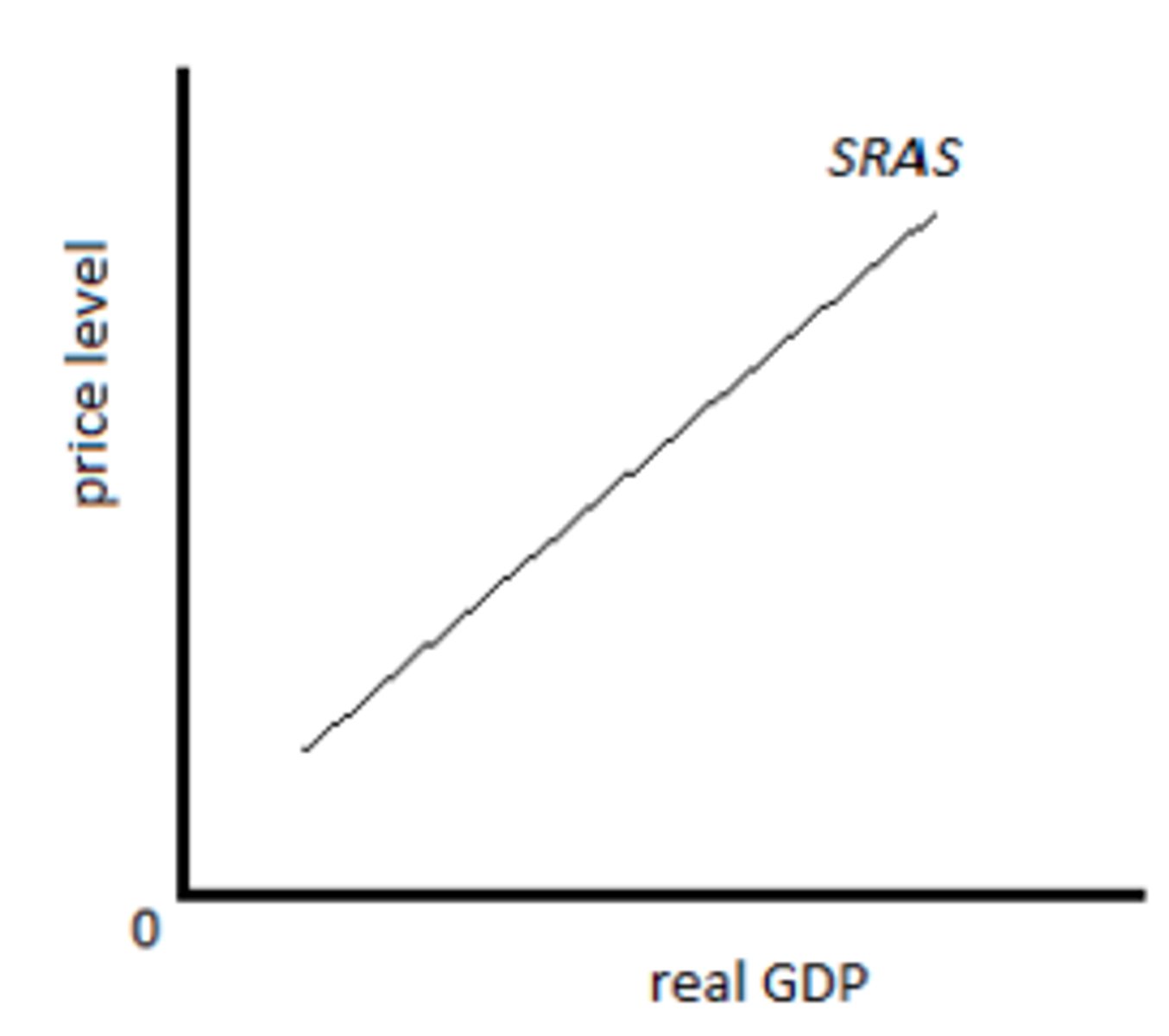
What happens along the SRAS curve?
Output expands as prices rise (because money costs are temporarily fixed)
What will shift the SRAS curve (generally)?
Anything that changes firms' costs at every price level
What factors can shift SRAS?
Money wage rates (higher wages > SRAS shifts left)
Raw material and commodity prices (eg. oil)
Business taxation (higher taxation > SRAS shifts left)
Productivity (higher productivity > SRAS shifts right)
Exchange rate (stronger pound > imports cheaper > costs cheaper > SRAS right)
What does a LRAS curve look like?
Assumed to be vertical
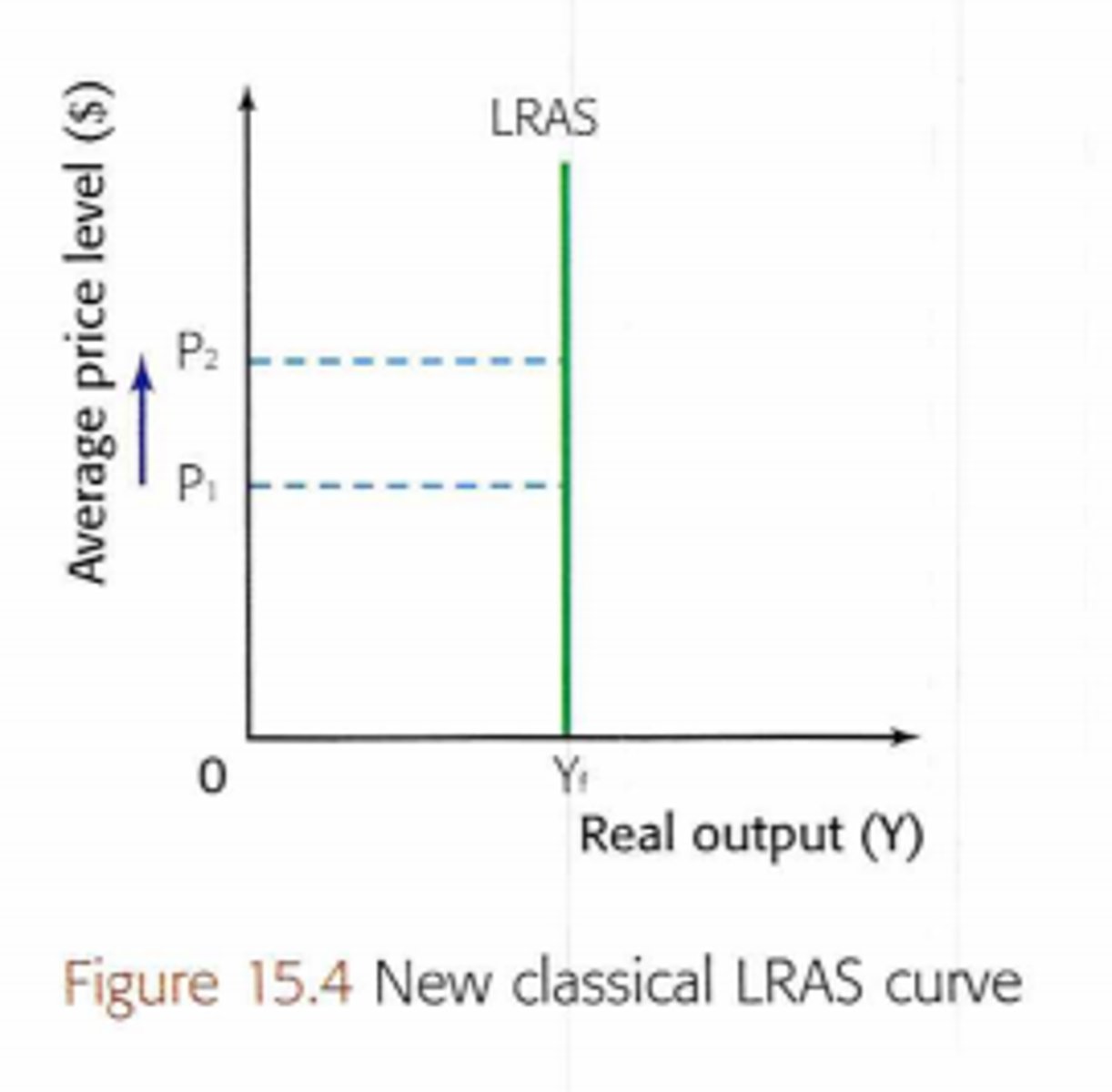
What does the LRAS curve represent?
The productive capacity of the economy
What is the position of the LRAS curve determined by?
The QUALITY and QUANTITY of the factors of production.
What are the key determinants of LRAS?
Technology and innovation (rightwards shift)
Productivity
Quantity and quality of labour (skills, education, migration)
Quantity and quality of capital stock (investment)
Economic incentives (taxes, benefits, regulation)
What does an outward (right) shift of LRAS represent?
Long run economic growth
> an increase in the economy's productive potential
What is macroeconomic equilibrium?
Where AD = AS
What is short run growth (actual growth)?
This is when real GDP rises using resources the economy already has. The economy isn't getting bigger in terms of capacity - it's just using its existing capacity more fully.
Caused by rising AD
Diagram: rightwards shift of AD / movement towards LRAS
What is long run growth (trend / potential growth)?
This is when the economy's productive capacity itself increases - the maximum amount it could ever produce gets bigger.
Caused by the economy getting more / better FoPs
Diagram: rightwards shift of LRAS / PPF curve shifts entirely rightwards
What is the economic cycle (business cycle)?
The pattern of recurrent ups and downs observed by real GDP growth overtime in many economies.
What are the phases of an economic cycle?
Boom
Downturn
Recession
Recovery
What is a boom?
Strong growth
Rising inflation
Low unemployment
Possible positive output gap
What is a downturn?
Growth slows
Inflation peaks
Unemployment starts rising
What is a recession?
Two consecutive quarters of negative real GDP growth
High unemployment
Low inflation
What is a recovery?
Growth returns
Output and employment rise
What is a positive output gap?
Where real GDP is ABOVE the productive potential of the economy.
Resources are stretched - inflationary pressure builds
What is a negative output gap?
Where real GDP is BELOW the productive potential of the economy.
There is spare capacity - unemployment is above normal, inflationary pressure is low
What is spare capacity?
Unused productive resources (idle labour, machinery, factories, etc.) where an economy produces below its maximum potential.
What are demand side shocks?
A sudden, unexpected event that significantly increases / decreases AD for goods and services
What are some examples of demand side shocks?
Financial crisis (example, 2009)
Foreign recessions (reduces export demand)
Changes in fiscal / monetary policy
What are supply side shocks?
A sudden, unexpected event that changes the ability of companies to produce goods and services, abruptly shifting the aggregate supply curve
What are examples of supply side shocks?
Pandemics
Natural disasters
Sudden technological break throughs
What are the determinants of short run growth?
Anything that shifts AD right
Anything that shifts SRAS right
Eg: any component of AD increasing, lower wage costs, etc.
What are the determinants of long run growth?
Anything that shifts LRAS right
What are the 2 ways to measure unemployment?
Claimant Count
Labour Force Survey (LFS)
What is the claimant count?
The number of people claiming unemployment related benefits (now mostly universal benefit)
What is a pro + con of using the Claimant count?
Easy and cheap to compile but excludes those who are unemployed but don’t claim (or aren’t entitled)
What is the Labour Force Survey (LFS)?
Based off the ILO definition - people without a job, available to start work in the next 2 weeks, and actively seeking work.
Which is considered a better measure of unemployment, Claimant Count or Labour Force Survey?
Labour Force Survey
More comprehensive and accurate, however more expensive
What are the 4 types of unemployment?
Seasonal
Frictional
Structural
Cyclical (demand deficient)
What is seasonal unemployment?
Caused by time of year variation in demand (tourism, agriculture, construction)
What is frictional unemployment?
Short term unemployment as people move between jobs.
Usually low and inevitable
What is structural unemployment?
Caused by long term changes in the structure of the economy - workers’ skills or location no longer match available jobs
What is cyclical (demand deficient) unemployment?
Caused by a fall in AD during a recession