BIO 190 Lab#13 *Evolution and Hardy Weinberg Equation*
 Call Kai
 Learn
Learn Practice Test
 Spaced Repetition
 Match
Match Flashcards
 Knowt Play
1/17

There's no tags or description
Looks like no tags are added yet.
Name | Mastery | Learn | Test | Matching | Spaced | Call with Kai |
|---|
No analytics yet
Send a link to your students to track their progress
18 Terms
define evolution
the sum total of genetically inherited changes in the individuals who are members of a populations gene pool
which two individuals defined evolution
hardy and weinberg
how did hardy and weinberg define evolution
gene pool frequencies are inheritaly stable but that evolution should be expected in all populations virtually overtime
Hardy and Weinberg defined evolution as a change in allele frequencies within a population over generations.
who described natural selection
Charles Darwin
natural selection
the characteristics of organisms within a population may change overtime due to selective pressures within the environment
what are selective pressures that influence natural selection
Selective pressures are environmental factors or conditions that drive natural selection by affecting the survival and reproductive success of individuals within a population.
Common selective pressures include:
Predation:
Disease and parasites:
Competition for resources:
Environmental conditions:
Mate choice (sexual selection):
Human activity:
define allelic frequences
Allelic frequencies refer to how often a specific allele (a version of a gene) appears within a population’s gene pool, expressed as a proportion or percentage.
in p+q=1
what is p vs q
p is the dominant
q is the recessive
KNOW HOW TO SOLVE
genetic drift
changes in allelic frequencies of a gene that are due soley by chance
mutation
A change in a gene or chromosome.
migration
the movement of individuals (or groups of organisms) from one population or geographic location to another, often with the intention of settling and reproducing.
bottleneck effect
A change in allele frequency following a catastrophe in the size of a population
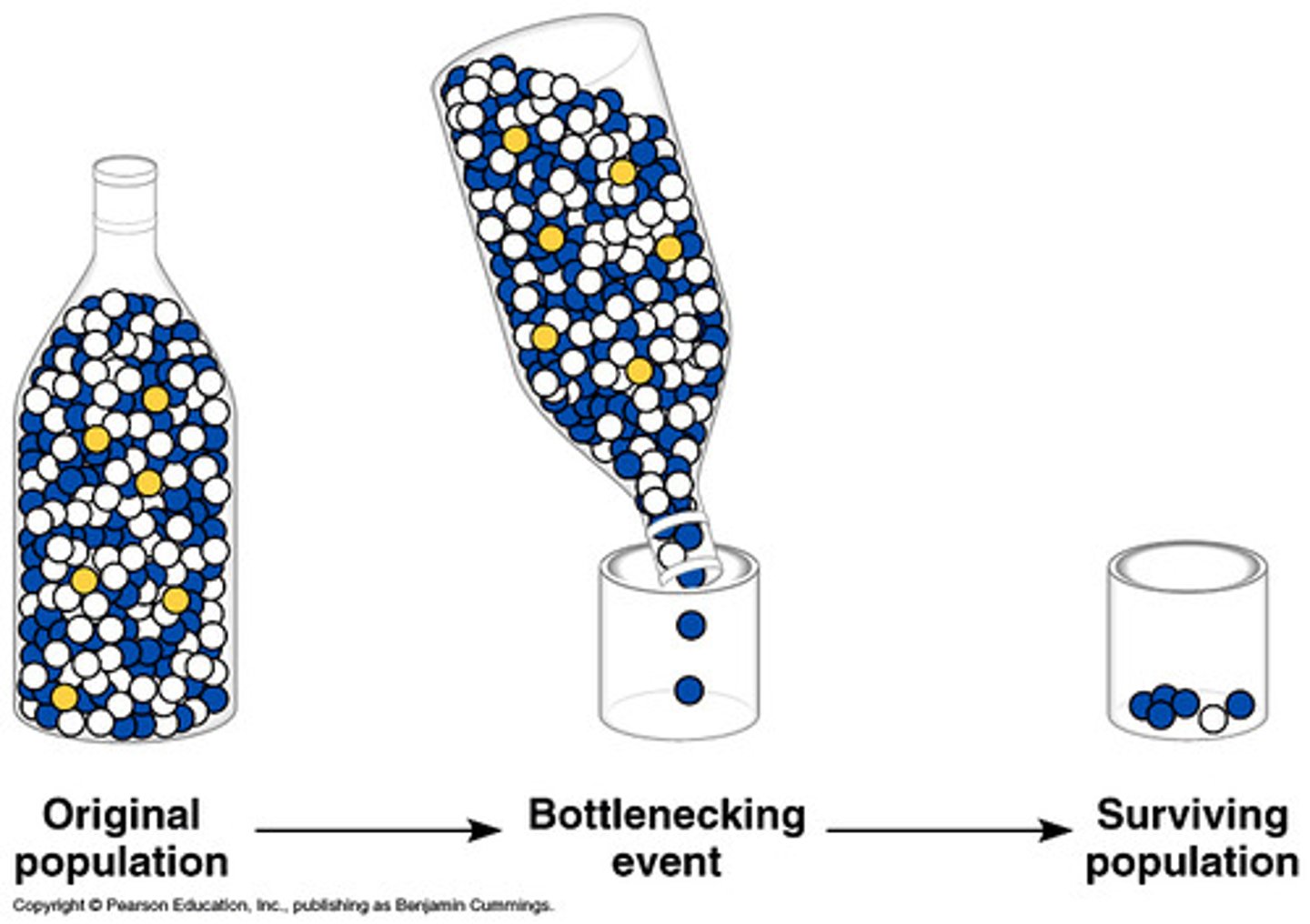
founder effect
when a small group breaks off from a large population and becomes isolated
gene flow
the transfer of alleles of genes from one population to another population
what does hardy weinberg principle state
if there are no evolutionary forces acting in a population then the percentage of the alleles within that population will not change over time
basically: the ratio of dominant to recessive alleles will remain the same from one generation to the next
what happens to genetic diversity in a population if they are in equilibrium/ there are no evolutionary forces acting on the population
Without evolutionary forces, genetic diversity is maintained at a constant level, and no evolution occurs.
what does a population in equilibrium mean
A population in equilibrium is stable, genetically unchanging, and not evolving.
what seven conditions must be met for equilibrium to exist