Production, Costs and Revenue
 Call Kai
 Learn
Learn Practice Test
 Spaced Repetition
 Match
Match Flashcards
 Knowt Play
1/20

Earn XP
Description and Tags
r
Name | Mastery | Learn | Test | Matching | Spaced | Call with Kai |
|---|
No analytics yet
Send a link to your students to track their progress
21 Terms
What is production and productivity and labour productivity
Production is the conversion of inputs (fops) into a final output
Productivity is the output per unit employed
Labour Productivity is the output per worker
Benefits and disadvantages of specialisation
people can specialise into things they’re best at
better quality and higher quantity produced, inc productivity
firms can achieve economies of scale
more efficient production and tackles scarcity
workers can end up doing repetitive tasks which can lead to boredom
countries become less self sufficient, can be a problem is trade disrupted
lack of flexibility
why is specialisation needed
it means that trade is vital as people can buy stuff they are no longer making themselves
Provides an efficient way of exchanging goods and services and using money as a medium of exchange
Difference in between short run and long run
short run theres at least one cost fixed (e.g rent of a shop is fixed).
long run all the costs are variable so they vary as output changes (higher sales of bags, higher costs of bags)
Total cost and average cost and marginal cost
Total cost= all costs involved (total fixed cost + total variable costs)
Average cost (AC) is the cost per unit produced (TC/ Q)
Marginal cost (MC) is the extra cost incurred as a result of producing the final unit of output (change in TC/ change in quantity)
Reasons for the shape of the graph
MC slopes up because it decreases initially as output increases and the begins to increase due to the law of diminishing returns
When MC lower than AC, AC is falling as each extra unit produced will decrease the average costs
When MC higher than AC, AC is rising as each extra unit produced will increase the average costs
Where AC= MC, its the lowest average cost and so productive efficiency
What is the law of diminishing returns?
If one variable factor production is increased while other factors stay fixed, eventually the marginal returns from the variable factor will begin to decrease
only for short run
marginal returns, average returns and total returns
MR- The additional output produced by adding one more unit of a factor input
mirrors MC on the curve, if returns rise, costs fall and vice versa.
AR: average returns are the output produced per unit of factor input
Total R: the total output produced using a particular combination of factor inputs
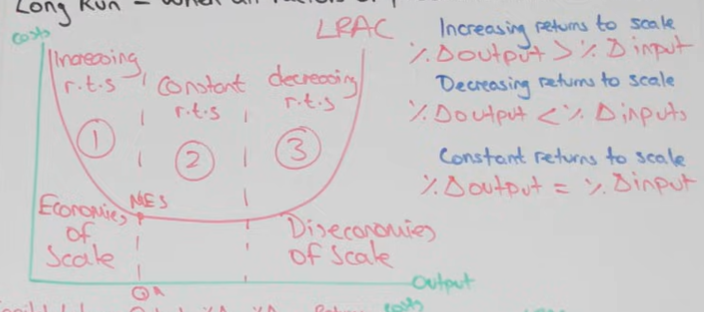
What are Returns to Scale?
Difference between increasing, constant and decreasing returns to scale
describes the effect of increasing all factor inputs by the same proportion, so in the long run
Increasing: when an increase in all factor inputs leads to a more than proportional increase in the output (doubling input, triples output)
Decreasing: when an increase in all factor inputs leads to a less than proportional increase in output (tripling inputs, doubles output)
Constant: when an increase in all factor inputs leads to a proportional increase in output (doubling inputs, doubles output)
eos def
Difference between internal and external eos
the long run average cost falls as output increases (in the long run producing more can reduce average costs)
internal involves changes within a firm
external involves changes outside a firm like in a market- if a firm is so big it can sell products at a lower price it will gain a larger market share and so monopoly power
examples of eos
Technical: workers can specialise and large firms can produced and purchase specialised equipment
Purchasing: larger firms can buy larger quantities of raw materials and negotiate lower prices as they buy stuff in bulk so they put in the biggest orders
Managerial: large firms will employ specialist managers who can take care of different areas of production. good decision making
Financial: banks more likely to lend and at a lower rate of interest, they are seen as less risky
Risk bearing; can take more risks
Marketing: advertising is a fixed costs so spread over more units will mean lower costs
Deos- what are they and examples
average costs rise as output rises
Internal: wastage and loss can inc costs, communication can become difficult as firms grow, managers less able to control what goes on
External: as a whole industry becomes bigger, the price of raw materials may increase, buying large amounts of materials may not make them less expensive
link between returns to scale and eos
RTS inc for eos
RTS dec for Deos
Total revenue, marginal revenue and average revenue
TR: total amount of money received, in a time period from a firm’s sales
MR: the extra revenue received as a result of selling the final unit of output
AR: revenue per unit sold
Why is the average revenue curve the firm’s demand curve?
D curves show what quantity of a product a firm will be able to sell at a particular price and price= AR so the same curve shows the relationship between quantity sold and AR
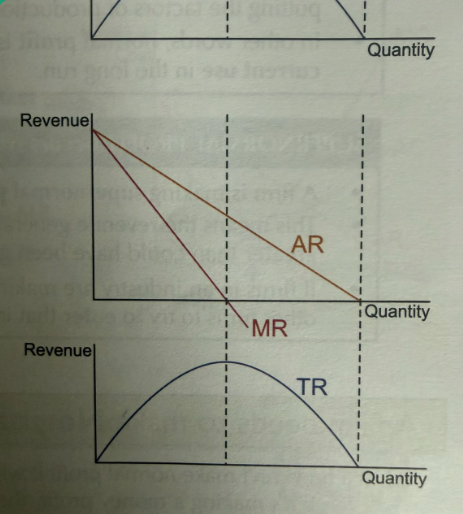
relationship between AR and MR
relationship between MR and TR
What does price taker demand curve look like
AR=MR when there is a perfectly elastic demand curve, the price is the same as the output level. because each extra unit sold brings in the same revenue as all the others.
MR=0, when TR is at a maximum. the demand curve is AR so the max TR occurs at the midpoint of AR. MR is always twice as steep as AR. when TR is max, MR=0
Price take has a horizontal straight AR curve
Profit def
the difference between total revenue and total costs
difference between normal and supernormal profit
Normal profit: This is the minimum amount of profit required to keep a country operating in a particular industry. It is equal to the opportunity cost of all of the factors of production used by a company. Companies operating in perfectly competitive markets earn normal profits in the long-run.
Supernormal profit: or abnormal profit refers to any profit that is more than the level of normal profit. Supernormal profit can be achieved in the short-run in perfect competition and in the sort run and long run in imperfectly competitive markets.
why do firms need normal profit in the long run
if a firm can’t make normal profit in the long run it will close down because its revenue isnt covering all of its costs
in the short run, a firm has fixed costs to pay so if its loss making it wont close immediately
role of profit
Profit is an incentive to produce
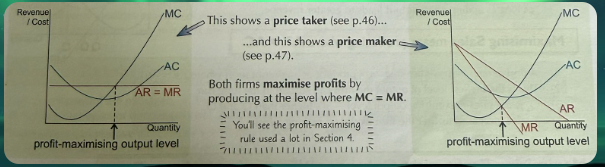
if MR> MC, then should inc output to get more profit
if MR< MC, then should dec output to get more profit
MR=MC = profit maximisation
curves for revenue price taker and price makers