Lecture 12: Posture
 Call Kai
 Learn
Learn Practice Test
 Spaced Repetition
 Match
Match Flashcards
 Knowt Play
1/54

There's no tags or description
Looks like no tags are added yet.
Name | Mastery | Learn | Test | Matching | Spaced | Call with Kai |
|---|
No analytics yet
Send a link to your students to track their progress
55 Terms
What are the three goals of postural control?
Postural Stability
Postural Orientation
Readiness to Move
Describe the goal of postural stability.
Maintain stability of body relative to gravity during a task-directed motion
Keep COM within base of support
Eseentially, we do not want to fall down
Describe the goal of postural orientation?
Maintain postural and visual orientation of body relative to task and environmental constraints
Postural alignment and gaze stabilization
Essentially, am I aligned and is my gaze oriented to the right place
Describe the goal of readiness to move.
Postural tone
Derived from both neural and non-neural mechanisms
Why do some postural control mechanisms have different goals?
Postural control mechanisms have different goals based on the context and goal of the motion
Examples: running to catch a ball vs hiking
Running to Catch Ball: goals involve visual and body orientation on the ball (not really paying attention to ground)
Hiking: goals involve visual orientation on the ground to detect obstacles
What three mechanisms are utilized to fulfill goal #1 (COM within base of support)?
Proactive Control
Reactive Control
Steady State Control
What is proactive control (with goal #1)?
Anticipatory postural and alignment adjustments based on internal predictions of movement's affect on postural stability
"We have the luxury of anticipating how changes to our alignment will have changes to our stability"
What is reactive control (of goal #1)?
Postural reactions to unexpected, unplanned events resulting in instability
Example: someone runs into shoulder → didn't expect it but need to fix it to keep COM within BOS (so we do not fall)
It also could be just that our motor plan was bad and we need to fix it
What are the two different types of reactive control?
Automatic Postural Reactions
Mechanisms used to recover balance from an unexpected perturbation
E.g. -- someone running into shoulder
Volitional Postural Reactions
Used to modify or override an automatic postural correction
What is steady state control (for goal #1)?
Maintenance of postural stability under predictable and non-changing conditons
Example: standing in a quiet position with no external demands (conditions are predictable and non-changing)
What strategies are utilized in automatic postural reactions?
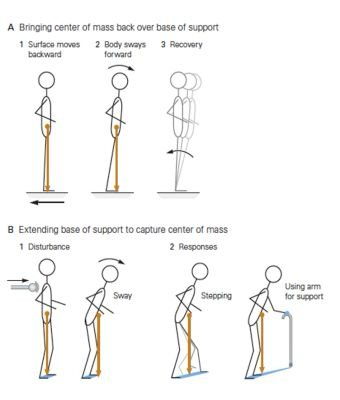
Ankle Strategy
Utilized when perturbation is relatively small
Example: forward perturbation → plantarflexors used to "come back"
Hip Strategy
Utilized when larger perturbation occurs or there is a narrow base of support
Stepping Strategy
Utilized for larger perturbation where you need to take a step to prevent falling, etc.
Suspensory Strategy
More of a protective strategy
Example: walking over an icy surface, you already have knees bent; it is a "protective" and automatic strategy
Patient's with Parkinson's Disease have issues with _______
Automatic postural reaction strategies
What are volitional postural corrections?
Reaction Time
How fast they can supplement automatic postural reactions
E.g.: reaching for counter when you have to step to prevent falling
Conscious Override
Override it from cortex
E.g.: Gymnasts perform vaults and maybe they land wrong; they know that taking a step during landing is a point deduction so they completely override that mechanism and do everything else to regain balance and not take a step
What are the sensory contributions of goal #1?
Vision
Vestibular
Somatosensation
What does vision contribute to goal #1?
Body orientation and move via optic flow
As you move through the environment, you are seeing things/objects move past you (or as you fall you see things moving past you) -- this is optic flow
What does vestibular contribute to goal #1?
Orientation of the body relative to gravity
It can also help with understanding if you are accelerating or decelerating
More active if there discrepancy b/w vision and somatosensation (to determine who is right/wrong)
What does somatosensation contribute to goal #1?
Center of mass displacement and position
Example:
I know my body is more anterior if I can feel more pressure or weight on my toes
Also can give a sense of the surface we are on (e.g., grass, concrete, etc.)
We rely a lot on somatosensation because it is the quickest
What structures contribute to the neural control of goal #1?
Spinal Cord
Brainstem
Cerebellum
Basal Ganglia
Supplementary Motor Area
Temporparietal Cortex
Limbic Regions
What role does the spinal cord play in the neural control of goal #1?
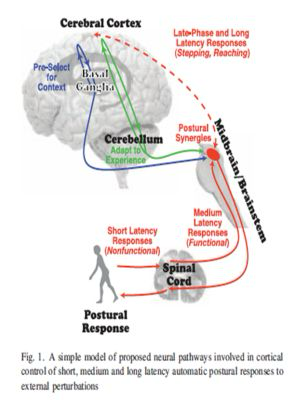
Maintenance of anti-gravity support
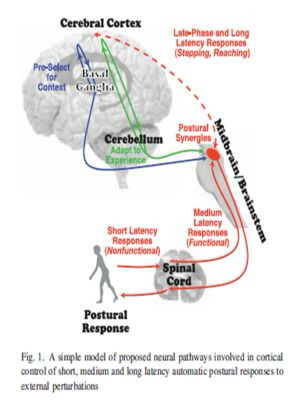
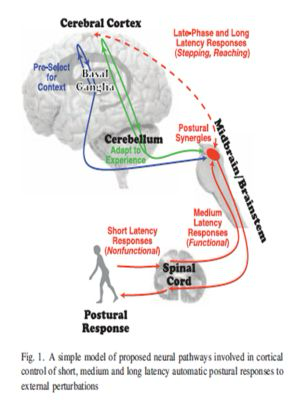
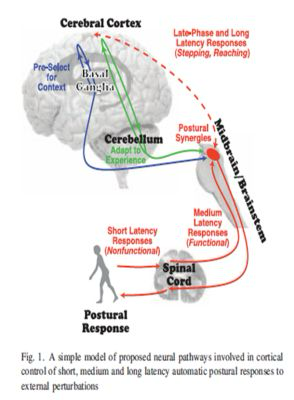
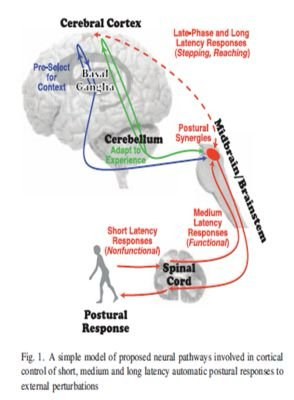
It has Short Latency Responses (Nonfunctional)
"Nonfunctional" because it cannot correct in reactive scenario (basically, cannot work alone)
Example: feel stretch in gastroc --> you then turn on gastroc --> but if this is all you do you will still fall down
What role does the brainstem play in the neural control of goal #1?
Automatic postural responses (from the reticular formation)
Has medium latency but is functional
"What role does the cerebellum play in neural control of goal #1?"
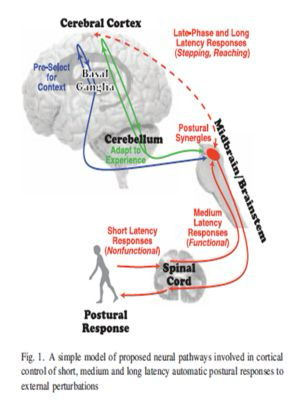
Response magnitude adaptation
Matching the response based on the magnitude
(Sets sensitivity of muscle spindles and APRs)
What is the role of the basal ganglia in neural control of goal #1?
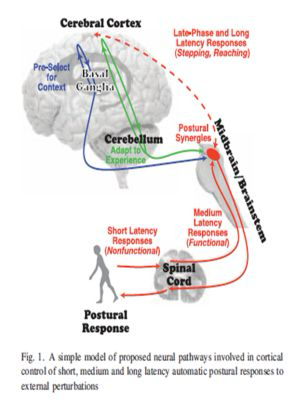
Response context
Basal ganglia helps us pick the correct (APR) strategy for the context (e.g., ankle, hip, step, etc.)
** people with Parkinson's Disease tend to pick the wrong strategy
What is the role of the supplementary motor cortex in neural control of goal #1?
Proactive / Anticipatory control
Has long latency
Does a better job planning for perturbation compared to reacting to it
SMA is internally driven (more of a "planner" versus a "do-er")
What is the role of the temporoparietal cortex in neural control of goal #1?
Perception of body verticality
Has long latency
Example: Individuals who have experienced a stroke have an issue with this; patient will see something in the right orientation (like a door frame) but still feel like they are falling down
What is the role of the limbic regions in neural control of goal #1?
Emotional influence over postural correction
Has long-latency
Neurons might change the magnitude of a response
Example: if you are nervous, you over-recruit for a motor response
________ are always part of the motor plan
Autonomic Postural Alignment Reflexes
FOR GOAL #2"
What are automatic postural alignment reflexes?
Maintains postural orientation of eyes, head, and body to vertical
Reflexes bias by feedforward planning
Example: catching a ball vs hiking --> goal #2 is still reflexive but how we utilize it is biased by volitional goals
Can also be triggered by feedback from sensory input
What automatic postural alignment reflexes are used for gaze stabilization (for goal #2)?
Vestibulo-Ocular Reflex
This reflex serves to move your eyes accordingly in response to head movement
Cerebellar Role in VOR:
VOR Cancellation
Sets Reflex Gain
Learns via Retinal Slip
What automatic postural alignment reflexes are used for postural alignment (for goal #2)?
Vestibulo-spinal Reflexes
Vestibulo-collic Reflexes
Asymmetric Tonic Neck Reflex (ATNR)
Symmetrical Tonic Neck Reflex (STNR)
What is the vestibulo-spinal reflex?
Alignment of the body based on head movement
What is the vestibulo-collic reflex?
Activating neck movement to keep head upright
What is the asymmetric tonic neck reflex (ATNR)?
If you turn your head to one side → arm on same side will extend and opposite arm will flex
Example:
Turn head to right
Right arm extends
Left arm flexes
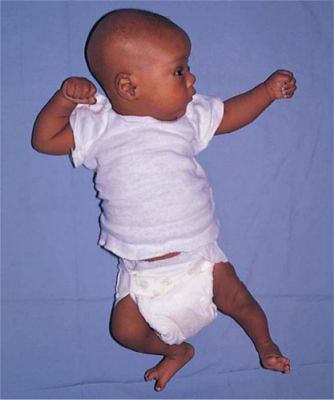
What is the symmetrical tonic neck reflex (STNR)?
The arms follow the movement of the head, while the legs are opposite
Example:
Head flexes
Arms flex
Legs extend
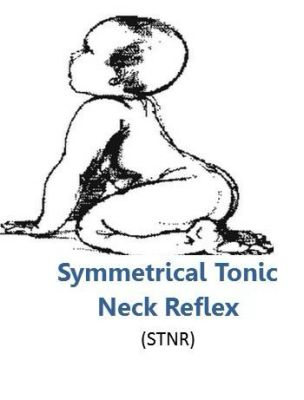
The ATNR and STNR are obligatory in ________ and become integrated into the motor plan as you ________
Children, Age
Cortex usually overrides reflex in older children/adults
What structures are responsible for postural alignment and gait stabilization?
Spinal Effectors
Brainstem Centers
Lateral Vestibular Nuclei
Medial Vestibular Nuclei
Medial Longitudinal Fasciculus
Reticular Formation
Cerebellum
Vestibulocerebellum
Spinocerebellum
Temporoparietal Cortex
What is the function of spinal effects for goal #2 (postural alignment / gaze stabilization)?
Tonic facilitation of anti-gravity muscle groups (in most contexts, this is the extensors)
What is the function of lateral vestibular nuclei for goal #2 (postural alignment / gaze stabilization)?
Compensates for body movement/tilt via activation of anti-gravity muscles (facilitates ext. m tone to keep alignment)
What is the function of medial vestibular nuclei for goal #2 (postural alignment / gaze stabilization)?
Adjusts head position to upright, especially during walking
What is the function of the medial longitudinal fasciculus for goal #2 (postural alignment / gaze stabilization)?
Facilitates gaze and postural alignment reflexes via conjugate eye movement
Want both our eyes on the same thing at the same time
What is the function of reticular formation for goal #2 (postural alignment / gaze stabilization)?
Internal represenation of postural orientation
"uprightness" / "verticality"
What is the function of the vestibulocerebellum for goal #2 (postural alignment / gaze stabilization)?
Modulates VOR, saccades, vergence
Generates smooth pursuits (cerebellum is required for this!)
Balance reactions for head/body
(Triggers balance reactions by acting on vestibular nuclei to influence vestibulospinal tracts)
What is the function of the spinocerebellum for goal #2 (postural alignment / gaze stabilization)?
Internal representation of postural orientation
(Internal model for posture / postural alignment)
What is the function of the temporoparietal cortex for goal #2 (postural alignment / gaze stabilization)?
Sensory integration and perception of body verticality
What three structures deal with verticality/uprightness?
Reticular Formation
Temporoparietal Cortex
Spinocerebellum
What is the role of the reticular formation in "upright" sensation?
Informs vestibular nuclei
What is the role of the spinocerebellum in "upright" sensation?
Internal model of "upright"
What is the role of the temporoparietal cortex in "upright" sensation?
Conscious perceptionof body verticality
"Accurate perception of verticality is essential for goal(s) ________ and ________
#1 (COM within BOS), #1 (COM within BOS) and #2 (postural alignment / gaze stabilization)
What three structures are involved in goal #3 (postural tone)?
Reticular Formation
Ceruleo/Raphe Nuclei
Pedunculopontine Nucleus
Cerebellum
Basal Ganglia
What is the function of the ceruleo and raphe nuclei in goal #3 (postural tone)?
Faciitation of muscle tone (inc. baseline activation; inc. activity of LMN)
(part of the emotional motor system)
What is the function of the pedunculopontine nucleus in goal #3 (postural tone)?
Inhibition of the reticulospinal tract to inhibit muscle tone (at rest)
What is the function of the cerebellum in goal #3 (postural tone)?
Cerebellar inputs regulate the gain on muscle spindle settings
What is the function of the basal ganglia in goal #3 (postural tone)?
Modulates postural tone via connections with pedunculopontine nucleus (to influence the reticulospinal tracts)
Pontine Reticulospinal Tract acts on ________ muscles
Extensor
Medullary Reticulospinal Tract acts on ________ muscles
Flexor