why witnesses fail
 Call Kai
 Learn
Learn Practice Test
 Spaced Repetition
 Match
Match Flashcards
 Knowt Play
1/41

There's no tags or description
Looks like no tags are added yet.
Name | Mastery | Learn | Test | Matching | Spaced | Call with Kai |
|---|
No analytics yet
Send a link to your students to track their progress
42 Terms
Criminal trials
Attempt to reconstruct a past event to determine what happened
fingerprints, fibers, blood
eyewitness evidence
Eyewitness evidence, like trace evidence, can be contaminated, lost, or destroyed, but police practice doesn’t reflect this
Goal is to ideally identify a perpetrator
Courts have not embraced scientific model for eyewitness testimony, especially from vulnerable witnesses, witnesses that have experienced a trauma event and children
wrongful convictions
Leading cause of wrongful convictions is faulty EWT - misidentification from lineups (72% cases involved this)
Also 47% of wrongful cases involved forensic evidence
Innocence project worked to exonerate nearly 400 people who were wrongly convicted, mainly worked with DNA evidence
Memory for Events
If encounter misleading info after a crime, can be very inaccurate.
Eg, Pps in lab and watch a mock crime, could be video, live reenactment etc.
Short delay, then fed misleading info, could be questions or narrative.
Then had memories tested - could be written, pictures etc. how well do they remember details of og mock crime.
Memory deficit after receiving misinformation can be 30-40%, sometimes even more depending on what info is presented
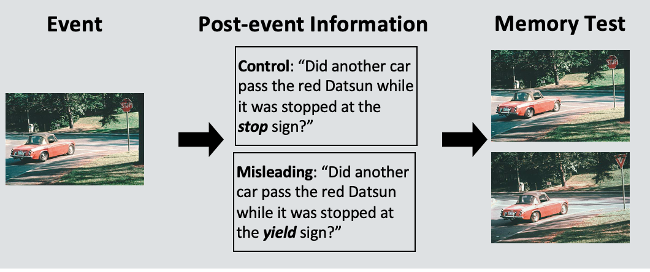
Post-event information
Why does post-event information play havoc with memory?
Two types of info enter memory:
[1] information received during the original event
[2] information supplied after the original event
Over time, info from both sources may be integrated in such a way that we’re unable to tell where each bit of info has come from. Misinformation forms part of og.
But, what happens to the original memory? Is it lost forever? Is it overwritten? Is it blocked by new info?
new info impact
Orange circle represents memory of crime witnessed, not a complete memory - don't encode everything. Over time memory will fade so more and more gaps. When encounter misinfo - may fill in gap. Eg watch a news report and talk about number plate of car, may integrate into memory and think recalled it originally. - sumplement memory
Can also transform memory - info can override og memory - can make an og part completely inaccessible.
Can sometimes have both things.
Planting false childhood memories
Surge of cases in which adults, especially women, went to therapy and would remember being abused as children and cause of disorders caused by abuse of children. But women spent whole life thinking they had never been abused. Concerned researchers as people could misremember events - psychotherapists used techniques that were highly suggestive, make people believe it was abuse, then confirmation bias kicks in etc.
But no evidence to back up concerns of psychotherapists using suggestive techniques
In the mid 1990s, researchers devised procedures to make people believe and remember entirely false childhood experiences.
A new procedure for studying false memories in the lab…
Concept came from a student in loftus’s class.
Would come to a lab to do a study, 3 interviews spaced across a week.
Looked at a booklet that contained stories from childhood, around 5-7. Included one made up by researchers - lost in shopping mall for an extended period of time.
Pps would think about events and recall as much as they could in the interview. Tried to mimic a potential situation that happens in therapeutic setting.
25% of participants in Loftus and Pickrell’s (1995) study came to believe or remember the suggested event (getting lost in a mall)
Would come up with details about what they were doing in that shopping mall, showed signs of genuinely remembering event
Called memory implantation studies
Could fake images—just like fake narratives—induce false memories?
Could fabricated photos lead people to remember entire events that never happened?
All photos were real apart from one which was fake. Have to buy into image exactly how it is, not told anything about it.
False event was hot air balloon event - used because not very common and pps parents could confirm this.
Photoshopped photo of a child onto the photo
Could fabricated photos lead people to remember entire events that never happened?
Same procedure as before - three interviews, recall as much as possible. Spread over a week.
Results
50% of subjects reported images or memories consistent with experiencing a childhood hot air balloon ride
Many of them came up with detailed narratives of how the event occurred
Sample memory report:
“I’m still pretty certain it occurred when I was in form one at um the local school there…basically for $10 or something you could go up in a hot air balloon and go up about 20 odd meters. Um, yeah…it would have been a Saturday and I think we went with yeah, parents …and I’m pretty certain that mum is down on the ground taking a photo.”
Info not provided in the photo
Usually when misremember autobiographical event - large proportion still accurate, combo of the truth, imagination, suggested by external source
Implanting entire events into memory
Since the 1995 “Lost in the mall” study…
Around 20 studies have used a variant of the procedure to examine the factors that influence false memories, have to be careful about the ethics - sensitive about debriefing pps, type of event etc
False recall has ranged from 0% of subjects (Pezdek et al., 1997) in some conditions and up to 82% of subjects (Garry & Wade, 2005) in other conditions
Wide range of false memory rates could be due to many factors:
how “false memory” is operationalised or measured - do they express confidence in memory, what info do they talk about. Do they consciously claim to recollect info about the events
the type of false event - eg implausible and neg events less likely to become false memory
the length of the study period - longer they spend imagining events, greater the likelihood of a false memory
the instructions given to subjects
the individual characteristics of the interviewer and subject, eg introverted pp and suggestive researcher, more likely to inaccurately recall
Examples of events include: being rescued by a lifeguard, dog bite, stole as a teen, hospitalised overnight for a particular procedure
How often do these pps have false memories
Couldn't do formal meta-analysis as methods differed so much
Did a mega-analysis
Data from as many published studies as they could
8 out of 20 studies included, as people talked about childhood memories, researchers did not always publish transcripts
400 pps part of 8 false memory studies
Recode transcripts to see how many pps recalled false events suggested to them
Stringent criteria for false memory - confidence in event etc
31% had false memories
23% believed event happened to them but didn't actually recollect it, eg well it must have happened as mum said and there's a photo of it
False beliefs and memories can influence what we do…they may even have health benefits
Eg if get children to believe they got sick after having a certain food, give opportunity to eat food, less likely to eat food.
Obvious imps for health and wellbeing
Can tell people they really enjoyed eating asparagus, then more likely to eat asparagus
Theoretical framework for false memory formation
Why can memories be so wrong, what factors, how can we predict if they will have one.
First need to accept that they event happened, certain factors can make an event more or less plausible
Can normalise event eg people in your area have reported it, also movies and books, surge in people saying about abductions
Ways in which these events can become plausible to them
Then start thinking about event - imagine it, develop images, come up with a story of how that event occurred
Then unable to monitor source of info, dont realize it has been supplied to them and it isnt their actual memory. then become rich, clear and detailed in mind

false memory research summary
False memory research has shown that we can be wildly wrong about...
what we see
what we do
But can suggestive techniques induce people to falsely accuse another person of committing a crime?
Studying false evidence and false accusations in the lab….it’s not easy!
Can a pp potentially witness a crime, then be exposed to fake video evidence and testify they witnessed a crime
Phase 1: Subjects witness a target event (mock crime)
Phase 2: Subjects exposed to false evidence regarding the suspect
Phase 3: Elicit a false accusation (witness statement) from subject
Can false evidence induce witnesses to falsely testify?
- Running a gambling study, pps came in the morning and afternoon. Sat alongside confed. - - Online gambling task, told them they are taking a vid as want to look at beh.
- Asked trivia questions
- If get answer right, a tick will come and can take money from bank. If wrong, put the money back
- Idea of game is to earn as much as can, whoever had the most out of the pp and confed would win a big cash prize
phase 2
Their partner was suspected of cheating
Their partner’s profits exceeded what computer records showed
Their partner was known for cheating in other studies
Psychology Department was taking disciplinary action
Interested in seeing whether pp supported disciplinary action even though the confed never cheated
Some people saw video of confed cheating, (researchers edited video to replace tick with a cross), so looks like the confed took money from a bank when they got it wrong
Other group told there was a video but not shown it
Last group not mentioned
phase 3
Sign this statement if you believe you saw it. They were told dont sign it because you saw the video. Only sign it if you actually saw the confed cheating
Results
Participants were unaware of the true nature of the study
20% signed the witness statement
4 participants described additional incriminating details:
“I saw the cross sign on her screen and she reached out and for a note from the bank”
“I sensed that she took money from the bank very often... but the X symbol was always on the screen”
Confabulation - made up details to support what they believed they saw
People who viewed the video were significantly more likely to sign the statement than those who were simply told that video evidence existed or were not given any information about video evidence.
Around 45% of the pps who saw the video signed the witness statement
First study of how fabricated video evidence can lead people to make false accusations
People will falsely confess as well!
In a follow-up study, we showed that people who viewed a video of THEMSELVES CHEATING were more likely to internalise guilt than people who were merely told that video evidence existed
implications
Doctored evidence might induce people to confess to, and accuse other people of, doing something they never did
In some US states, police can present fabricated evidence to elicit a confession. Some best practice manuals encourage lying to suspects and witnesses
Memory for People
Most evidence in court is circumstantial (eg fingerprint only tells us someone touched a surface), but eyewitness identification is direct evidence of guilt which makes it very powerful
And we know that mistaken eyewitness evidence is the leading cause of wrongful convictions
Also lots of research showing that judges and jurors find EWT powerful
What factors affect witnesses’ identification decisions?
Gender of witness
Intelligence of witness
Age of witness
Face recognition skills
Personality
Alcohol
Prior exposure
View
Disguise of perp
Exposure time
Same vs other-race identification
Stress
Weapon
Retention interval
Interpolated mugshots
Overheard descriptions
Pre-lineup instructions
Structure of lineup/fillers
Simultaneous/sequential procedure
Suggestive behaviours during lineup
Post-identification feedback
A chronological categorisation of eyewitness identification variables
Factors related to the witness matter.
Eg alcohol means dont encode as much.
Affect how reliable you are.
If an unfamiliar person, EW will rely on outer parts of face to identify them.
Post-identification factors - If tell them after that they have correctly identified the suspect, feel more confident, but if that is an innocent suspect, it makes them more confident in their decision in court which can lead to wrongful convictions
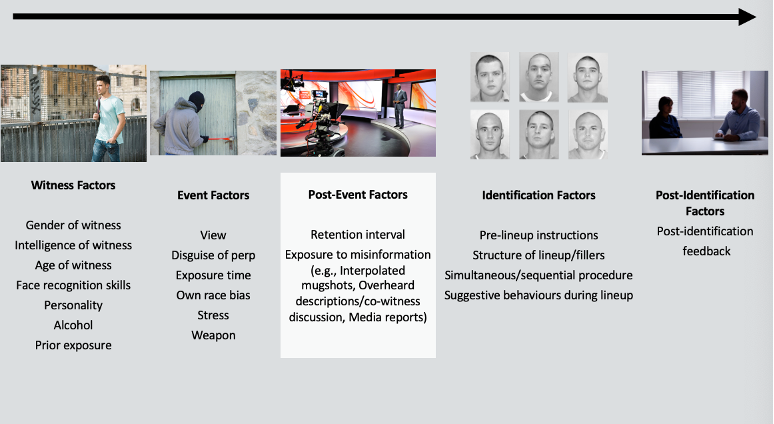
Making an identification
One prevailing account of how witnesses make identification decisions suggests that witnesses use a relative judgement strategy.
That is, witnesses tend to identify the person who most closely resembles their memory of the perpetrator relative to other members of the lineup.
Many studies support this notion.
This strategy works well when the perpetrator is present… But it’s not good when the perpetrator is absent!
So if they are just looking for the best match, they feel they have to pick someone, so pick who matches their memory most closely
police must tell the witness the perpetrator might not be there
High rate of witnesses picking someone, whether or not they're a perpetrator
Also a difference if show line up simultaneously vs sequential
simultaneous vs sequential
Simultaneous
Traditional method - show all pictures together
Sequential
Show witness pictures from a line up one by one
When say yes stop showing
Prevents them comparing across all the images, have to make a more absolute decision
Support for the concept of a relative judgement strategy comes from the finding that when subjects in lineup studies are unable to make relative judgements—as with sequential lineups—they make fewer false identifications
Selecting foils
Must not suggest which person is the focus of the police investigation
Foil selection is crucial — the suspect should not stand out
Police and Criminal Evidence Act (PACE, Code D, 2017) says foils should: “so far as possible, resemble the suspect in age, general appearance and position in life”
Helps to protect innocent suspects
If suspect stands out, they dont have to use their memory. Have to be using memory for evidence to be good
Conducting line ups in the UK
Created by West Yorkshire Police in 2003, VIPER contains >50,000 pre-recorded videos of people who can be used as fillers in lineups
UK is one of the best for lineups
Most are done digitally - every time the police need a lineup VIPER put together an identification parade. Then send to laptop, go to witnesses house or do it at police station
Video clips are of people standing against a grey background
When police have a suspect, go into recording booth
Will see the line up one by one and determine whether they are the suspect or not
When have a suspect with a distinctive feature - how can they not make them stand out?
Concealment (using a mask), do it on everyone in the lineup
Also use still photos instead
Pixelate
Or replicate - might think this is the best thing to do, suspect is still fully visible and have marking
Digitally editing identification parades
Approximately 30-40% of parades in the UK require image manipulation to prevent a suspect from standing out in the lineup (P. Burton, West Yorkshire Police)
One survey showed that 70% of US police officers surveyed reported using image manipulation when creating lineups for suspects with distinctive features (Wogalter, Malpass, & McQuiston, 2004)
In short, a substantial portion of police lineups are digitally edited.
Should the police use the mask, pixelation or replication technique?
PACE states that the officer responsible for the case can decide which technique to use.
Police tend to prefer the mask/block or pixelation approach:
Northumbria Identification Unit conducted 2,496 lineups in 2008 of which 40% involved suspects with distinctive features and in each case a mask or pixelation was applied (Karl Burns, personal communication, Jan 30, 2009).
Not surprising that these techniques are preferred: both are less costly and time-consuming than replicating a distinctive feature, and pixelation can be used in video lineups.
But we still don’t know whether concealment is optimal technique for enhancing eyewitness identification performance!
Exploring how different lineup editing techniques affect eyewitness identification accuracy
a = replication
b = pixelation
c = mask
d = control (no editing)
Around 9000 pps, watched a 2 min video (4 dif videos, 4 dif perpetrators with 4 dif distinctive features)
8 min filler task
Had to make an identification
Lineup when perpetrator there vs not there
next stage
Tell them (after a break so memory can fade a little)
You will now be presented with a lineup which may or may not contain the culprit you saw in the mugging video.
If you believe the culprit is in the lineup, write down the number of the person you think is the culprit. Otherwise, write “not present”.
Then ask for confidence in decision
Do this because in courtroom usually look at witness’s confidence about how accurate they are. Can see if this relates to their accuracy
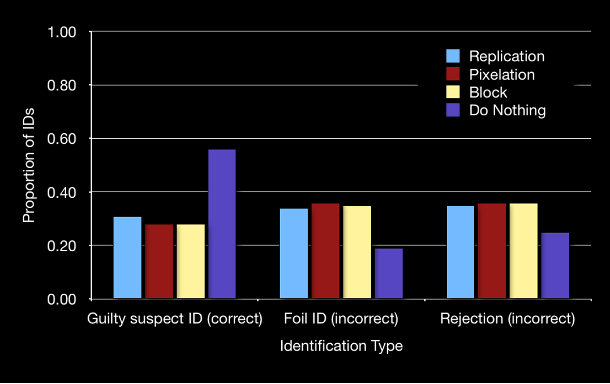
Identification results when perpetrator was present in the lineup
Most witnesses in the do nothing select the one that stands out
So may think best thing to do is to leave them standing out.
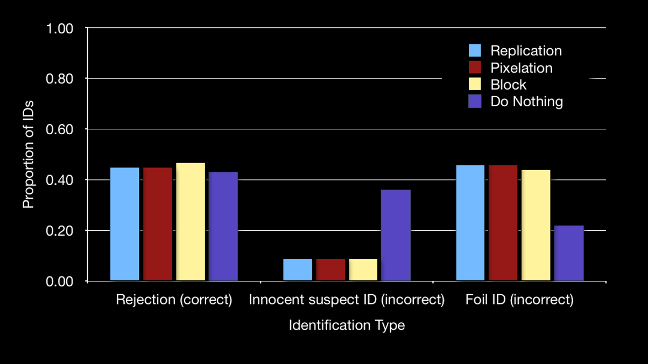
Identification results when perpetrator was NOT present in the lineup
40% make a correct decision, that the perpetrator wasn’t there
When incorrect suspect is there, they choose them
So shouldn't leave suspect to stand out
confidence ratings
Bottom lineup when suspect was left to stand out - no matter how confident the witnesses were, the chances of them making a correct identification were much lower. Even those who were 100%, only made the correct judgement about 65% of the time.
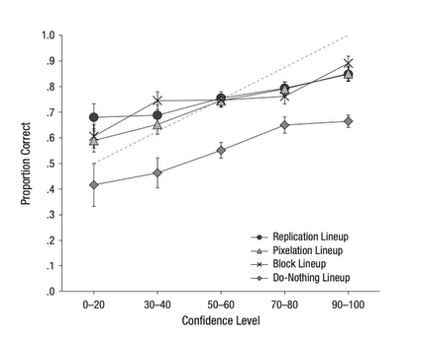
So what should the police do?
Ensure suspects don’t stand out! Leaving a suspect to stand out increased subjects’ willingness to select the suspect regardless of whether the suspect was guilty or innocent
When the ratio of correct IDs to incorrect IDs was considered, do-nothing lineups, overall, led to poorer ID performance than the other types of lineups
Why? When a suspect stands out, witnesses may fail to appreciate that the distinctive feature is not useful in helping them to make a decision, and they rely heavily on that feature to make their identification. By contrast, when the suspect doesn’t stand out (as in replication, pixelation or block lineups) witnesses can appropriately discount the distinctive feature and rely on other more diagnostic cues to make their decision - Diagnostic feature detection model (Wixted & Mickes, 2014)
Subjects were also likely to be over-confident in the accuracy of their decision when the suspect stood out.
Do we need a radical new approach to eliciting identification evidence?
What if the traditional lineup procedure used by police... “had never existed and the legal system [had] turned to psychology to determine how information could be extracted from eyewitnesses’ memories... Operating from scratch, it seems likely that modern psychology would have developed radically different ideas” (pp. 68-69)
A promising alternative to traditional lineups
Rationale:
Traditional lineups require witnesses to make a single decision (i.e., to determine whether or not the perpetrator appears in the lineup) and it’s a really difficult decision!
Many factors may influence identification decisions such as encoding time, lighting conditions, alcohol, delay etc
But social, metacognitive and heuristic influences also play a role. e.g., how difficult the witness perceives the identification decision to be:
“If I pick this person, he’ll probably get a long jail sentence” >> more conservative judgement
“If I don’t pick this person, a dangerous man may walk free” >> less conservative judgement
Metacognitive processes could lead to overly lax or unduly stringent criteria.
method
Two key components:
Witnesses rate the degree of match between the culprit they have in memory and each lineup member
Witnesses perform this matching process under severe time constraints
Results
Scoring in deadline condition:
A single maximum confidence value was treated as a positive identification (i.e., the subject selected a lineup member) eg 80% confident about one person, 50% everyone else
If no single lineup member was rated highest, researchers assumed no identification was made
Decision accuracy was significantly higher in deadline condition than in control condition across all three studies (27%, 24%, 66%)
This effect was replicated when the retention interval was extended from 5 minutes to 1 week
Subjects’ confidence profiles were a good indicator of accuracy (i.e., subjects with a lot of variability in their confidence ratings were more likely to be accurate than subjects with little variability in their confidence ratings)
Summary
Faulty witness testimony is the leading cause of wrongful convictions
Suggestive questioning and lineup procedures can have immense effects on the quality and quantity of witness testimony
There remains a large gap between what psychological science advises and the practices law enforcement professionals use (although police practice and policy in the UK is better aligned with scientific recommendations than is practice and policy in many other countries)
We need more communication and collaboration between researchers working in psychology and law, and policymakers and practitioners in legal contexts