Trigonometric geometry and proofs
 Call Kai
 Learn
Learn Practice Test
 Spaced Repetition
 Match
Match Flashcards
 Knowt Play
1/60

There's no tags or description
Looks like no tags are added yet.
Name | Mastery | Learn | Test | Matching | Spaced | Call with Kai |
|---|
No analytics yet
Send a link to your students to track their progress
61 Terms
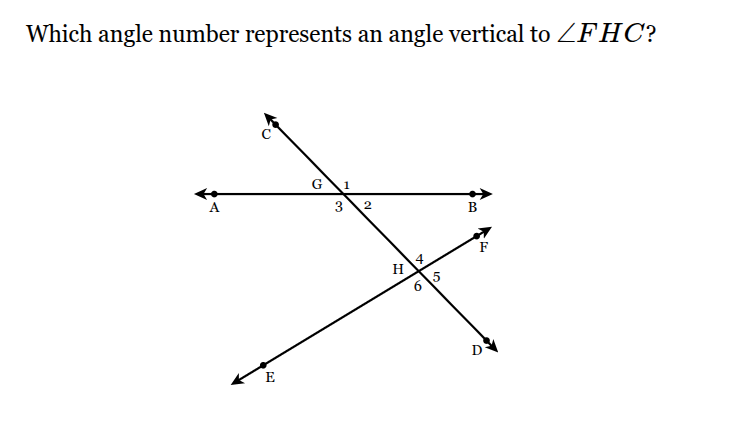
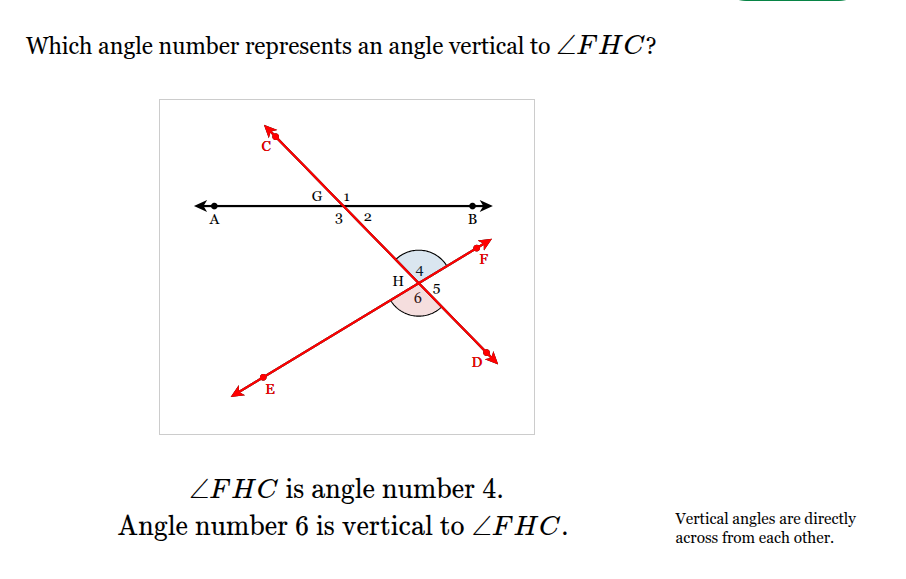
Which angle number represents an angle vertical to ∠FHC?
Angle number 6 is vertical to ∠FHC.
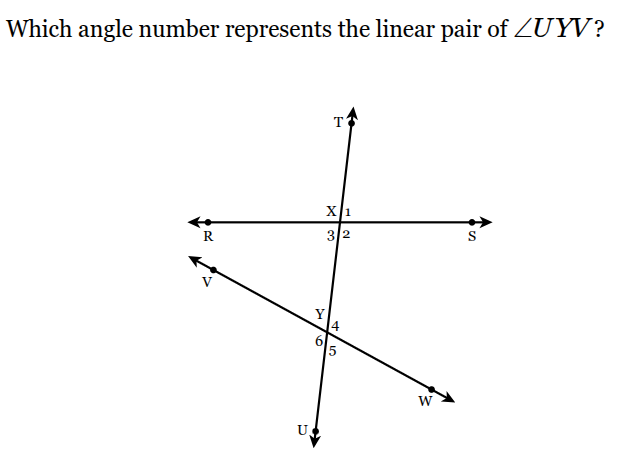
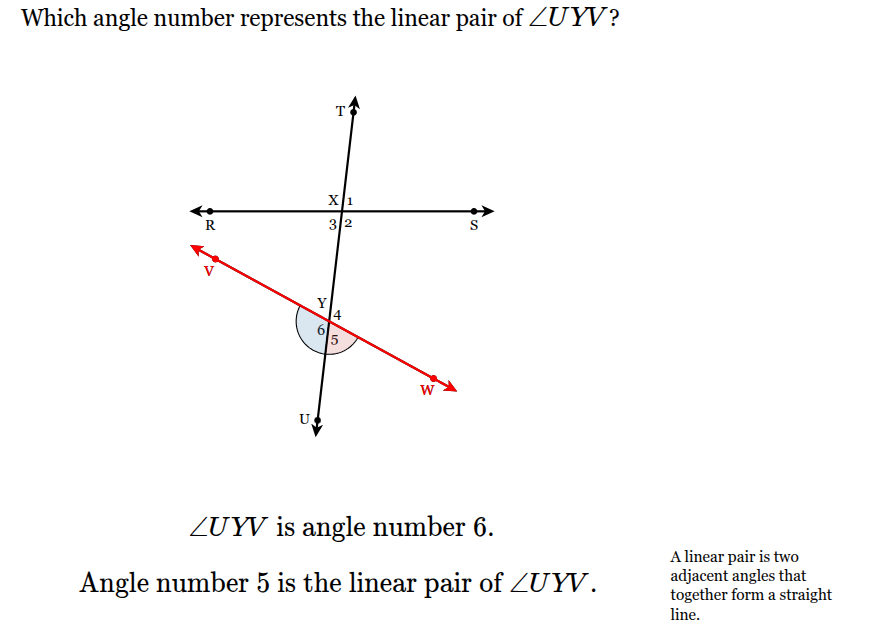
Which angle number represents the linear pair of ∠UYV?
Angle number 5 is the linear pair of ∠UYV.
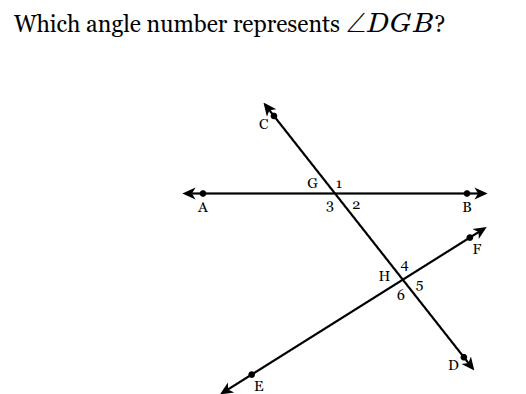
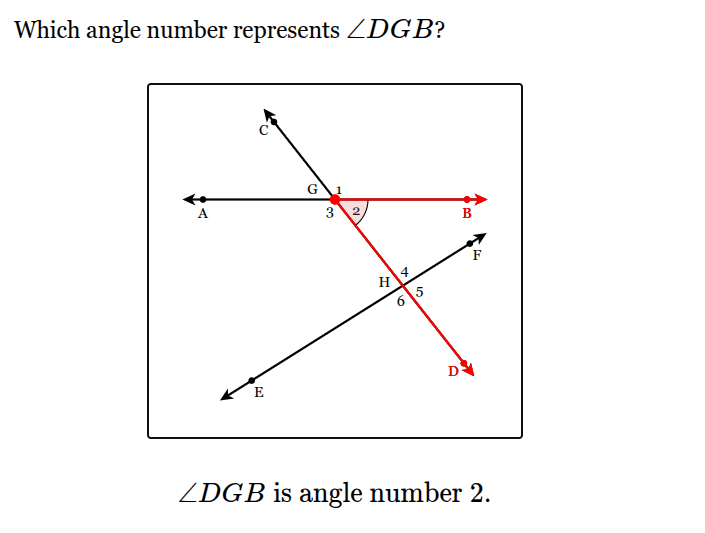
Which angle number represents ∠DGB?
∠DGB is angle number 2.
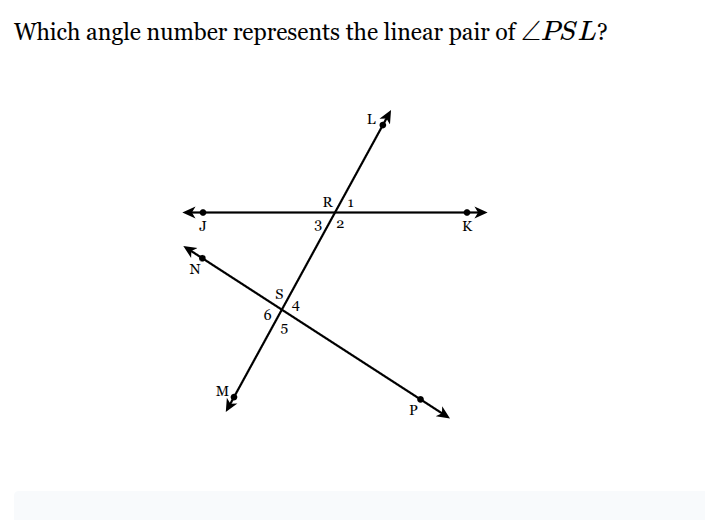
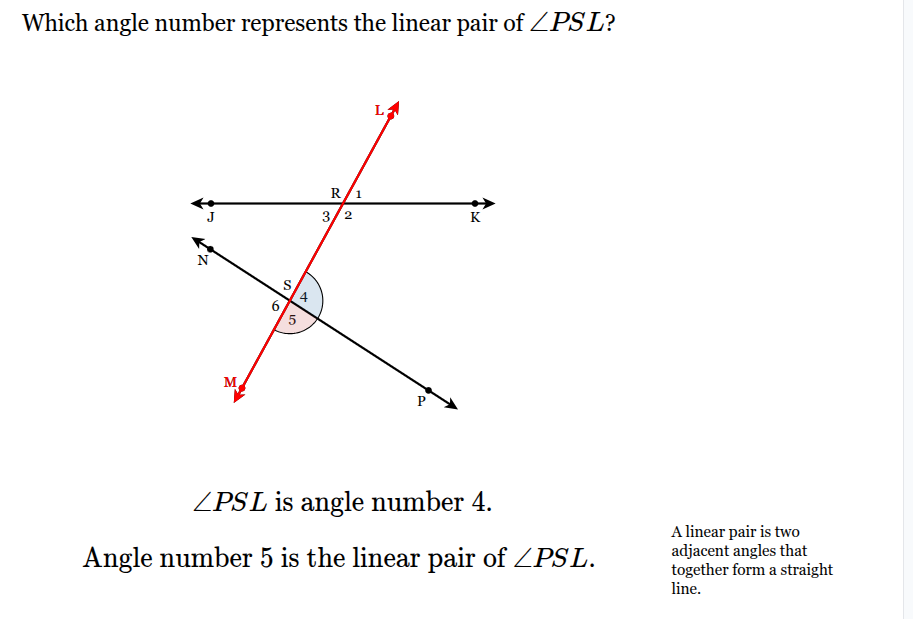
Which angle number represents the linear pair of ∠PSL?
Angle number 5 is the linear pair of ∠PSL.
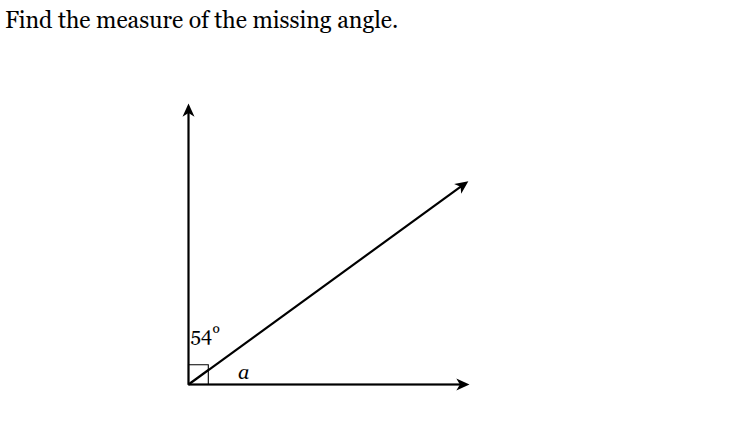
Find the measure of the missing angle.
36
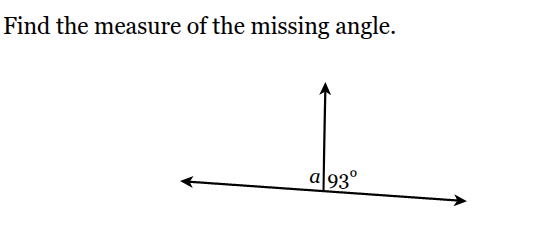
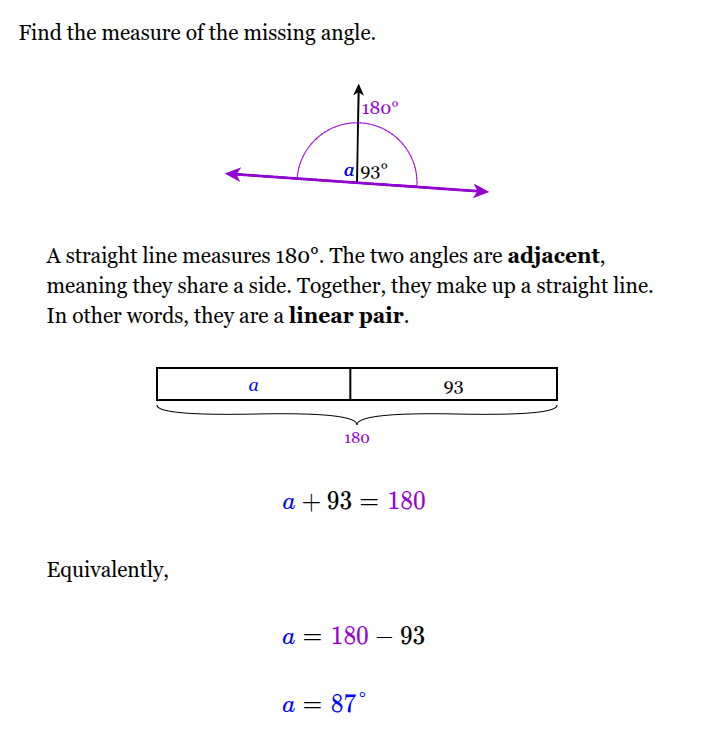
Find the measure of the missing angle.
a = 87°
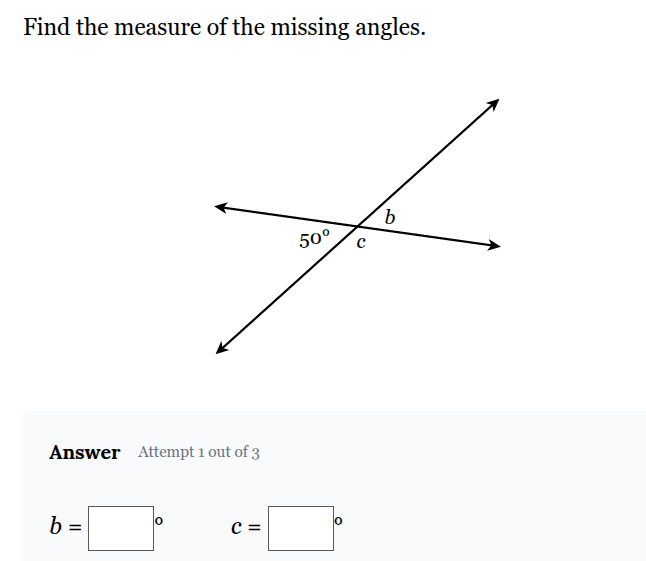
Find the measure of the missing angles.
b = 50°
c = 130°
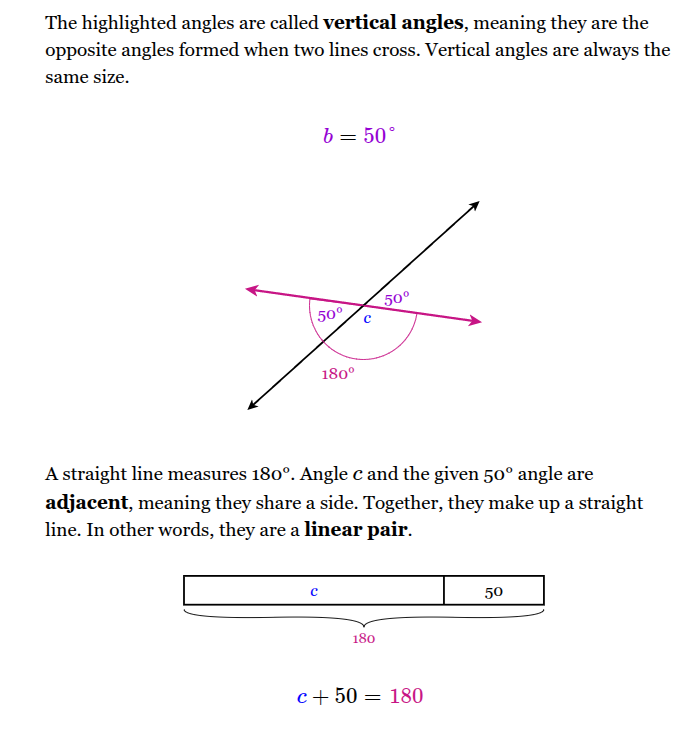
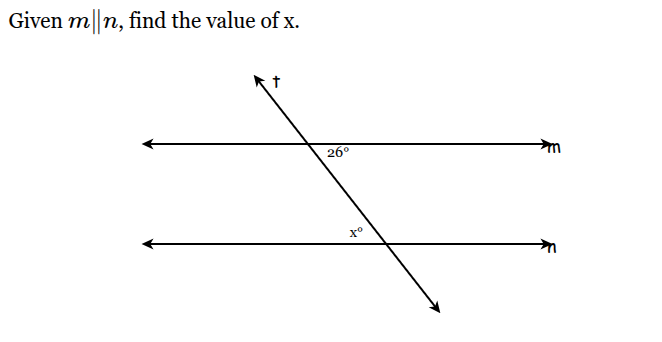
Given m∥n, find the value of x.
x = ___
x = 26∘
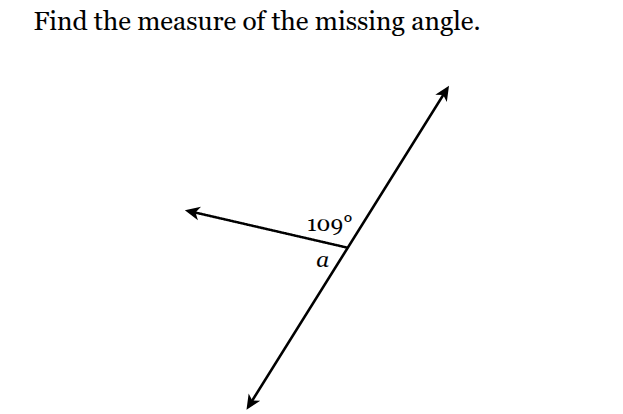
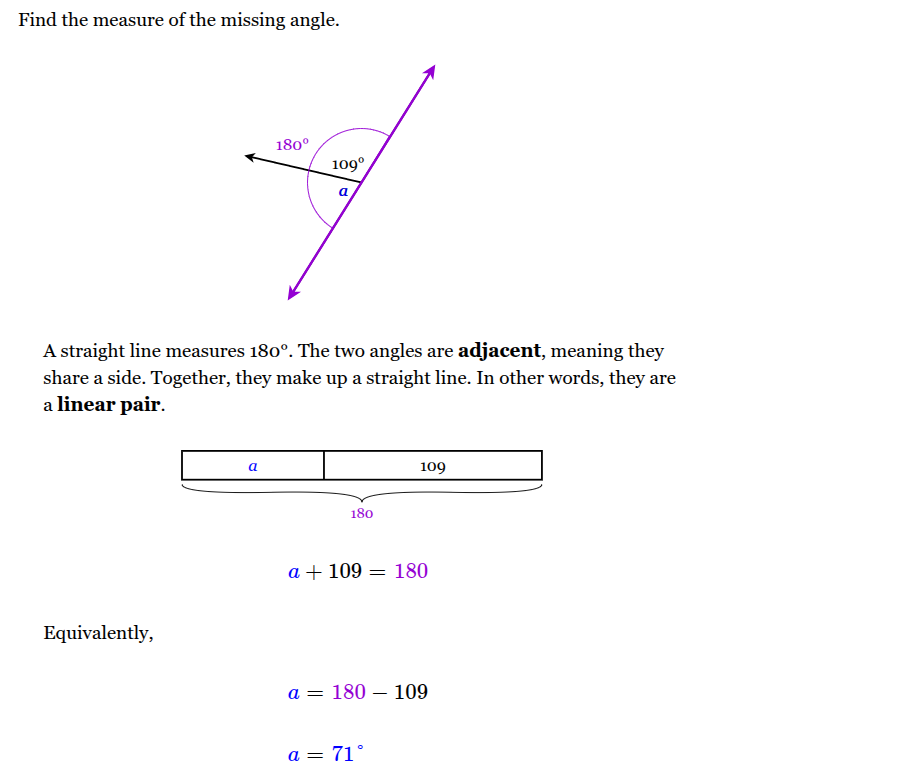
Find the measure of the missing angle.
a = 71°
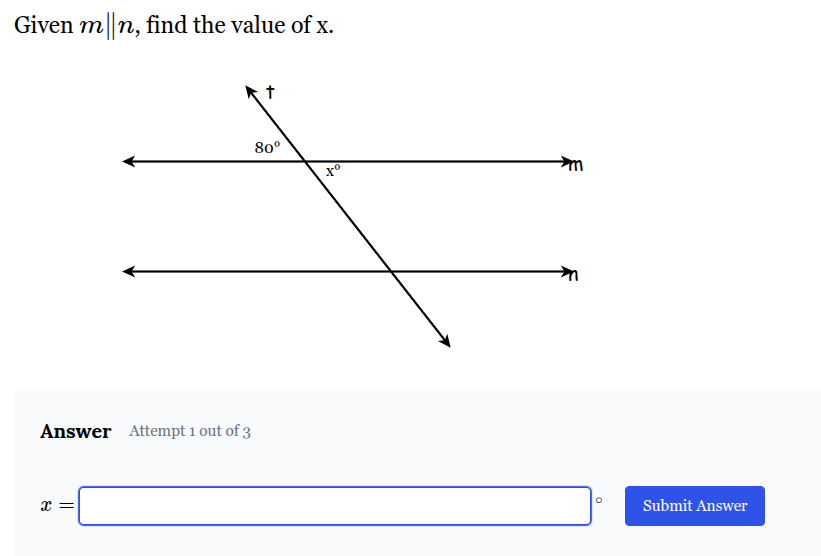
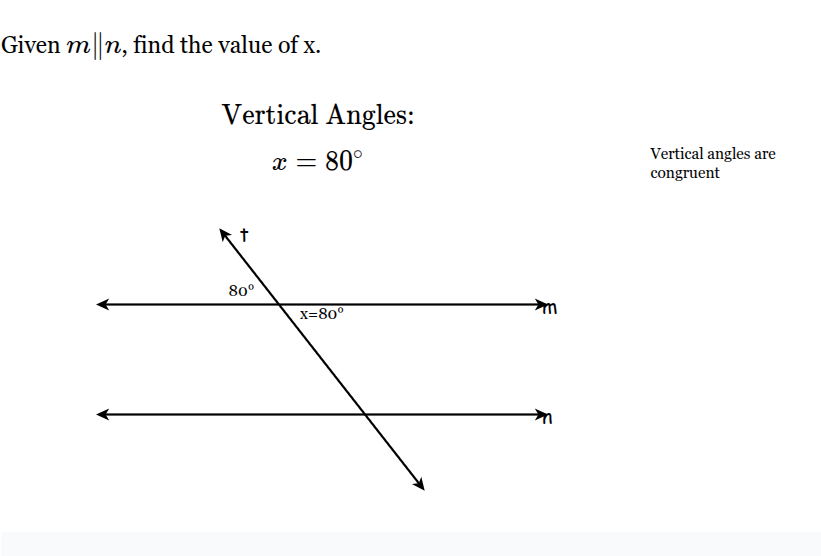
Given m∥n, find the value of x.
x = 80∘
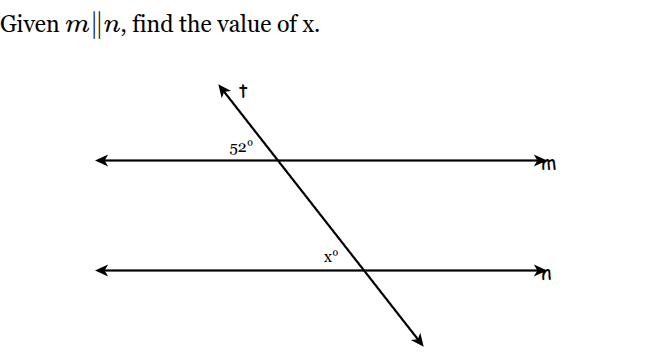
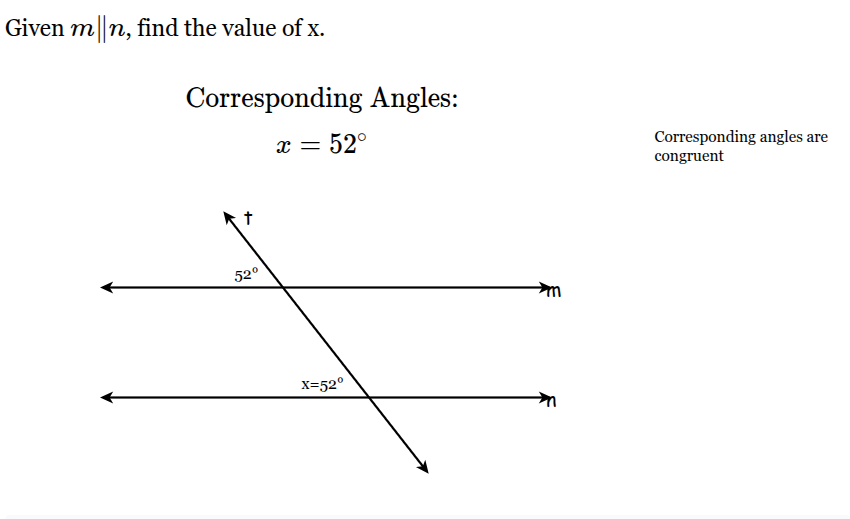
Given m∥n, find the value of x.
x = 52∘
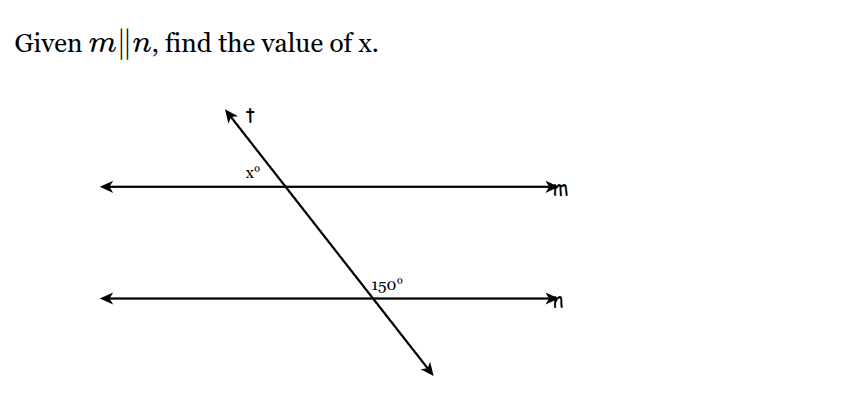
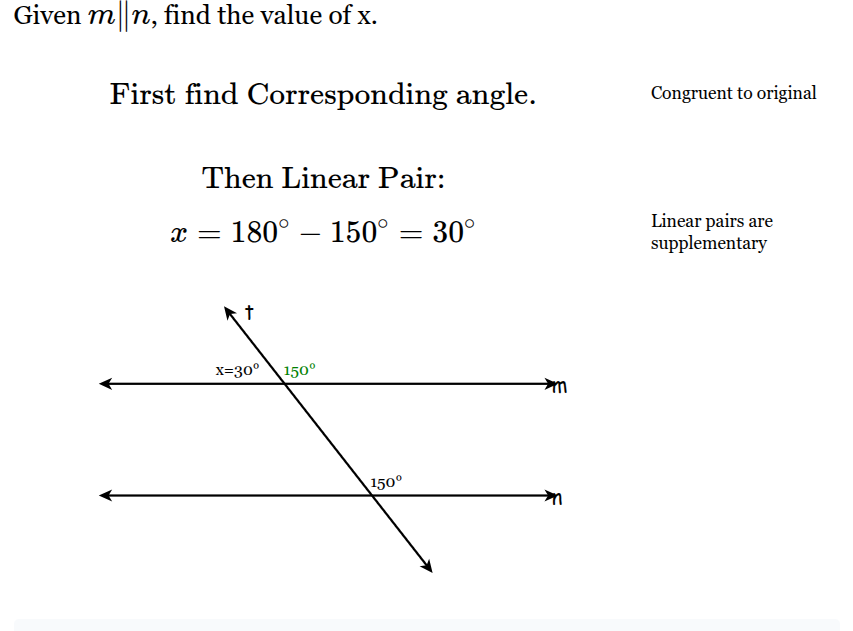
Given m∥n, find the value of x.
x = 30∘
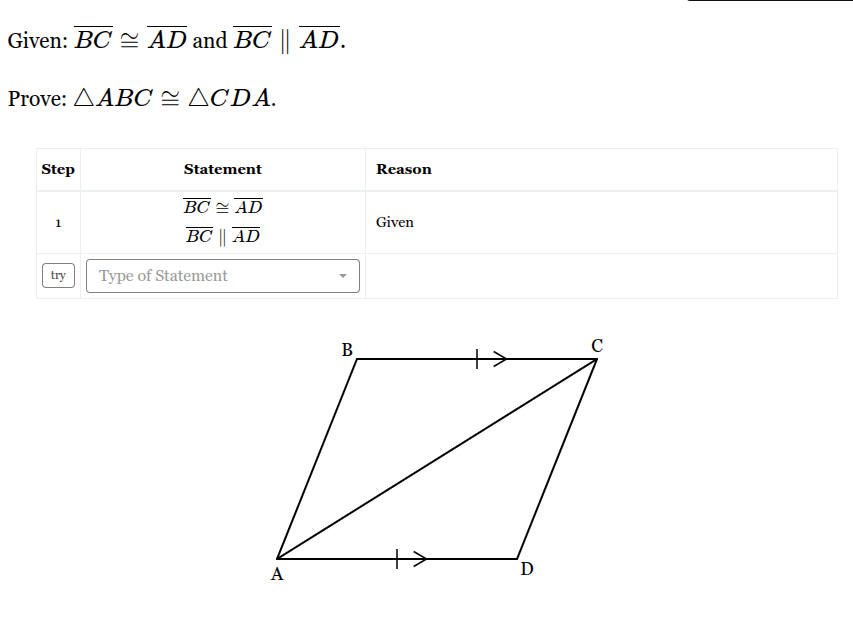
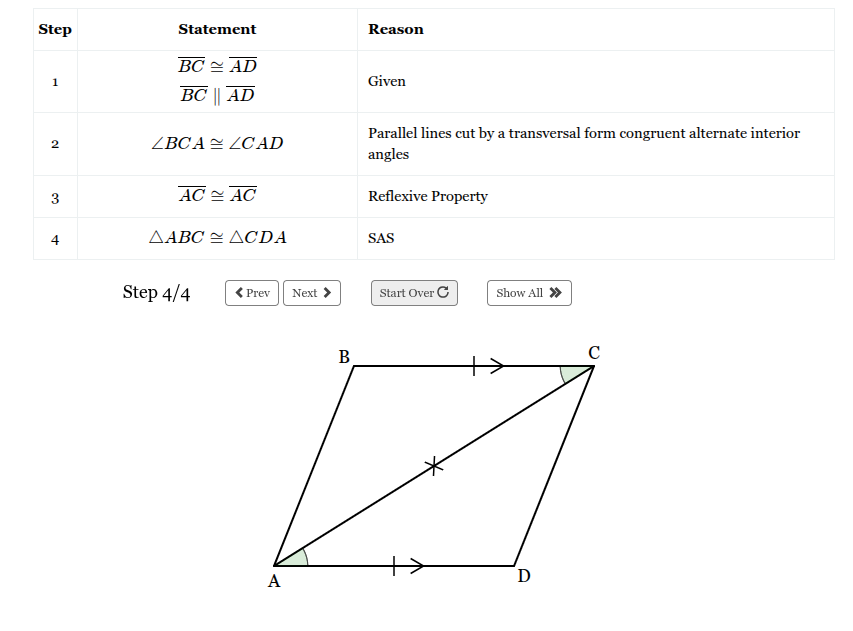
Fill out the rest of the statement/reason table to prove the triangles are similar
Step | Statement | Reason |
1 | BC≅AD BC∥AD | Given |
2 | AC≅CA | Reflexive Property |
3 | ∠ACB≅∠DAC | Alternate interior angles are congruent when lines are parallel. |
4 | △ABC≅△CDA | SAS |
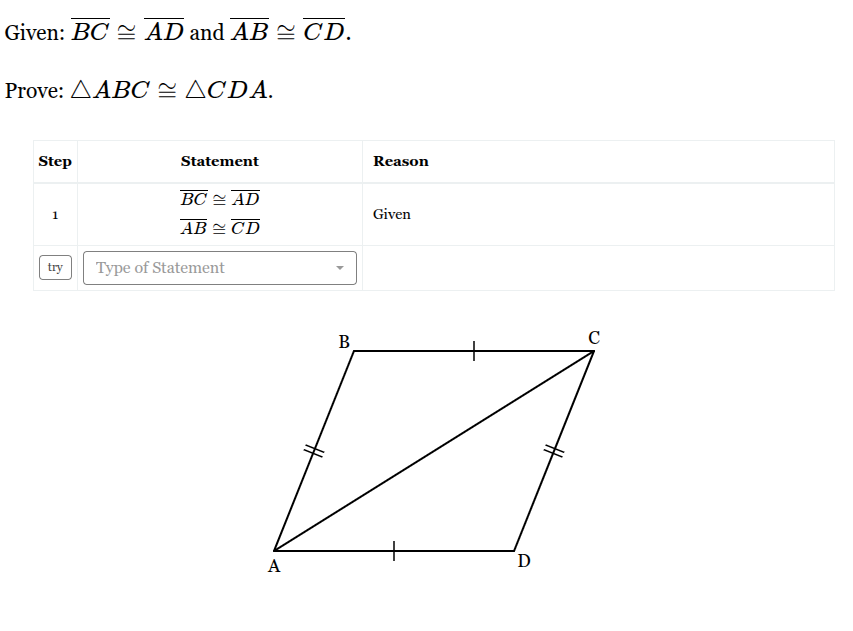
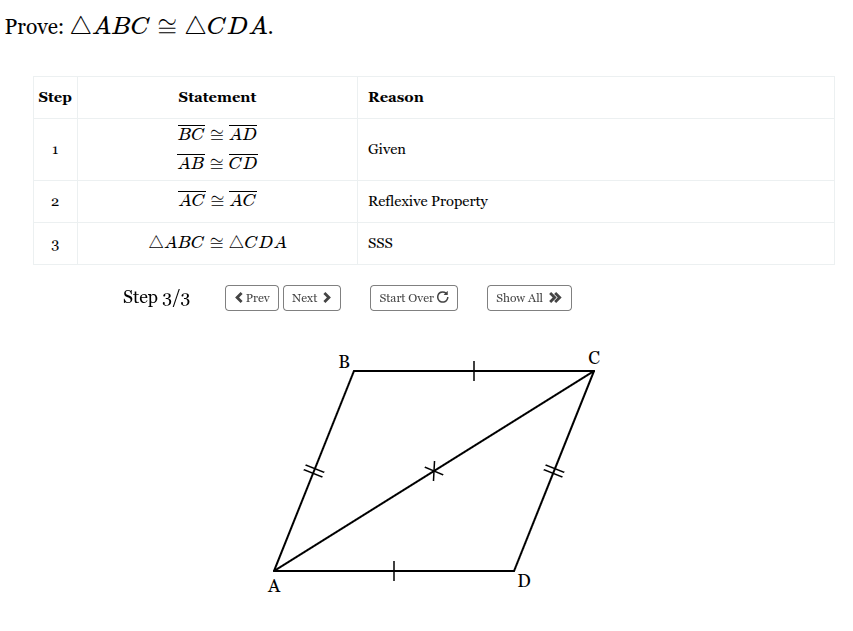
Fill out the rest of the statement/reason table to prove the triangles are similar
Step | Statement | Reason |
1 | BC≅AD AB≅CD | Given |
2 | AC≅CA | Reflexive Property |
3 | △ABC≅△CDA | SSS |
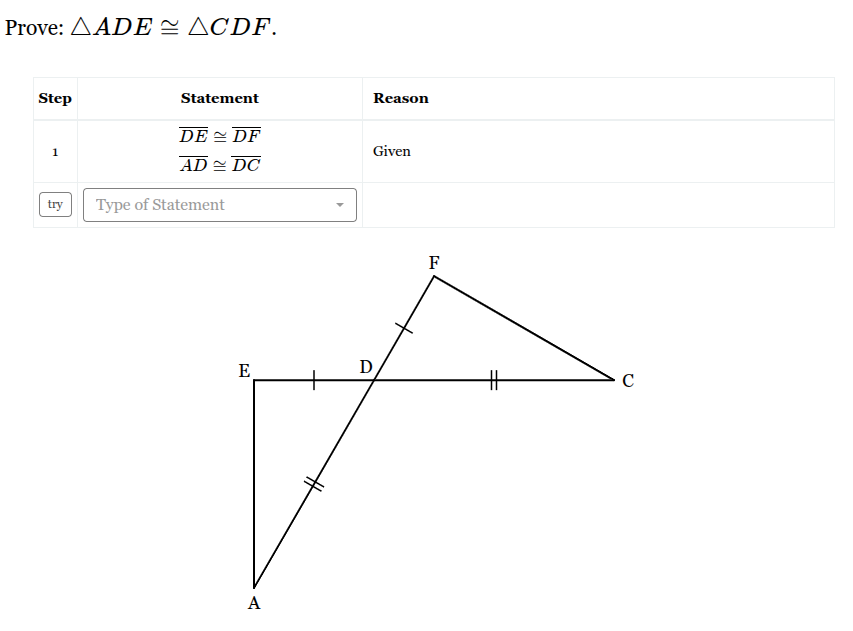
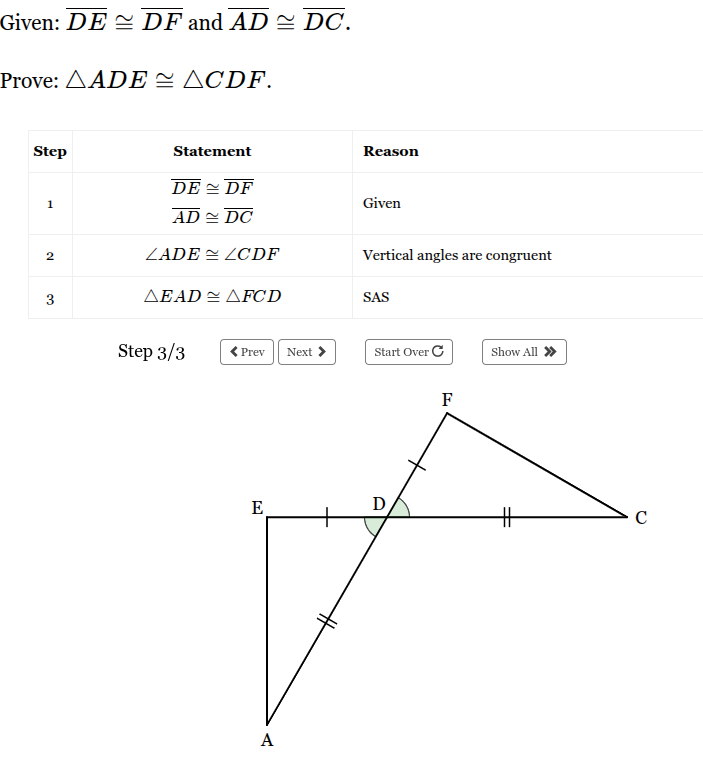
Fill out the rest of the statement/reason table to prove the triangles are similar
Step | Statement | Reason |
1 | DE≅DF AD≅DC | Given |
2 | ∠ADE≅∠CDF | Vertical angles are congruent |
3 | △ADE≅△CDF | SAS |
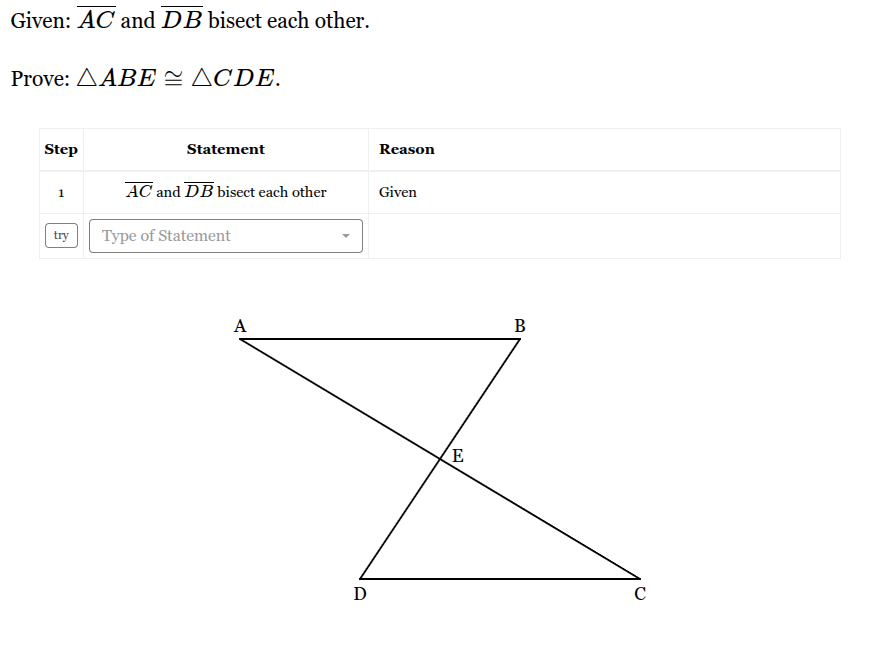
Fill out the rest of the statement/reason table to prove the triangles are similar
Step | Statement | Reason |
1 | AC and DB bisect each other | Given |
2 | AE≅EC | A segment bisector divides a segment into two congruent segments |
3 | BE≅ED | A segment bisector divides a segment into two congruent segments |
4 | ∠AEB≅∠CED | Vertical angles are congruent |
5 | △ABE≅△CDE | SAS |
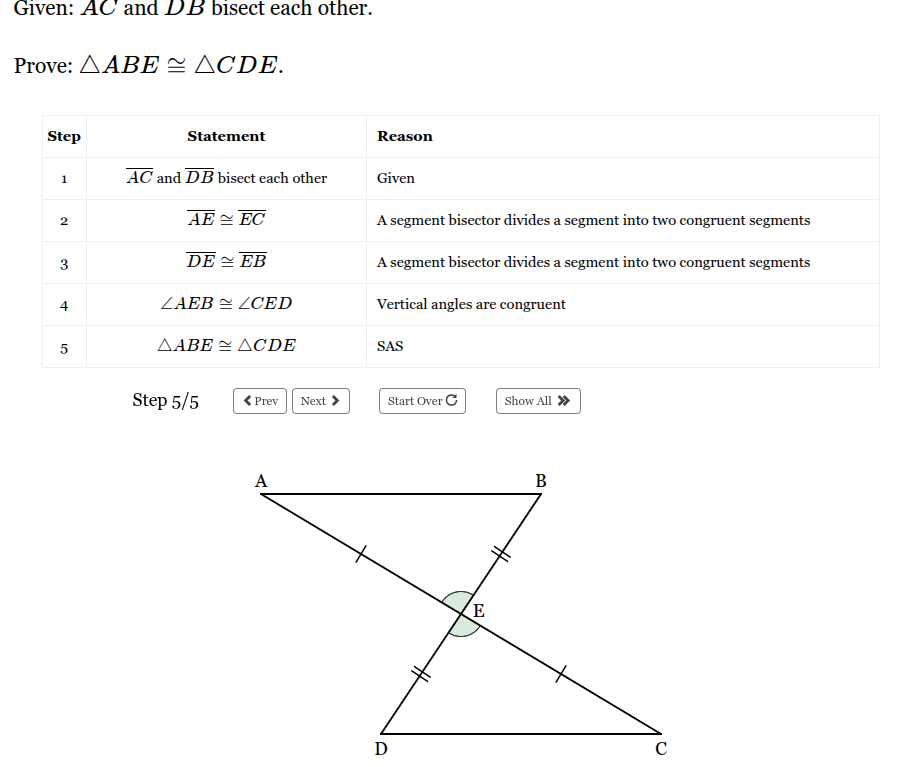
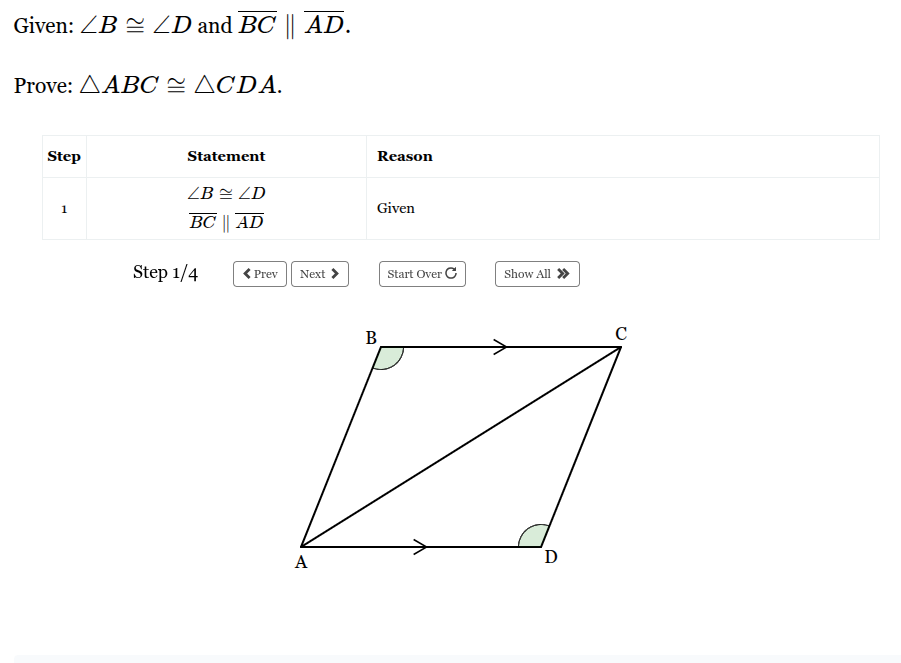
Fill out the rest of the statement/reason table to prove the triangles are similar
Step | Statement | Reason |
1 | ∠B≅∠D BC∥AD | Given |
2 | ∠BCA≅∠DAC | Alternate interior angles are congruent when lines are parallel. |
3 | CA≅AC | Reflexive Property |
4 | △ABC≅△CDA | AAS |
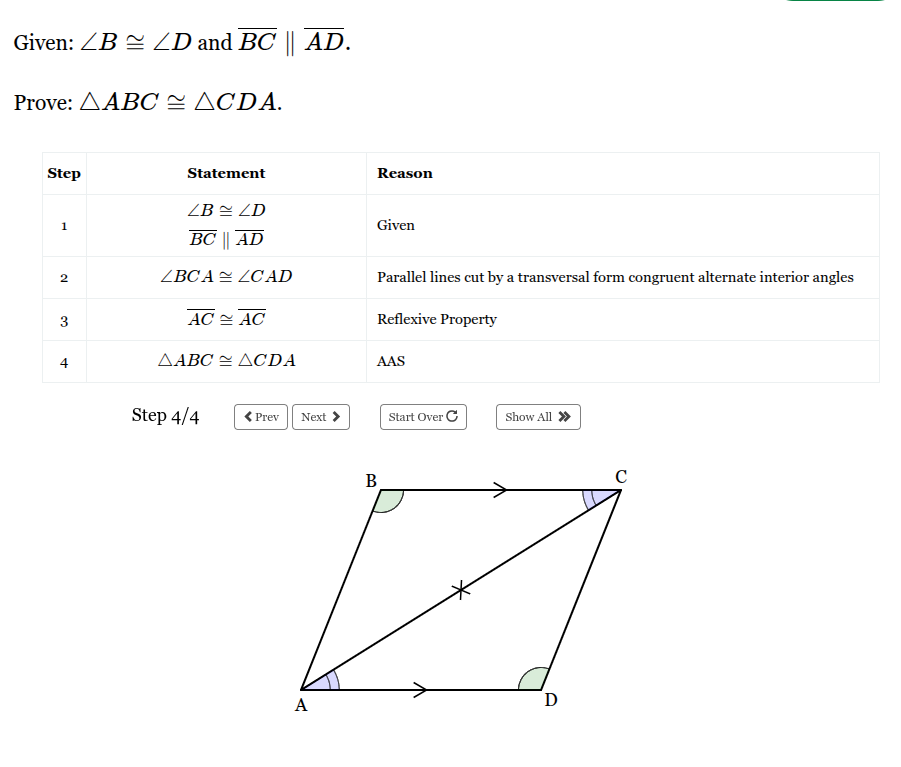
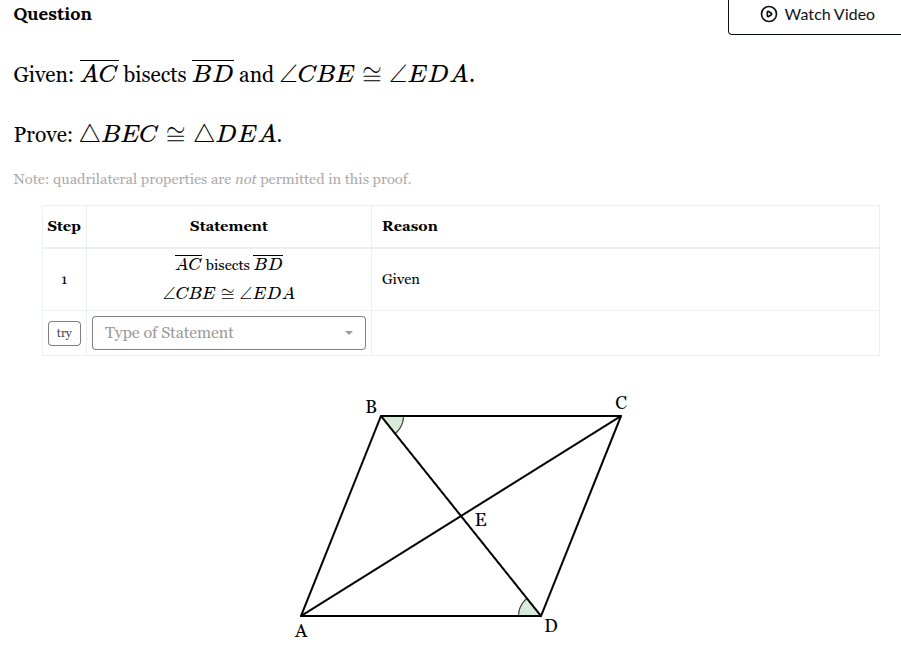
Fill out the rest of the statement/reason table to prove the triangles are similar
Step | Statement | Reason |
1 | AC bisects BD ∠CBE≅∠EDA | Given |
2 | BE≅ED | A segment bisector divides a segment into two congruent segments |
3 | ∠AED≅∠CEB | Vertical angles are congruent |
4 | △BEC≅△DEA | ASA |
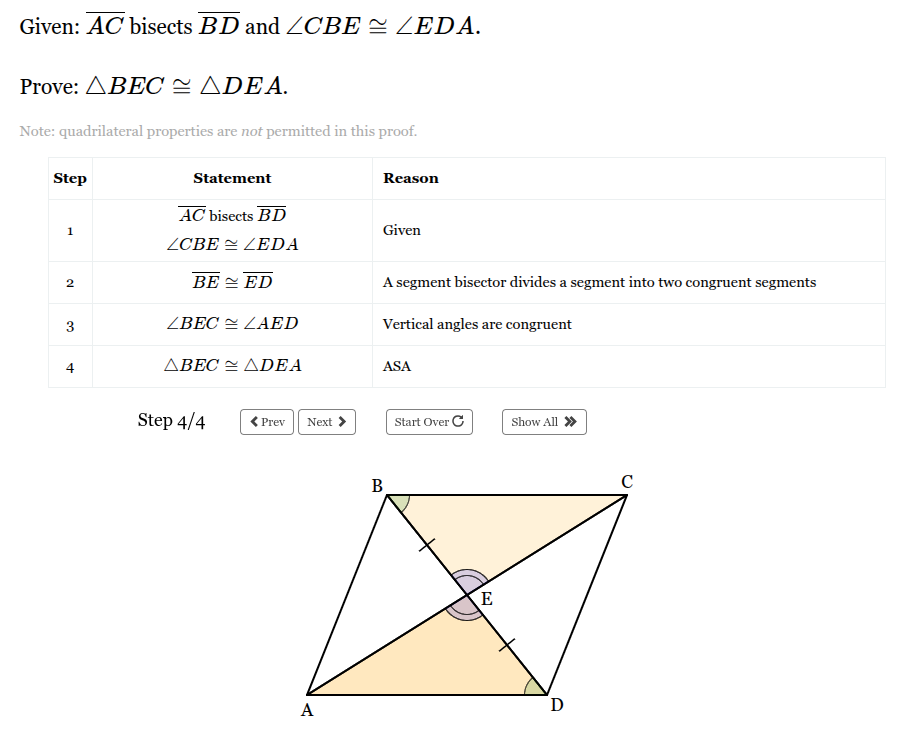
Fill out the rest of the statement/reason table to prove the triangles are similar
Step | Statement | Reason |
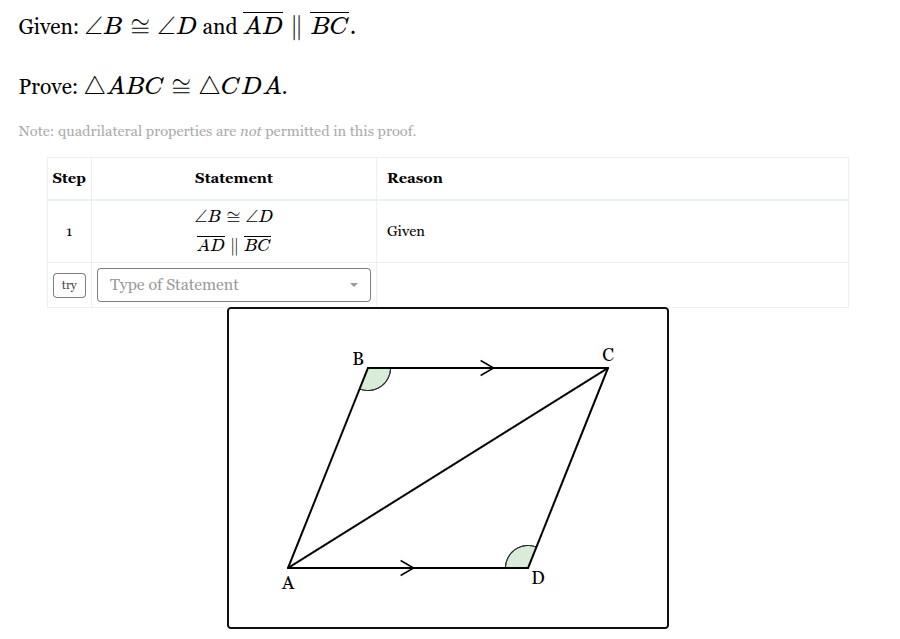
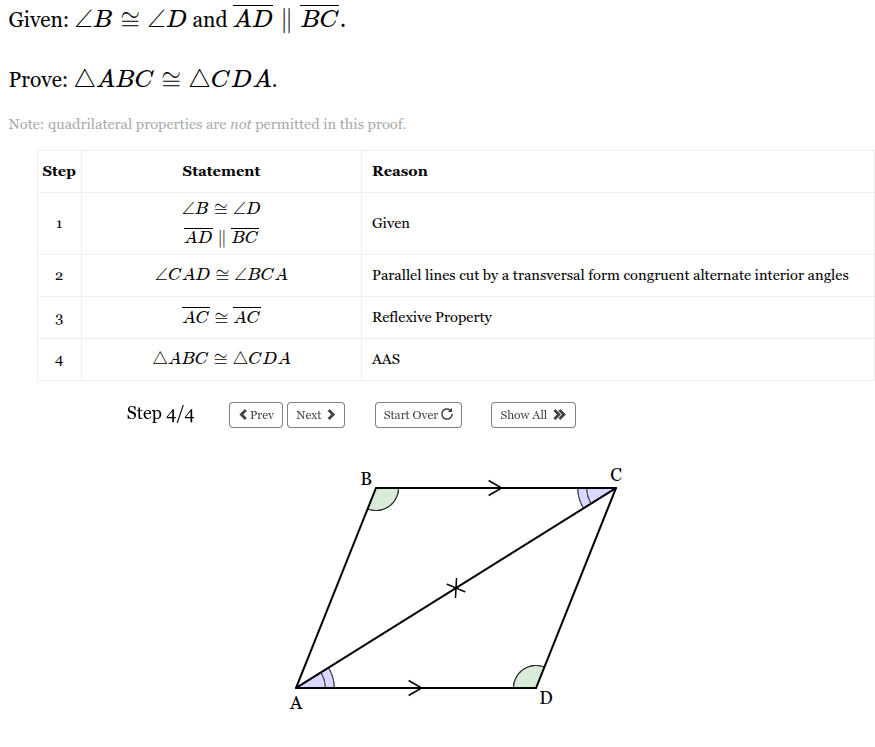
1 | ∠B≅∠D AD∥BC | Given |
2 | ∠BCA≅∠DAC | Alternate interior angles are congruent when lines are parallel. |
3 | CA≅AC | Reflexive Property |
4 | △ABC≅△CDA | AAS |
Fill out the rest of the statement/reason table to prove the triangles are similar
Step | Statement | Reason |
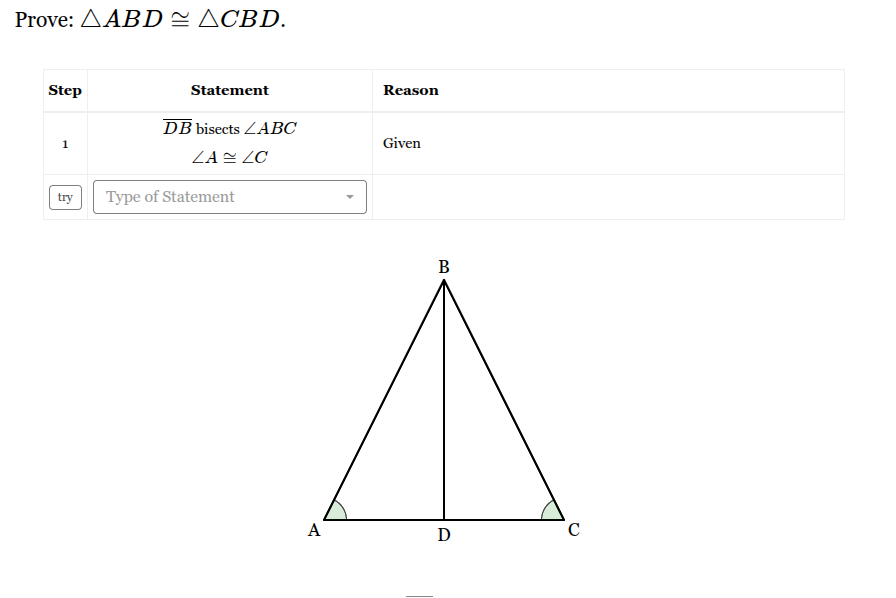
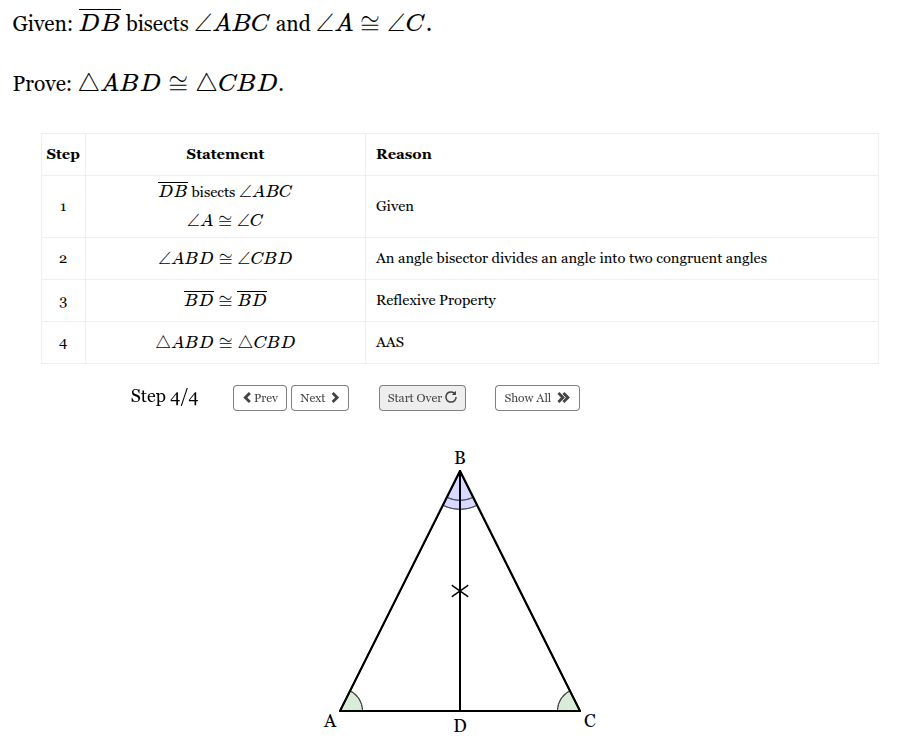
1 | DB bisects ∠ABC ∠A≅∠C | Given |
2 | ∠ABD≅∠CBD | An angle bisector divides an angle into two congruent angles |
3 | BD≅DB | Reflexive Property |
4 | △ABD≅△CBD | AAS |
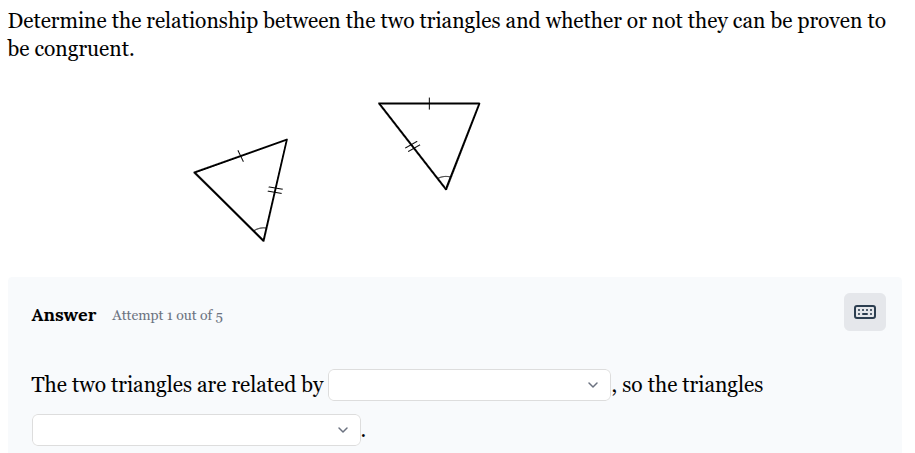
Determine the relationship between the two triangles and whether or not they can be proven to be congruent.
The two triangles are related by _____ , so the triangles ___.
The two triangles are related by Side-Side-Angle (SSA), so the triangles CANNOT be proven congruent.
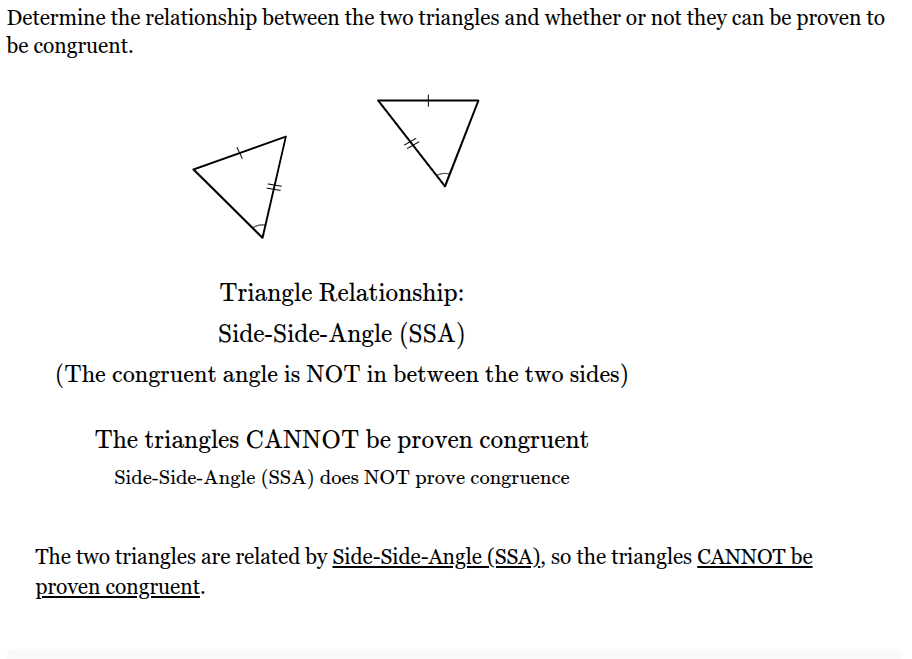
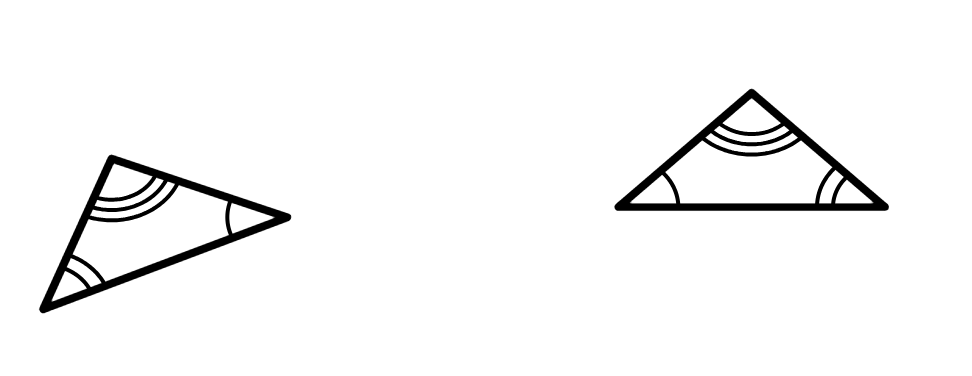
Determine the relationship between the two triangles and whether or not they can be proven to be congruent.
The two triangles are related by _____ , so the triangles ___.
The two triangles are related by Angle-Angle-Angle (AAA), so the triangles CANNOT be proven congruent.
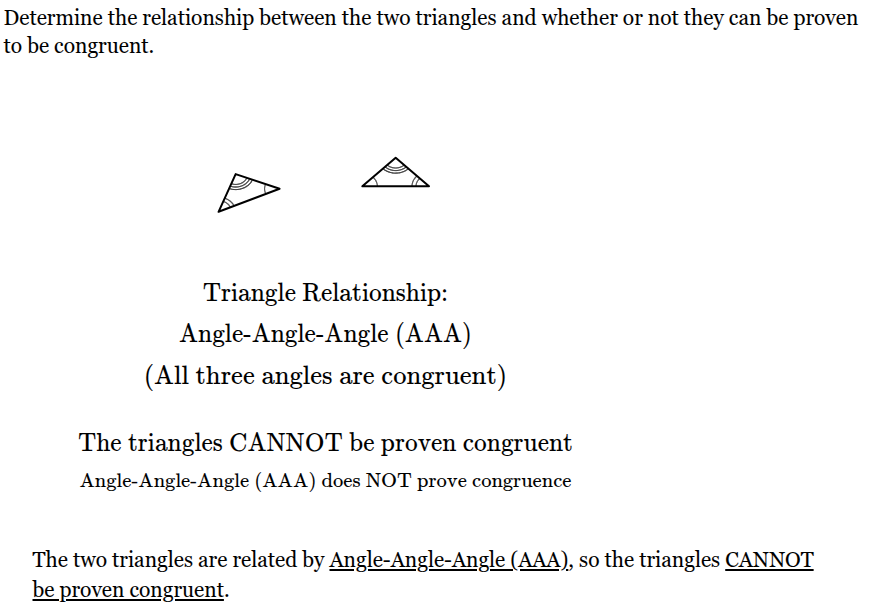
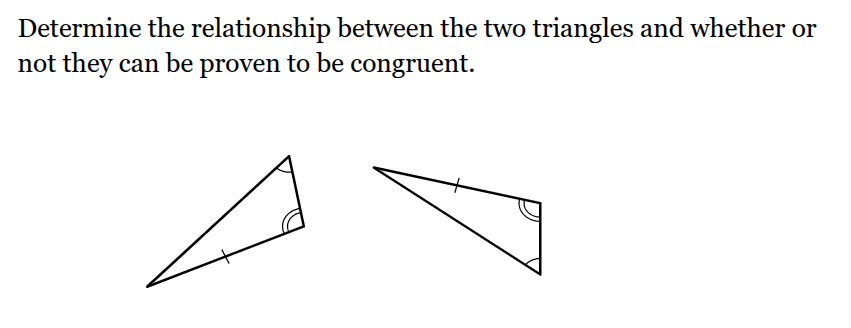
Determine the relationship between the two triangles and whether or not they can be proven to be congruent.
The two triangles are related by _____ , so the triangles ___.
The two triangles are related by Angle-Angle-Side (AAS), so the triangles can be proven congruent.
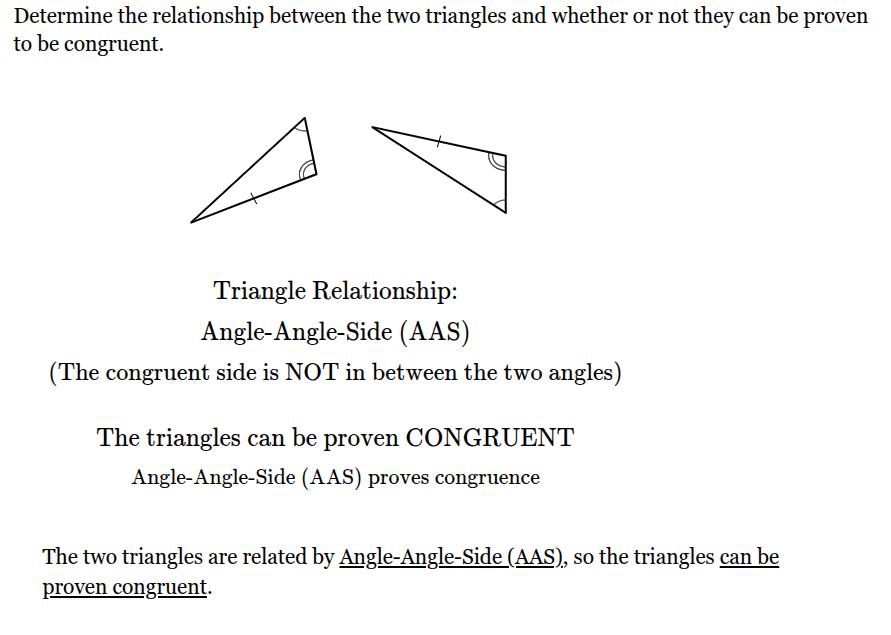
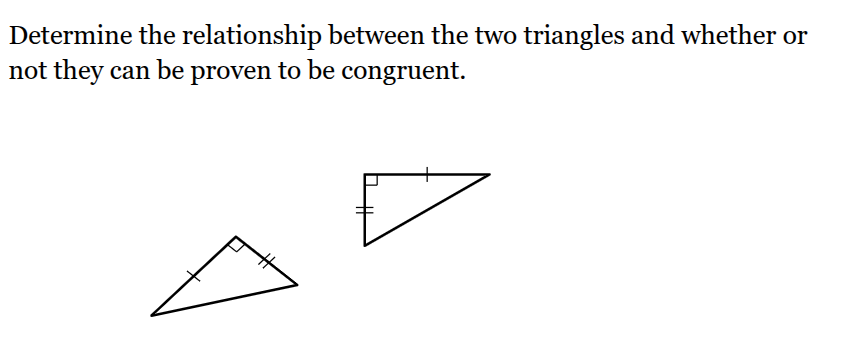
Determine the relationship between the two triangles and whether or not they can be proven to be congruent.
The two triangles are related by _____ , so the triangles ___.
The two triangles are related by Side-Angle-Side (SAS), so the triangles can be proven congruent.
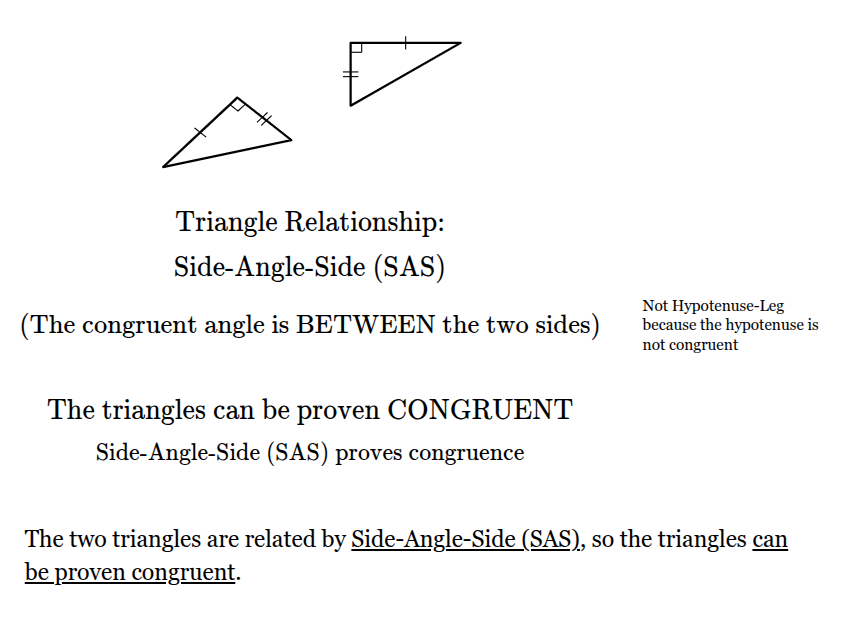
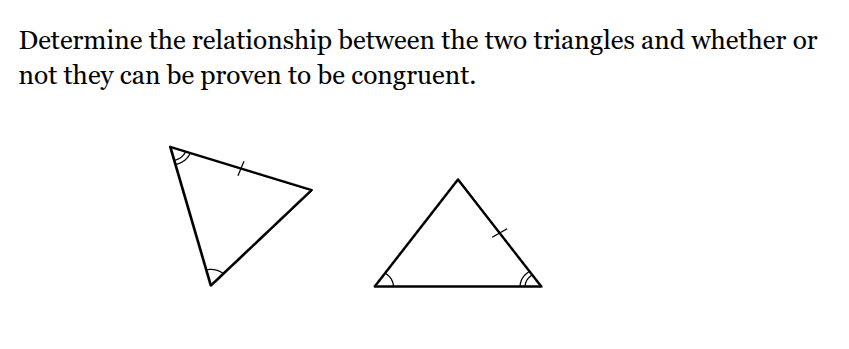
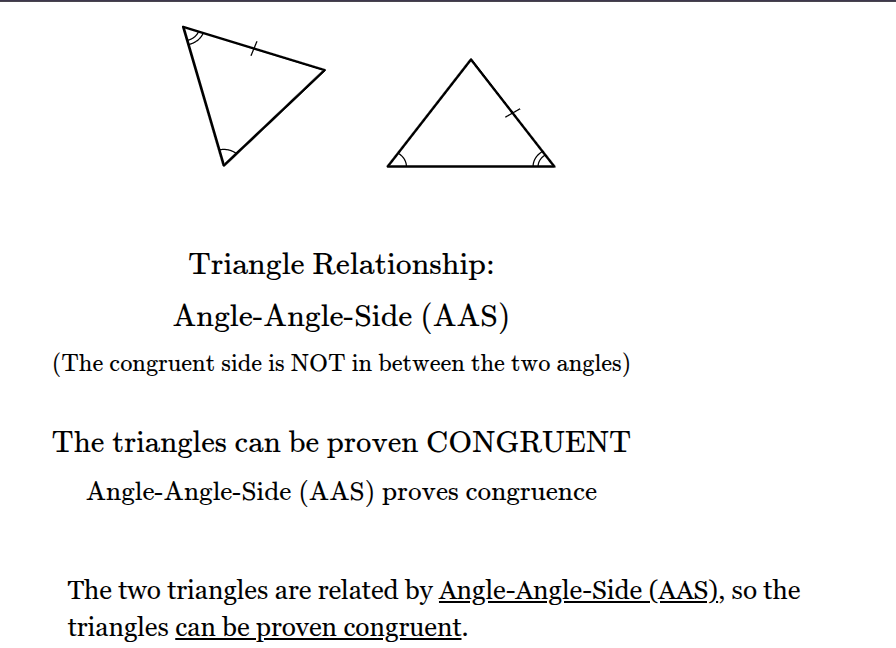
Determine the relationship between the two triangles and whether or not they can be proven to be congruent.
The two triangles are related by _____ , so the triangles ___.
The two triangles are related by Angle-Angle-Side (AAS), so the triangles can be proven congruent.
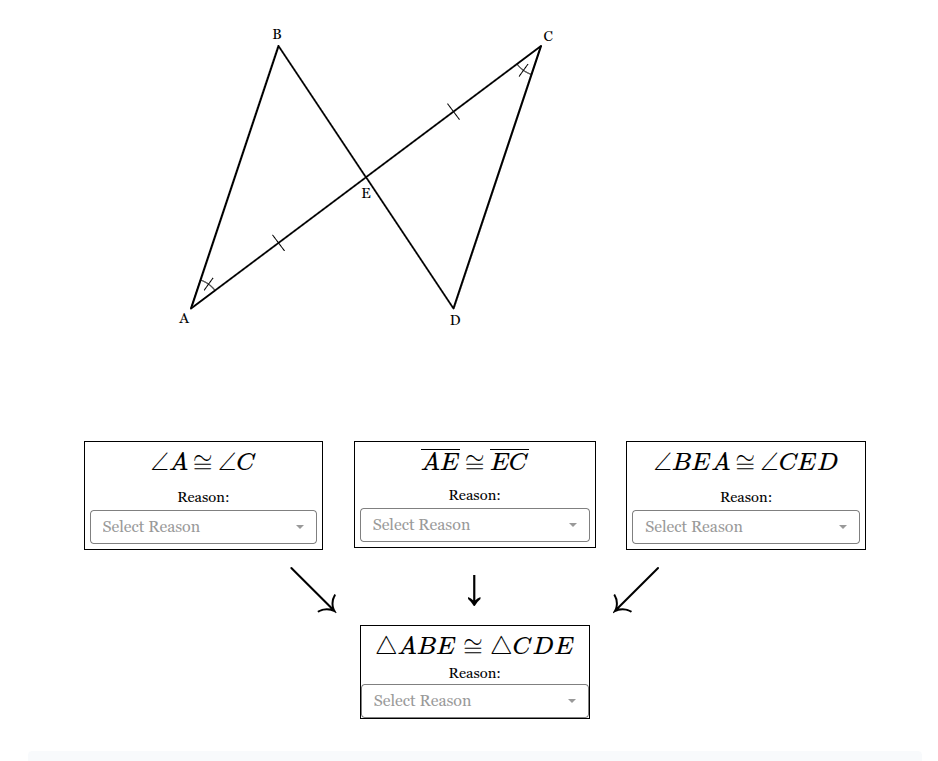
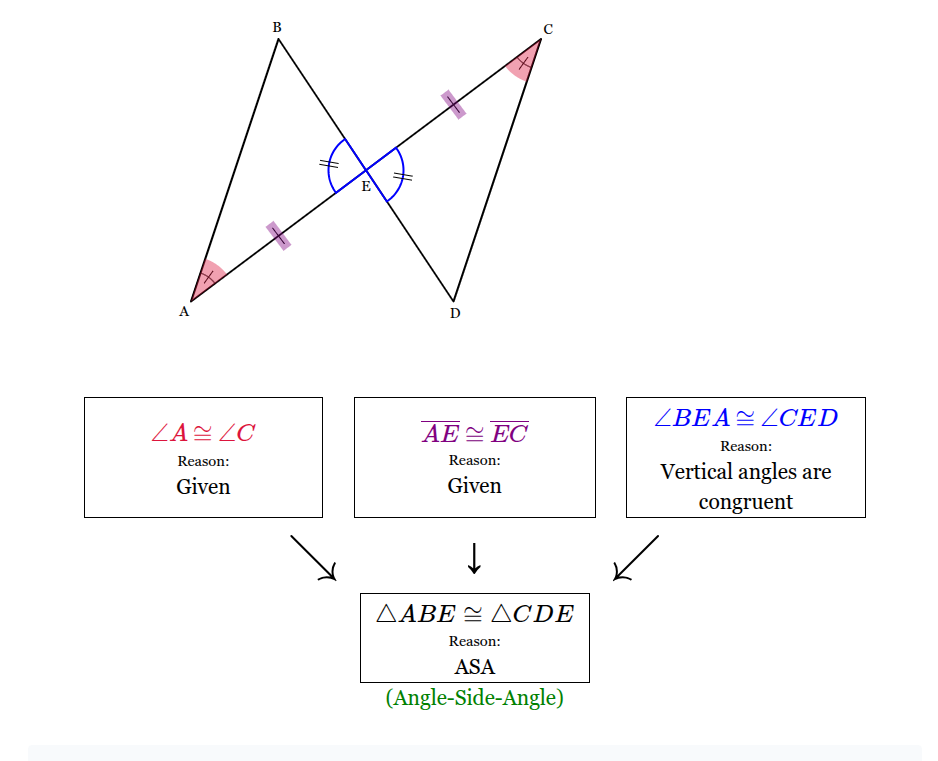
Based on the given diagram, complete the flowchart proof below.
Reason: Given,
Reason: Given,
Reason: Vertical angles are congruent,
Reason: ASA
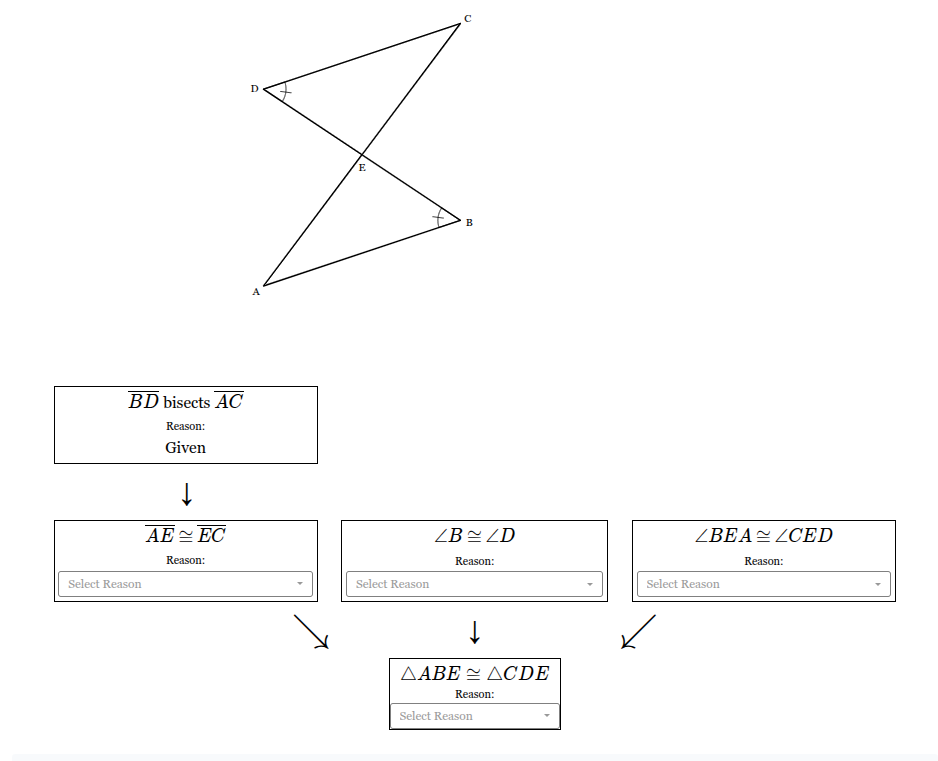
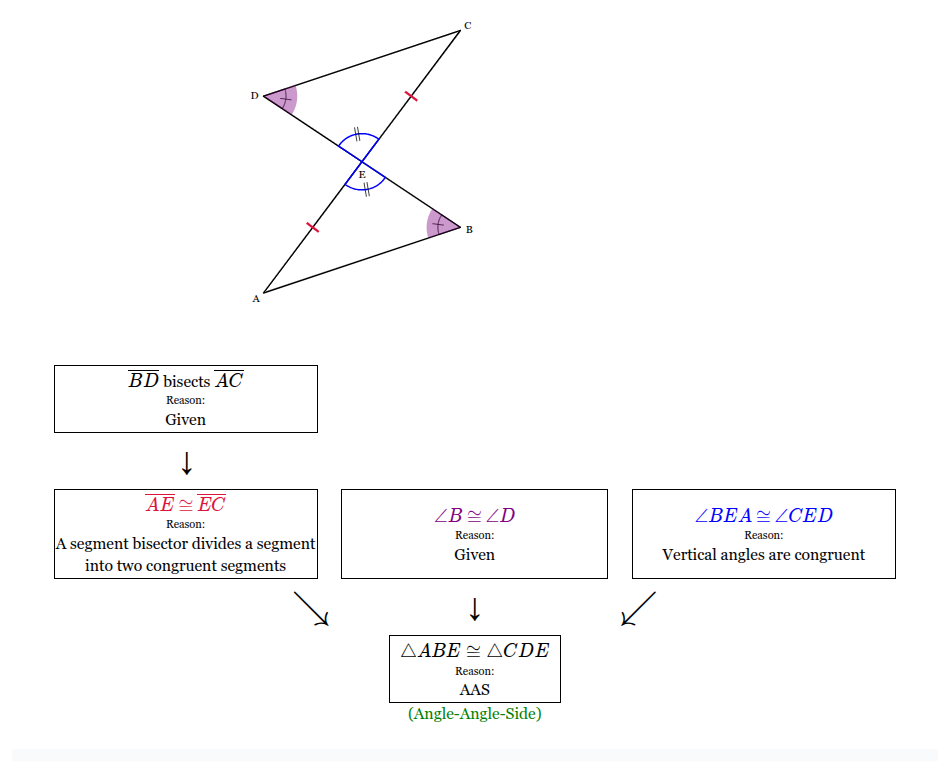
Given BD bisects AC, complete the flowchart proof below.
Reason: A segment bisector divides a segment into two congruent segments,
Reason: Given,
Reason: Vertical angles are congruent,
Reason: AAS
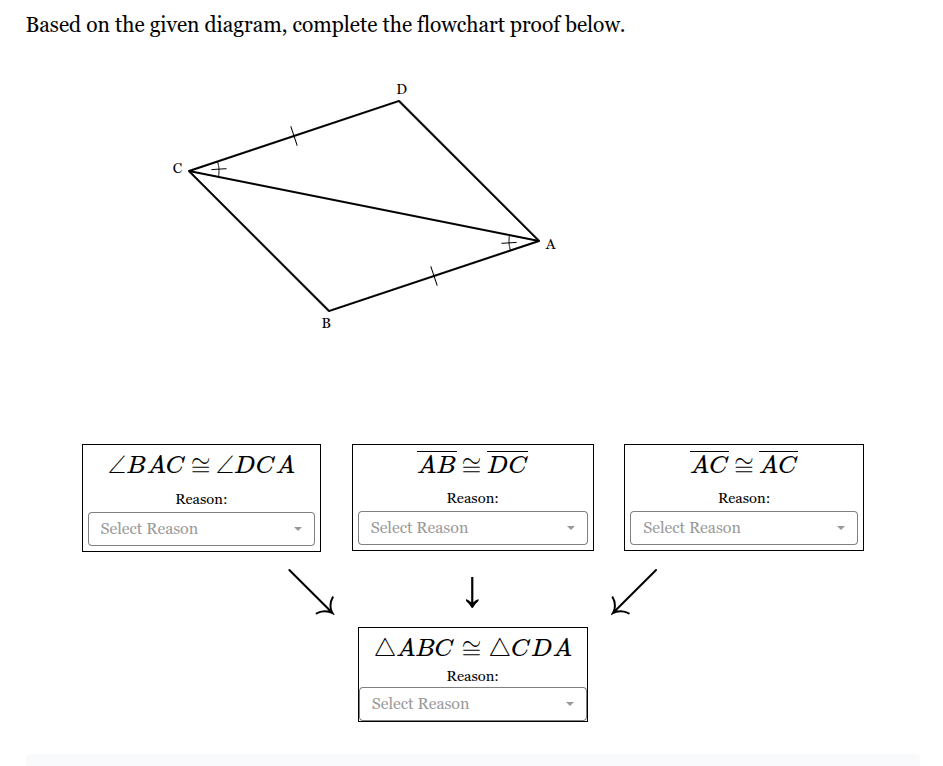
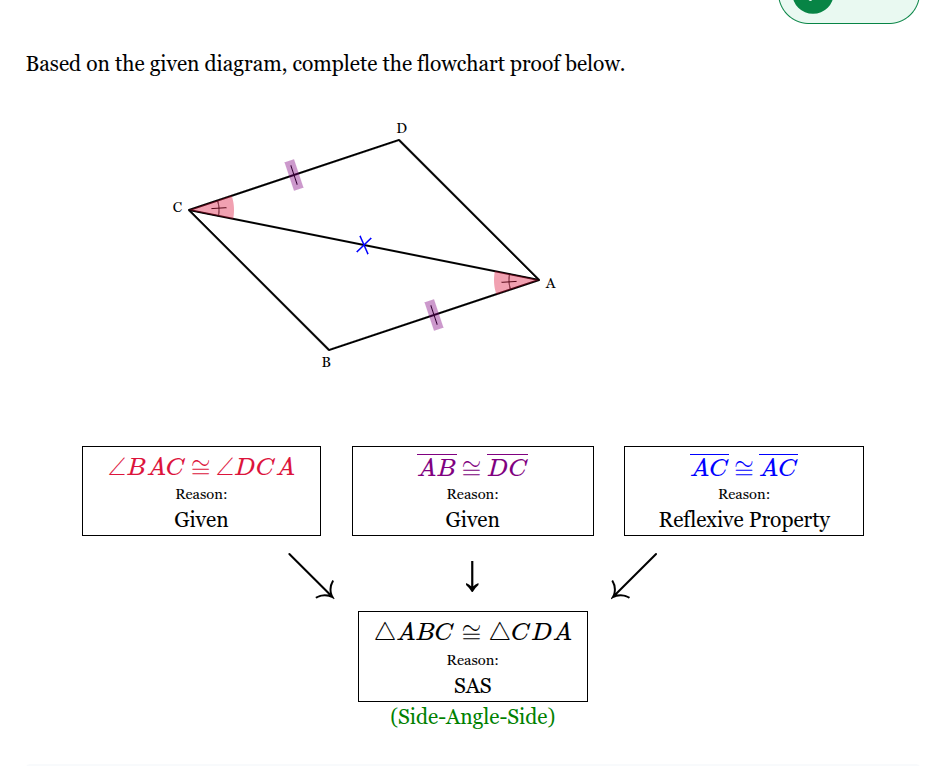
Based on the given diagram, complete the flowchart proof below.
Reason: Given,
Reason: Given,
Reason: Reflexive Property,
Reason: SAS,
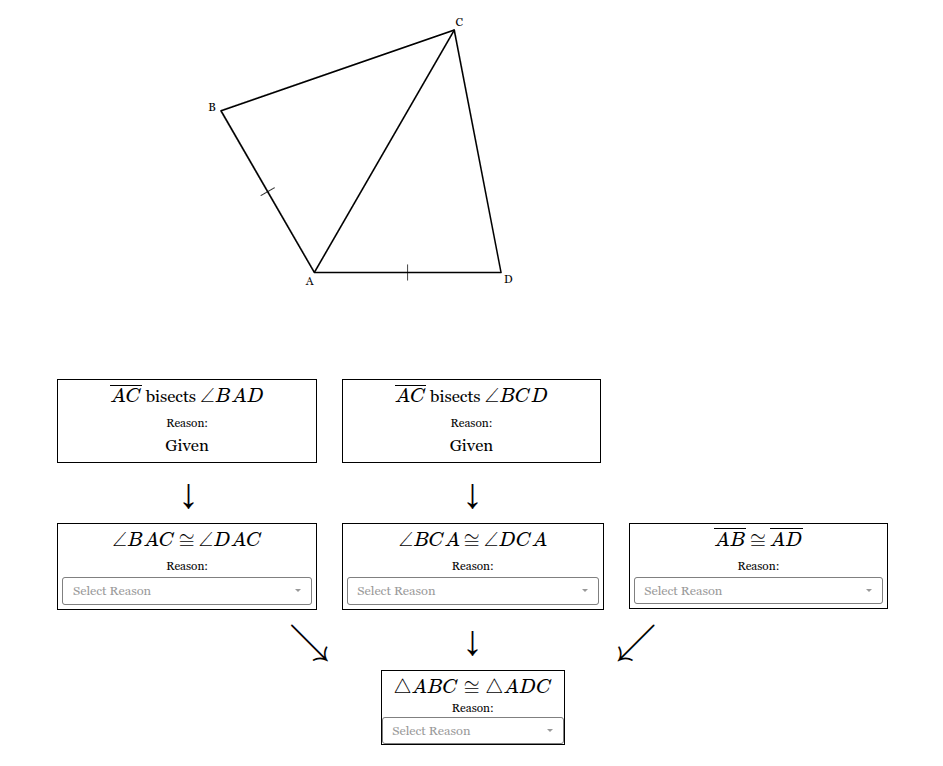
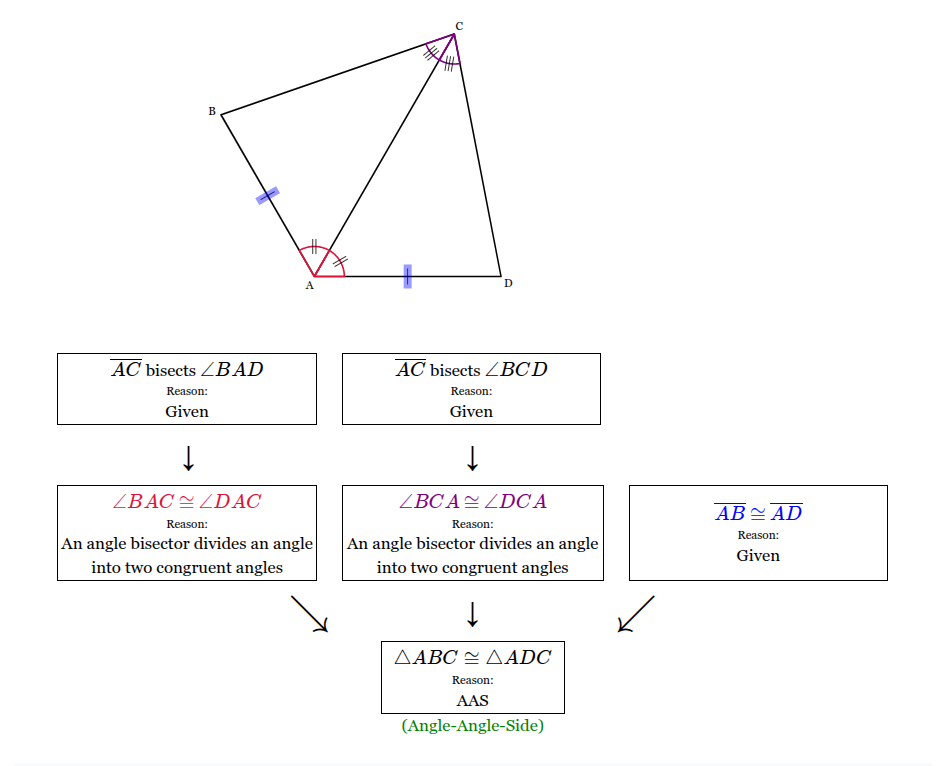
Given AC is the angle bisector of ∠BAD and ∠BCD, complete the flowchart proof below.
Reason: An angle bisector divides an angle into two congruent angles,
Reason: An angle bisector divides an angle into two congruent angles,
Reason: Given,
Reason: AAS
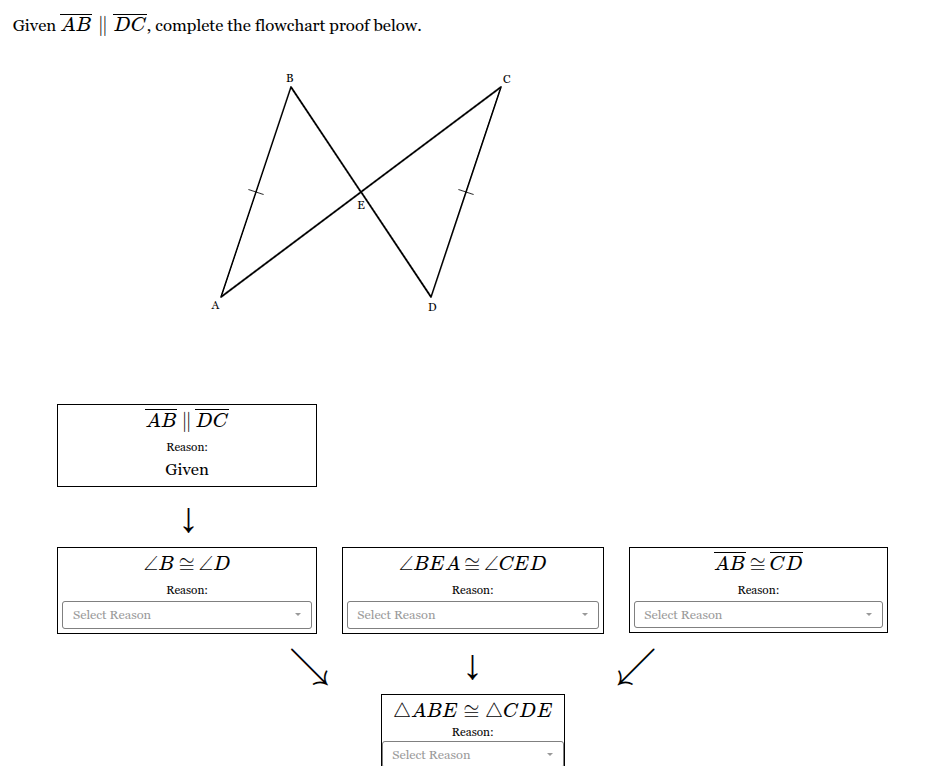
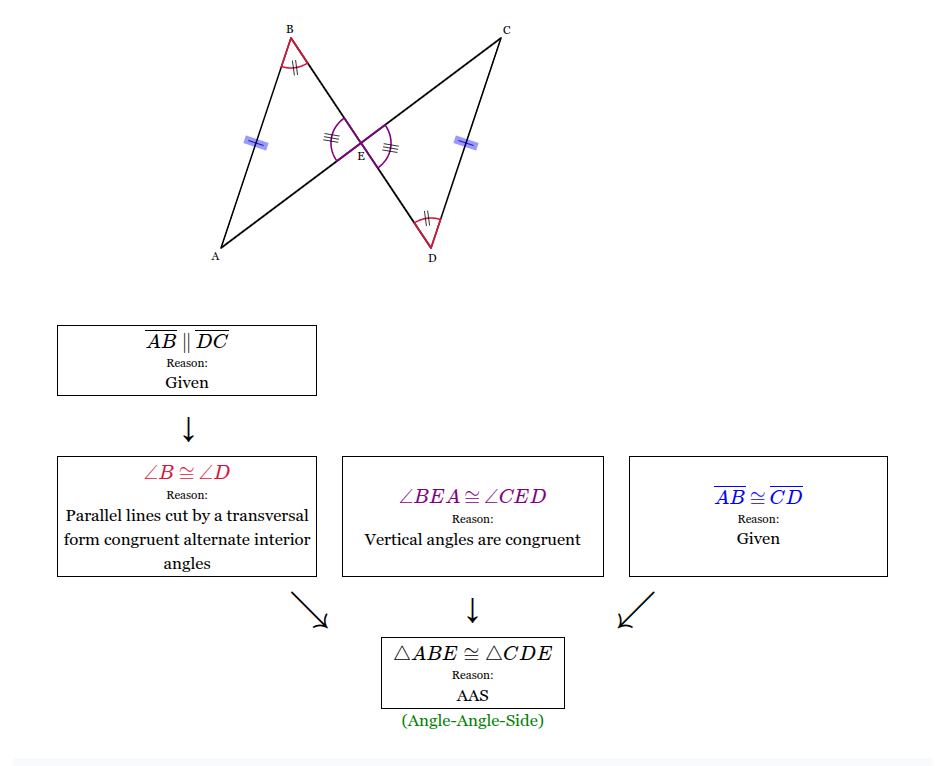
Given AB∥DC, complete the flowchart proof below.
Reason: Alternate interior angles are congruent when lines are parallel.
Reason: Vertical angles are congruent.
Reason: Given
Reason: AAS
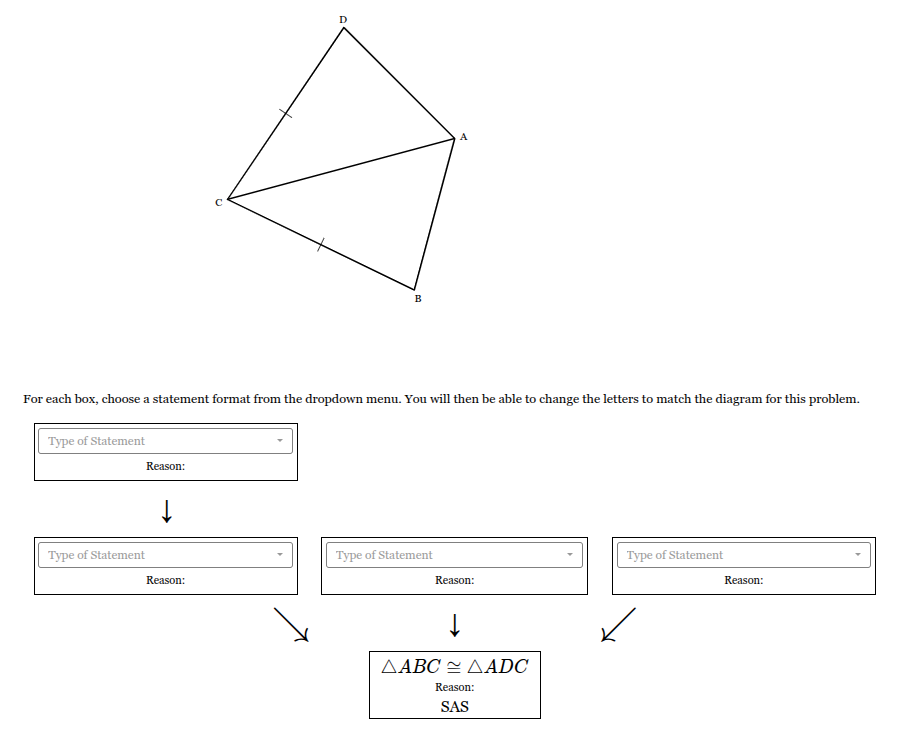
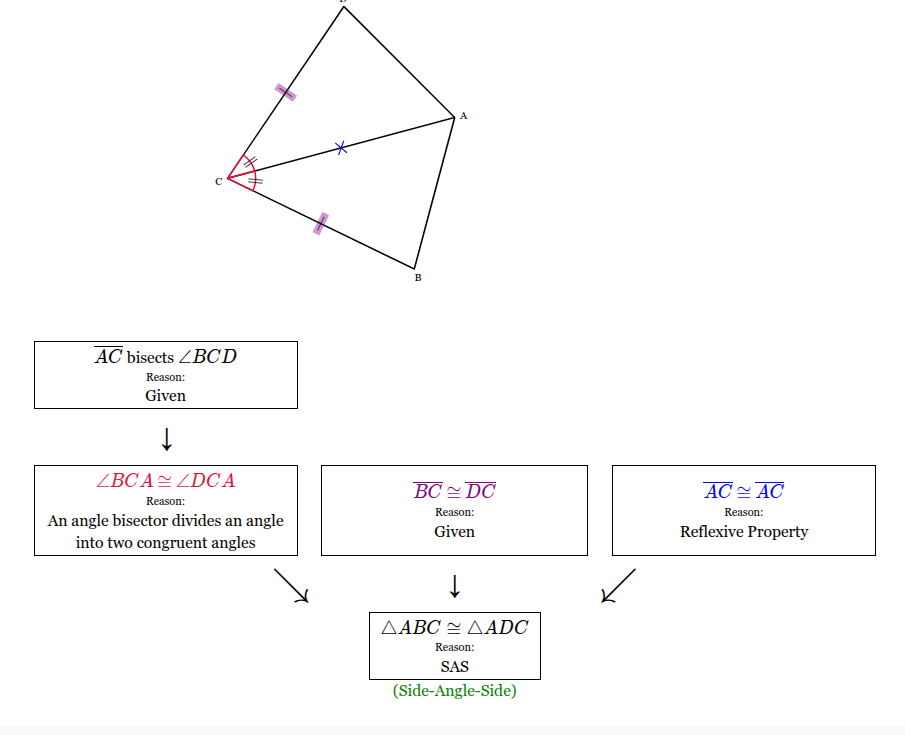
Given AC bisects ∠BCD, complete the flowchart proof below. Note that the last statement and reason have both been filled in for you.
AC bisects ∠BCD Reason: Given
∠BCA ≅ ∠DCA Reason: An angle bisector divides an angle into two congruent angles
BC ≅ DC Reason: Given
AC ≅ AC Reason: Reflexive Property
△ABC≅△ADC Reason: SAS
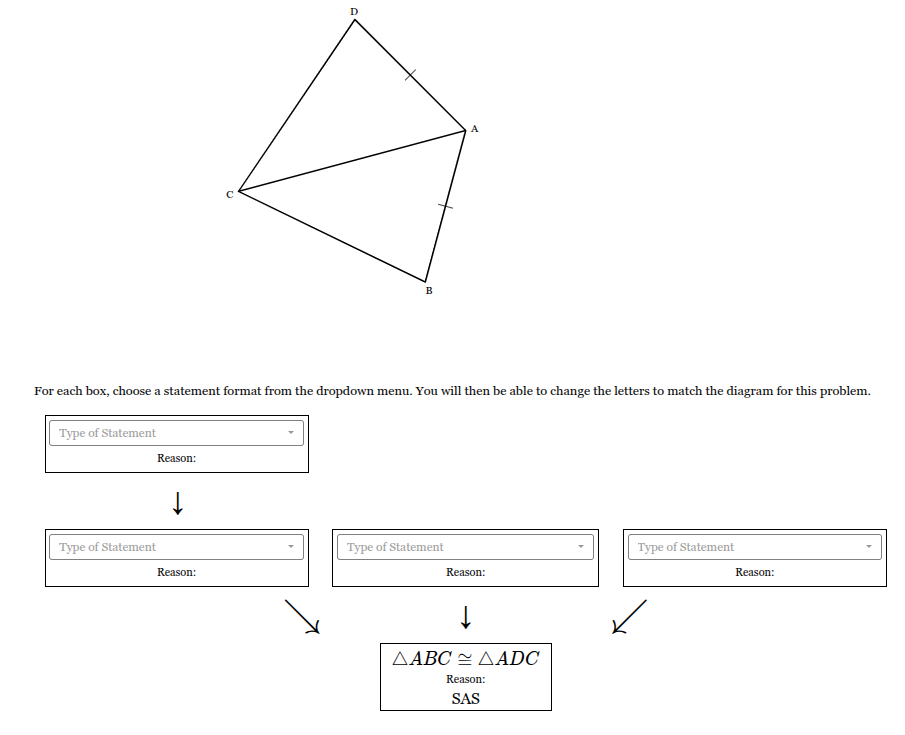
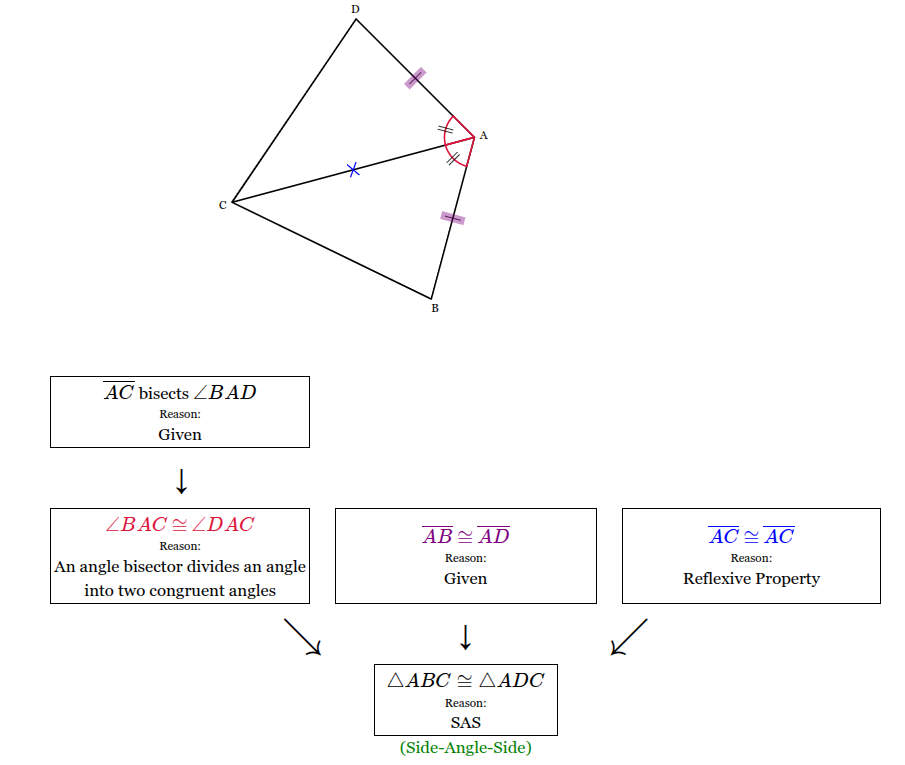
Given AC is the angle bisector of ∠BAD, complete the flowchart proof below. Note that the last statement and reason have both been filled in for you.
AC bisects ∠BAD Reason: Given
∠BAC ≅ ∠DAC Reason: An angle bisector divides an angle into two congruent angles
AB ≅ AD Reason: Given
AC ≅ AC Reason: Reflexive Property
△ABC≅△ADC Reason: SAS
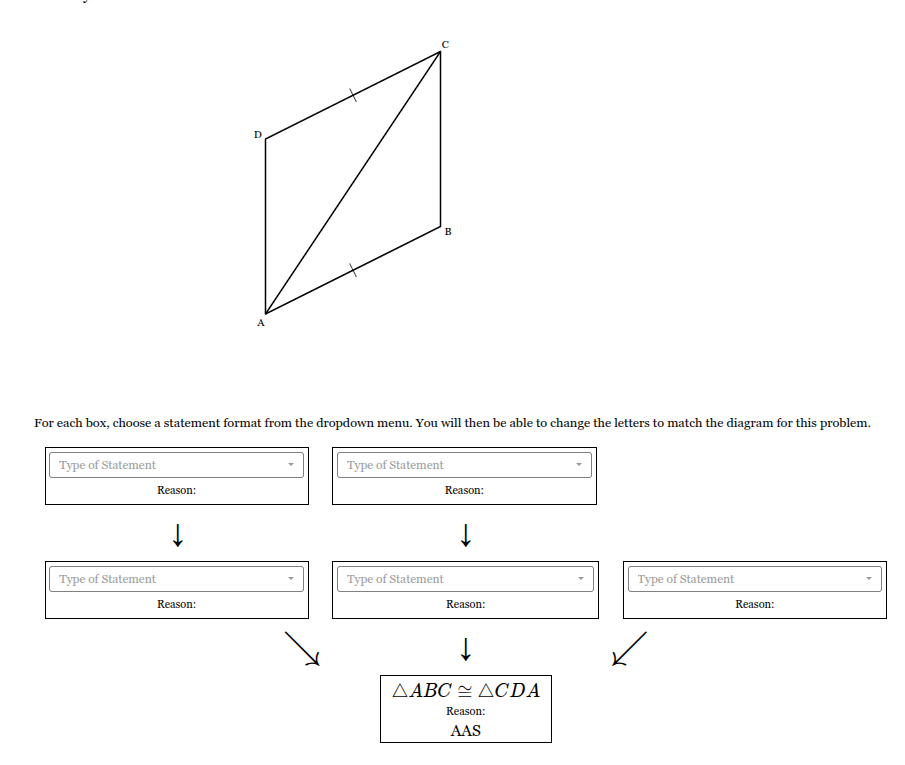
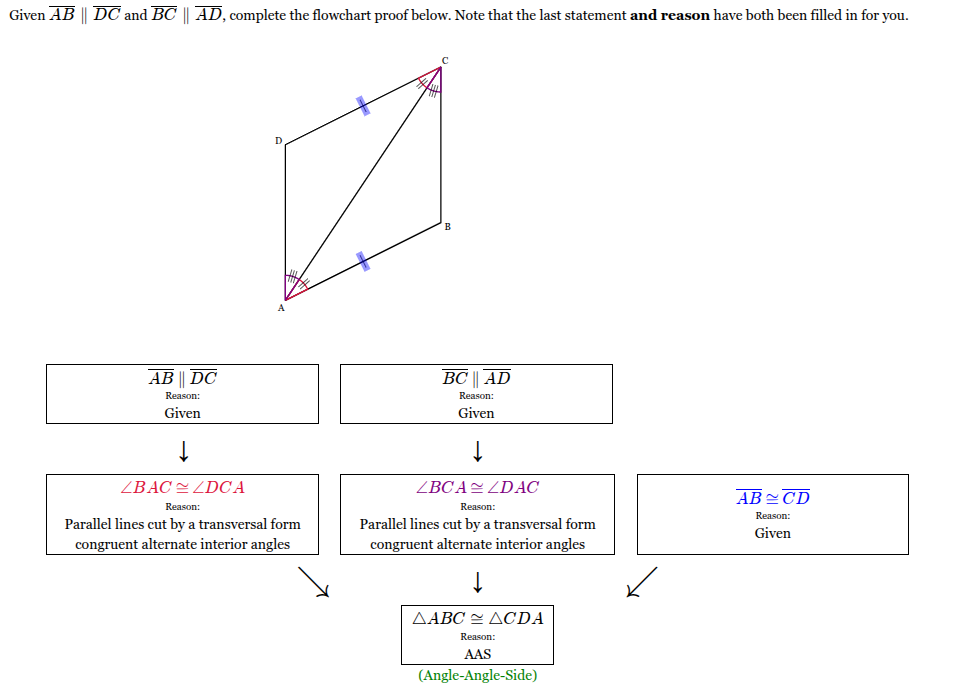
Given AB∥DC and BC∥AD, complete the flowchart proof below. Note that the last statement and reason have both been filled in for you
AB ∥ DC Reason: Given
∠BAC ≅ ∠DCA Reason: Parallel lines cut by a transversal form congruent alternate interior angles
BC ∥ AD Reason: Given
∠BCA ≅ ∠DAC Reason: Parallel lines cut by a transversal form congruent alternate interior angles
AB ≅ CD Reason: Given
△ABC≅△CDA Reason: AAS
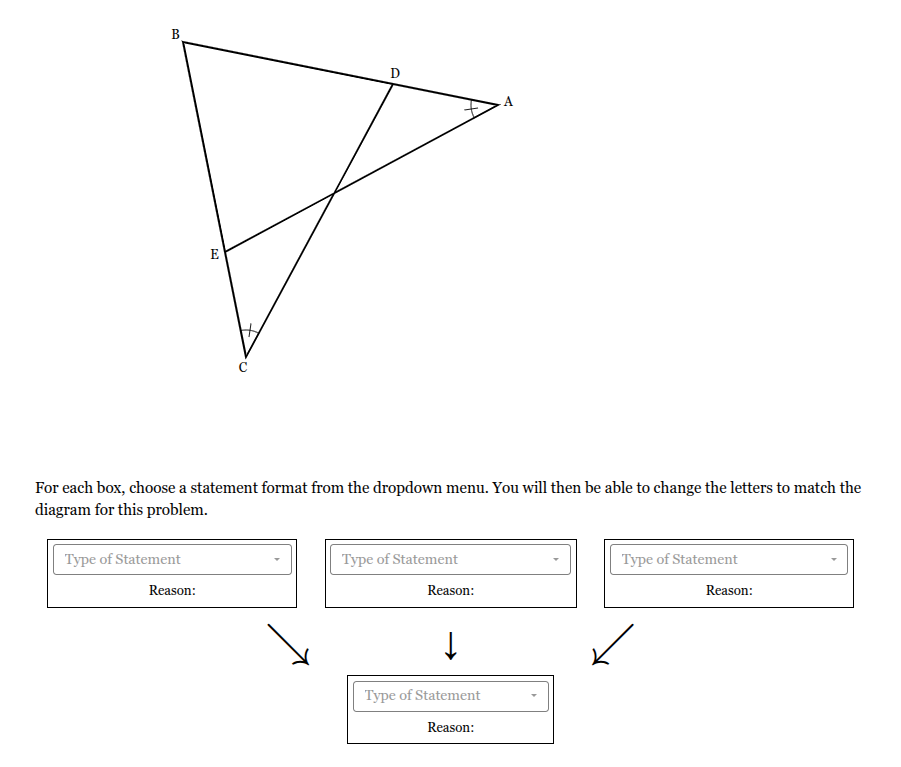
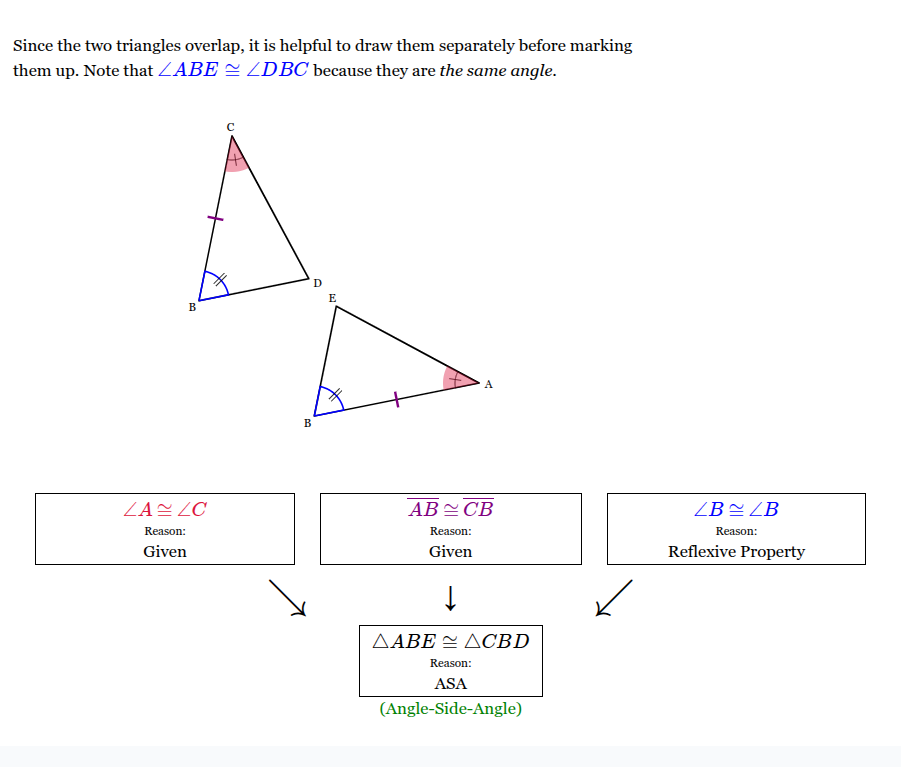
Given AB≅CB, prove △ABE≅△CBD by filling out the flowchart below.
∠A ≅ ∠C Reason: `Given
AB ≅ CB Reason: Given
∠B ≅ ∠B Reason: Reflexive Property
△ABE≅△CBD Reason: ASA
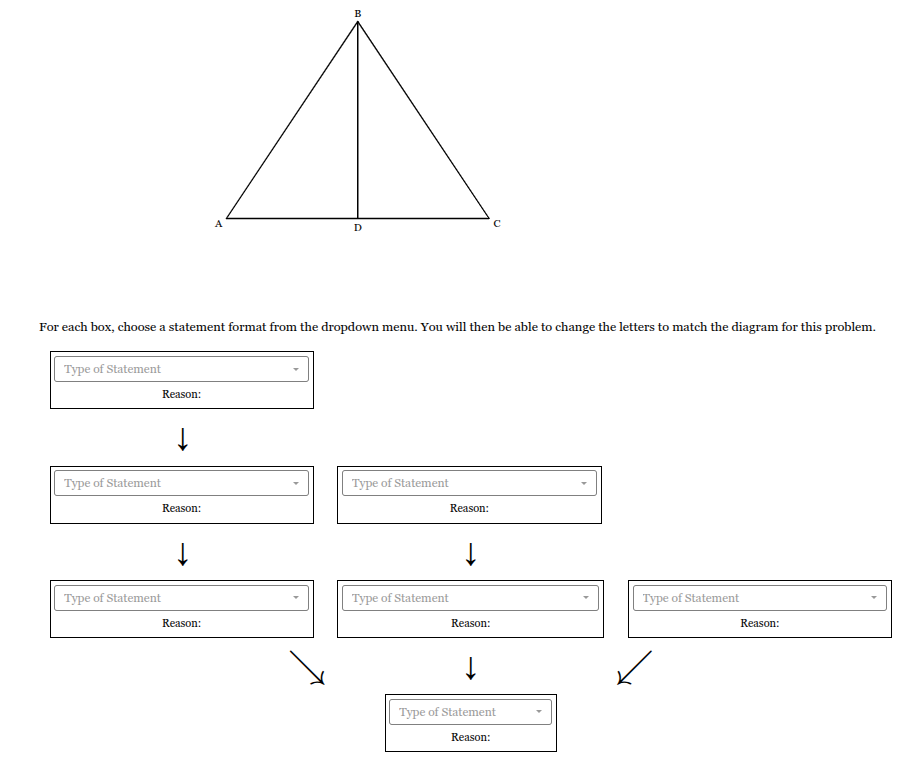
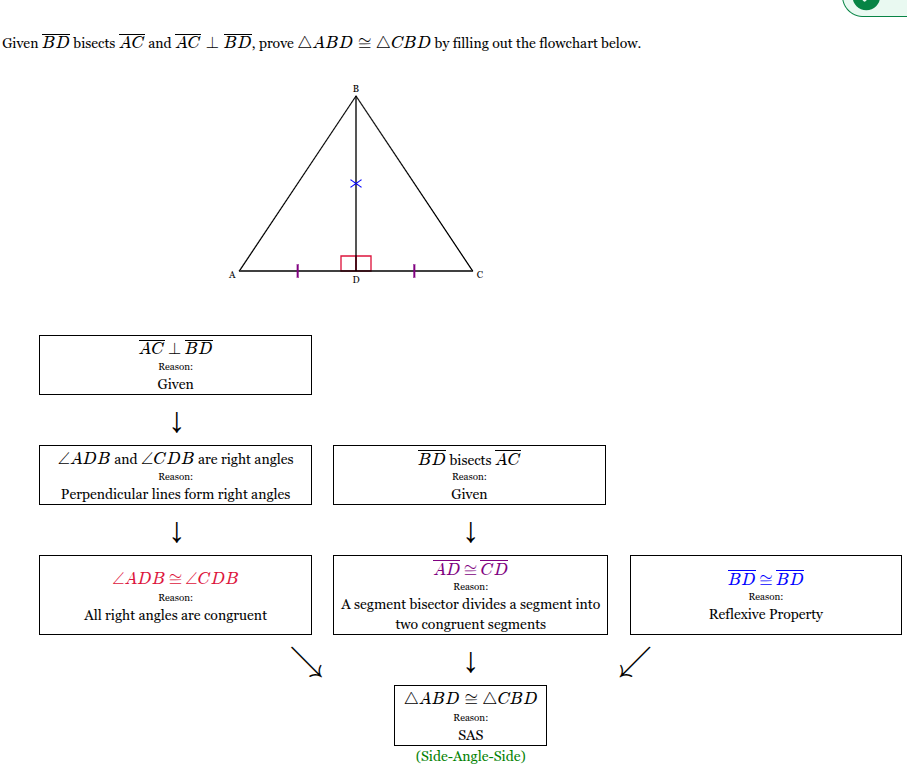
Given BD bisects AC and AC⊥BD, prove △ABD≅△CBD by filling out the flowchart below.
AC ⊥ BD Reason: Given
∠ADB and ∠CDB are right angles Reason: Perpendicular lines form right angles
∠ADB ≅ ∠CDB Reason: All right angles are congruent
BD bisects AC Reason: Given
AD ≅ CD Reason: A segment bisector divides a segment into two congruent segment
BD ≅ BD Reason: Reflexive Property
△ABD≅△CBD Reason: SAS
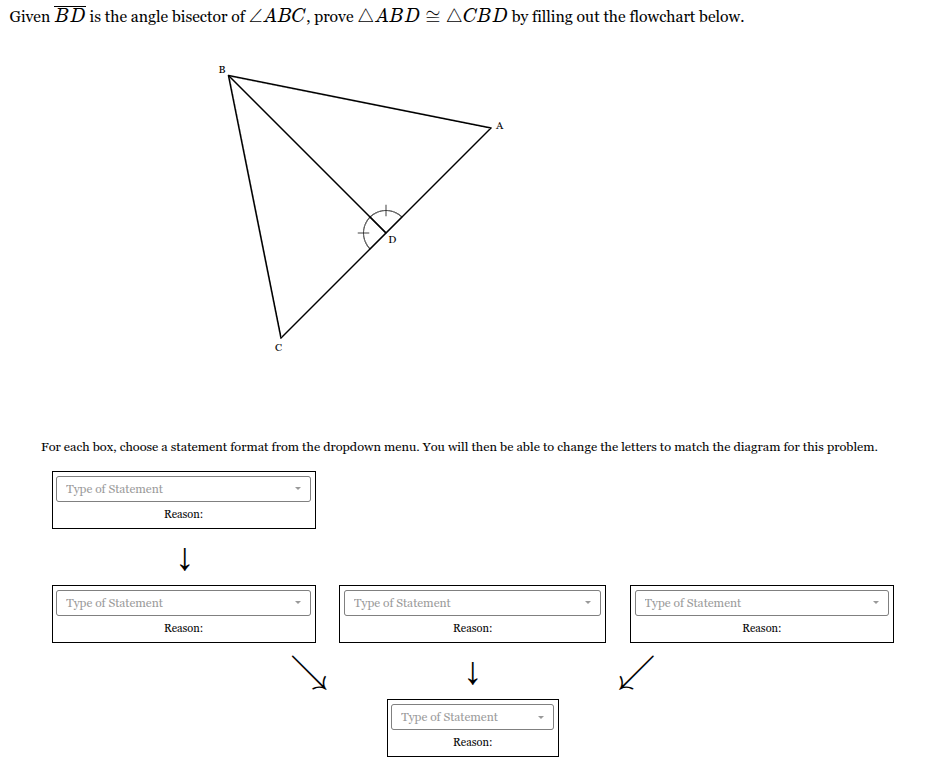
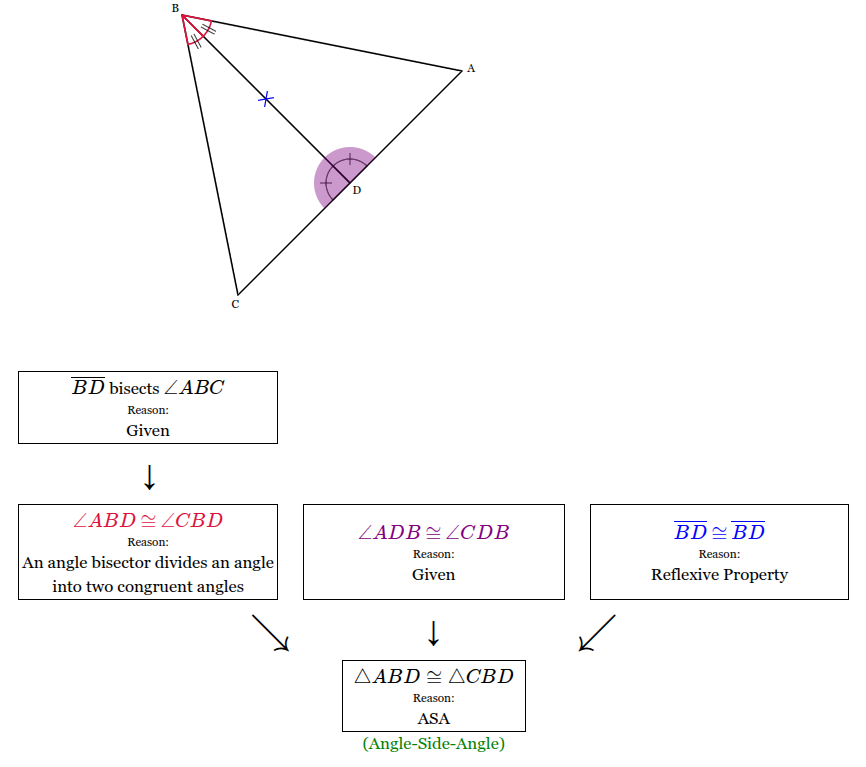
Given BD is the angle bisector of ∠ABC, prove △ABD≅△CBD by filling out the flowchart below.
BD bisects ∠ABC Reason: Given
∠ABD ≅ ∠CBD Reason: An angle bisector divides an angle into two congruent angles
∠ADB ≅ ∠CDB Reason: Given
BD ≅ BD Reason: Reflexive Property
△ABD≅△CBD Reason: ASA
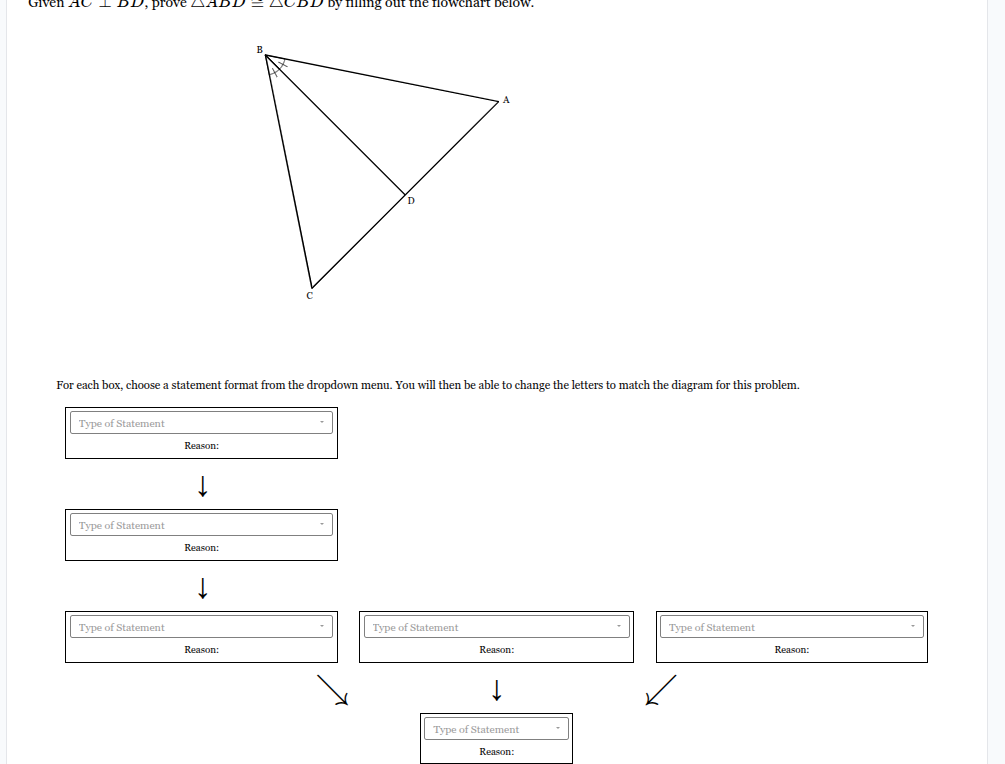
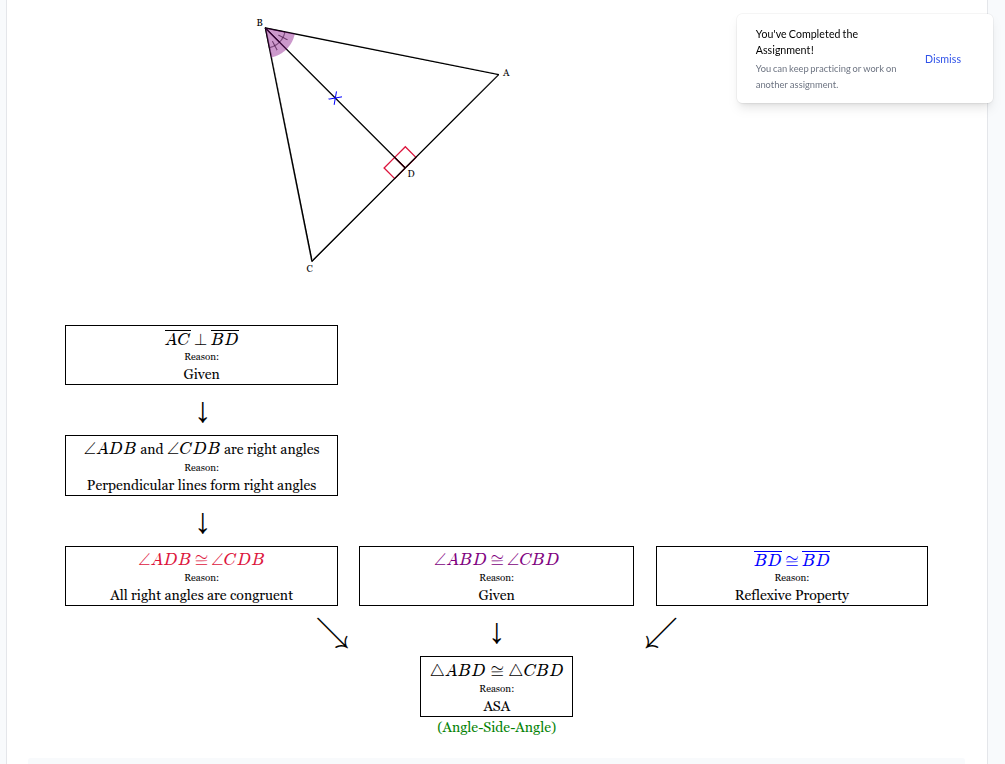
Given AC⊥BD, prove △ABD≅△CBD by filling out the flowchart below.
AC ⊥ BD Reason: Given
∠ADB and ∠CDB are right angles Reason: Perpendicular lines form right angles
∠ADB ≅ ∠CDB Reason: All right angles are congruent
∠ABD ≅ ∠CBD Reason: Given
BD ≅ BD Reason: Reflexive Property
△ABD≅△CBD Reason: ASA
Fill out the rest of the statement/reason table to prove the triangles are similar
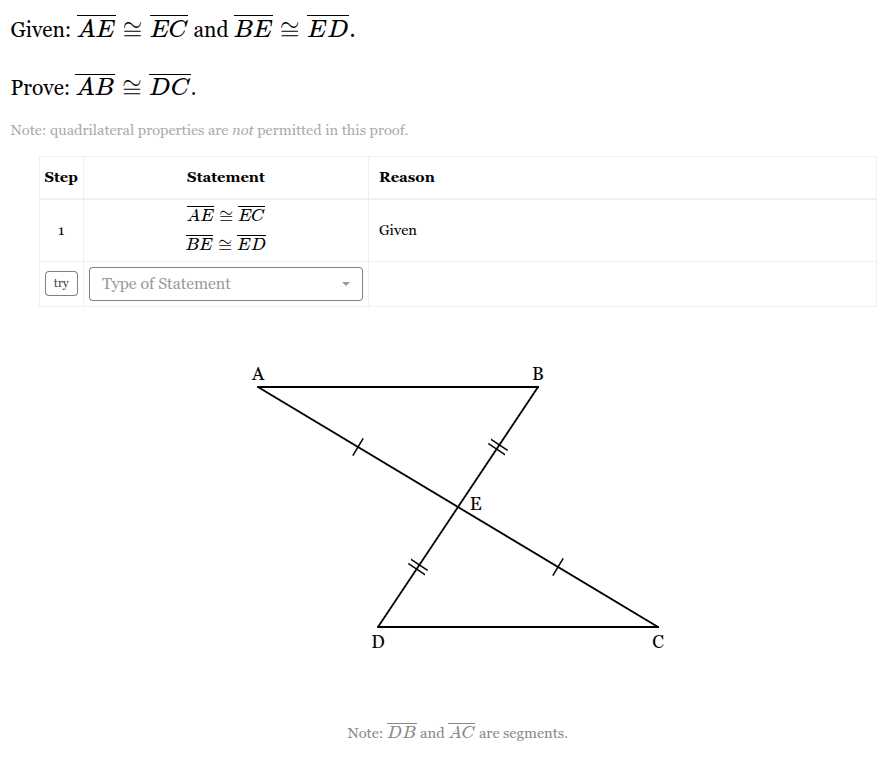
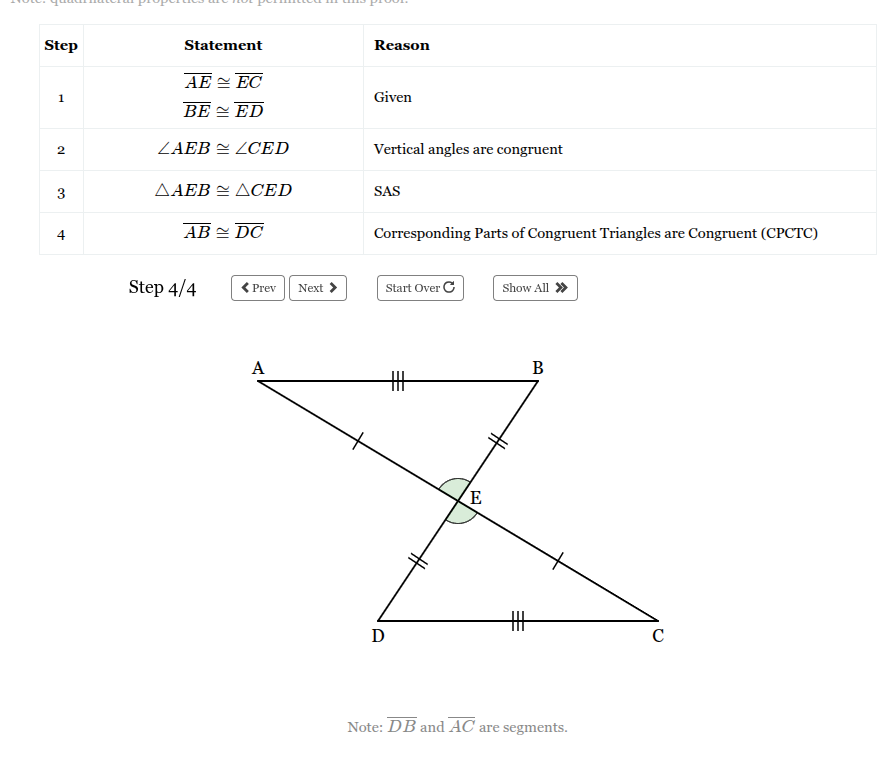
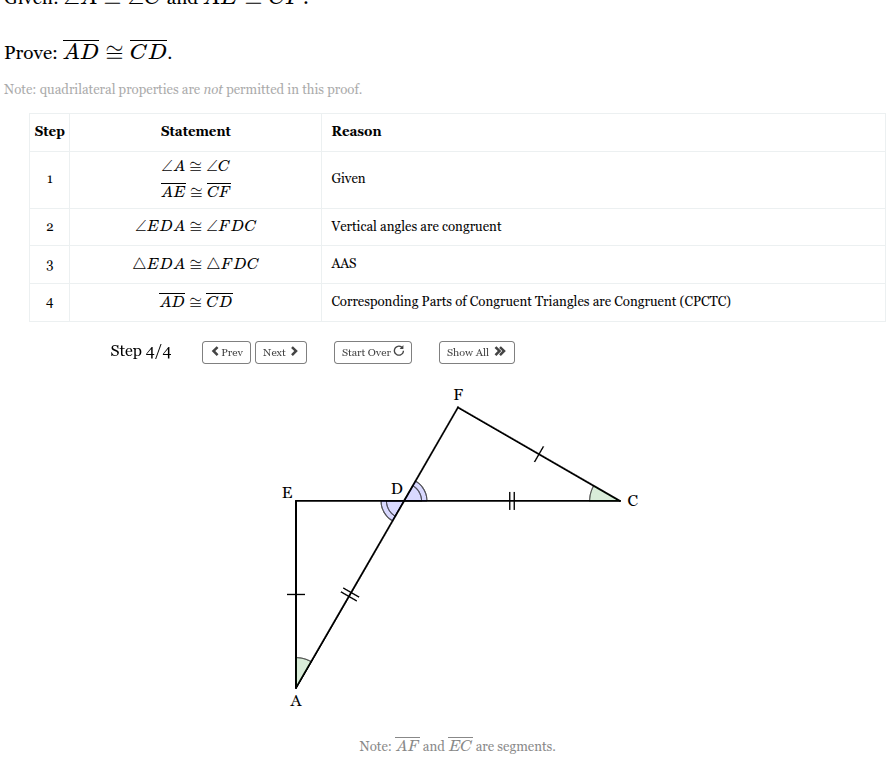
Given: ∠A≅∠C and AE≅CF.
Prove: AD≅CD.
Step | Statement | Reason |
1 | AE≅EC BE≅ED | Given |
2 | ∠AEB≅∠CED | Vertical angles are congruent |
3 | △AEB≅△CED | SAS |
4 | AB≅DC | Corresponding Parts of Congruent Triangles are Congruent (CPCTC) |
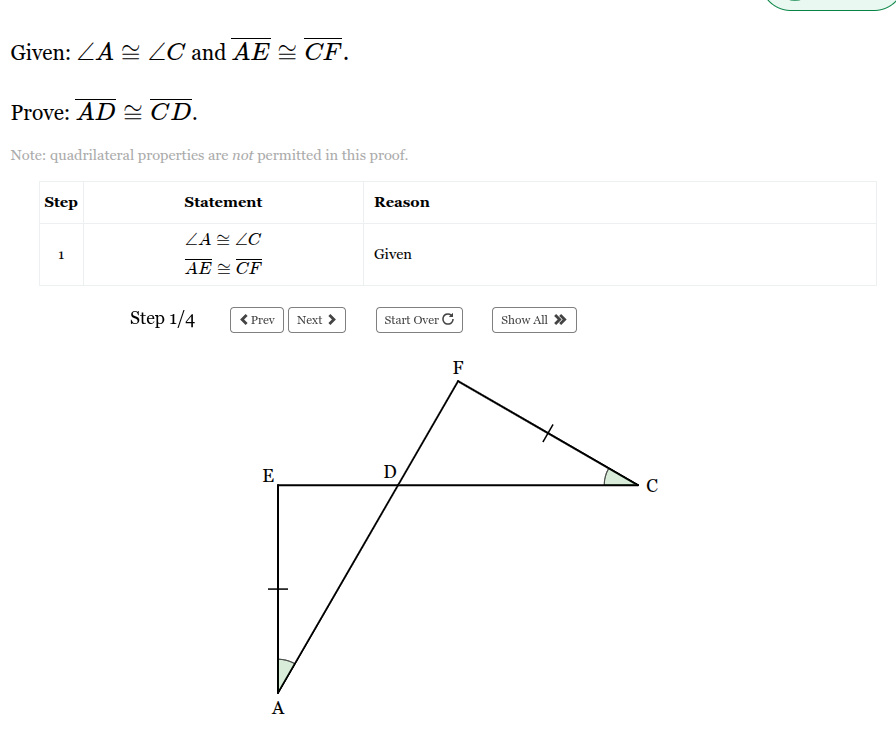
Given: ∠A≅∠C and AE≅CF.
Prove: AD≅CD.
Fill out the rest of the statement/reason table to prove the triangles are similar
Step | Statement | Reason |
1 | ∠A≅∠C AE≅CF | Given |
2 | ∠EDA≅∠FDC | Vertical angles are congruent |
3 | △DFC≅△DEA | AAS |
4 | AD≅CD | Corresponding Parts of Congruent Triangles are Congruent (CPCTC) |
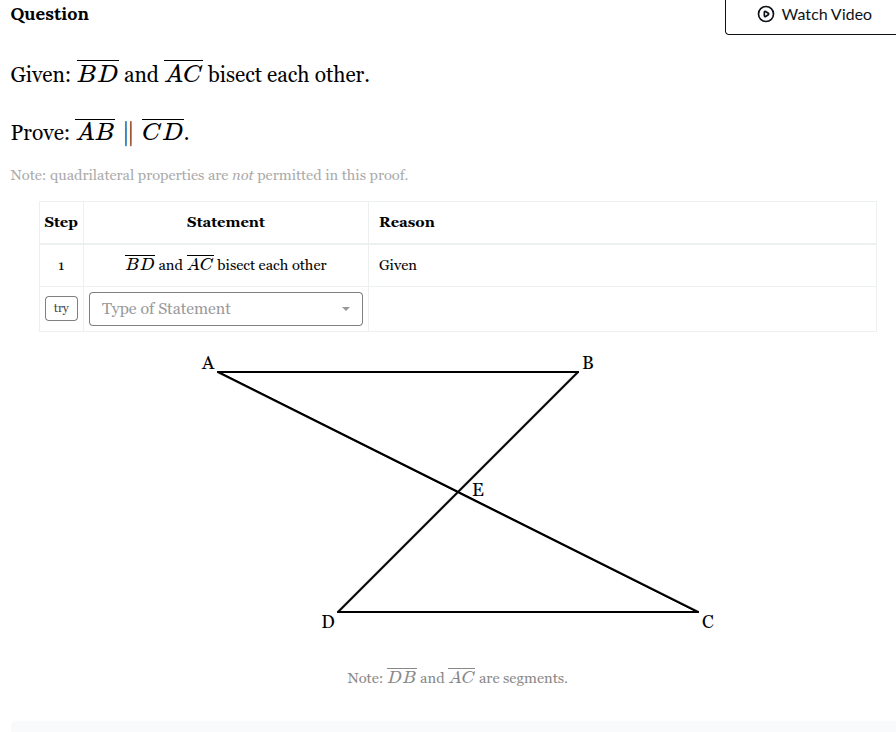
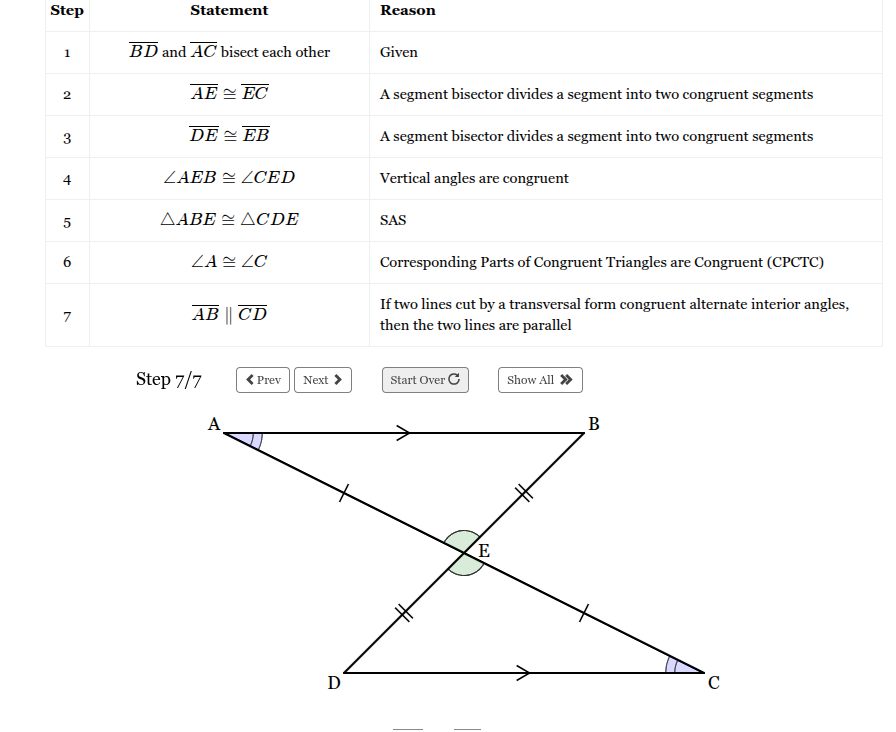
Given: BD and AC bisect each other.
Prove: AB∥CD.
Fill out the rest of the statement/reason table to prove the triangles are similar
Step | Statement | Reason |
1 | BD and AC bisect each other | Given |
2 | AE≅EC | A segment bisector divides a segment into two congruent segments |
3 | DE≅EB | A segment bisector divides a segment into two congruent segments |
4 | ∠AEB≅∠CED | Vertical angles are congruent |
5 | △AEB≅△CED | SAS |
6 | AB≅CD | Corresponding Parts of Congruent Triangles are Congruent (CPCTC) |
7 | ∠EAB≅∠ECD | Corresponding Parts of Congruent Triangles are Congruent (CPCTC) |
8 | ∠EBA≅∠EDC | Corresponding Parts of Congruent Triangles are Congruent (CPCTC) |
9 | AB∥CD | If two lines form congruent alternate interior angles, then the two lines are parallel |
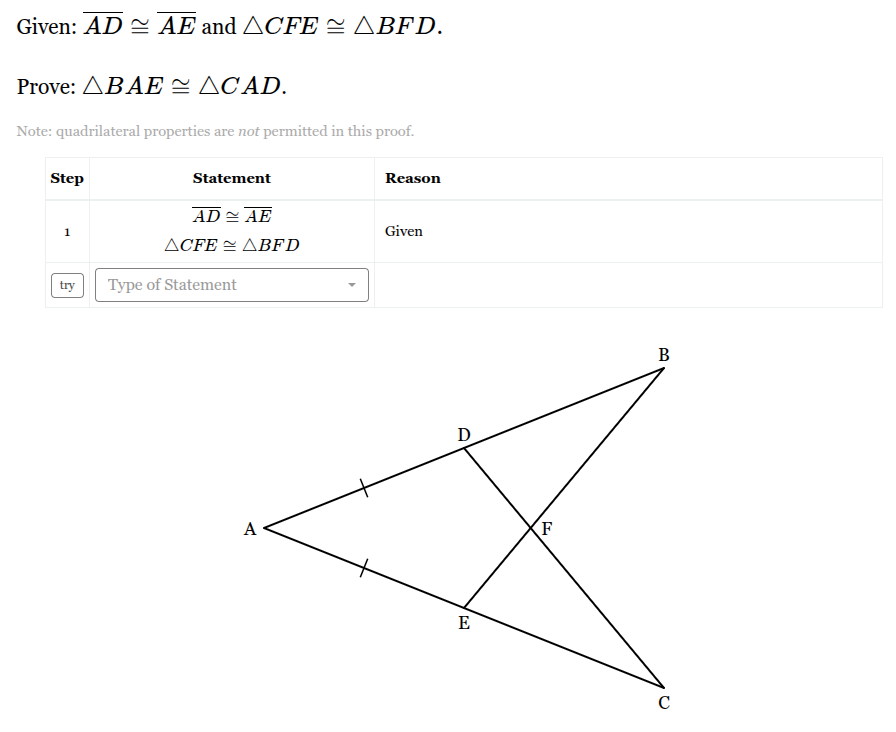
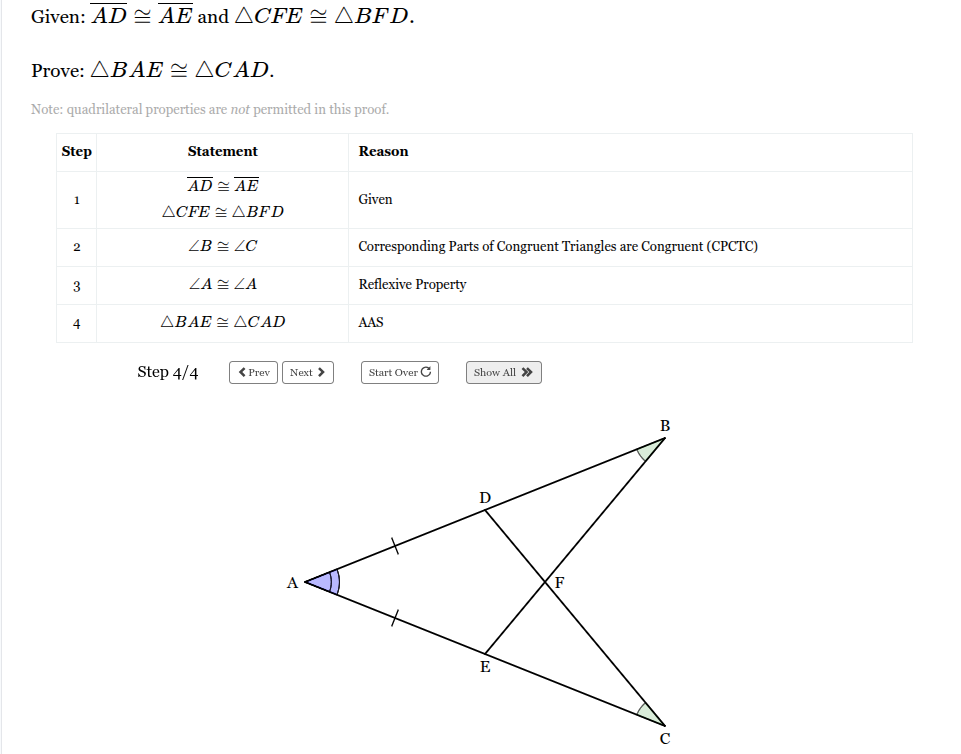
Given: AD≅AE and △CFE≅△BFD.
Prove: △BAE≅△CAD.
Fill out the rest of the statement/reason table to prove the triangles are similar
Step | Statement | Reason |
1 | AD≅AE △CFE≅△BFD | Given |
2 | ∠BAE≅∠CAD | Reflexive Property |
3 | ∠DBF≅∠ECF | Corresponding Parts of Congruent Triangles are Congruent (CPCTC) |
4 | △ACD≅△ABE | AAS |
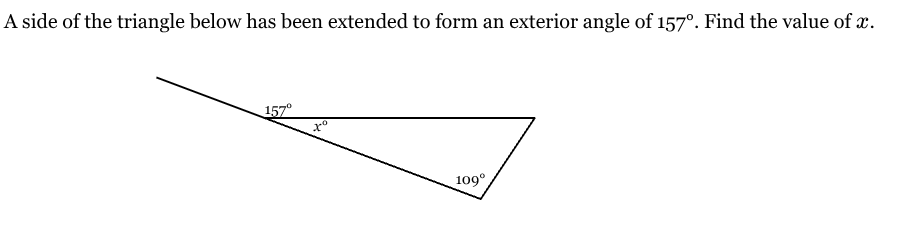
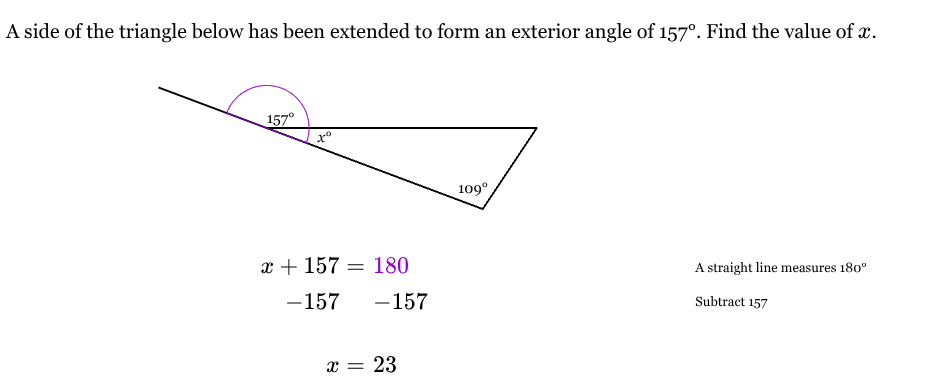
A side of the triangle below has been extended to form an exterior angle of 157°. Find the value of x.
x = 23
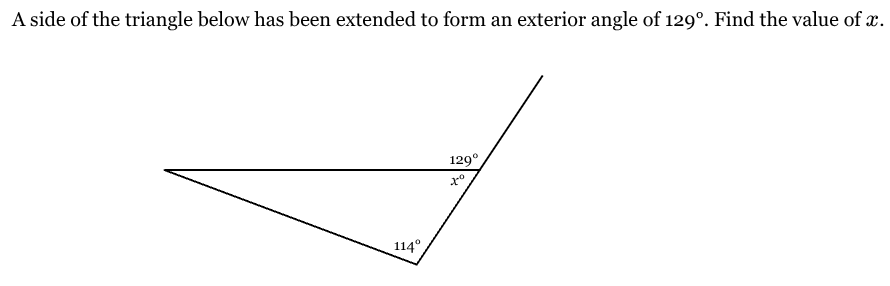
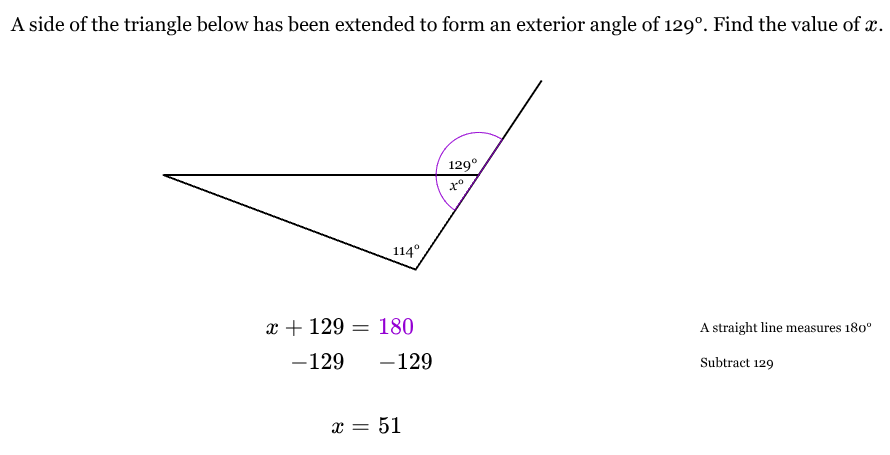
A side of the triangle below has been extended to form an exterior angle of 129°. Find the value of x.
x = 51
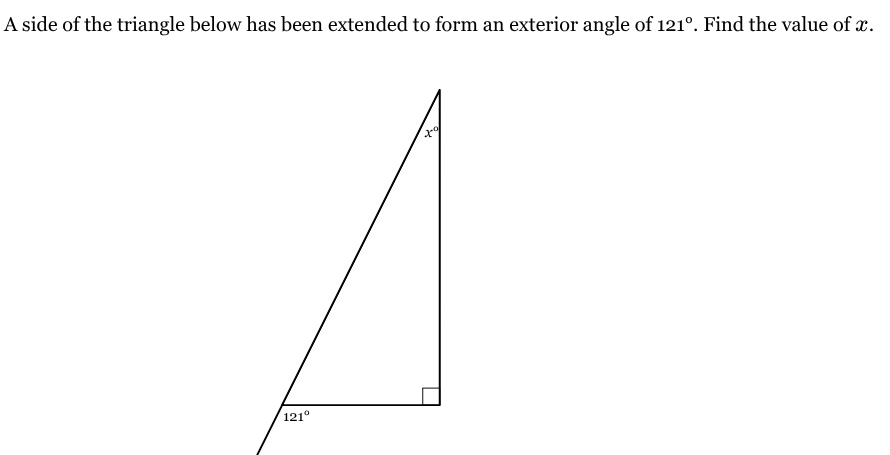
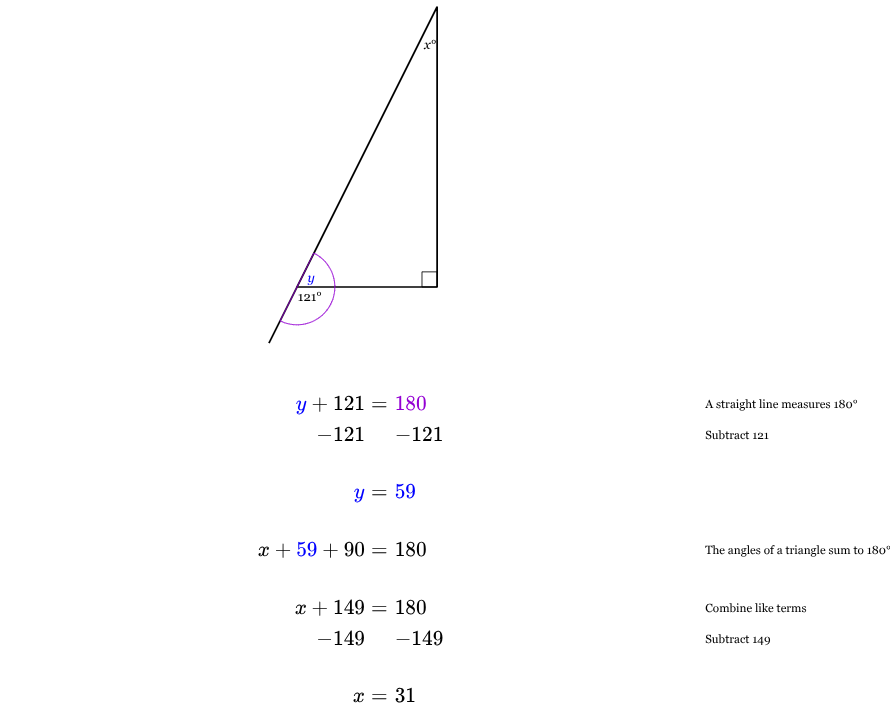
A side of the triangle below has been extended to form an exterior angle of 121°. Find the value of x.
x = 31
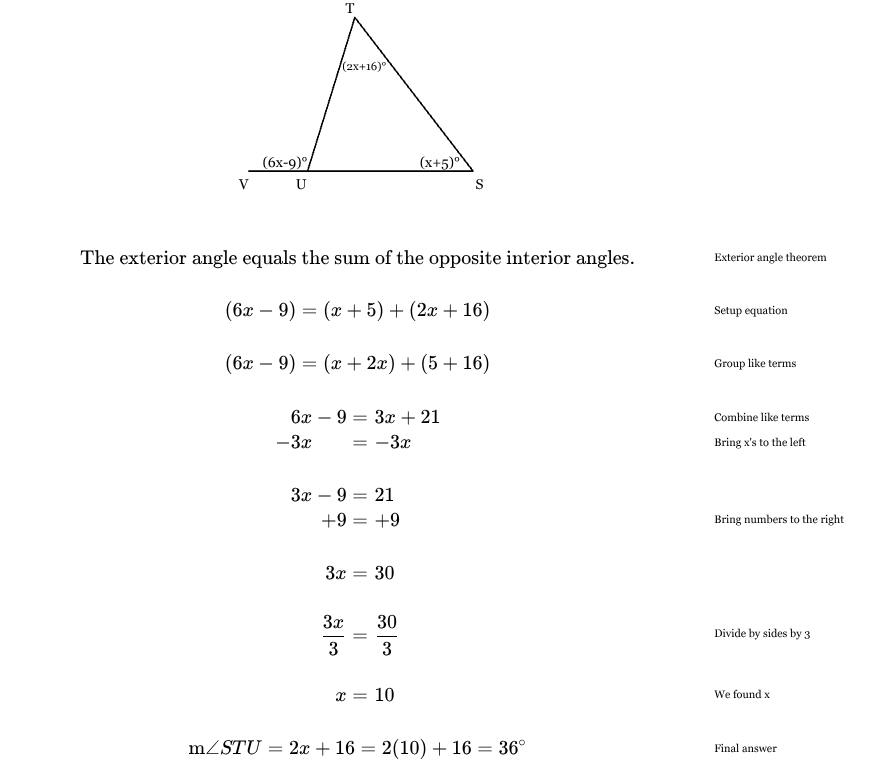
In ΔSTU, SU is extended through point U to point V, m∠UST=(x+5)∘, m∠STU=(2x+16)∘, and m∠TUV=(6x−9)∘. Find m∠STU.
m∠STU=36∘
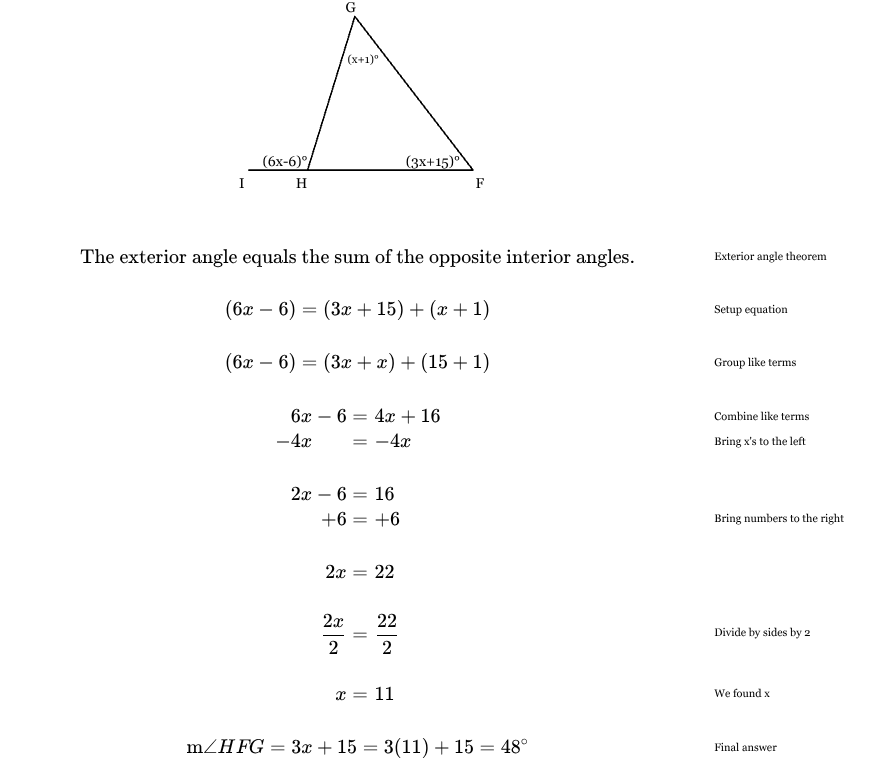
In ΔFGH, FH is extended through point H to point I, m∠HFG=(3x+15)∘, m∠GHI=(6x−6)∘, and m∠FGH=(x+1)∘. Find m∠HFG.
m∠HFG=48∘
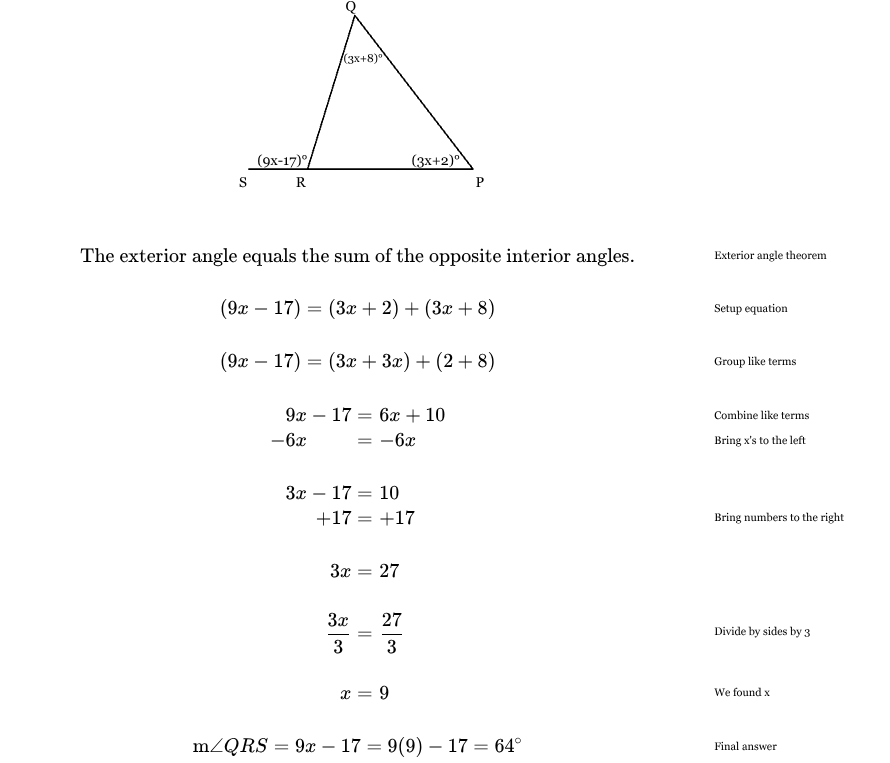
In ΔPQR, PR is extended through point R to point S, m∠PQR=(3x+8)∘, m∠QRS=(9x−17)∘, and m∠RPQ=(3x+2)∘. Find m∠QRS.
m∠QRS=64∘
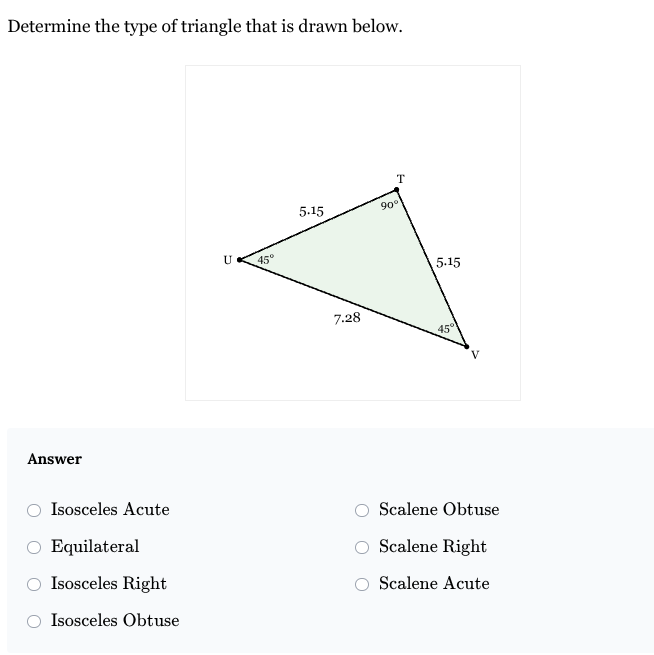
Determine the type of triangle that is drawn below.
1. Isosceles Acute
Scalene Obtuse
Equilateral
Scalene Right
Isosceles Right
Scalene Acute
Isosceles Obtuse
Isosceles Right
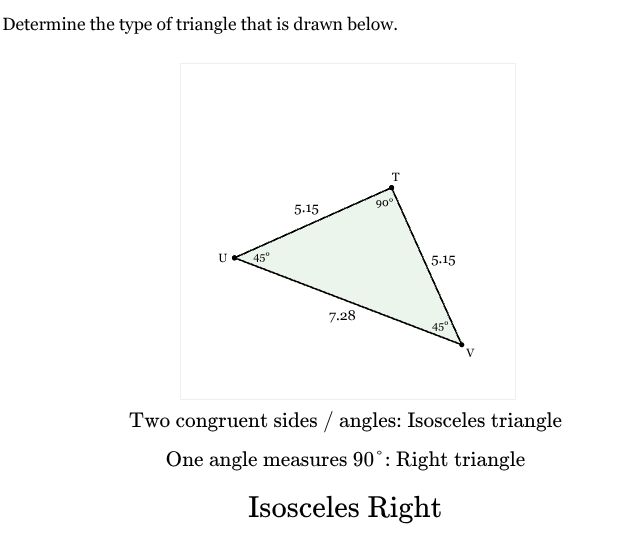
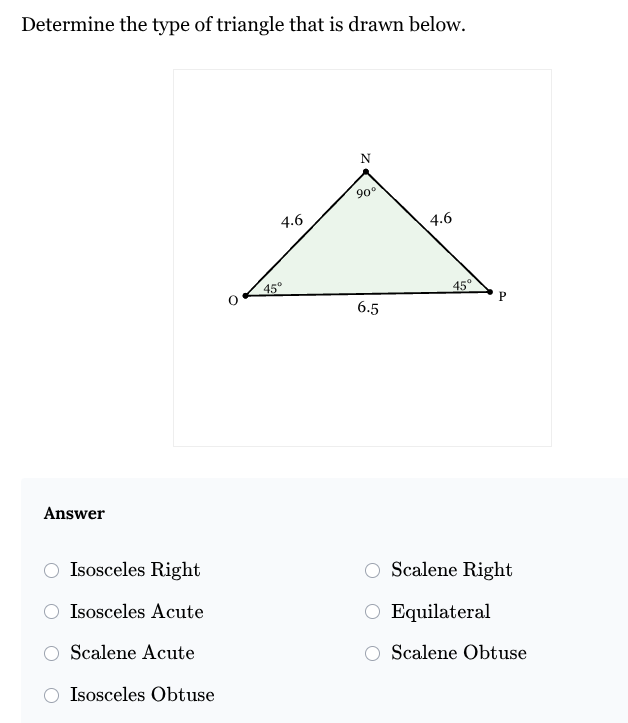
Determine the type of triangle that is drawn below.
1. Isosceles Acute
Scalene Obtuse
Equilateral
Scalene Right
Isosceles Right
Scalene Acute
Isosceles Obtuse
Isosceles Right
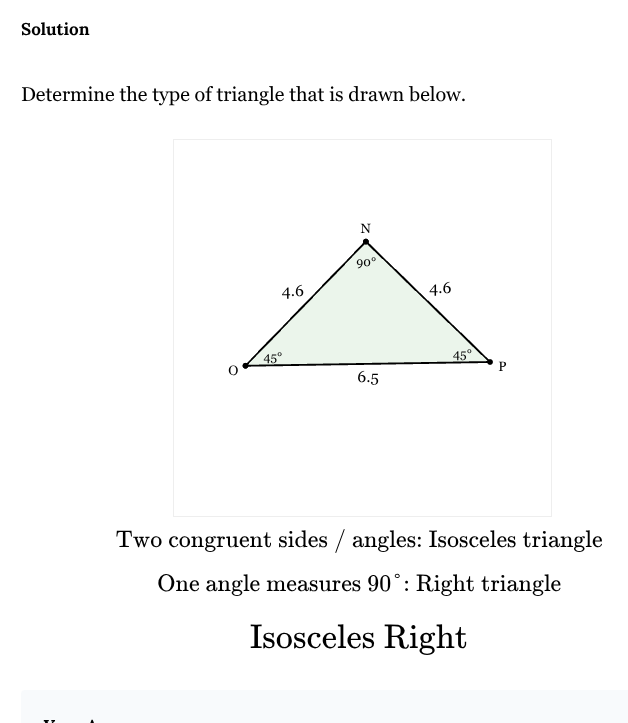
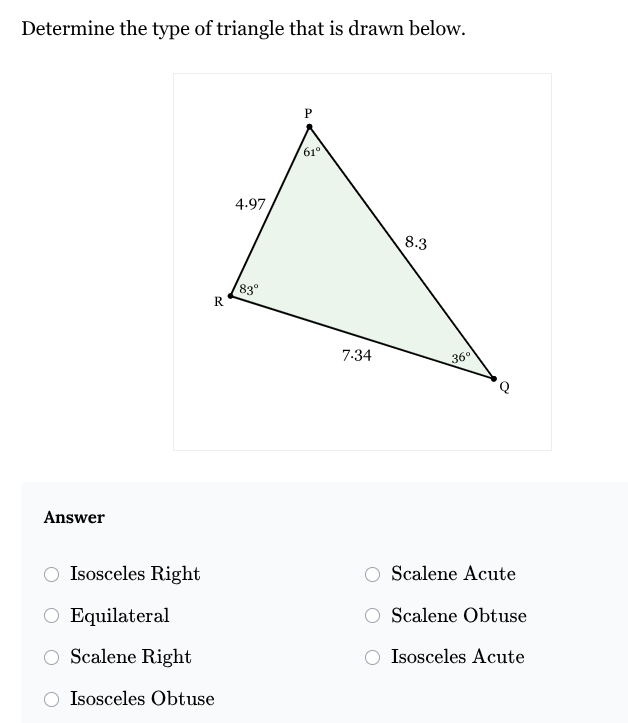
Determine the type of triangle that is drawn below.
1. Isosceles Acute
Scalene Obtuse
Equilateral
Scalene Right
Isosceles Right
Scalene Acute
Isosceles Obtuse
Scalene Acute
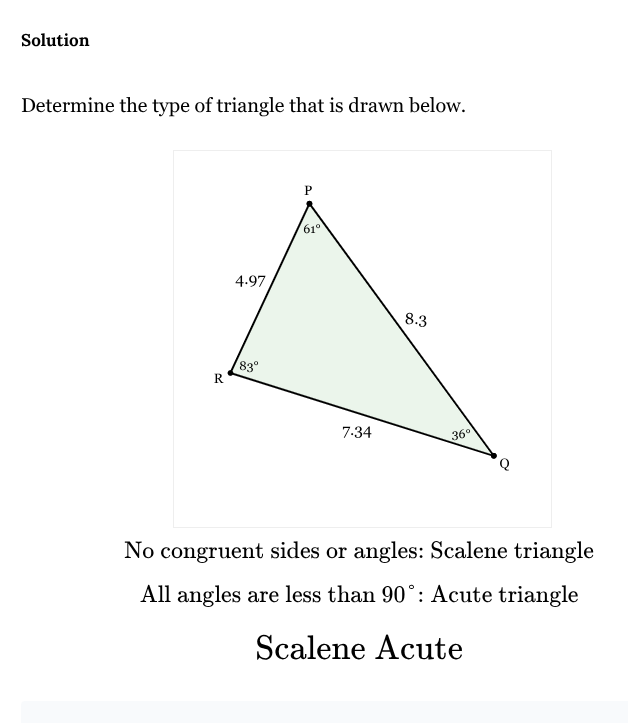
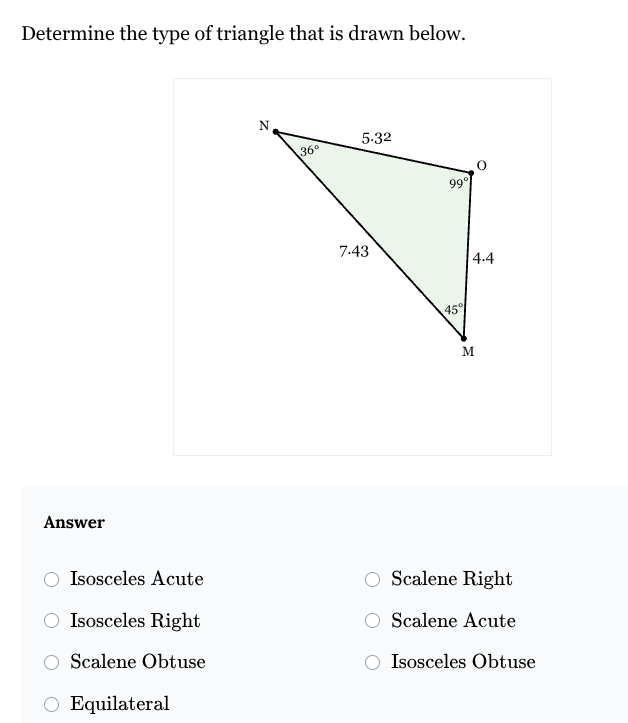
1. Isosceles Acute
Scalene Obtuse
Equilateral
Scalene Right
Isosceles Right
Scalene Acute
Isosceles Obtuse
Scalene Obtuse
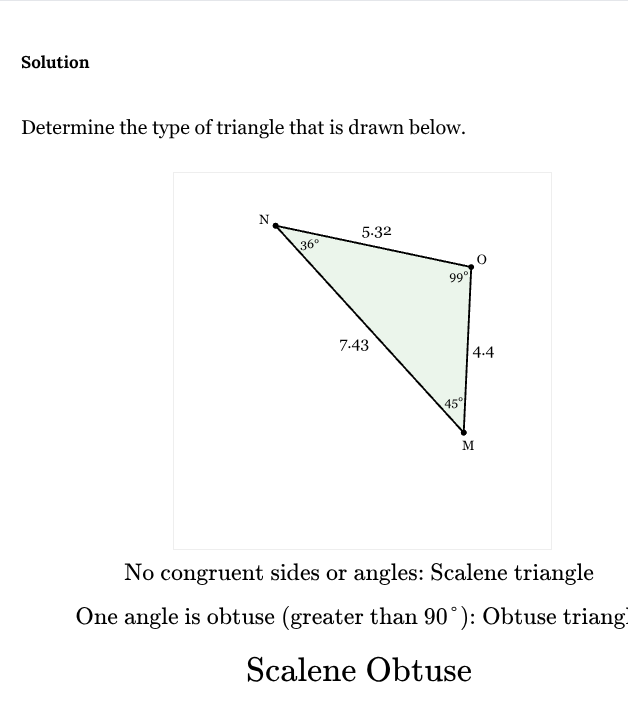
Which of the following sets of numbers could represent the three sides of a triangle?
a. {10,21,28}
b. {9,19,28}
c. {9,20,30}
d. {10,25,35}
a. {10,21,28}
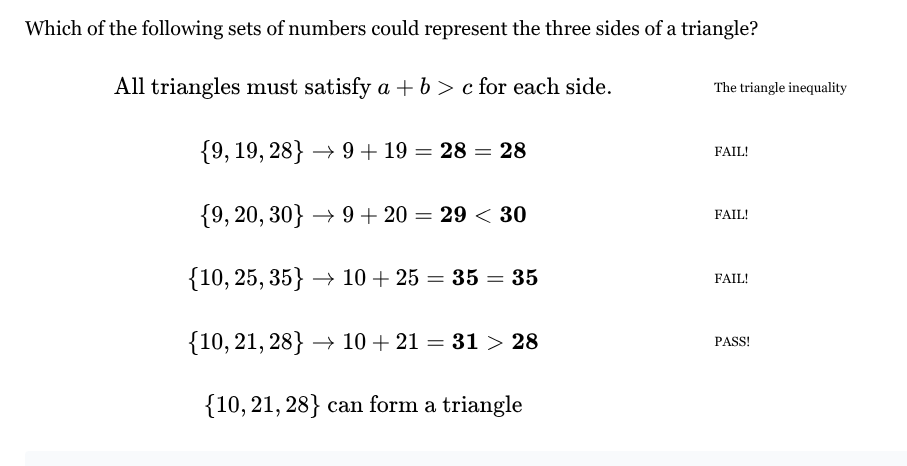
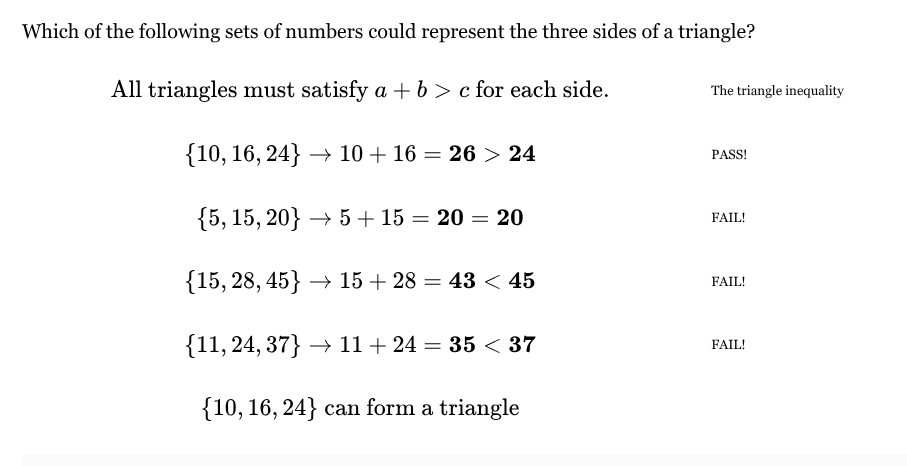
Which of the following sets of numbers could represent the three sides of a triangle?
a. {15,28,45}
b. {5,15,20}
c. {10,16,24}
d. {11,24,37}
c. {10,16,24}
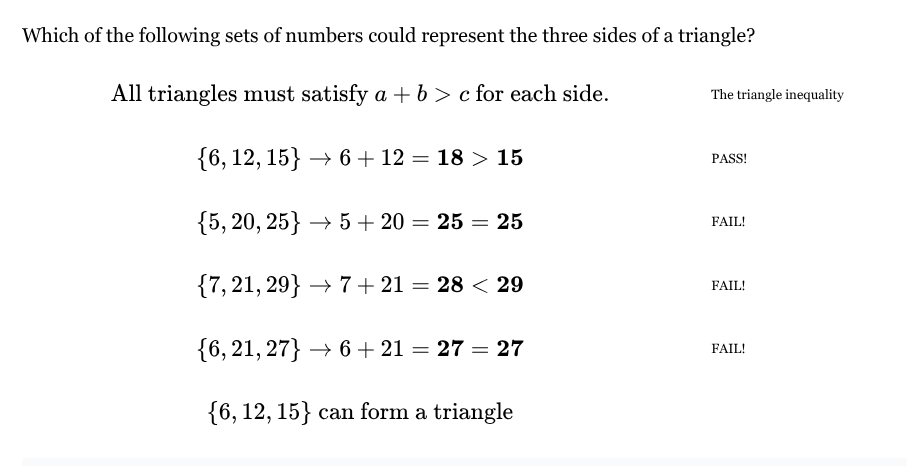
Which of the following sets of numbers could represent the three sides of a triangle?
a. {5,20,25}
b. {6,21,27}
c. {6,12,15}
d. {7,21,29}
c. {6,12,15}
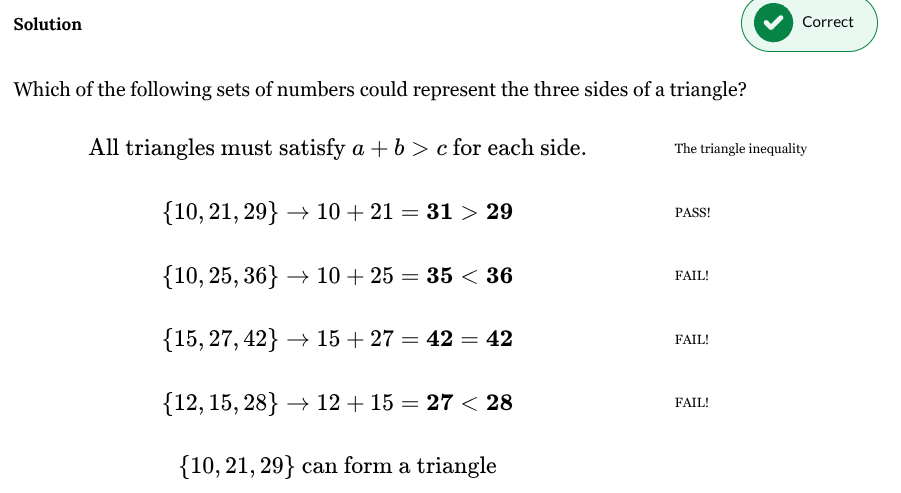
Which of the following sets of numbers could represent the three sides of a triangle?
a. {12,15,28}
b. {10,25,36}
c. {10,21,29}
d. {15,27,42}
c. {10,21,29}
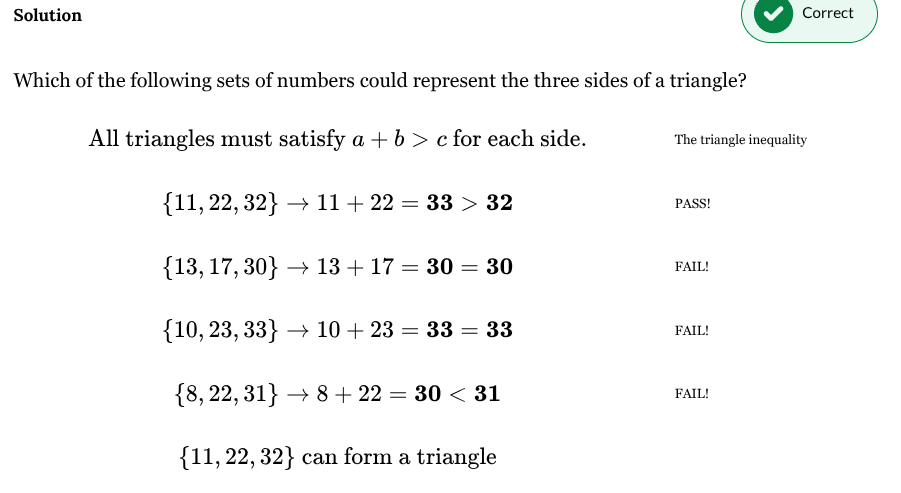
Which of the following sets of numbers could represent the three sides of a triangle?
a. {11,22,32}
b. {8,22,31}
c. {13,17,30}
d. {10,23,33}
a. {11,22,32}
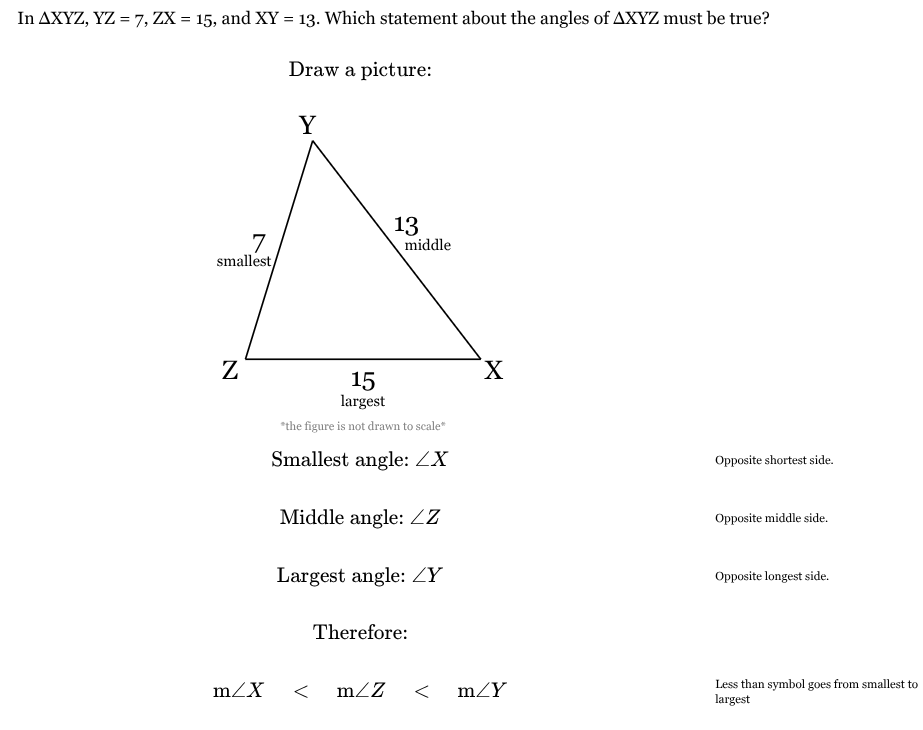
In ΔXYZ, YZ = 7, ZX = 15, and XY = 13. Which statement about the angles of ΔXYZ must be true?
a. m∠X<m∠Y<m∠Z
b. m∠X<m∠Z<m∠Y
c. m∠Z<m∠Y<m∠X
d. m∠Y<m∠X<m∠Z
e. m∠Y<m∠Z<m∠X
f. m∠Z<m∠X<m∠Y
b. m∠X<m∠Z<m∠Y
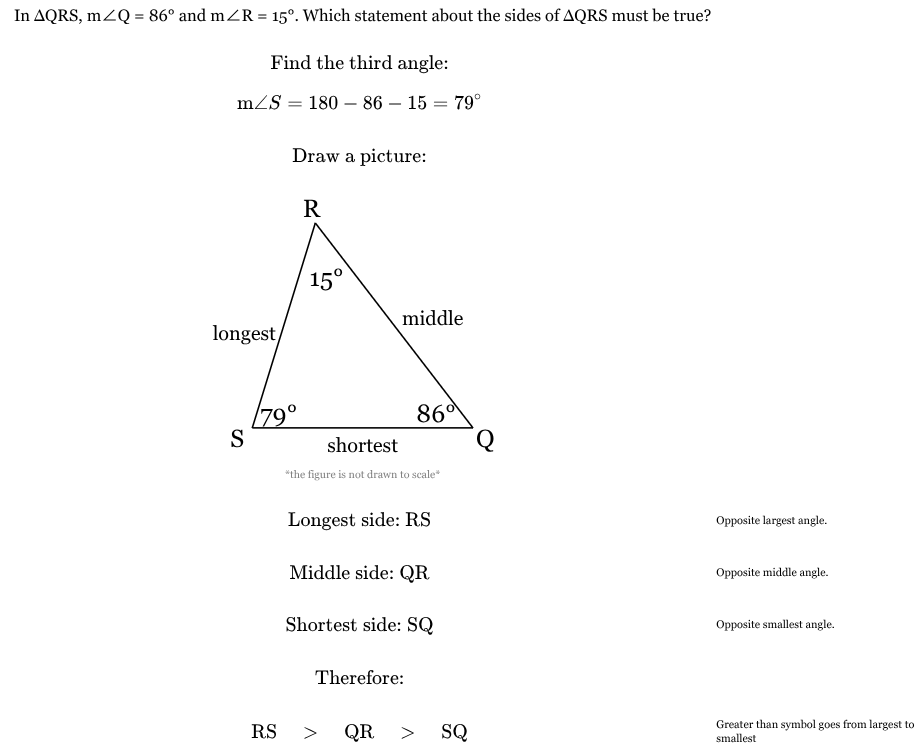
In ΔQRS, m∠Q = 86° and m∠R = 15°. Which statement about the sides of ΔQRS must be true?
a. QR>RS>SQ
b. RS>QR>SQ
c. SQ>RS>QR
d. SQ>QR>RS
e. RS>SQ>QR
f. QR>SQ>RS
b. RS>QR>SQ