Mitral Valve and Right Heart and 12-Lead EKG Interpretation
 Call Kai
 Learn
Learn Practice Test
 Spaced Repetition
 Match
Match Flashcards
 Knowt Play
1/28

There's no tags or description
Looks like no tags are added yet.
Name | Mastery | Learn | Test | Matching | Spaced | Call with Kai |
|---|
No analytics yet
Send a link to your students to track their progress
29 Terms
Measurements performed with PW
Measurements performed with CW
what side of the baseline is flow?
which side of the baseline is regurgitation?
what is ischemia?
initial lack of oxygen
restricted lack of blood flow causing oxygen deprivation
potentially reversible
what is infarction?
tissue death from prolonged hypoxia
permanent tissue death
irreversible damage
how do you evaluate ischemia on an EKG?
ST segment: depression and elevation
T wave: peaking, flattening, and inversion
Q wave: deepening or widening of Q wave and a loss of the R wave
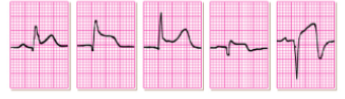
what does this EKG show?
ST elevation
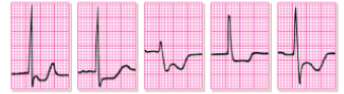
what does this EKG show?
ST depression
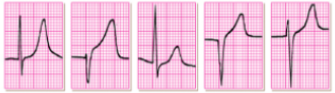
what does this EKG show?
Tall, peaked T wave
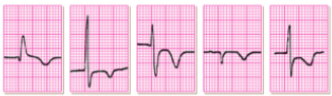
what does this EKG show?
inverted T wave
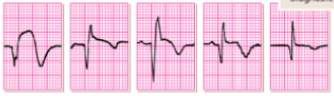
what does this EKG show?
deep Q wave with inverted T wave
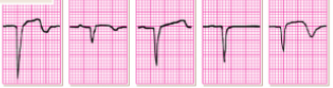
what does this EKG show?
deep Q wave with loss of the R wave
what can be identified on EKG?
information about heart’s electrical status
proof of what happened to heart during recording
what can’t be identified on EKG?
no information about heart’s mechanical pump
cannot prove what will happen to heart in the future
what is RVSP?
RV systolic pressure
noninvasive estimate of how much pressure the lungs’ blood vessels are generating
often points towards pulmonary hypertension
use the simplified bernoulli equation to calculate TR pressure gradient
RVSP formula
= 4 (TR peak)² + RAP
step by step calculation of RVSP
obtain TR jet via A4C/parasternal
use CW to measure peak TR velocity
square the velocity and multiple by 4
now you have RV-RA gradient
estimate RAP from IVC
add RAP to gradient to get RVSP
measurements needed for RVSP
TR peak velocity (CW) (gets pressure gradient between RV and RA)
right atrial pressure (estimated from IVC size)
what is the IVC size of a RAP of 3 mmHg?
less than 2.1 cm
what is the IVC size of a RAP of 8 mmHg?
intermediate
what is the IVC size of a RAP of 15 mmHg?
greater than 2.1 cm
how is 2D mode used for RVSP?
identifies anatomy (IVC size) and TR jet location
how is color doppler mode used for RVSP?
visualizes regurgitant jet
aliasing jet
how is CW mode used for RVSP?
measures high velocities
measures TR peak velocity
how is M-Mode mode used for RVSP?
IVC dynamics
what does RVSP tell us?
pulmonary artery pressure (indirectly)
right heart afterload (how hard the RV has to pump to the lungs)
why is RVSP important?
screening for pulm HTN, lt heart disease, lung disease
monitors progression of pulmonary hypertension
assesses risk
guides further testing