Chap 13 + cog demos
 Call Kai
 Learn
Learn Practice Test
 Spaced Repetition
 Match
Match Flashcards
 Knowt Play
1/7

There's no tags or description
Looks like no tags are added yet.
Name | Mastery | Learn | Test | Matching | Spaced | Call with Kai |
|---|
No analytics yet
Send a link to your students to track their progress
8 Terms
Decisions and Reasoning
Decisions: The process of making choices between alternatives
Reasoning: The process of drawing conclusions
past knowledge effects our decisions & reasoning
Inductive Reasoning
Reasoning that is based on observation
Reaching conclusions from evidence
happens in discussion section of paper
ex: an hypothesis → deductive
Strength of argument
Representativeness of observations → do they represent what ur trying to conclude about
Number of observations → normally use not a lot of observations
Law of large numbers: the larger the number of individuals randomly drawn from a population, the more representative the resulting group will be of the entire population
Quality of observations → did you get a good sense of what you saw?
Used to make scientific discoveries
Hypotheses and general conclusions
Used in everyday life
Make a prediction about what will happen based on observation [or what we heard] about what has happened in the past
Character – “one’s mental and moral qualities”
What is Probably true, not what is definitely true.
conclusions are tenative
Heuristics
“Rules of thumb” that are likely to provide the correct answer to a problem, but are not foolproof
quick ways of getting to conclusions
helpful but can lead us astray
Two more commonly used heuristics include the availability heuristic and the representativeness heuristic
Availability heuristic: events more easily remembered are judged as being more probable than those less easily remembered
when something is memorable we tend to over estmate its probability
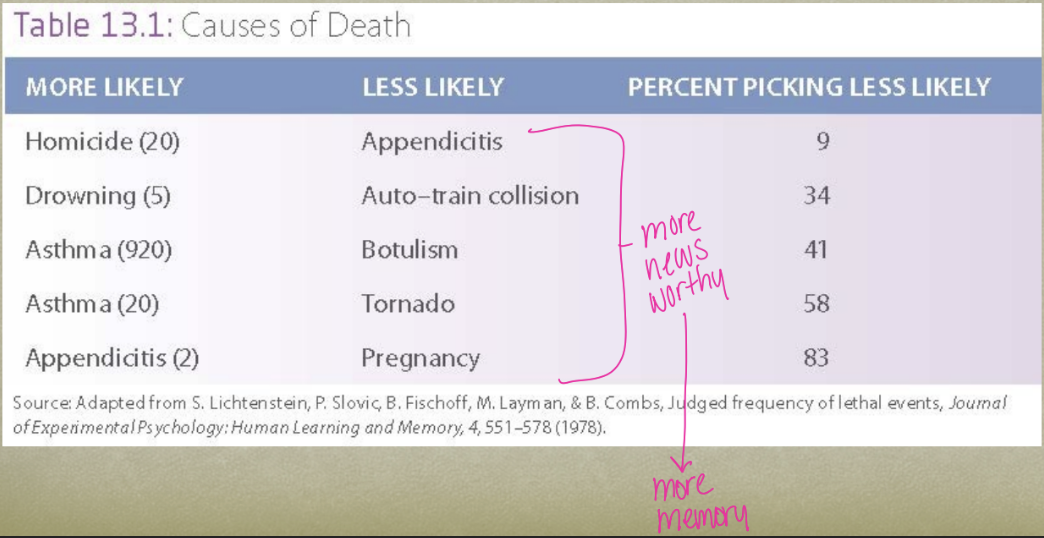
Illusory correlations: correlation appears to exist, but either does not exist or is much weaker than assumed → when something seems related but its not actually
Stereotypes: Oversimplified generalizations about a group or class of people that often focuses on the negative
Representativeness heuristic: the probability that A is a member of class B can be determined by how well the properties of A resembles properties normally associated with class B → to know if something is in that category, we use characterisitics of that category => doesn’t take into account the ppl in the category
Use base rate (relative proportion of different classes in the population) information if it is all that is available
Base rate – how frequently does something occur in general.
Use descriptive information if available and disregard base rate information
ex: Rep Heu Examples
Sarah loves to listen to New Age music and faithfully reads her horoscope each day. In her spare time, she enjoys aromatherapy and attending a local spirituality group.
School Teacher? → but based on probability, more likely than this
Holistic Healer? → What she sounds like she should be in but is less probable
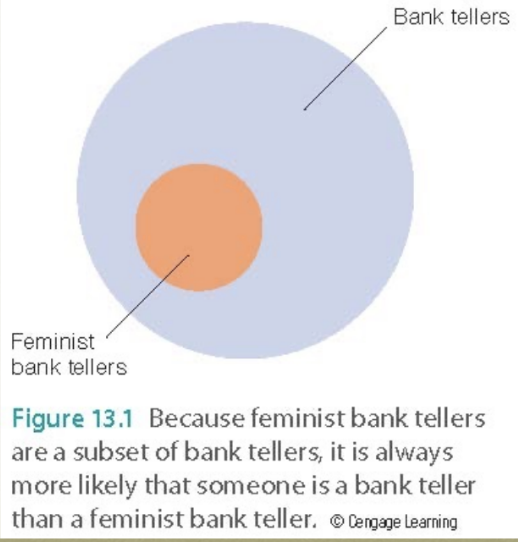
Conjunction rule: probability of two events cannot be higher than the probability of the single constituents
have both traits is less probable than just being 1 trait
Law of large numbers: the larger the number of individuals randomly drawn from a population, the more representative the resulting group will be of the entire population
if small sample size (error) → more likely to be effected by error
The myside bias: tendency for people to generate and evaluate evidence and test their hypotheses in a way that is biased toward their own opinions and attitudes
to generate
The confirmation bias: tendency to selectively look for information that conforms to our hypothesis and overlook information that argues against it
to specific look for
can overlook information that go against your information
“cherry picking”
The confirmation bias/myside bias
Lord and coworkers (1979)
Had those in favor of capital punishment and those against it read the same article → weren’t actually analyzing the article
Those in favor found the article convincing
Those against found the article unconvincing => just disagreeing bc not taking into account of other info
Decision-Making
Decisions depend on how choices are presented
Opt-in procedure
Active step to be organ donor
ex: in US
Opt-out procedure
Organ donor unless request not to be
ex: in Europe
Status quo bias
The tendency to do nothing when faced with making a decision → want things to stay the same
Oatley (2016)
tested on what emotion are the eyes showing?
ppl who read fictions were more accuraye compared to ppl who read non-fiction
fiction as a social simulation (invision text)
(visual) transportation
inferences
images
emotion
fiction → simulate social inferences in a mental representation
since doesn’t say explicitly → makes you infer/have to guess what they were thinking
we have to infer:
what they look like (images)
what it feels like (emotions)
fiction → allows for practice of social simulations
make them better when faced w/ it in real lifet
fiction → has more variety of language (more descriptive) → when compared to non-fiction
movies vs. reading
movies are more passive when attending to details
don’t have to infer as much bc of facial expressions
Reading makes you have to make connections to infer when attending to details
neuro: emotion centers are being activated (mirroring)
same neural representation happening as character as if its happening to you
Mckay: about emotion & memory)
binding-hypothesis
remember color of taboo words more than neural words
bc we remember things tied to emotionality better
Burke: tip of tounge
moves from semantic nodes to phonological nodes
ex: semantic knowlegde → phonological knowledge → muscle knowledge
w/ tip of tounge → word is stuck in semantic knowledge
failure of activation to move from the semantic levels to the other levels (phonological & muscle)
factors that influence this:
frequency of word (commonality)
recency → when was the last time you used it
if used recently → probably won’t have trouble
age: older you get, the more difficult it becomes
Harris: judging assertions & implications
bc when things are implied → we tend to think they are true
assertions vs. implications ads → ppl will infer & willl answer true
don’t remember verbatim → remember fist → make pragmatic impications
remember things not actually said