ALL of Biological molecules 1.1 AQA
 Call Kai
 Learn
Learn Practice Test
 Spaced Repetition
 Match
Match Flashcards
 Knowt Play
1/93

Earn XP
Description and Tags
Aqa Alevel Biology new spec
Name | Mastery | Learn | Test | Matching | Spaced | Call with Kai |
|---|
No analytics yet
Send a link to your students to track their progress
94 Terms
condensation definition
forming a chemical bond removing one water molecule
hydrolysis definition
breaking a chemical bond using one molecule of water
Define monomer
A small repeating unit which can form a polymer
Explain how proteins or antibodies are digested
Peptide bonds are hydrolysed
Endopeptidases break internal peptide bonds
Exopeptidases break terminal bonds
Membrane bound dipeptidases break di-peptidases to amino acids
what elements do carbohydrates contain?
C,H,O
give 4 examples of monosaccharides
alpha glucose
Beta glucose
fructose
galactose
give 3 examples of disaccharides
sucrose
maltose
lactose
give 3 examples of polysaccharides
cellulose (plants)
starch (plants)
glycogen (animals)
What is the plant cell wall made of?
cellulose
sucrose is made of ___ and ___
glucose+fructose
lactose is made of ___ and ___
glucose+galactose
maltose is made of ___ and ___
glucose+glucose
Disaccharide definition
carbohydrates formed when 2 monosaccharides are joined by a glycosidic bond by a condensation reaction.
monosaccharide defintion
is the individual monomer of carbohydrates
give the properties of monosaccharides, disaccharides and polysaccharides
monosaccharides- soluble, energy source for respiration
disaccharides-soluble, energy transport and storage
polysaccharides-insoluble, energy storage
definition of a glycosidic bond
the bond between two monosaccharides
define polysaccharide
a carbohydrate formed from many repeating monoscharides joined by glycosidic bonds via condensations reactions
what is cellulose? and what is its structure? how does it relate to it’s function?
a polysaccharide made of many 'β' (beta) glucose monomers
long, straight, unbranched chains of beta glucose held in parallel by hydrogen bonds
forming microfibrils
the many hydrogens provide structural support to cellulose for plant cell walls
contains 1,4 glycosidic bonds
what is glycogen ? and what is its structure? how does it relate to it’s function? where is it located in?
a polysaccharide made of many ‘α’ (alpha) glucose
highly branched structure- providing a large surface are for rapid hydrolysis into glucose for respiration by enzymes
insoluble-doesn’t affect the water potential of the cell
large molecule-doesn’t pass through the cell membrane
animals - mainly muscle and liver cells
contain 1,4 and 1,6 glycosidic bonds
what is starch? and what is its structure? how does it relate to it’s function? where is it located in?
a polysaccharide made up of many ‘α’ (alpha) glucose monomers
made of 2 polymers
amylose- unbranched helical structure- making it compact and can lot’s can be stored in a small space
amylopectin- branched molecule- providing a large surface area for the rapid hydrolysis into glucose for respiration by enzymes.
insoluble- won’t affect the water potential of the cells
large molecule-so it won’t pass through the cell membrane
found only in plants
please draw the structure of an ‘α’ (alpha) glucose monomer
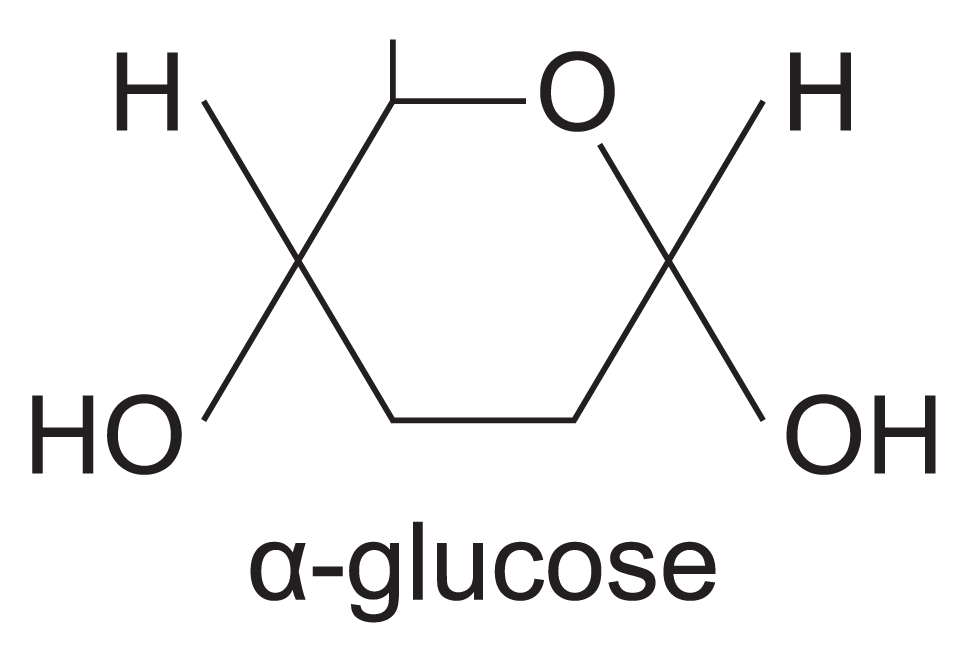
please draw the structure of a 'β' (beta) glucose monomer
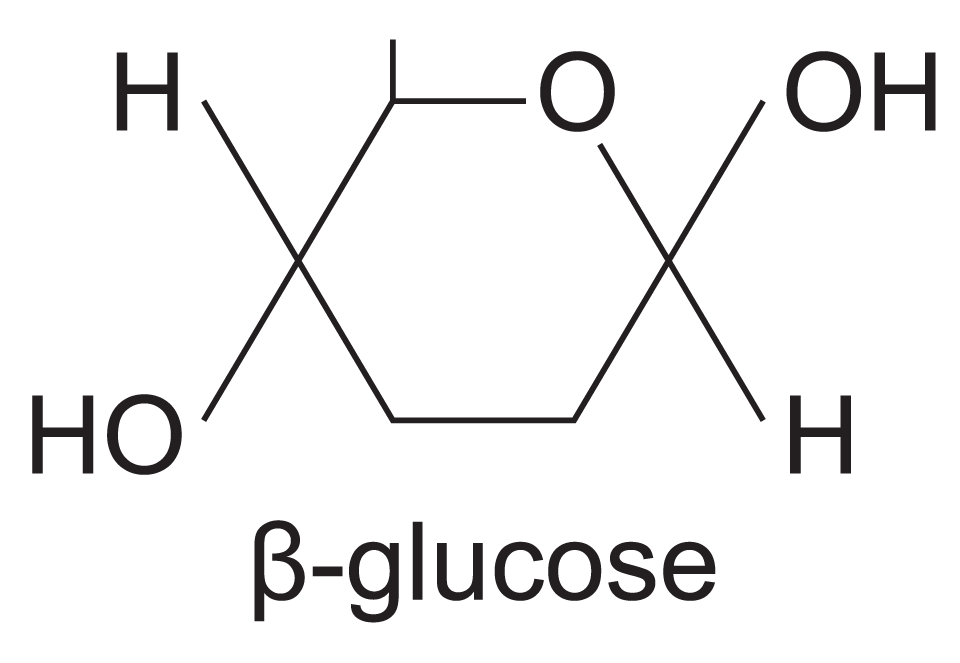
draw the formation of maltose and the structure of maltose. (2 marks)
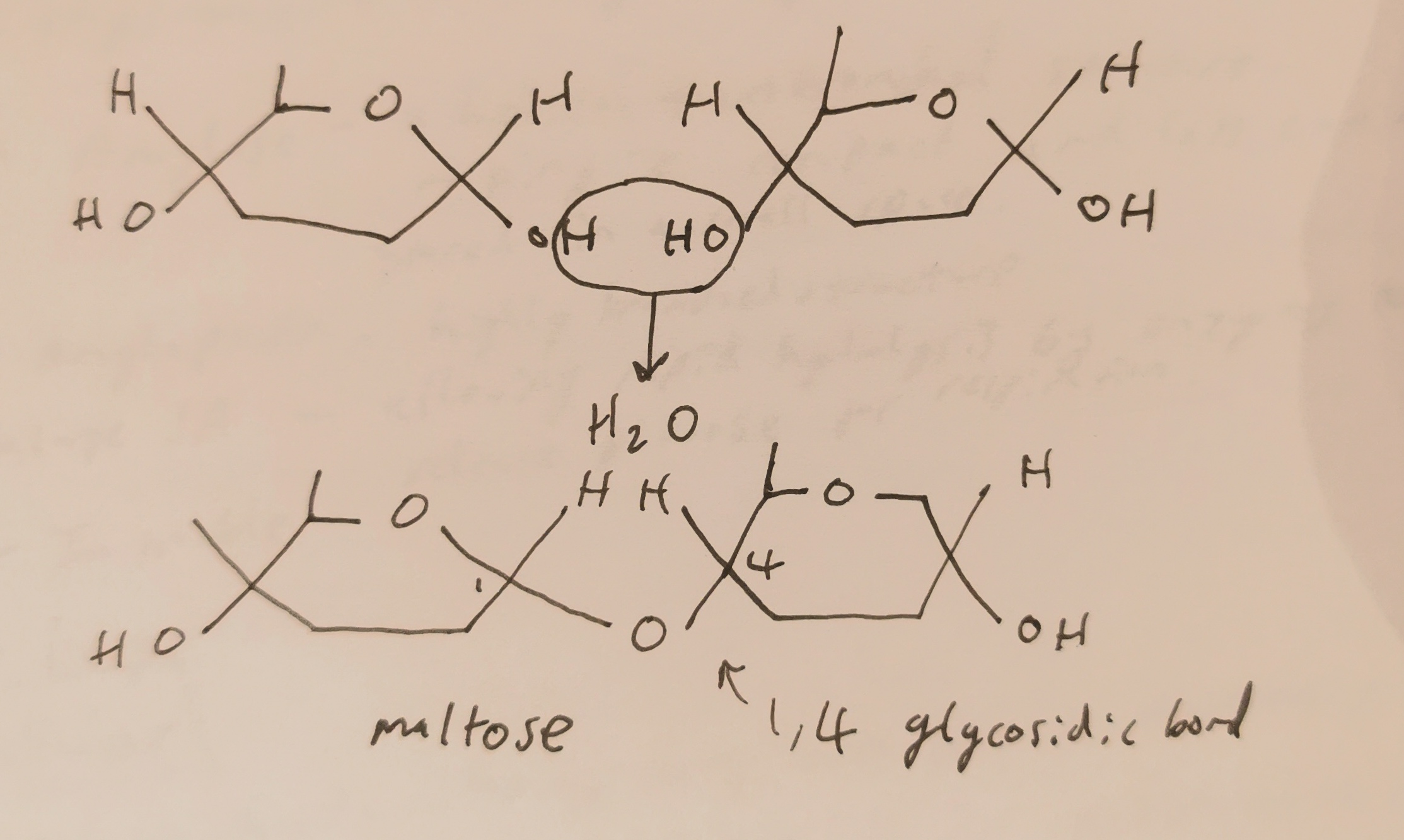
explain how maltose is formed and broken down (3 marks)
maltose is formed when two alpha glucose monosaccharides are joined by a glycosidic bond, via a condensation reaction. Releasing one molecule of water.
maltose is broken down by maltases.
where maltase catalyses the hydrolysis of maltose into two alpha glucose monosaccharides with the addition of one molecule of water to break the glycosidic bond.
explain how sucrose is formed and broken down (3 marks)
sucrose is formed when one fructose and one a glucose monosaccharide are joined by a glycosidic bond, via a condensation reaction. Releasing one molecule of water.
Sucrose is broken down by sucrases.
Where sucrase catalyses the hydrolysis of sucrose into one fructose and one glucose monosaccharide with the addition of one water molecule to break the glycosidic bond.
explain how lactose is formed and broken down (3 marks)
lactose is formed when one galactose and one glucose monosaccharide are joined by a glycosidic bond, via a condensation reaction. Releasing one molecule of water.
Lactose is broken down by lactases.
Where Lactase catalyses the hydrolysis of lactose into one galactose and one glucose monosaccharide with the addition of one water molecule to break the glycosidic bond.
What is the chemical equation for both alpha and beta glucose?
C6 H12 O6
Compare the structures of Cellulose and Chitin
Both are polysaccharides made up of many beta-glucose monomers
Both are joined by glycosidic bonds
Both have a linear shape and form long straight unbranched chains.
What is the term used to describe the different structures of alpha and beta glucose
Isomerism
Suggest why the water potential in fruits containing starch decreases as the fruits are stored (3 marks)
Because the starch is being hydrolyed by amylase into maltose.
Maltose is a disaccharide that is soluble in water
Therefore lowers the water potential
Describe the transport of carbohydrates in plants (5 marks)
Sucrose is actively transported into the phloem by companion cells
Lowering the water potential in the phloem, allowing water to enter from the xylem by osmosis
This increases the hydrostatic pressure in the phloem, creating a pressure gradient
Creating mass flow to respiring cells
Sucrose is then unloaded from the phloem to the cells by active transport
Compare and contrast the structure of starch and the structure of cellulose
Starch has a helical structure while cellulose has a linear structure
Starch is a polysaccharide made up of many alpha glucose monomers, while cellulose is a polysaccharide made up of many beta glucose monomers
Starch is highly branched while cellulose is not
Starch and cellulose both have C,H,O
Both have glycosidic bonds
Starch has amylose and amylose pectin while Cellulose does not
Describe how starch is digested (4 marks)
The glycosidic bonds in starch is hydrolysed by amylase, converting starch into maltose.
The glycosidic bonds in maltose are then hydrolysed by membrane bound maltase, converting maltose into alpha glucose
Explain the importance the structure of starch
helix is compact and can fit in small spaces
branches increase surface area for rapid hydrolysis back into glucose.
efficient for storing and source of glucose
Insoluble- wont change (Ψ) water potential
Explain the importance the structure of cellulose
very strong (lots of hydrogen bonds)
cell wall provides structural support to the plant cell
Insoluble- wont change (Ψ) water potential
Explain the importance the structure of glycogen
large surface area for rapid hydrolysis into glucose
Insoluble- wont change (Ψ) water potential
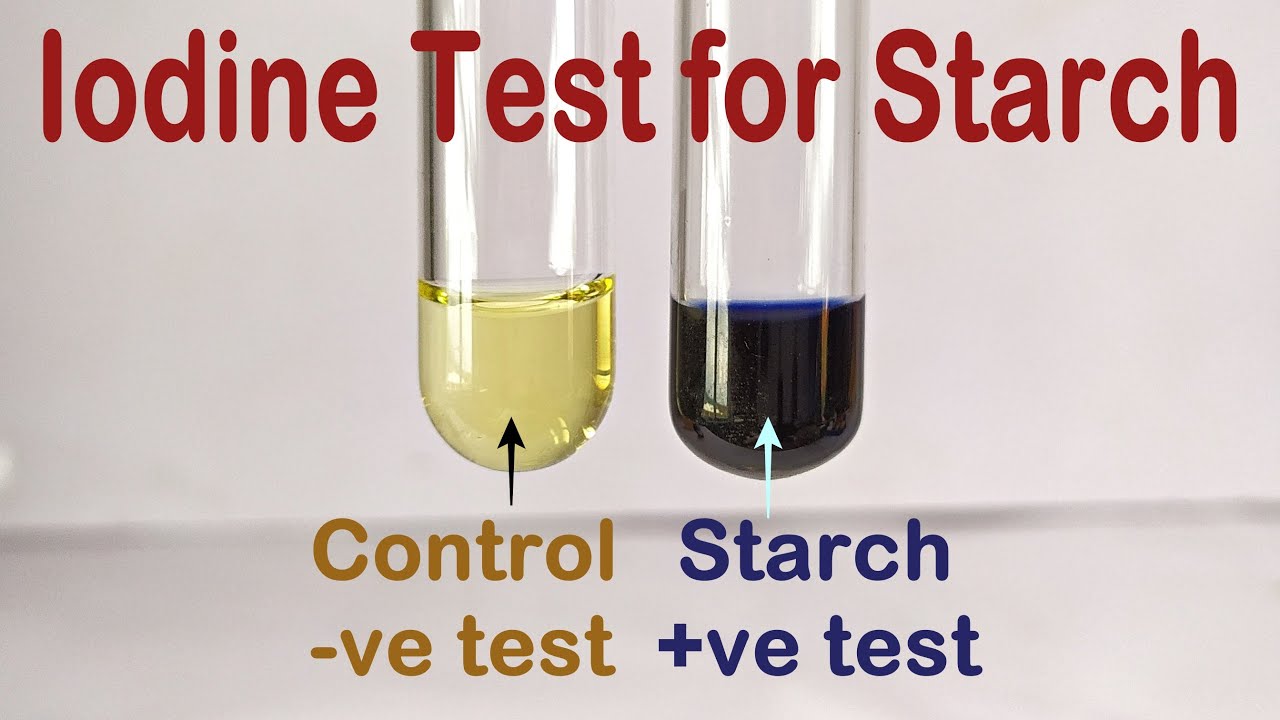
What is the test for starch?
add iodine solution
positive result- solution turns from orange to blue black
What is the test for reducing sugars?
add Benedicts solution and heat in water bath for 5 minutes at 80 C
positive result: solution turns from blue to a red precipitate
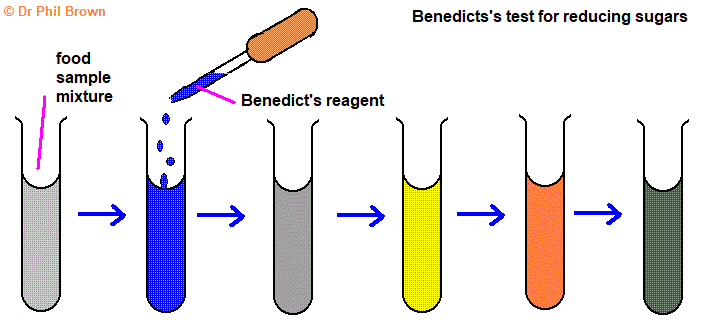
What is the test for non-reducing sugars? (done after the test for reducing sugars)
add acid and boil
let it cool
add an alkaline to neutralize
then add Benedicts reagent and heat
positive result: turns blue to red precipitate
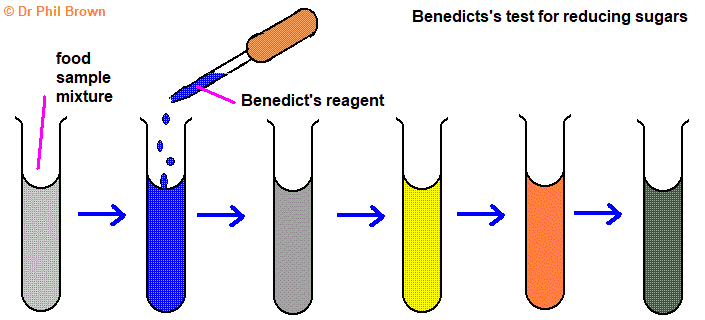
The benedicts test is describes as a semi-quantitative test. explain what is mean by this. (1 mark)
the benedicts test is an approximate indication of concentration.
doesn’t provides numerical values
describe how you would test for a sample containing an unknown concentration of glucose. without a colorimeter (5 marks)
prepare a dilution series of 5 known concentrations of glucose in 5 test tubes.
label them. and label a test tube containing the sample
add benedicts reagent to all of them and heat in a water bath for 5 minutes at 80 C
colour change will be from blue green to yellow to orange to brick red (depending on concentration)
then compare the colour of the samples to the known concentrations.
describe how you would test for an unknown concentration of glucose. using a colorimeter (6 marks)
use a dilution series of 5 known concentrations of glucose
carry out the benedicts test for each of them and the unknown sample
place the samples in cuvettes and place them in the colorimeter
record the absorbance of light
plot a graph of absorbance against concentration of glucose
find the absorbance of light of the unknown value, use the graph to find the concentration.
give an example of a non-reducing sugar
sucrose

defintion of a reducing sugar
a sugar that is able to donate electrons to another chemical
Give 2 examples of lipids
Triglycerides and phospholipids
Explain how triglycerides are formed
Triglycerides are formed by 3 condensation reactions between the glycerol and 3 fatty acid chains. Forming 3 ester bonds between them. Releasing three water molecules.
Explain how phospholipids are formed
Where 2 condensation reaction occur between the glycerol that’s attached to a phosphate group and two fatty acid chains. Forming 2 ester bonds and releasing 2 Water molecules
What is the difference between saturated and unsaturated fatty acid chains?
What similarity do they have?
Saturated
the hydrocarbon has only single C-C bonds, no C=C bonds
Unsaturated
the hydrocarbon has at least one C=C bond.
Both have a hydrocarbon
Give 4 Properties of triglycerides and their importance
Due to the large ratio of C-H bonds compared to the number of Carbon atoms a lot of energy can be stored. Making them a good for energy storage
Due to high ratio of hydrogen atoms they can be oxidised to release water. Making them a good source of water for animals in the desert. E.g Camels
Large and hydrophobic. Making them insoluble to water, doesn’t affect water potential.
Low/small mass. Therefore a lot can be stored without increasing mass.
Explain why phospholipids can form a bilateral but triglycerides cannot
Triglycerides are fully hydrophobic and non polar
While phospholipids are both hydrophobic and hydrophilic, as it’s consists of a hydrophilic phosphate head that attracts water and hydrophobic fatty acid tails.
Give the properties of phospholipids and how it’s important
They have a polar,hydrophilic head face outwards
And non-polar hydrophobic fatty acid tails facing inwards
This is importantly in the formation of the phospholipid bi-layer of the cell membrane. Where only small, non-polar lipid soluble molecules can diffuse across it.
What is the test for lipids?
Add ethanol and mix
Then add distilled water and shake
Positive result- a white emulsion forms
why do lipids form an emulsion in the test for lipids? (2 marks)
lipids are insoluble to water, but soluble in ethanol
when mixed in water. lipid droplets disperse, forming a white emulsion
What are amino acids?
Monomers from which proteins are made
Draw the structure of an amino acid
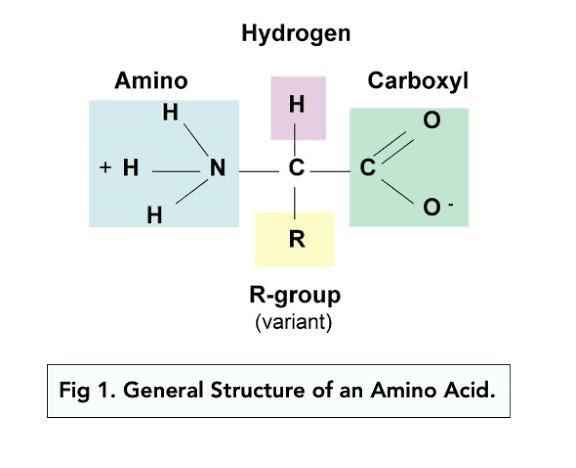
Explain how dipepetides and polypeptides are formed
A condensation reaction happens between 2 amino acids
Many condensation reactions of amino acids
What is the primary structure of a protein (1 mark)
The sequence of amino acids, held by peptide bonds
What is the secondary structure of proteins (2 marks)
The sequence of amino acids causes the protein molecule to bend into an alpha helix shape or beta pleated sheet.
Held by hydrogen bonds.
What is the tertiary structure of a protein? (3 marks)
Further folding of the secondary structure
To form a 3D structure
Held in place by ionic, hydrogen and disulfide bonds.
What is the quaternary structure of proteins? And give an example
A protein made of more than one polypeptide chain.
Haemaglobin- has 4 polypeptide chains
Describe how a quarternary protein is formed from its monomers (5 marks)
Primary structure is formed by amino acids joined by peptide bonds to form a peptide a chain
Secondary structure is formed by hydrogen bonding as is either an alpha helix or beta pleated sheet
Tertiary structure is formed by ionic, hydrogen and disulfide bonds between R groups
Quarternary structure contains more than one polypeptide and is formed by further ionic, hydrogen and disulfide bonding between polypeptides
What would happen to an enzyme if the sequence of it’s the amino acids changes?
If even one amino acid in the sequence is different
then it will cause the ionic, hydrogen or sulphide bonds to form in different locations.
Which will change the 3D shape
Causing the enzyme’s active site to have a different shape
Or a carrier proteins
Or a carrier protein’s binding site changes
What is the test for proteins?
Add biuret reagent
A positive result: solution turns blue to purple
Definition of an enzyme (1 mark)
Are tertiary structure proteins
which are biological catalysts which catalyse reactions by lowering the activation energy.
Describe the lock and key model of enzymes
The active sit is substrate specific and will only for an enzyme substrate complex with the specific substrate that are complementary in shape.
The active site is a fixed shape
Describe the induced fit model of enzymes
(Currently Accepted model)
Substrate enters to the active site
The enzymes active site distorts around the substrate becoming complementary and forming an enzyme substrate complex.
The enzyme Puts strain on the bonds which lowers the activation energy
causing to be broken into products
Enzyme returns to original shape
What are the 5 factors that affect Enzymes? (3 marks)
Temperature
pH
Substrate conc.
Enzyme conc.
Presence of Inhibitors
Explain how temperature can affect enzymes (2 marks)
If temperature is too low- there is not enough KE for successful collisions between the substrate and enzyme.
If temperature is too high- enzymes will denature and the active site changes shape and will no longer be complementary.
fewer enzyme substrate complexes formed
Explain how pH can affect enzymes (2 marks)
When pH levels are too high or too low it will interfere with the charges in the amino acids in the active site. Causing its tertiary structure to change shape. And the active site is no longer complementary.
The enzyme denatures and fewer enzyme substrate complexes are formed.
Explain how substrate conc./ enzyme conc. can affect enzymes (2 marks)
Low conc. of substrate -Fewer successful collisions between the substrates and enzymes.fewer enzyme substrate complexes.
Low conc. of enzymes- fewer active sites available and becomes a limiting factor.
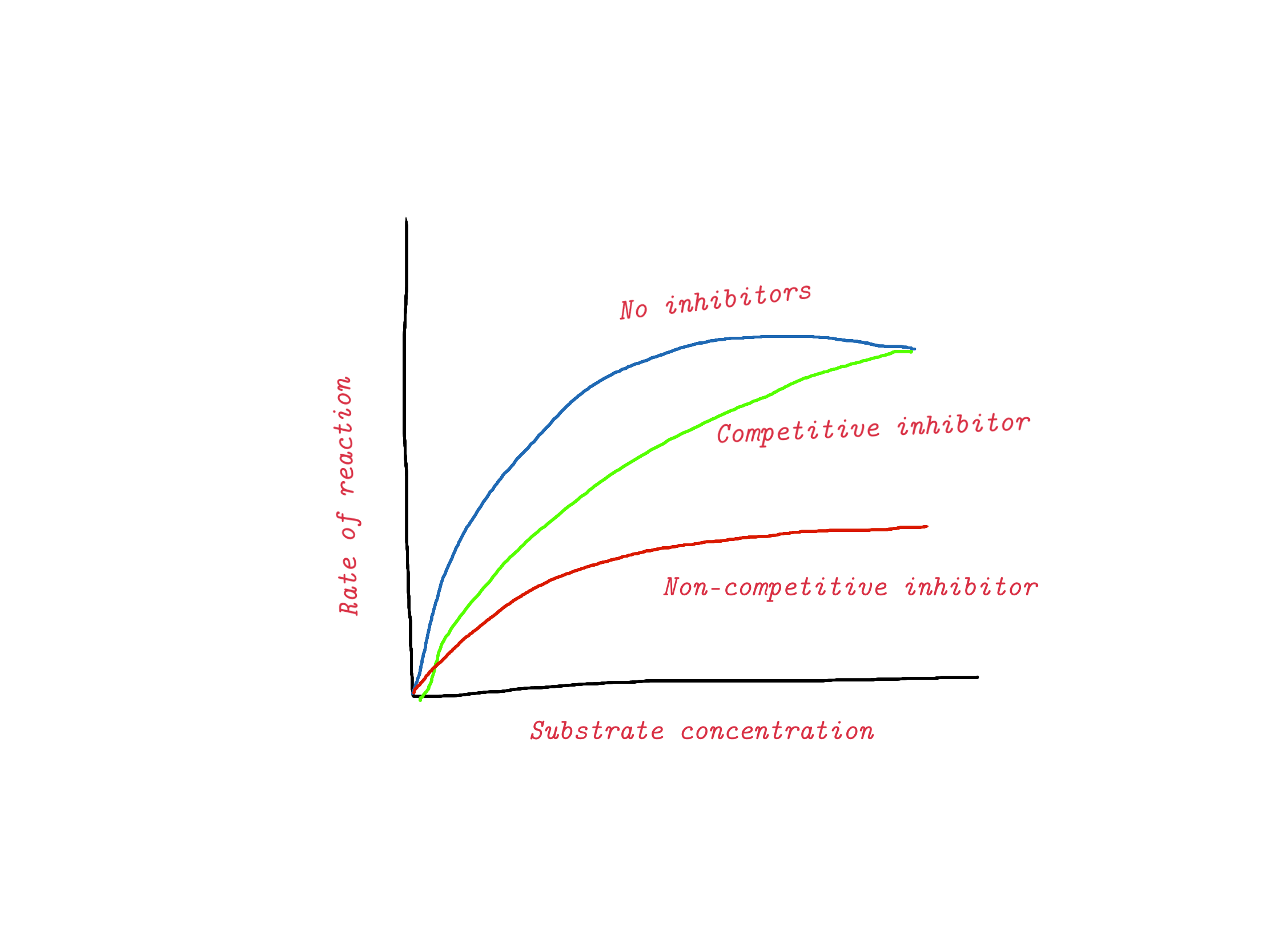
What is a competitive inhibitor and how does it reduce the rate of reactions?
Competitive inhibitors are similar in shape with the substrate and can bind to the active site.
Preventing substrates from being able to bind.
Reducing the rate of reaction.
How can you stop competitive inhibitors from competing with the substrates?
Increase conc. of substrate, so that it out-competes the inhibitors.
What are non-competitive inhibitors and why are they so bad?
Non-competitive inhibitors bind to an enzymes binding site and causes the active site to permanently change shape.
Causing the substrate to no longer be complimentary with the enzyme’s active site. And no longer for enzyme substrate complexes.
Increasing the conc. of substrate does nothing.
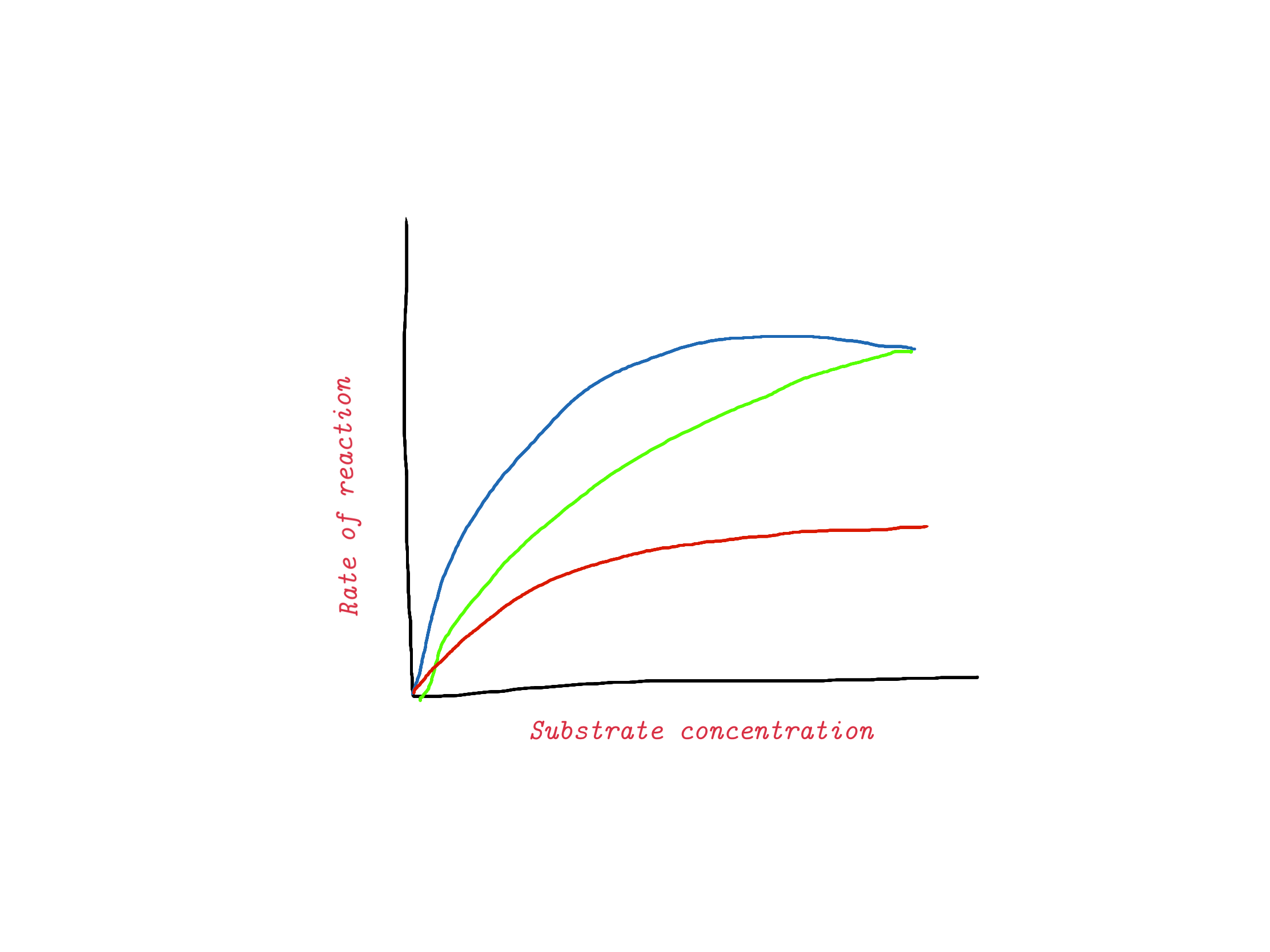
Label the lines on this graph
Give 2 examples of polymers of nucleic acids
Deoxyribonucleic acid (DNA)
Ribonucleic acid (RNA)
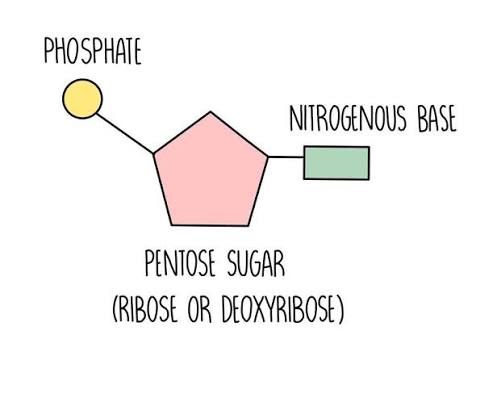
Draw and label the structure of a nucleotide ( both DNA and RNA)
What are the differences and similarities of DNA and RNA?
DNA has thymine bases, while RNA has uracil bases instead
DNA has deoxyribose Pentose sugar, while RNA has just ribose Pentose sugar
DNA is double stranded, while RNA is single stranded
DNA has a double helical shape, while RNA is linear
Explain what a polynucleotide is and how it’s formed
It is a polymer of nucleotides.
And is created via condensation reaction between the deoxyribose sugar and the phosphate group.
Forming phosphodiester bonds.
What are phosphodiester bonds and why are they important in creating polynucleotides?
Phosphodiester bonds are strong covalent bond.
Therefore help ensure the genetic code is not broken down.
Describe the structure of DNA (2 marks)
Two polynucleotide chains that form a double helix.
The 2 chains are held by hydrogen bonds between specific complementary nitrogenous bases.
What are the complimentary base pairs in DNA and RNA? And how many hydrogen bonds will form between them?
Cytosine and guanine will form 3 hydrogen bonds
Adenine and Thymine/Uracil will form 2 hydrogen bonds
How does the structure of DNA relate to its function or inportance? (5 marks)
Strong phosphodiester bonds,Strong sugar phosphate backbone
Double stranded, forms 2 template strands in semi conservative DNA replication
Weak hydrogen bonds between nitrogen bases, easy broken to form the 2 strands
Very large molecule,carry lots of genetic information
Complementary base pairing allows identical copied of DNA to be made
When does Semi-conservative DNA replication occurs in the cell cycle?
Before mitosis in the S phase
What does ‘semi’ mean in semi-conservative DNA replication
One strand is the original parent strand, and the other strand is newly synthesised
In the new daughter DNA
What are the 2 enzymes in semi-conservative DNA replication? And state their roles. (2 marks)
DNA helicase- hydrolyses the hydrogen bonds between the complementary bases
DNA polymerase- joins adjacent nucleotides, forming a phosphodiester bond via condensation
Describe the process of semi-conservative replication
DNA helicase hydrolyses the hydrogen bonds between the complementary bases, causes the polynucleotide strands to unwind.
Free DNA Nucleotides are attracted to the exposed bases on the template strands.
DNA polymerase joins adjacent nucleotides, forming phosphodiester bonds via condensation reactions.
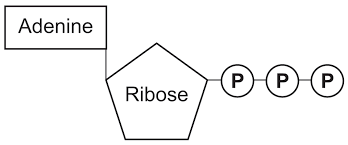
Draw and label the structure of ATP
Describe how ATP is broken down to release energy and resynthisized
ATP is hydrolysed by ATP hydrolase into ADP and an inorganic phosphate
Releasing energy
ATP is resynthesized by condensation reaction between ADP and an inorganic phosphate
What is the reversible reaction of ATP
ATP + Water ← → ADP + Pi +(energy)
Describe the structure of water
Water is a polar molecule and has uneven charge distribution
Where hydrogen is partially positive and oxygen is partially negative
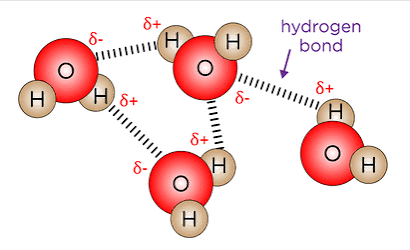
What are the 5 properties of water and how does it link to their importance? (6 marks)
Water can form hydrogen bonds between other water molecules
Strong cohesion between water molecules, Water can move as one mass (important in the xylem and transpiration). And provides surface tension when water meets the air.
Water is a metabolite and is used in condensation and hydrolysis reactions
A universal solvent as positive and negative ions can be dissolved
Has a high heat capacity, lots of energy is needed to raise the temperature of water by 1 degree Celsius (Buffered temperature changes and helps maintain body temperature)
Large latent heat of vaporisation (lots of energy is needed to vaporise water into a gas, so it provides a cooling effect as it evaporates)
What are 2 physical properties of water?
It’s transparent (let light shine through, important for aquatic plants to photosynthesis. E.g algae)
It’s denser than ice (so when a lake freezes only the top is frozen as ice is less dense than water, providing insulation for aquatic organisms below)
Where are 2 places inorganic ions can be found in?
The cytoplasm and bodily fluids
Give 4 example of ions and explain their importance (4 marks)
Hydrogen ions H+ affect pH
Iron irons Fe 2+. Found in haemoglobin, involved in oxygen transport
Sodium ions Na+. Used in the co-transport of glucose and amino acids
Phosphate ions PO4 3- Found in DNA and ATP, needed in the resynthesis of ATP