Chapter 1 : Fluid
 Call Kai
 Learn
Learn Practice Test
 Spaced Repetition
 Match
Match Flashcards
 Knowt Play
1/24

There's no tags or description
Looks like no tags are added yet.
Name | Mastery | Learn | Test | Matching | Spaced | Call with Kai |
|---|
No analytics yet
Send a link to your students to track their progress
25 Terms
Mechanic
The oldest physical science
that deals with both stationary and moving bodies
under the influence of forces
Sains fizikal yang tertua
yang mengkaji kedua-dua jasad pegun dan bergerak
di bawah pengaruh daya
Statics
The branch of mechanics that deals with bodies at rest.
Cabang mekanik yang mengkaji jasad pada keadaan rehat (pegun)
Dynamics
The branch that deals with bodies in motion.
Cabang yang mengkaji jasad dalam pergerakan.
Fluid mechanics
The science that deals with the behavior of fluids at rest (fluid statics)
or in motion (fluid dynamics)
and the interaction of fluids with solids or other fluids at the boundaries
Sains yang mengkaji kelakuan bendalir dalam keadaan pegun (statik bendalir)
atau dalam keadaan bergerak (dinamik bendalir)
serta interaksi bendalir dengan pepejal atau bendalir lain pada sempadan
Fluid
A solid can resist an applied shear stress by deforming.
A fluid deforms continuously under the influence of a shear stress, no matter how small.
When a constant shear force is applied, a solid eventually stops deforming at some fixed strain angle, whereas a fluid never stops deforming.
Pepejal boleh menahan tegasan ricih yang dikenakan dengan cara berubah bentuk
Bendalir akan berubah bentuk secara berterusan di bawah pengaruh tegasan ricih, walaupun sekecil mana pun
Apabila daya ricih malar dikenakan, pepejal akhirnya berhenti berubah bentuk pada sudut terikan tetap
Manakala bendalir tidak pernah berhenti berubah bentuk
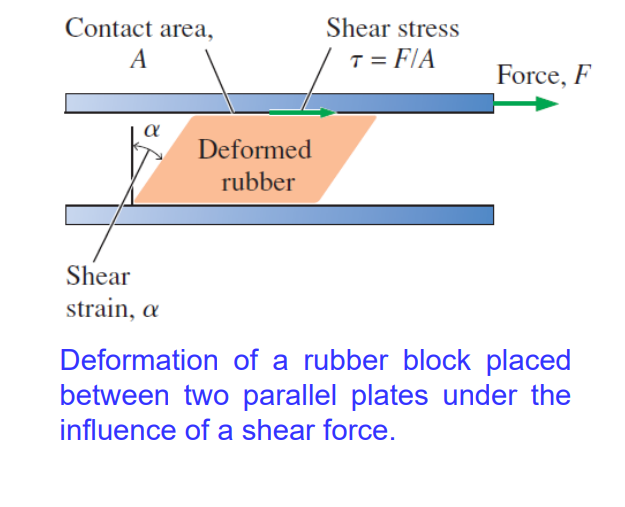
A solid can resist an applied shear stress by deforming.
Solid = “push me, I push back”
It may bend a bit, but then it holds shape and stops changing
Like rock or metal: you push → it resists → then becomes steady
A fluid deforms continuously under the influence of a shear stress, no matter how small.
Fluid = “push me, I keep moving”
Even tiny push makes it keep flowing forever
Like water or oil: always sliding, never staying fixed
When a constant shear force is applied, a solid eventually stops deforming at some fixed strain angle, whereas a fluid never stops deforming.
Solid: deform a bit → settle → stop changing shape
Fluid: deform → keep going → no stopping point
Solid has “end point” shape, fluid has “no final shape”
Stress
Force per unit area
P=F/A
P = pressure
F = force (N)
A = area (m²)
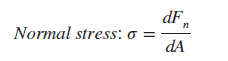
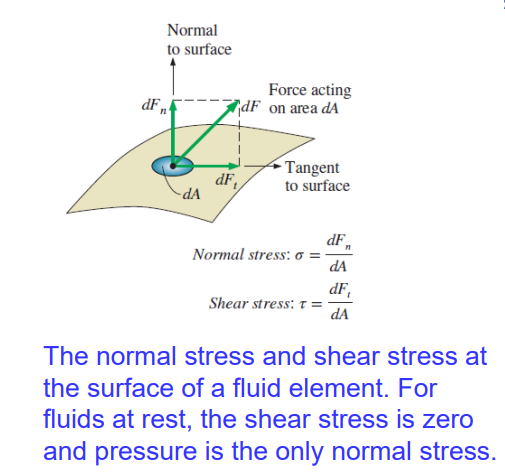
Normal stress
The normal component of a force acting on a surface per unit area.
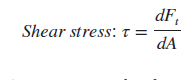
Shear stress
The tangential component of a force acting on a surface per unit area.
Pressure
The normal stress in a fluid at rest.
Zero shear stress
A fluid at rest is at a state of zero shear stress.
(Caveman explanation):
Fluid just sitting still = no side push inside it
No sliding layers, no rubbing force
So shear stress = zero
Fluid “chill mode” → nothing trying to drag or deform sideways
The NO-SLIP Condition
In fluid dynamics, the no-slip condition for viscous fluids assumes that at a solid boundary, the fluid will have zero velocity relative to the boundary
Particles close to a surface do not move along with a flow when adhesion is stronger than cohesion
At the fluid-solid interface, the force of attraction between the fluid particles and solid particles (adhesive forces) is greater than that between the fluid particles (cohesive forces)
Dalam dinamik bendalir, keadaan “no-slip condition” untuk bendalir likat mengandaikan bahawa pada sempadan pepejal, bendalir mempunyai halaju sifar relatif terhadap sempadan
Partikel yang dekat dengan permukaan tidak bergerak bersama aliran apabila daya lekatan (adhesion) lebih kuat daripada daya kohesi
Pada antara muka bendalir-pepejal, daya tarikan antara partikel bendalir dan pepejal (daya lekatan) lebih kuat daripada daya antara partikel bendalir sendiri (daya kohesi)
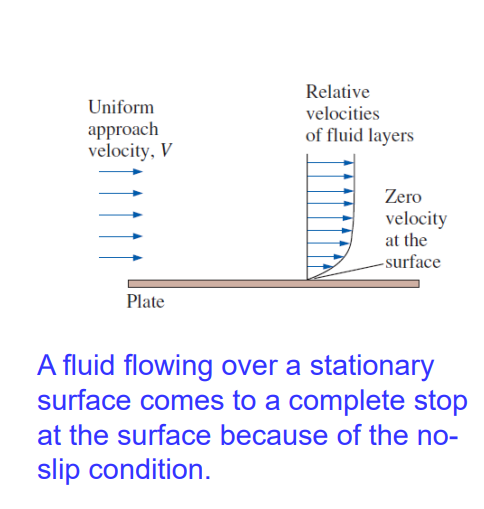
(Caveman explanation):
Wall + fluid meet
Fluid sticks to wall
At wall = fluid “no move” (speed = 0)
Layer above pulls it → next layer moves
So flow starts from zero at wall, then increases upward
External flow
The flow of an unbounded fluid over a surface such as a plate, a wire, or a pipe.
Aliran bendalir tak terhad di atas permukaan seperti plat, wayar, atau paip.
Internal flow
The flow in a pipe or duct if the fluid is completely bounded by solid surfaces.
Aliran dalam paip atau saluran jika bendalir sepenuhnya dikelilingi oleh permukaan pepejal.
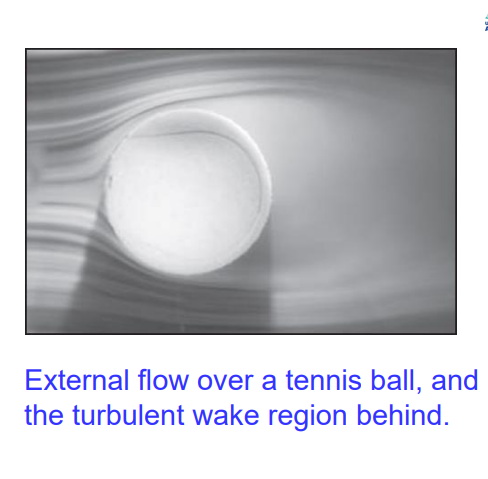
Water flow in a pipe is internal flow, and airflow over a ball is external flow .
The flow of liquids in a duct is called open-channel flow if the duct is only partially filled with the liquid and there is a free surface.
Aliran dalam paip atau saluran
di mana bendalir sepenuhnya dikelilingi oleh permukaan pepejal
(Caveman explanation):
Fluid trapped inside pipe
Wall all around
Fluid cannot escape
It only flows forward inside tube
Wall controls flow, not open space
Incompressible flow
If the density of flowing fluid remains nearly constant throughout (e.g., liquid flow).
Compressible flow
If the density of fluid changes during flow (e.g., highspeed gas flow)
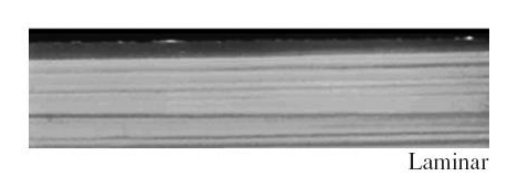
Laminar flow
The highly ordered fluid motion characterized by smooth layers of fluid. The flow of high-viscosity fluids such as oils at low velocities is typically laminar.
Pergerakan bendalir yang sangat teratur yang dicirikan oleh lapisan bendalir yang licin. Aliran bendalir berkelikatan tinggi seperti minyak pada halaju rendah biasanya adalah laminar.
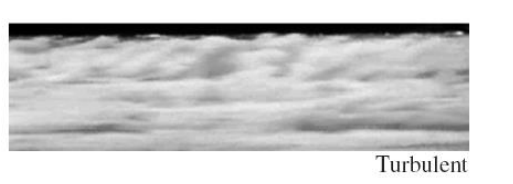
Turbulent flow
The highly disordered fluid motion that typically occurs at high velocities and is characterized by velocity fluctuations. The flow of lowviscosity fluids such as air at high velocities is typically turbulent.
Pergerakan bendalir yang sangat tidak teratur yang biasanya berlaku pada halaju tinggi dan dicirikan oleh turun naik halaju. Aliran bendalir berkelikatan rendah seperti udara pada halaju tinggi biasanya adalah turbulen.
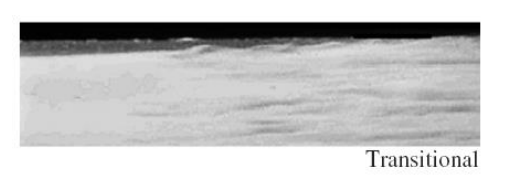
Transitional flow
A flow that alternates between being laminar and turbulent.
Natural flow
Fluid motion is due to natural means such as the buoyancy effect, which manifests itself as the rise of warmer (and thus lighter) fluid and the fall of cooler (and thus denser) fluid
Pergerakan bendalir berlaku secara semula jadi seperti kesan keapungan, yang menyebabkan bendalir yang lebih panas (dan lebih ringan) naik dan bendalir yang lebih sejuk (dan lebih tumpat) turun.
Force flow
A fluid is forced to flow over a surface or in a pipe by external means such as a pump or a fan.