P8 : Space Physics
 Call Kai
 Learn
Learn Practice Test
 Spaced Repetition
 Match
Match Flashcards
 Knowt Play
1/22

Earn XP
Description and Tags
Name | Mastery | Learn | Test | Matching | Spaced | Call with Kai | Chat |
|---|
No analytics yet
Send a link to your students to track their progress
23 Terms
What is the galaxy we live in?
Milky Way
What does our solar system consist of? (5)
A star (the sun)
8 Planets
Dwarf planets
Moons
Artificial Satellites
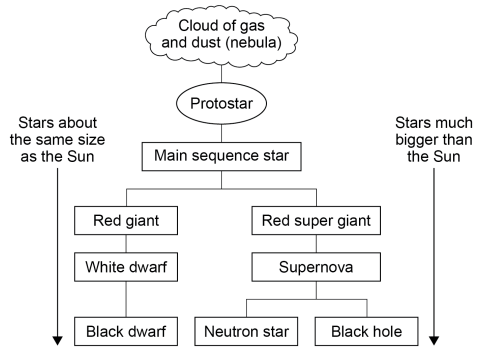
Describe the life cycle of a star
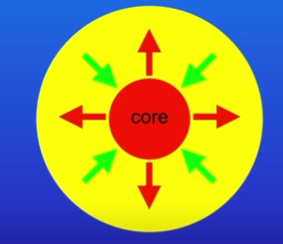
What do the green and red arrows represent and explain their effect on the star (2)
Green → force of gravity → acts inwards and makes the star collapse
Red → energy released from nuclear fusion → acts outwards and makes the star expand
Explain the formation of stars (give details) (8)
Stars form from clouds of dust and gas called a nebula → the gas is mainly hydrogen
Gravity causes the nebula to collapse. This causes the temperature rises as the star gets denser and more particles collide, forming a protostar.
When the temperature is high enough, hydrogen nuclei undergo nuclear fusion to form helium nuclei and more elements
This gives out lots of energy
The star then enters a long stable period where the outward pressure caused by the nuclear fusion tried to expand the star balances the force of gravity pulling everything inwards
This is called a main sequence star and it lasts billions of years.
Eventually the hydrogen begins to run out, the star then swells into a red giant or a red super giant depending on its size.
It becomes red because the surface cools, fusion of helium occurs and heavier elements are created in the core of the star
Explain what type of giant planet is formed after a main sequence star if the planet is the same size/smaller than the sun (4)
If a planet is the same size/smaller than the sun it will form a red giant
A small to medium sized star like the sun then becomes unstable and ejects its outer layer of dust and gas
This leaves behind a hot, dense solid core called a white dwarf
As the white dwarf cools down it emits less and less energy and when it stops emitting energy it is called a black dwarf
Explain what type of giant planet is formed after a main sequence star if the planet is larger than the sun (5)
If a planet is larger than the sun it will form a red super giant
It then starts to glow brightly as it undergoes more fusion and expand and contracts several times, forming heavy elements such as iron
Eventually they’ll explode in a supernova, forming elements heavier than iron and ejecting them into the universe to form new planets and stars
The exploding supernova throws outer layers of dust and gas into space leaving a very dense core called a neutron star.
If the star is massive enough it will become a black hole, a super dense point in space that not even light can escape from
How do planets orbit the sun?
In an elliptical orbit (not a perfect circle)
What are the 2 types of satellites + give examples
Natural satellite → moon
Artificial satellite → man made (something NASA or Elon Musk have made)
What do planets orbit?
The sun
What do moons orbit?
Planets
What holds planets/satellites in their orbits?
The force of gravity
What does/doesn’t the force of gravity change when a satellite orbits the earth + what does this lead to? (3)
It changes the velocity as the direction is changing
But speed is not changing
This leads to the satellite constantly accelerating due to the force of gravity
What happens to the radius of orbit if the satellite changes speed + why? (2)
Increase in speed → radius of orbit decrease because a greater force of gravity is needed to keep the satellite in orbit and prevent it from flying into space
Decrease in speed → radius of orbit increase
What is the difference in the wavelengths of light from distant galaxies compared to wavelength of light from closer galaxies?
Distant galaxies → increased (longer) wavelength
Closer galaxies → decreased (shorter) wavelength

On a spectrum why are there black lines?
Because certain elements in the sun absorb specific wavelengths of light
What is red-shift?
When lines on a spectrum have slightly shifted to the red end of the spectrum
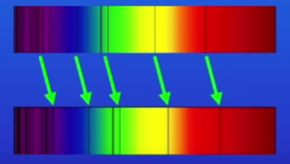
What does the red shift tell us?
Galaxies are moving away from each other
What happens to the light waves that make their way to earth?
They get stretched
What is the red shift of more distant galaxy + what does this tell us + how do we know? (3)
More distant galaxies have a larger red-shift
This tell us that they are moving away faster
We know this because when they move towards the red end of the spectrum the wavelength increases (red has the long wavelength)
What does the big bang theory suggest?
The universe began from a very small region that was extremely hot and dense which exploded and is expanding to this day
How does the red-shift prove the big bang theory? (2)
The big bang theory proposes the idea that the universe in expanding
Red shift proves that distant galaxies are moving away faster than nearby galaxies which means the universe is expanding
What do scientists think the universe is mostly made up + could be the possible reason for why the universe is expanding more faster than expected?
Dark matter
Dark energy