Introduction to Criminal Justice: Key Concepts and System Overview
 Call Kai
 Learn
Learn Practice Test
 Spaced Repetition
 Match
Match Flashcards
 Knowt Play
1/97

There's no tags or description
Looks like no tags are added yet.
Name | Mastery | Learn | Test | Matching | Spaced | Call with Kai |
|---|
No analytics yet
Send a link to your students to track their progress
98 Terms
What is the definition of criminal justice?
Criminal justice refers to the agencies that dispense justice and the process by which justice is carried out.
What are the three basic components of the criminal justice system?
Police, Courts, and Corrections.
What does social justice encompass?
Social justice embraces all aspects of civilized life and is linked to fairness and cultural beliefs of right and wrong.
What is civil justice?
Civil justice deals with fairness in relationships between citizens, government agencies, and businesses in private matters.
What is the significance of the Law Enforcement Assistance Administration?
It provided technical assistance and funding to state and local justice agencies between 1969 and 1982.
What is evidence-based justice?
Evidence-based justice uses the scientific method to determine whether criminal justice programs reduce crime rates and offender recidivism.
What is meant by the term 'criminal justice assembly line'?
It refers to the criminal justice system as a conveyor belt where cases flow through various decision points.
What are the stages of the formal criminal justice process?
The stages include Crime Committed, Initial Contact, Investigation, Arrest, Custody, Charging, Bail, Preliminary Hearing, Arraignment, Trial, Sentencing, and Appeal.
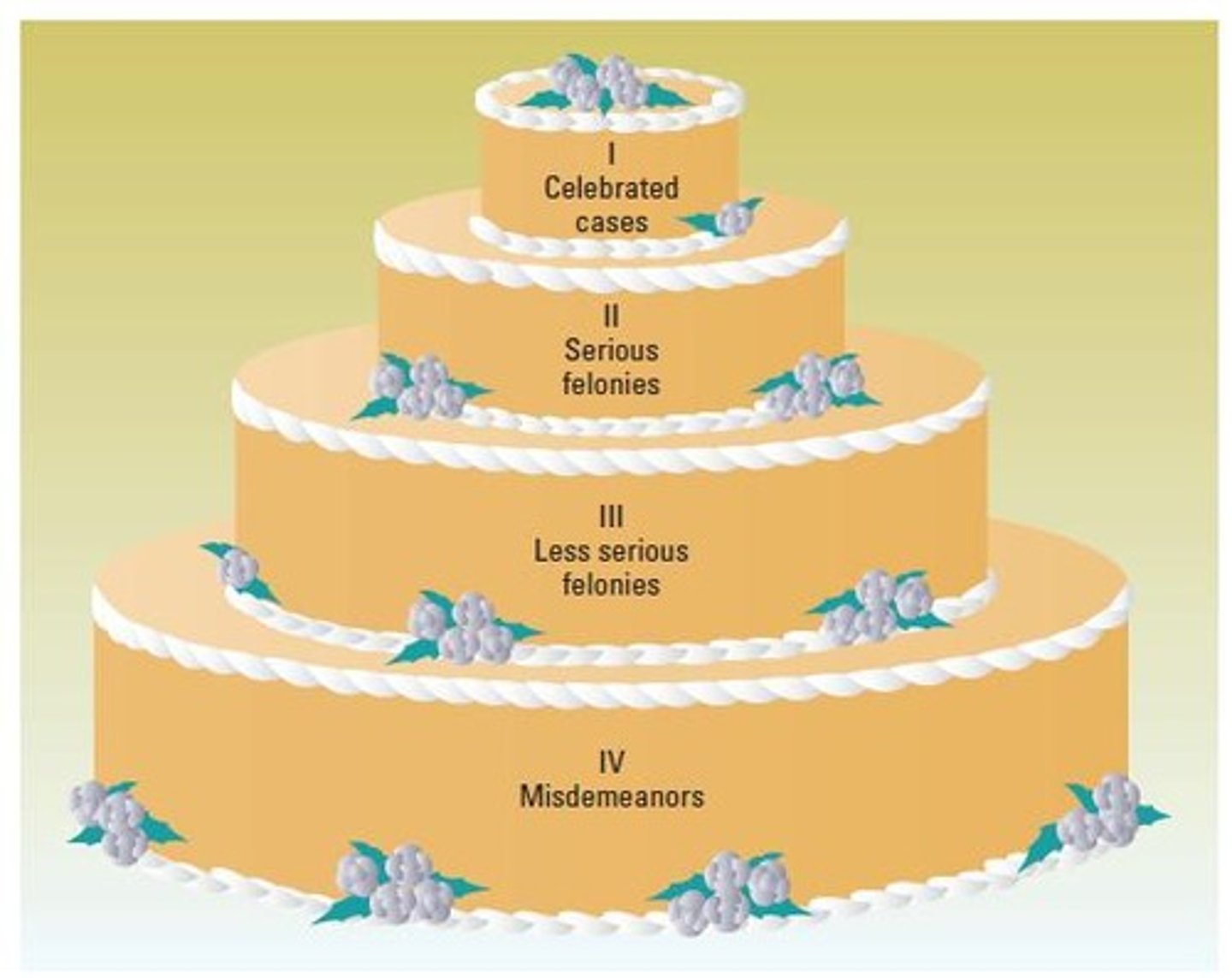
What is the wedding cake model of justice?
It illustrates how the criminal justice system prioritizes cases, with serious cases receiving more attention than less serious ones.
What is the role of the courtroom work group?
It implies that all parties in the justice process work together to settle cases efficiently rather than engaging in a true adversarial procedure.
Who are the members of the courtroom work group?
Judge, Jury, Prosecutor, Defense Attorney, Defendant, Court Clerk, Court Reporter, Bailiff, Sheriff, and Witnesses.
What does the crime control perspective emphasize?
It emphasizes the control of dangerous offenders and the protection of society through harsh punishment as a deterrent to crime.
What is the rehabilitation perspective on crime?
It views crime as an expression of frustration due to social inequality and focuses on counseling programs rather than punishment.
What does the due process perspective emphasize?
It emphasizes individual rights and constitutional safeguards against arbitrary judicial proceedings.
What is the nonintervention perspective?
It favors the least intrusive treatment possible, such as de-incarceration and diversion, to avoid stigma.
What is the equal justice perspective?
It focuses on making the criminal justice system equitable, ensuring that every person is treated equally.
What does the restorative justice perspective focus on?
It focuses on finding peaceful solutions to crime and stresses peacemaking rather than punishment.
What is the contemporary cost of the criminal justice system in the U.S.?
It costs federal, state, and local governments more than $260 billion per year.
How many people are arrested each year in the U.S.?
More than 11 million people are arrested each year.
What is the significance of plea bargaining in the criminal justice process?
Plea bargaining allows for the resolution of cases without a trial, often resulting in reduced sentences.
What are the potential consequences of errors in the criminal justice assembly line?
An innocent person may suffer or a dangerous individual may be released.
What is the impact of extralegal factors in the criminal justice process?
Extralegal factors such as race, gender, class, and age may influence decision outcomes.
What is the focus of the discussion question regarding funding for law enforcement?
It questions whether too much, too little, or the right amount of money is spent on crime compared to education.
What are the characteristics of high-profile cases in the wedding cake model?
High-profile cases receive the most attention from the justice system and media due to their serious nature.
What perspective on justice might explain the legalization of recreational marijuana?
The perspective that emphasizes social equity and the reduction of stigma associated with criminalization.
What ethical challenges does the justice system face?
Determining fairness and justice while protecting the public.
What does evidence suggest about monitoring sexual offenders?
It is not especially effective at lowering recidivism.
Why is ethics particularly important in law enforcement?
Law enforcement can deprive people of their liberty and has considerable discretion.
What role conflict may prosecutors experience?
Conflicting obligations between being an advocate for defendants and an officer of the court.
What ethical issues do correctional workers face?
They have significant coercive power and must not use excessive force.
What is the purpose of data in criminal justice?
To shape public policy, analyze programs, create new programs, plan laws, and develop funding requests.
What is the Uniform Crime Reports (UCR)?
A system that collects data on crimes known to police, initiated in 1930.
What types of crimes are included in the UCR Crime Index?
Part I offenses: violent crimes (murder, rape, robbery, assault) and property crimes (burglary, larceny, motor vehicle theft, arson).
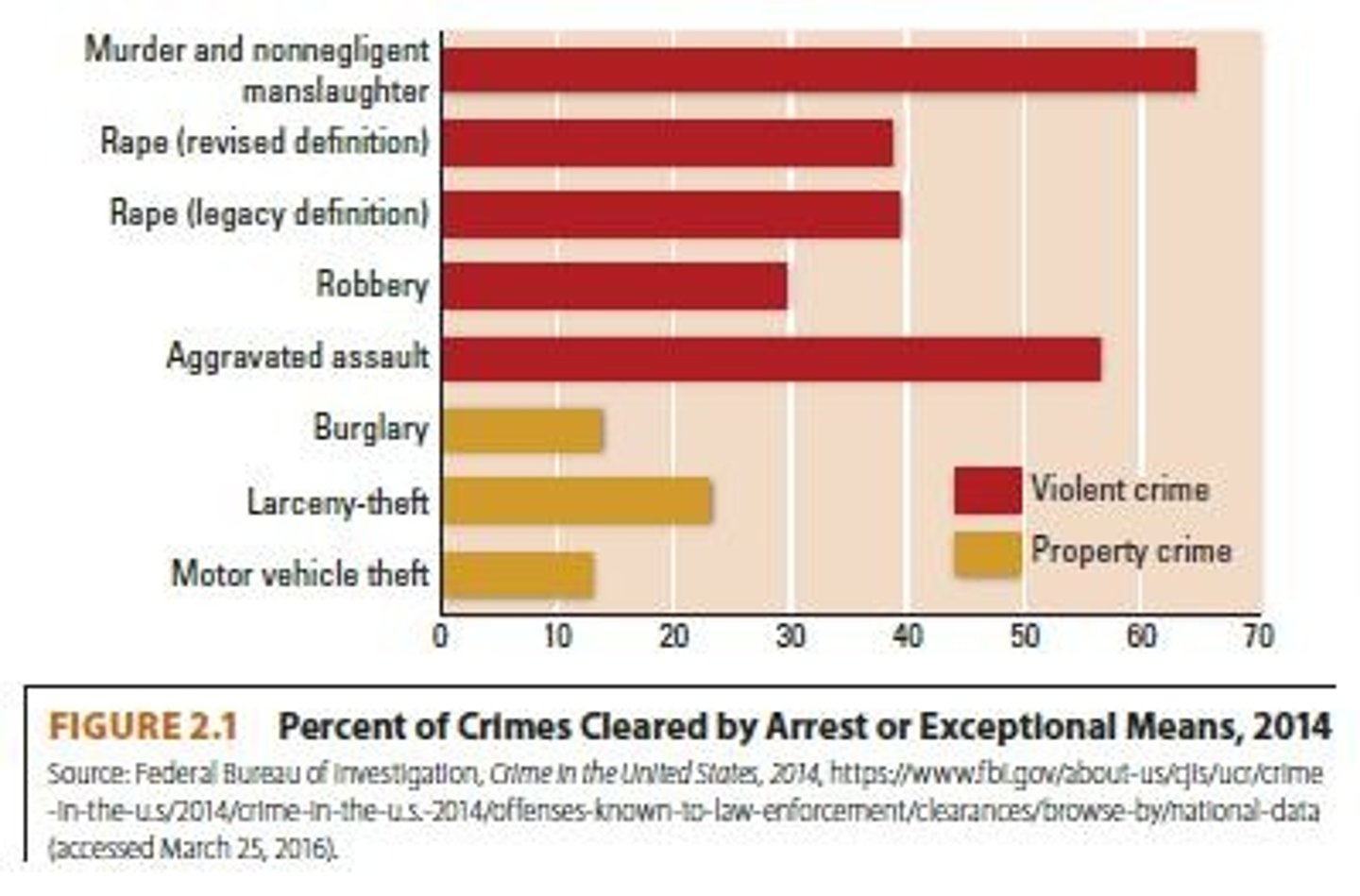
What is the clearance rate in the context of crime?
The number of crimes solved divided by the number of crimes committed.
What is the definition of murder?
The unlawful killing of a human being by another, excluding suicides and accidental deaths.
What are the characteristics of spree killings?
Two or more people killed on more than one occasion without a cooling-off period.
What defines a mass killing?
Three or more people killed in a single event by an offender who does not seek concealment.
What is forcible rape?
Carnal knowledge of a female forcibly and against her will, excluding male victims and statutory rape.
Why is forcible rape considered underreported?
Victims may fear police ineffectiveness, embarrassment, or further victimization.
What is robbery?
The unlawful taking of property from another by force or fear, excluding pickpocketing.
What demographics are most commonly arrested for robbery?
90% male, 62% under age 25, and 56% minorities.
What constitutes aggravated assault?
Unlawful inflicting of serious injury, including attempted assaults with deadly weapons.
What is burglary?
Unlawful entry of a structure to commit a felony or theft.
What are the types of burglaries?
Forcible entry, unlawful entry without force, and attempted forcible entry.
What is larceny-theft?
Unlawful taking or attempted taking of property from another's possession, excluding motor vehicle theft.
What is identity theft?
A crime where an imposter obtains key personal information to commit fraud.
What is motor vehicle theft?
The theft or attempted theft of a self-propelled vehicle, excluding trains and airplanes.
What is carjacking?
The taking of a motor vehicle directly from the owner by force, classified as robbery.
What is arson?
The burning or attempted burning of property, with or without intent to defraud.
What is the most common type of arson?
The burning of structures.
What is the average loss due to arson?
$1 billion, with an average of $11,098 per incident.
What are Part II offenses?
Less serious offenses including simple assault, DUI, prostitution, vandalism, receiving stolen property, fraud, and embezzlement.
What does NIBRS stand for?
National Incident Based Reporting System.
When did the FBI start the NIBRS program?
In 1989.
What is the goal of NIBRS?
To enhance and improve crime data collection, analysis, and publication.
How many general offenses does NIBRS include?
22 general offenses.
What is the purpose of the National Crime Victimization Survey (NCVS)?
To measure the 'dark figure' of crime based on victim self-reports.
What types of crime does the NCVS include data on?
Robbery, assault, burglary, personal and household larceny, motor vehicle theft, and rape.
What percentage of households are touched by crime according to NCVS statistics?
15% of all households.
What are some problems associated with the UCR?
Not all crimes are reported, inaccuracies from victims, and bureaucratic influences.
What is a crime typology?
A classification of crimes along a particular dimension, such as legal categories or offender motivation.
What is the Violence Against Women Act (VAWA)?
An act that seeks to eliminate violence against women and provides federal funding for related services.
What is the primary demographic of stalking victims?
80% of stalking victims are women.
How do elderly crime victims differ from younger victims?
Elderly victims are more likely to be victims of property crime and face armed offenders.
What motivates hate crimes?
Hatred, bias, or prejudice based on race, color, religion, national origin, ethnicity, gender, or sexual orientation.
What percentage of hate crime incidents were motivated by race in 2004?
52.5%.
What defines corporate crime?
A violation of a criminal statute by a corporate entity or its representatives for the benefit of the corporation.
What is white-collar crime?
Nonviolent crime for financial gain committed by individuals in their professional capacity.
What is organized crime?
Unlawful activities by a highly organized group supplying illegal goods and services.
How many serious crimes involve the use of a handgun each year?
Approximately 1 million.
What is the Brady Handgun Violence Prevention Act?
An act requiring a 5-day waiting period and background checks before purchasing a handgun.
What has happened to the rate of drug-related crime since 1975?
It has more than tripled.
What is cybercrime?
Any crime perpetrated through the use of computer technology.
What is cyberterrorism?
A form of terrorism that uses high technology, especially computers and the Internet.
What factors may influence future crime trends?
Population demographics, immigration effects, economic conditions, and gun availability.
What is crime?
Conduct in violation of the criminal laws of a state, the federal government, or a local jurisdiction for which there is no legally acceptable justification or excuse.
What are the different views on crime?
Consensus View, Conflict View, and Interactionist View.
Define justice in the context of criminal justice.
The principle of fairness; the ideal of moral equity.
What does criminal justice refer to?
Agencies that dispense justice and the process by which justice is carried out.
What is the Criminal Justice Funnel?
A model illustrating the decreasing number of cases as they progress through the criminal justice system.
What are the basic divisions of the criminal justice system?
Law enforcement, courts, and corrections.
List the functions of the police.
Enforce the law, investigate crimes, apprehend offenders, reduce and prevent crime, maintain public order, ensure community safety, provide emergency services, and protect individual rights.
What are the functions of correctional agencies?
Carry out sentences, provide safe custody, protect the community, rehabilitate offenders, and respect legal rights.
What are the functions of criminal courts?
Conduct fair trials, decide cases, ensure due process, determine guilt, impose sentences, uphold the law, and protect rights.
Differentiate between civil law and criminal law.
Civil law deals with private rights and remedies, while criminal law pertains to offenses against the state.
What are the 15 stages of a felony case?
Crime committed, investigation, arrest, custody, Miranda warnings, charging, preliminary hearing, arraignment, bail, plea bargaining, trial, sentencing, appeal, correctional treatment, and release.
What are the six different perspectives on justice?
Crime Control, Rehabilitation, Due Process, Nonintervention, Equal Justice, and Restorative Justice.
What is social justice?
An ideal linked to fairness and cultural beliefs about right and wrong.
What is the ecology of crime?
The study of how crime is influenced by environmental factors.
Define violent crime.
Crimes that involve force or threat of force against individuals.
What is a hate crime?
Crimes motivated by hatred, bias, or prejudice against a person's characteristics.
What is larceny?
Theft or unlawful taking of someone else's property.
What is the difference between Part I and Part II offenses?
Part I offenses are more serious crimes, while Part II offenses are less serious.
What is the purpose of the Uniform Crime Reports (UCR)?
To provide a consistent measure of crime in the United States.
What are dark figures of crime?
Unreported crimes that are not captured in crime statistics.
What is tort law?
Laws pertaining to wrongful acts causing harm or injury not involving a breach of contract.
What are felonies?
Criminal offenses punishable by death or incarceration for at least one year.
What are misdemeanors?
Offenses punishable by incarceration for less than one year.