Lecture 3: Adaptations to land and lifecycle
 Call Kai
 Learn
Learn Practice Test
 Spaced Repetition
 Match
Match Flashcards
 Knowt Play
1/17

There's no tags or description
Looks like no tags are added yet.
Name | Mastery | Learn | Test | Matching | Spaced | Call with Kai |
|---|
No analytics yet
Send a link to your students to track their progress
18 Terms
List the 4 challenges aquatic plants had to place in order for plants to colonize land (learning obj #1)
Adapt to dry, high light (“xeric”) conditions
Develop transport systems for water and nutrients
Develop structural support
Find new ways to disperse reproductive cells and progeny
List the 7 adaptations that allowed ancestors of plant to begin to grow on land (learning obj #2)
Cuticle, a waxy coating that slows water loss
Stomata, closable openings that regulate gas exchange (most lineages)
Pigments that protect against UV radiation and increase photosynthesis efficiency
Spores with thick walls containing sporopollenin
A mutually beneficial association with fungi (mycorrhizae) that promotes nutrient uptake from the soil
Gametangia, (singular: gametangium) are organs that enclose gametes and prevent them from drying out:
Embryos, young plants contained within a protective structure.
what is the function of spores with a thick sporopollenin wall?
sporopollenin wall protects spores from drying out and decaying

define Mycorrhizae
association with fungi that provide nutrients to plants
what are the subgroups of mycorrhizae?
Mycorrhizae: Fungi associated with underground plant parts (roots).
Ectomycorrhizal (EM) fungi wrap themselves around the plant, increasing surface area for water and mineral absorption.
Vesicular-arbuscular mycorrhizal (VA) fungi grow into root cells & exchange water & nutrients
define apical growth
found in certain streptophyte algae- ability to grow by elongation, and branch
Embryos are found in all land plants, and the land plant clade is called …..
“Embryophyta”
define Gametangia, (singular: gametangium
sex organ that produces gametes (sperm and eggs) in gametophyte stage.
define embryo
young plants contained within a protective structure.
define cuticle
a waxy coating that slows water loss
define stromata
closeable openings that regulate gas exchange
what is the function of pigments
protect against UV radiation and increase photosynthesis efficiency
draw alternation of generations
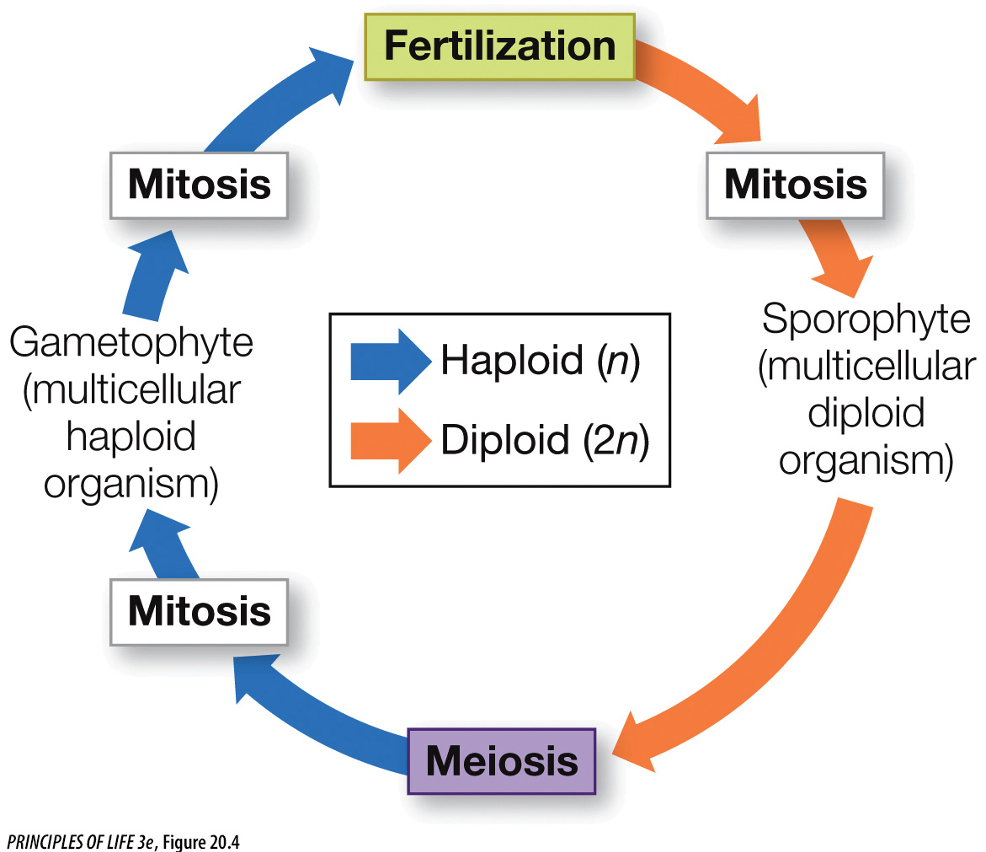
define gametophyte
the multicellular haploid phase that produces the gametes. (Contrast with sporophyte.)
what are the two types of gametangia?
antheridia - make sperm
archegonia - which make eggs
define sporophyte
the diploid phase that produces the spores. (Contrast with gametophyte.)
define sporangium (plural: sporangia)
Sex organ that produces spores in sporophyte stage
List the 6 steps in the alternation of generations
Spores grow to produce haploid multicellular gametophytes, that make gametes by mitosis in gametangia.
There are two types of gametangia, antheridia, which make sperm, and archegonia, which make eggs.
Eggs are fertilized by sperm to form diploid zygotes.
The diploid zygote develops by mitosis into a multicellular embryo, which eventually grows into a mature diploid plant.
This multicellular diploid plant is called the sporophyte. It forms spore-producing sporangia (singular: sporangium).
Cells in sporangia produce haploid spores by meiosis.