test 2 ._.
 Call Kai
 Learn
Learn Practice Test
 Spaced Repetition
 Match
Match Flashcards
 Knowt Play
1/507

There's no tags or description
Looks like no tags are added yet.
Name | Mastery | Learn | Test | Matching | Spaced | Call with Kai |
|---|
No analytics yet
Send a link to your students to track their progress
508 Terms
functions of the nervous system
they encode, process, and store a wide variety of information from the external and internal environments and they used that information to control and regulate the physiology and behavior of the organism.
what is a neuron
a nerve cell
what do all neurons have in common
they all generate and conduct electric signals
what are the type major types of glia
macroglia
microglia
what is macroglia
macroglia support and modulate the functions of neurons
what is microglia
phagocytic cells derived from blood-forming stem cells, they are motile and are the first and major immune defense mechanism in the nervous system
what are the two types of nervous systems
central nervous system (CNS)
peripheral nervous system (PNS)
what does the central nervous system do
the central nervous system has lots of densely populated neurons that process and store information and generate commands
what is the central nervous system
the brain and spinal cord
what does the peripheral nervous system do
it provides communication between the central nervous system and all the rest of the body
how do new neurons form
the neural tube contains rapidly dividing neuronal stem cells. Division is usually symmetrical - all stem cells. but it can be asymmetrical - one stem cell, neuroblast or gliablast (progenitor cells)
what do progenitor cells produce
progenitor cells like the neuroblasts and gliablasts produce the neurons and glia that together form the various structures of the nervous system
what are the four regions of the neuron
cell body
dendrites
axon
axon terminals
what is the cell body of the neuron
the cell body contains the nucleus and most of the cell’s organelles.
what is the dendrites of the neuron
dendrites are the shrub-like projections that extend from the cell body.
dendrites receive information from other neurons or sensory cells and bring it to the cell body
what are the axons of the neuron
in most neurons, one projection - the axon is much longer than the others.
Axons carry information from the cell body to target cells
what are the axon terminals of the neuron
the axon divides into a spray of fine nerve endings. the tips of these nerve endings have swellings called axon terminals
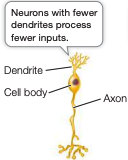
neurons with few dendrites
they receive information from specific and limited sources
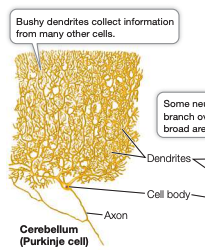
neurons with large array of dendrites
they can collect and integrate information from a wide range of sources
in all cells, where is the electric change negative
the electric charge on the inside of the neuronal cell membrane is slightly negative in comparison with the outside
what is an action potential (AP)
stimuli create electrical changes that travel along till the base of the cell’s axon, where a small change in membrane potential generates a large, rapidly reversed change in membrane potential
what happens when the action potential reaches the axon terminals
axon terminals come extremely close to the membrane of the target cell. here synapses transfers the information conveyed by the action potential from the presynaptic cell to the postsynaptic cell
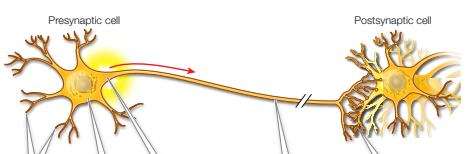
what are the type kinds of synapses
electrical
chemical
what do electrical synapses do
they allow the action potential to pass directly between two neurons
what do chemical synapses do
At chemical synapses, there is a small gap between the pre and postsynaptic membrane.
when an action potential arrives at an axon terminal it causes the release of neurotransmitters who diffuse across the synaptic space and bind to receptors on the cell membrane of the target cell.
types of macroglia
oligodendrocytes
schwann cells
astrocytes
ependymal cells
what are oligodendrocytes
they wrap around the axons of neurons of the brain and spinal cord, covering them with concentric layers of cell membranes . it prevents electric current from leaking out of the axon
what are schwann cells
schwann cells wrap around the axons for the peripheral nerves. it prevents the electric current from leaking out of the axon
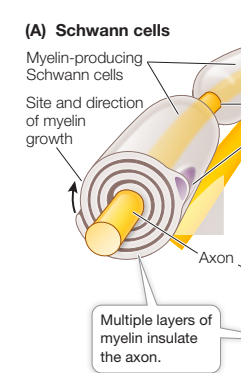
what is myelin
myelin is the wrapping produced by oligodendrocytes and schwann cells. cells that are myelinated conduct action potentials more rapidly than those without
what are epdendymal cells
it lines the central fluid-filled chambers in the brain called ventricles and produce the cerebrospinal fluid that bathes the brain and spinal cord
nodes of ranvier
at the intervals between schwann cells - the nodes of ranvier - the axon is exposed
what are astrocytes
it contributes to the blood-brain barrier that protects the brain from toxic chemicals in the blood.
why are astrocytes important
blood vessels throughout the body are very permeadble to many chemicals, including toxic ones. astrocytes surround the blood vessels in the brain
what is perivascular space
in the blood-brain barrier there is a small space between the membranes of the blood vessels and the astrocyte end-feet that surround them
the glymphatic system
interstitial fluid enters the brain through the perivascular spaces between blood vessels and the astrocytes that surround them. the astrocytes have aquaporins that enable them to take up fluid from the perivascular spaces and distribute it to the interstitial fluid compartment of the brain. that fluid leaves the brain through the perivascular spaces of the vein, taking metabolic waste products with it.
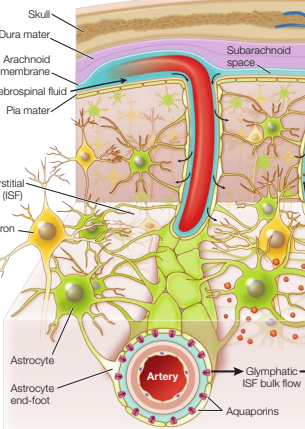
functions of astrocytes at the synapse
they can take up neurotransmitters
they can supply neurons with nutrients
they have signaling properties - release neurotransmitters
they aid in the repair and regeneration of neurons
they can signal changes in the composition of the blood
why is the inside of a cell more negative relative to the outside
this is due to the cell membrane being differentially permeable to certain ions. for neurons at rest, their membranes are most permeable to potassium, and that permeability is primarily responsible for the electric charge across their membranes.
what will happen because the concentration of potassium is higher inside the cell than out
potassium tends to diffuse out of the cell down its concentration gradient.
what happens when potassium leaks out of the cell
it leaves behind an unbalanced negative electric charge that tends to pull potassium back into the cell
what is membrane potential
the resulting charge difference across the membrane
resting potential
in neurons it is the steady-state membrane potential
what is action potential in terms of membrane potential
the action potential is a sudden, large, transcient change in membrane potential generated by sudden changes in permeability to sodium ions.
how is electric current carried in a solution
electric current is carried by ions
what are the major ions that carry electric charges across the cell membranes of neurons
sodium
potassium
calcium
chloride
what is resting potential in millivolts
-60 and - 70 mV
what does the resting potential allow to happen
this resting potential provides a means for a neuron to respond to stimuli.
if some determinant of this balance of forces is altered, the membrane potential will change.
what happens if physical or chemical stimulus changes the permeability of the cell membrane to ions
it will cause a change in the cell’s membrane potential
what would happen to the membrane potential if there was a sudden increase in the permeability of the membrane to sodium ions?
it would cause a change of the membrane potential in the positive direction. if that change in sodium permeability were transient, the membrane potential would rapidly return to resting. and such rapid change is an action potential
where are sodium ions most abundant
outside the cell
why do ions need transporters and channels to get into neuron cells
like any cell, the membrane are lipid bilayers that are impermeable to ions so they’ll contain protein molecules that serve as ion transporters and ion channels.
what does the sodium-potassium pump do
it actively expels sodium ions from inside the cell, exchanging them for potassium ions from outside the cell
what is the purpose of the sodium-potassium pump
it keeps the concentration of potassium inside the cell greater than the potassium concentration of the extracellular fluid, and the concentration of sodium inside the cell less than that of the extracellular fluid.
how do the concentration differences established by active transport relate to the electrical gradients
ion channels permit the diffusion of ions across membranes in either direction. the direction and magnitude of ion movement depend on the concentration gradient and on the voltage difference across that membrane
electrochemical gradient
the two motive forces (concentration and voltage differences) that drives the movement of ions through channels
potassium leak channels
an open channel which make resting neurons more permeable to potassium than to any other ion.
how are potassium leak channels responsible for the resting membrane potential
the combination of potassium leak channel and Na-K pumps keep potassium concentration higher inside than out. thus potassium tends to diffuse out of the cell but when they leave they leave behind unbalanced negative change, generating an electric potential which pull potassium back into the cell
potassium equilibrium potential
the membrane potential at which the net diffusion of potassium out of the cell ceases
(the diffusion out is balanced by inward movement)
what are the different types of gated ion channels
voltage-gated channels
chemically gated channels
mechanically gated channels
what are voltage-gated channels
ion channels that open or close in response to a change in the voltage across the cell membrane
what are chemically gated channels
ion channels that open or close depending on the presence or absence of a specific molecule that binds to the channel protein/ receptor
what are mechanically gated channels
ions channels that open or close in response to mechanical force applied to the cell membrane
opening and closing gated channels alters what?
openings and closings of gated channels alter the membrane potential
what happens when the sodium gated channel opens
sodium ions move down their electrochemical gradient until the membrane approaches the equilibrium potential for sodium which makes the inside of the cell less negative
what is a depolarized membrane
when the inside of a neuron becomes less negative (or more positive) than it is in its resting condition its cell membrane is depolarized
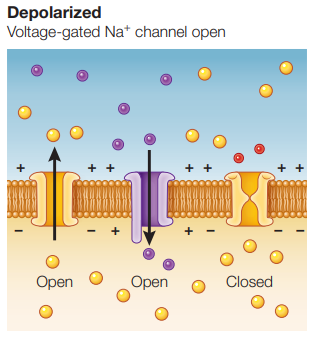
what happens when a gated potassium channel opens
potassium moves out of the cell, and the membrane potential becomes even more negative than when only the potassium leak channel were open
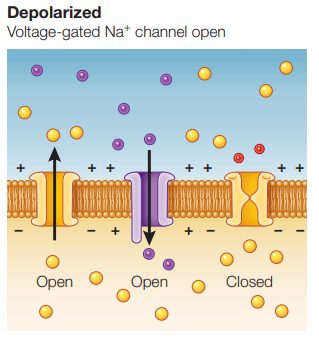
what is a hyperpolarized cell membrane
when the inside of a neuron becomes more negative than it is in its resting condition
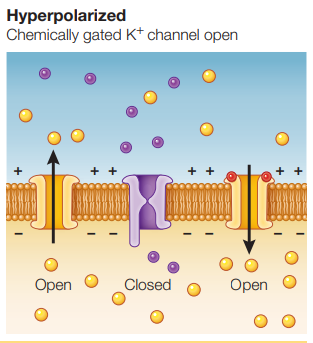
what are the basic mechanisms for how neurons respond to stimuli
the openings and closings of ion channels that result in changes in the voltage across the cell membrane
what do local changes in membrane potential cause
it causes a flow of ions that spreads the change in membrane potential to adjacent regions of the membrane.
what is a graded membrane potential
it is a change from the resting potential that is proportional to the magnitude of a stimulus
what are graded membrane potentials a means of
integrating stimuli because the membrane can respond with proportional amount of depolarization or hyperpolarization to each stimulus
limitations of graded membrane potential
the spread of graded potentials can only be local and cannot be transmitted down long axons
explain what happens to voltage when an action potential travels down the axon
at resting potential voltage differences would be ~60-~70mV. when an action potential travels down the axon, a rapid change in membrane potential occurs, going from ~-60mV to +50mV, followed by a rapid return to the resting level.
what are action potentials generated by?
the openings and closings of voltage gated sodium and potassium channels in the cell membrane of the axon
what can cause some voltage gated sodium channels to open
a slight depolarization of the membrane
where are voltage gated sodium channels most concentrated
at the axon hillock
what happens when a neuron is stimulated sufficiently
it causes the membrane of its ell body to depolarize slightly, that graded potential spread by local current flow to the axon hillock which causes some of the voltage gated channels to open briefly
what happens when the voltage gated channels are opened briefly
the increased sodium permeability depolarizes the membrane even more, causing more sodium channels to open
what is a threshold
when the membrane is depolarized about 5-10 mV above the resting potential
what happens when a threshold is hit
a large number of sodium channels open and the membrane potential becomes positive - an action potential
what causes the axon to return to resting potential after active potential
the voltage gated sodium channels close
voltage gated potassium channels open
how do the voltage gated potassium channels respond to depolarization
they open, but they do so more slowly and they stay open longer than the sodium channels
what happens when voltage gated potassium channels open
the membrane potential returns to a negative value and usually becomes even more negative than the resting potential until the channels close again
what is the refractory period of voltage gated sodium channels
it’s the 1-2 milliseconds during which the voltage gated sodium channels cannot open again
what are the two types of gates of voltage gated sodium channels
activation gate
inactivation gate
which gate is closed under resting conditions
an activation gate
which gate is open under resting conditions
an inactivation gate
how does the refractory period work
depolarization of the membrane to the threshold level causes both gates to change state, but the activation gate responds faster. Thus the activation channel is open along with the inactivation channel for a brief moment. the inactivation channel will then close briefly before spontaneously opening again.
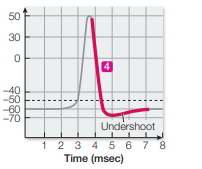
what is after-hyperpolarization or undershoot
the dip in the membrane potential following an action potential
what is an action potential that is an all-or-none event?
it is the process where slight depolarization of the membrane opens voltage gated sodium channels, leading to further depolarization through a positive-feedback mechanism and the generation of an action potential
what is an action potential that is self-regenerating
it spreads by local current flow to adjacent regions of the cell membrane. the resulting depolarization brings those neighboring areas of membrane to threshold. therefore when an AP occurs at one location, it stimulates an adjacent region to generate an AP and so on.
why do action potentials only propagate in one direction
it goes away from the cell body and cannot reverse itself because the voltage gated sodium channels in the region of the membrane it came from are in their refractory period
at what kinds of axons are action potentials conducted the fastest
they travel faster in large-diameter axons than in small-diameter axons
they travel faster in myelinated than in unmyelinated axons
why do action potential conduct faster in large-diameter axons
the resistance to ionic current flow decreases as an axon’s diameter gets bigger
why do axons conduct action potentials faster with myelinated axons
they can move down the axon in short jump.
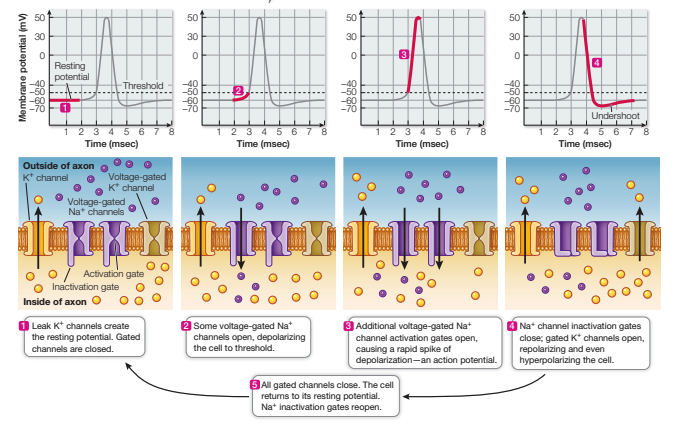
write out all phases of an action potential
leak potassium channels create the resting potential. Gated channels are closed.
some voltage gated sodium channels open, depolarizing the cell to threshold
additional voltage gated sodium channel activation gates open causing a rapid spike of depolarization
sodium channel inactivation gates close; gated potassium channels open, repolarizing and even hyperpolarizing the cell.
all gated channels close. the cell returns to its resting potential
how are action potentials able to jump from node to node
Action potentials cannot propagate under the myelin sheath but jump from node to node (Nodes of Ranvier) as local electric fields spread quickly between them. Depolarization at one node leads to the depolarization of the next which triggers action potentials down the axon.
saltatory action potentials
action potentials jump from node to node in myelinated axons, allow faster transmission of information
how do saltatory action potentials work
a sodium channel opens, generating an action potential, that current is taken through the myelin and brings the next node to threshold
how do neurons communicate with each other and with other cells
neurons communicate at synapses
electrical synapses
common among invertebrates, the action potential spreads directly from presynaptic to postsynaptic