Bio test 7
 Call Kai
 Learn
Learn Practice Test
 Spaced Repetition
 Match
Match Flashcards
 Knowt Play
1/32

There's no tags or description
Looks like no tags are added yet.
Name | Mastery | Learn | Test | Matching | Spaced | Call with Kai |
|---|
No analytics yet
Send a link to your students to track their progress
33 Terms
Four supergroups that evolved from the early heterotrophic and photosynthetic eukaryotes
Excavata
SAR
Archaeplastida
Unikonta
Endosymbiosis
A symbiotic relationship in which one organism lives inside the body or cell of another organism
Much of eukaryotic diversity can be traced back to this
What were the earliest eukaryotic cells like
Unicellular
Structurally more complex cell than prokaryotes
Initial diversification in eukaryotes
Diverse eukaryotes were present by 1.8 billion years ago
Early eukaryotes had a nucleus, a membrane, and a cytoskeleton
What does the term algae refer to
All photosynthetic protists
What novel biological features evolved during the early diversification of eukaryotes
Complex multicellularity
Sexual life cycles
Eukaryotic photosynthesis
When did large multicellular eukaryotes appear in the fossil record
Ediacaran period
About 635-541 years ago
What does it mean that a eukaryote is a “combination” organism
Some of their genes and cell characteristics are derived from archaea, and others from bacteria
Endosymbiont theory
Suggests that mitochondria and plastids evolved from bacteria living inside larger cells
Endosymbiont
The cell that lives inside a host cell
Serial endosymbiosis hypothesis
Suggests that mitochondria and plastids evolved sequentially
Mitochondria arose initially and plastids evolved later
SImilarities between mitochondria/plastids and bacteria that support their endosymbiont origins
Similar splitting for cell replication
Similar ribosome structure
DNA forms a circular chromosome lacking histones
Excavata
Simpler protists
Includes parasites and photosynthetic species
SAR
Made up of Stramenopiles, Alveolates, and Rhizarians
Stramenopiles
Include important photosynthetic organisms
such as diatoms
Alveolates
Includes photosynthetic and important parasitic species
such as the cause for malaria
Rhizarians
Include many species of amoebas with threadlike pseudopodia
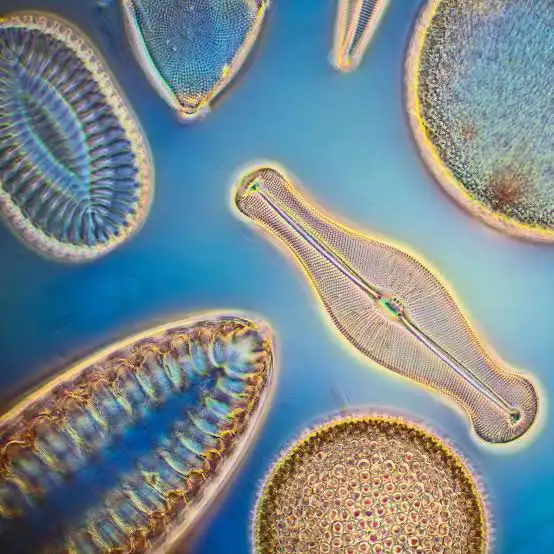
Diatoms
Microscopic, single-celled algae found in nearly all aquatic habitats
In the group Stramenopiles
Look like glass seashells
Archaeplastida
Precursors to plants
Most are photosynthetic
Species of red algae, green algae, and plants
Unikonta
Includes amoebas, animals, fungi, and non-amoeba protists
Excavata
Named for the excavated feeding groove found on one side of the cell body
Includes diplomonads, parabasalids, and euglenozoans
Most are found in anaerobic environments
Diplomonads
Derive energy from anaerobic biochemical pathways
Are often parasites (Giardia for example)
Move using flagella
Parabasalids
Generate some energy anaerobically and release hydrogen gas as a by-product
Euglenozoa
A diverse clade that includes predatory heterotrophs, photosynthetic autotrophs, and parasites
Their distinguishing feature is a rod with a spiral inside each flgellum