Week 9: Language production
 Call Kai
 Learn
Learn Practice Test
 Spaced Repetition
 Match
Match Flashcards
 Knowt Play
1/48

There's no tags or description
Looks like no tags are added yet.
Name | Mastery | Learn | Test | Matching | Spaced | Call with Kai |
|---|
No analytics yet
Send a link to your students to track their progress
49 Terms
What is the average speech production rate?
2-3 words per second, or 150 words per minute.
Name two strategies used to reduce processing demands when planning speech
Preformulation
Under specification
What is preformulation in speech production?
The production of phrases used before, such as 'a piece of cake' or 'under the weather'.
What does under specification refer to in speech?
The use of simplified expressions like '…or something' or '…and things like that'.
How does intoxication affect speech production?
Impairs attention, memory, thinking and reasoning
Produce more dysfluencies, e.g. stammering, stuttering
Slower speaking rate
Reduction in richness and creativity
What is the first stage of speech production?
Speech planning
What is a clause in speech production?
A part of the sentence containing a subject and a verb.
e.g. ‘The dog is sleeping’
What is a phrase in speech production?
A group of words that express a single idea.
e.g. ‘…on the bed’
What type of speech errors provide evidence of speech planning?
Errors at the clause level indicate that speech planning extends over the entire clause.
What is a word exchange error?
A type of speech error where words are swapped, indicating that speech planning extends over the entire clause.
e.g. ‘my room seems empty without my chair’ vs ‘my chair seems empty without my room’
What is meant by phrase level speech errors? What are the two conditions?
Phrase level: describe moving pictures. Two differing conditions:
Simple initial noun phrase, e.g. 'the tie moves'
Conjoined initial noun phrase, e.g. 'the tie and the candle move'
Name 6 speech errors
Word exchange
Sound (or phoneme) exchange
Spoonerism
Semantic substitution
Morpheme exchange
Number agreement
Describe the speech error sound (or phoneme) exchange
‘bedbugs’ vs ‘budbegs’
→ phoneme exchange
What is a spoonerism?
A speech error where the initial letters of two words are switched, e.g., 'shake a tower' instead of 'take a shower'.
What is semantic substitution in speech errors?
When a word is replaced by another with a similar meaning, e.g., 'cricket bat' vs 'racket'.
What is morpheme exchange in speech errors?
When inflections or suffixes are attached to the wrong words, e.g., 'he trunked two packs'.
What is number agreement in speech errors?
Errors related to whether a group is singular or plural, e.g., 'team has won' vs 'team have won'.
What are the two major theories of speech production?
Spreading-activation theory (Dell, 1986)
WEAVER ++ model (Levelt et al, 1999)
What is the spreading-activation theory of speech production?
A theory suggesting that processing occurs in parallel at different levels (semantic, lexical, phonological).
Categorical rules: impose constraints on items/categories that are acceptable at each level
Insertion rules: select items to be spoken, most highly activated nodes selected
→ processing occurs in parallel at different levels
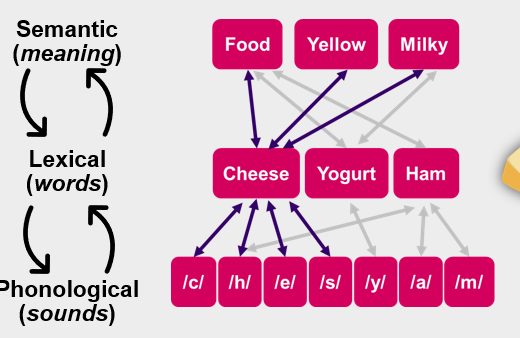
What are some strengths of the spreading-activation theory of speech production?
Levels of processing interact
Can account for several speech production errors
Link between speech production and other cognitive activities, e.g. word recognition
What are some limitations of the spreading-activation theory of speech production?
Extent interactive processes involved in speech production unclear
Occurs less when processing demands are high
What does the WEAVER++ model describe?
It describes word-form encoding by activation verification, with processing occurring in a serial fashion.
There are 3 levels: highest, second and lowest
Speech production proceeds from meaning (lexical selection/lemma) to sound (morphemes/phonemes
→ each processing stage occurs in seriation
What are the three main levels in the WEAVER++ model?
Lexical concepts,
Lemmas (abstract words)
Word forms (morphemes/phonemes).
Outline the process of speech production according to the WEAVER ++ model
Conceptual preparation
Lexical selection
Morphological encoding
Phonological encoding
Phonetic encoding
Articulation
What are the two types of aphasia?
Broca's aphasia
Wernicke's aphasia
What is Broca's aphasia?
Slow, non-fluent speech
Poor ability to produce syntactically correct sentences
Comprehension relatively intact
→ Problems with speech production
What are some strengths of the WEAVER ++ model?
Shift focus from speech errors and toward precise timing of production processes
Simple model that can make testable predictions
What are some limitations of the WEAVER ++ model?
Doesn’t allow interaction between different levels
Speech errors occurs more than model predicts
What is Wernicke's aphasia?
Also known as fluent or receptive aphasia
Fluent and grammatical speech
Speech often lacks meaning
→ Problems with speech comprehension
What are some limitations of neuropsychology and the connection to speech?
Same form of aphasia, but different impairments
Several different areas involved in language processing
Patients with Broca’s aphasia have damage to Wernicke’s area (and vice versa!)
Patients also have more general problems (attention/memory)
Name three specific cognitive impairments
Anomia
Agrammatism
Jargon aphasia
What is anomia? Name some factors involved with it
Impaired ability to name everyday objects, often experienced by all aphasics.
Problems with word retrieval
No problem with comprehension
Problems at phonological level
What is agrammatism?
Difficulties producing grammatically correct sentences
Short sentences with content words (nouns/verbs)
Omit function words (the, and, in) and word endings
Problems at lexical (syntax/grammar) levels
What is Jargon aphasia?
Speech grammatically correct but have difficulties accessing correct words
Substitute one word for another
Produce neologisms
Problems at phonological level
What is the importance of audience design in speech?
It involves taking into account the needs of listeners to ensure mutual understanding.
What is meant by common ground in the context of speech?
The shared knowledge, beliefs, and assumptions that participants in a conversation or public address take for granted, forming the foundation for effective communication
What is the difference between global and local in regards to the common ground of speech?
Global: preferred language, general knowledge, shared experiences
Local: attending to at a given moment
What are some limitations about common ground in the context of speech?
Very cognitively demanding: difficult for speakers to focus on listeners perspective while also planning what to say next
Individual differences
Speakers with high cognitive abilities can use more common ground
We often plan what to say without considering listeners perspective
What four factors are included to make common ground achievable in speech?
Syntactic priming
Gesture
Prosodic cues
Discourse markers
What is syntactic priming?
When a speaker copies words or phrases heard previously, influenced by the other person speaking.
→ tends to happen implicitly
What is the role of gesture within speech?
Assumed to increase ability to communicate with listener: listeners find it easier to understand
Also makes it easier to work-out what to say: use gestures even when we can't see the speaker
What are prosodic cues in speech?
Cues related to how something is uttered, including rhythm, stress, and intonation.
→ more likely to be provided when meaning is ambiguous
What are discourse markers in speech?
Words/phrases that are not directly relevant to the speaker's message
Speaker experiencing problems deciding what to say, e.g. ‘um…’, ‘er…’
Speaker checking that listener understands, e.g. ‘… you know’
What is the importance of written language in comparison to speech?
Written language leaves a trace, not transient like spoken language and so can be deciphered or analyses later
What is the dual-route model of spelling?
Posits that people use two distinct, parallel cognitive pathways to process words: a lexical route for familiar words based on memory, and a non-lexical (or phonological) route for unfamiliar words or non-words using sound-to-letter rules
What are common spelling errors analysed in cognitive neuropsychology?
Errors include substitutions, transpositions, omissions, and additions.
What does the case study of patients with aphasia reveal?
It shows that different areas of the brain are involved in language processing and that impairments can vary significantly.
Provide four example errors of spelling
Substitutions: e.g colore → conore (colour)
Transpositions: e.g. denaro → derano (money)
Omissions: e.g. nostro → nosro (ours)
Addition: e.g. fritto → frritto (fried)
What is the issue with double errors within spelling?
Most common error with double letters was shifting the double feature to another position
Concluded that letter identity and quantity are stored independently and can therefore be dissociated and reassigned incorrectly