CH 8 - Emotion and Motivation
 Call Kai
 Learn
Learn Practice Test
 Spaced Repetition
 Match
Match Flashcards
 Knowt Play
1/50

There's no tags or description
Looks like no tags are added yet.
Name | Mastery | Learn | Test | Matching | Spaced | Call with Kai |
|---|
No analytics yet
Send a link to your students to track their progress
51 Terms
emotion is a [temporary / permanent] state involving [objective / subjective] experiences such as _____. it has _____ and _____ features
[temporary] [subjective] [appraisals] [mental] [physical]
appraisal (def)
conscious and unconscious evaluations/interpretations of emotionally-relevant stimuli
action tendencies (def + example)
readiness to engage in specific emotion-relevant behaviours
anger → approach
disgust → avoid
fear → freeze / run
measurement of studying feelings
measuring reported closeness of one feeling to another
map-of-emotions / feeling-scape (def + dimensions)
maps location+distance between emotions
dimensions:
valence (X-AXIS: positive/negative)
arousal (Y-AXIS: active/passive (high arousal/low arousal))
2 theories explaining how we experience emotion
james-lange theory
cannon-bard theory
james-lange theory
explains how emotion is experienced
stimuli triggers ANS → produces emotional response
emotions arise as product of bodily reactions
cannon-bard theory
explains how emotion is experienced
emotions occur simultaneously, but INDEPENDENTLY of physiological activity
stanley schachter / jerome singer’s two-factory theory
stimuli triggers physiological arousal → mind then interprets it as emotion
interpretation differs based on circumstance
capilano bridge study (theory it supports)
stanley schachter and jerome singer’s two-factor theory
fear is interpreted as romantic arousal
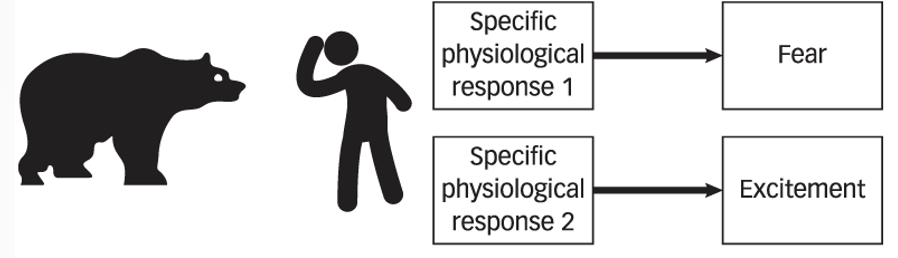
what theory does this diagram represent and why?
james-lange theory: emotion is directly interpreted as a response to the physiological reaction
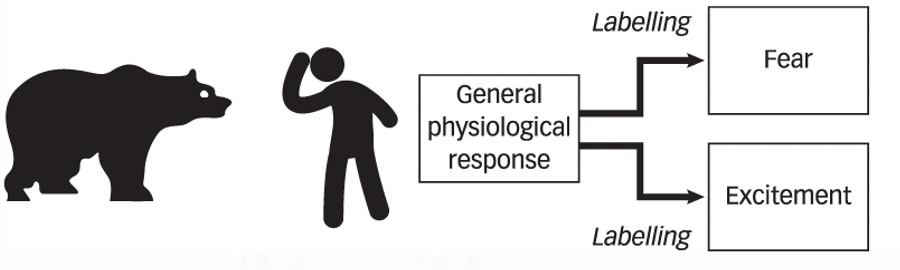
what theory does this diagram represent and why?
two-factor theory: cognitive thinking labels the emotion based on situation and physiological response (appraisal)
amygdala’s role
emotional - threat detector
works in appraisal (evaluation of emotional response to stimulus)
fast vs slow pathways
fast vs slow pathway of emotion (through the brain)
fast: thalamus → amygdala
slow: thalamus → cortex → amygdala
emotional expression
observable sign of emotional state (facial expressions, voice)
universality hypothesis
emotional expressions mean/are interpreted universally
list the 5 universal emotions
anger
disgust
fear
happiness
sadness
_____ cause emotional expressions
[emotions]
facial feedback hypothesis
emotional expressions can cause the emotional experiences they signify
contraction of the muscles is involved
mimicry
individual using their own emotions to identify others’ emotions
display rules (def + technique list)
norms for control of appropriate emotional expression (rules vary per culture)
intensification: exaggerating expression
deintensification: muting expression
masking: expressing one emotion while feeling another
neutralizing: no expression of the emotion (poker face)
telling lies affects _____ and _____ behaviour
[verbal] [nonverbal]
motivation (def)
internal causes of purposeful behaviour
instincts
emotions
drives / drive-reduction theory
hedonic principle, primary motivation
instinct (def)
william james - innate tendency to seek goals are instincts
concept rejected by behaviourists
2 ways emotions move human beings
provide information (helps decision-making)
provide objectives (to strive towards)
drives
internal state generated by physiological needs
homeostasis
drive-reduction theory
drive-reduction theory
theory suggesting organisms are motivated to reduce their drives
driven by reduction of drive - motivated to satisfy the need
homeostasis
stable set of conditions a system must maintain for efficient functioning
hedonic principle
motivation to experience pleasure, avoid pain
plato and aristotle
primary motivation
to feel good rather than bad
emotion regulation
use of cognitive and behavioural strategies to influence one’s emotional experience
reappraisal
changing one’s emotional experience by changing the stimulus’ meaning (alternate interpretation)
motivated body hierarchy (def, levels, founder)
abraham maslow - motivation to fulfill need hierarchy
some needs are more urgent (physiological)
BOTTOM TO TOP: physiological needs → safety/security → belongingness/love needs → esteem needs → self-actualization need
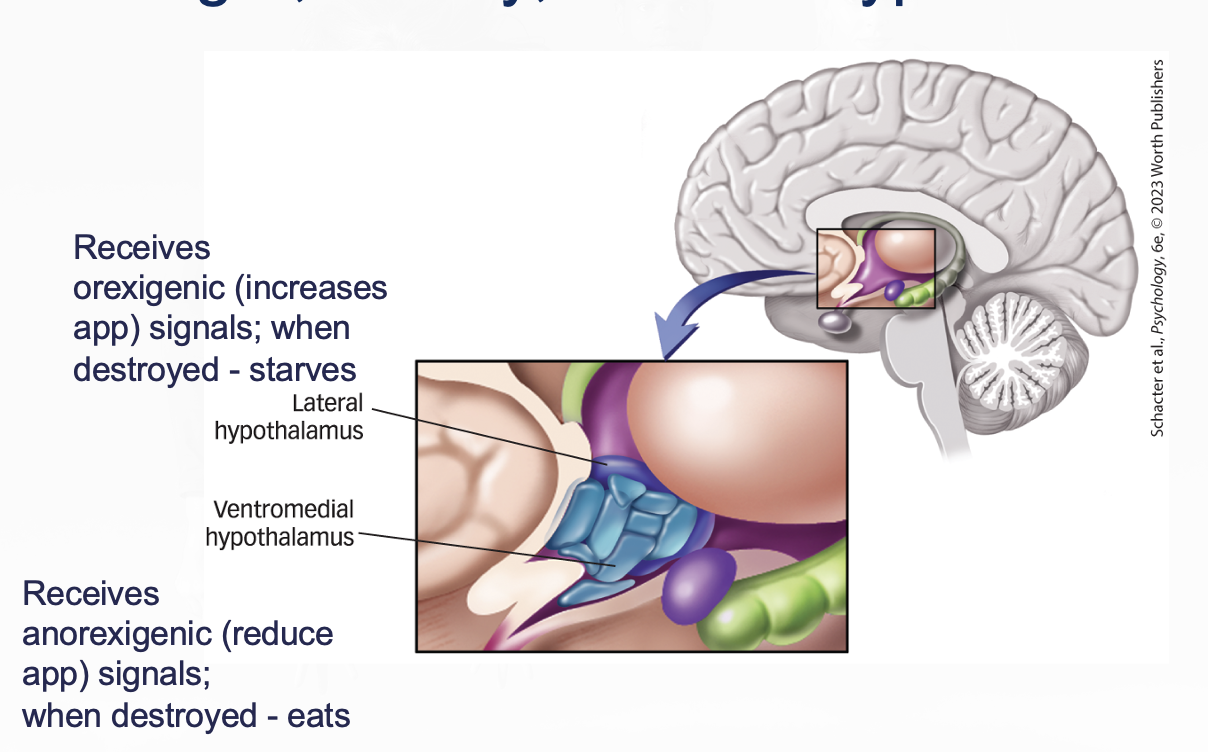
hunger: orexigenic vs anorexigenic
orexigenic
switches ON hunger - LATERAL HYPOTHALAMUS
ghrelin hormone
anorexigenic
switches OFF hunger - VENTROMEDIAL HYPOTHALAMUS
leptin hormone
eating disorders (list 3, brief desc)
binge eating disorder (BED)
uncontrolled episodes of eating large amt in short time periods
most common
bulimia nervosa
binge eating followed by purging
anorexia nervosa
intense fear, severe restriction of food intake
least common, highest mortality rates
obesity (BMI, causes)
BMI over/equal to 30 - most pervasive eating-related problem in canada
causes: genes, toxins, leptin-resistance, lack of exercise/overeating
how does evolutionary mismatch impact development of problems like obesity?
adaptive traits in ancestral environments are maladaptive in modern, sedentary lifestyle environments
how does the body resist weight loss?
fat cells are added during weight gain
added fat cells can only decrease in size, not number
dieting decreases one’s metabolism as a survival instinct
three hormones playing key role in sexual desire
DHEA (dehyroepiandrosterone)
testosterone
estrogen
fertility clues in animals VS humans
animals: female animals display ovulation indicators → mate-guarding
humans: female humans’ sexual interest is not limited to ovulatory cycle
____ may be the hormonal basis of sexual motivation in human males and females
[testosterone]
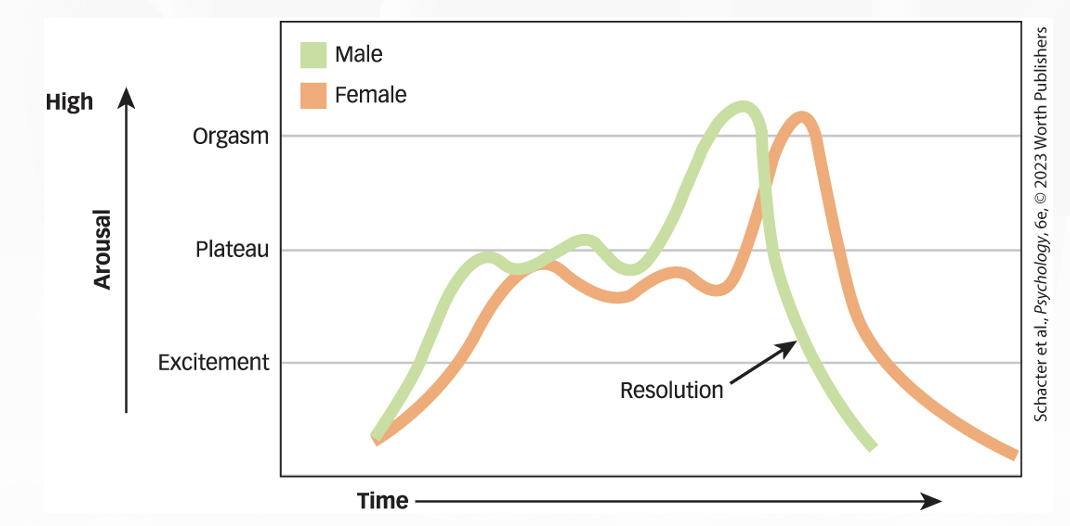
human sexual response cycle (def, phases)
stages of physiological arousal during sexual activity
phases:
excitement
plateau
orgasm
resolution
biological vs psychological motivations (examples) (3 dimensions)
biological:
food, sex, sleep, oxygen
psychological:
unique, limitless
dimensions
extrinsic/intrinsic
conscious/unconscious
approach/avoidance
psychological motivations: intrinsic vs extrinsic
intrinsic motivation: motivated to take actions that are inherently rewarding / fun / satisfying
overjustification effect: extrinsic rewards undermine intrinsic motivation
extrinsic motivation: motivation to take actions that are not rewarding, but lead to a reward
delayed gratification
psychological motivations: conscious vs unconscious
conscious motivation: individual is aware
easy actions → general motivation
difficult actions → more specific motivation targeted within
unconscious motivation: individual is not aware
achievement motivation: desire to experience sense of accomplishment through meeting one’s goal
psychological motivations: approach vs avoidance, loss aversion
approach motivation: motivated to experience positive outcomes
promotion focus
avoidance motivation: motivated to not experience negative outcomes
powerful, risktaking to avoid loss
prevention focus
loss aversion: tendency to care more about avoiding loss than achieving equal-size gain
what is stronger: avoidance motivation or approach motivation?
avoidance motivation
emotion (def)
temporary state involving subjective experiences (appraisals), physiological activity
mental and physical features
appraisal
cognitive, subjective evaluation of a situation or event, which determines an individual's emotional and behavioral response
assigns meaning
feelings are studied by…
measurement of reported closeness of one feeling to another
map of emotions (feeling-scape)
estimates location and difference between emotions
valence dimension (positive/negative)
arousal (active/passive)