IDU PRM flashcards
0.0(0)
Studied by 2 people Call Kai
 Learn
Learn Practice Test
 Spaced Repetition
 Match
Match Flashcards
 Knowt Play
Card Sorting
1/56

Earn XP
Description and Tags
The Interdisciplinary pre-release material 2023 on electric vehicles
Last updated 1:55 PM on 4/23/23
Name | Mastery | Learn | Test | Matching | Spaced | Call with Kai |
|---|
No analytics yet
Send a link to your students to track their progress
57 Terms
1
New cards
What is EV30@30-PRM1
Global campaign to transition to electric vehicles by 2030
2
New cards
EV30@30 for germany and netherlands-PRM1
One hundered percent of new car sales will be electric
3
New cards
Why are electric cars important: a Greener Future-PRM1
they can drive for 1000km, more affordable and significantly reduce air and water pollution and reduce the dependence of fossil fuels
4
New cards
what do electric cars work on/ how do they work-PRM1
Rechanrgeable batteries and electricity supply
5
New cards
Rechargeable battery lifeline-PRM1
8 years but it is expected to go to 20
6
New cards
why do we need electric cars (Non environmental reason)-PRM1
We need “smarter” and more flexible energy so that supply can match demand to reduce the need for additional peak capacity.
7
New cards
what is peak capacity-PRM1
Peak capacity refers to the amount of power generation capacity that is required to meet the highest level of electricity demand on the electrical grid during a given period of time.
8
New cards
define additional peak capacity-PRM1
Additional peak capacity refers to the extra amount of power generation capacity needed to meet the highest level of electricity demand on the grid during peak usage periods.
9
New cards
projected global sales in 2025-PRM1
10%
10
New cards
projected global sales in 2030-PRM1
28%
11
New cards
projected global sales in 2040-PRM1
58%
12
New cards
CO2 emmisions of electric cars when compared to petrol cars-PRM1
Can lower co2 emmisons by 40% when compared rto electric cars
13
New cards
Charging network infrastructure-PRM 1
Countries need to invest in a national charging network
14
New cards
Charging network infrastructure example-PRM 1
London has more than 500 rapid charge points and 7000 residential charge points. In the US 80% of electric vehicle owners charge their cars at home
15
New cards
which is cheaper to maintain EV or Petrol cars and why?-PRM2
electric vehicles (EV) because there are fewer to maintain
16
New cards
Noise pollution and electric vehicles-PRM2
reduces noise pollution
17
New cards
which car is more expensive electric or petrol-PRM2
electric cars are 30-40% more expensive, and at first there won’t be ,any used electric cars available.
18
New cards
why are petrol cars better for travel-PRM2
electric cars take hours to charge, limiting sustained long distance travel.
19
New cards
why can’t everyone have an eletric car yet (how is electric charging a limitation)-PRM2
A major nationweide investment into electric charging is needed
20
New cards
price of the bionic car (the biofuel car LPG)-PRM3
from 18500
21
New cards
engine of the bionic car-PRM3
1L turbocharged dual fuel engine, combining petrol and LPG capabalities with an LPG only mode
22
New cards
LPG full form-PRM3
Liquefied petroleum gas
23
New cards
range of the bionic car-PRM3
using LPG and petrol they have a combined range of 960km
24
New cards
Bionic cars and air pollution-PRM3
reduce CO2 emmissions of the driver by 10%, ( half a tonne of CO2 a year for average drivers), also reduce NOx (nitrogen oxides) emmissions
25
New cards
LPG biofuel price compared to petrol-PRM3
Since LPG is approximately half of the petrol price you can save up to 800$ on yearly fuel costs
26
New cards
Service and maintenance of a bionic car when compared to petrol cars-PRM3
identical
27
New cards
Price of sustain (the solar car)-PRM3
178500
28
New cards
speed/ rate of charging of sustain when compared to electric cars-PRM3
charges twice as fasr
29
New cards
Average distance of sustain when compared to elkectric cars-PRM3
twice as fast
30
New cards
average number of charges per 10,000 miles in sustain (based on 12 daylight hours and 6 hours are direct sunlight)-PRM3
20
31
New cards
average number of charges per 10,000 miles in electrical vehicles (based on 12 daylight hours and 6 hours are direct sunlight)-PRM3
60
32
New cards
does sustain emit CO2-PRM3
no, it doesnt emit co2
33
New cards
price of terrawatt 2023 electric car-PRM3
38,000$
34
New cards
torque of the terrawatt 2023 electric car-PRM3
320lb-ft max.
35
New cards
horsepower of the terrawatt 2023 electric car-PRM3
260
36
New cards
top speed of terrawatt 2023 electric car-PRM3
140mph
37
New cards
how many seconds for 0-60mph (0-100 km/hr) in the terrawatt 2023 electric car-PRM3
5 seconds
38
New cards
electrical range of the terrawatt 2023 electric car-PRM3
260 miles/418 km
39
New cards
Infinity and beyond (the hydrogen car) price-PRM3
from $68500
40
New cards
refuelling time of Infinity and beyond (the hydrogen car)-PRM3
5 minutes
41
New cards
average range of Infinity and beyond (the hydrogen car)-PRM3
300 miles/ 480km
42
New cards
CO2 emmisions of Infinity and beyond (the hydrogen car)-PRM3
0
43
New cards
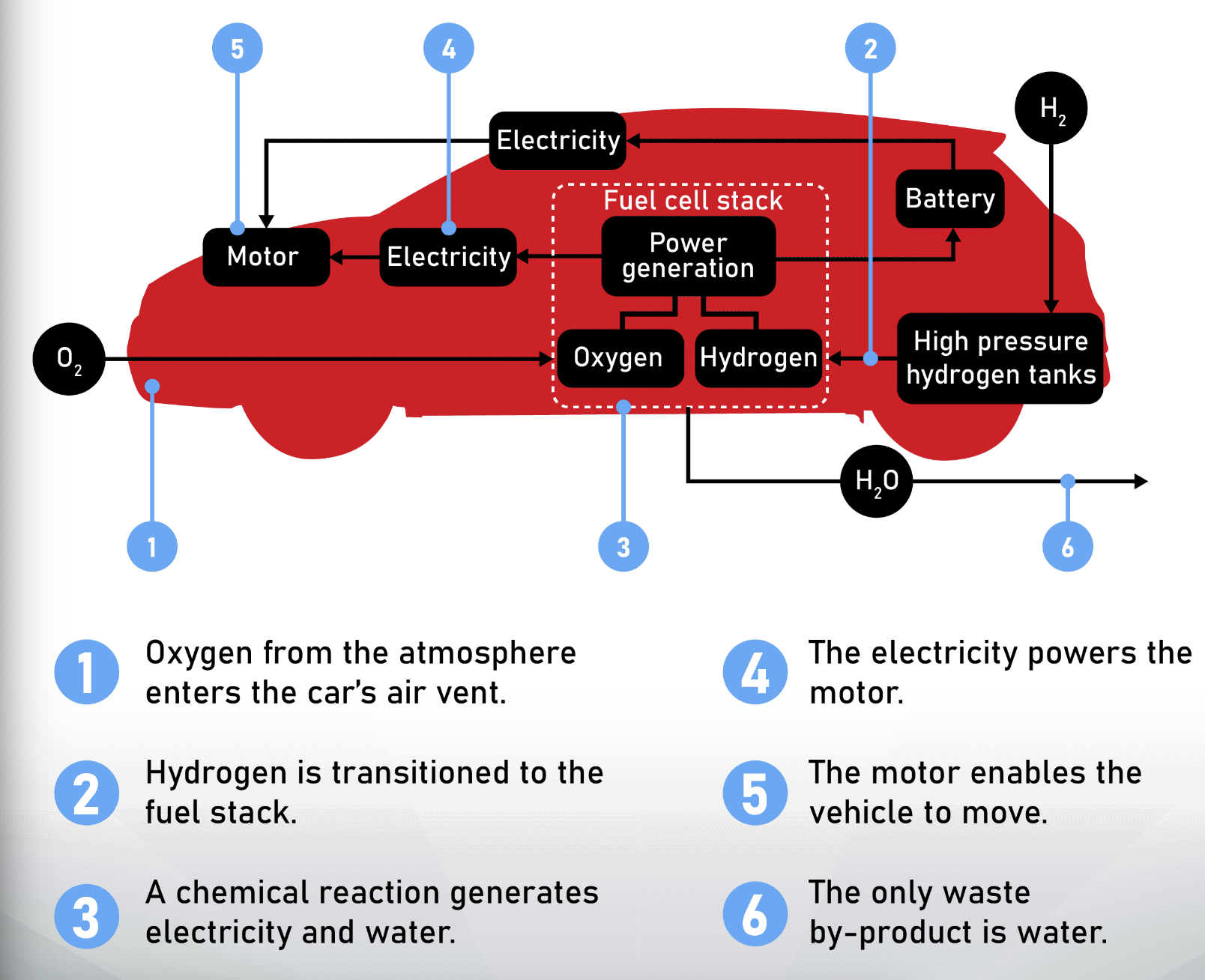
How does the Infinity and beyond (the hydrogen car) work-PRM3
oxygen enters through the air vents and enters the oxygen stacks where a combustion reaction occurs in this reaction electricity and water is created and this is why water is the only by product the electricity either goes to the battery or the motor to run the car
44
New cards
what is the Lithium-ion rechargeable battery technology used for-PRM3
known for its low self discharge, high energy density, lightweight, lack of memory effect and long lifespan
45
New cards
where is a lithim ion battery used-PRM4
smartphones, tablets and laptops and electric vehicles.
46
New cards
environmental cost of lithium ion batteries-PRM4
The lithium ion battery aspires to a fossil free society but the batteries are made with cobalt, nickel and manganese.
47
New cards
what is the issue with cobalt usage-PRM4
Most cobalt is mined in Congo. Human rights groups have exposed severe ethical and environmental issues in mining operations such as child labour and pollution.
48
New cards
Where does lithium come from?
more than half of the worlds supply comes from the arid salt flats of the Atacama Desert
49
New cards
What are the issues with lithium? PRM4
lithium uses a significant amounts of groundwater, resulting in a decreased water supply and less accessible water for local agriculture. In the Atacama desert, lithium mining companies have used 65% of the regions water supply.
50
New cards
Tibet chemical leak (issues with lithium)?-PRM4
In 2016, there was large chemical leak at a lithium mine in the tibetian highlands. As a result the river was was severly polluted and several fragile ecosystems on the tibetian plateau were devestated. Thousands of animals, including fish and local wildlife dependent on the river died.
51
New cards
Problems with lithium ion batteries in components of an old lithium batteries in smartphones and laptops?-PRM4
Cannot be easily recycled and end up in landfills. The components are highly flammabnle and responsible for fires and contamination of local environments at waste facilities.
52
New cards
benefits of old lithium ion car batteries from electrical vehicles-PRM4
can be repurposed, research facilities are already working on repurposing lithium ion car batteries in other applications, and car manufacturers are developing cost-effective technologies to recycle 100% of the components from lithium ion car batteries.
53
New cards
perspective of the transport minister on the transition to electrical vehicles- PRM5
“I have real concerns about the lack of electric car charging infrastructure in this country, at the moment, we only have a fraction of the charging stations needed to charge electric cars. The average distance between charging stations in the countryside is 50 miles, this just isn’t practical for most electric car owners”
54
New cards
perspective of a conscentious consumer on the transition to electrical vehicles- PRM5- PRM5
I still cna’t believe that so many people still drive petrol cars. In my country we are already at 30% electrification of all vehicles. This is because our government subsidizes ownership of electric cars, which reduces the price of electric car by 20-30%. Lets get rif of these dirty fossil fuel cars right now
55
New cards
perspective of a self employed delivery driver on the transition to electrical vehicles- PRM5
“I drive my delivery truck in the city every day, all day long. Now the government is telling me I have to pay higher taxes if I dont switch over to an electric truck. I barely make enough money to pay for groceries for my family now I’m expected to pay double the price for a new electric truck. We live in an apartment with no way of chatging an electric vehicle. There are some charging stations in my city, but the nearest one is an hour away from my home. Even if I were able to take the ruck to that charging statgion everyday, it woul still take 8 hours to fully charge the vehicle.”
56
New cards
perspective of an automotive engineer delivery driver on the transition to electrical vehicles- PRM5
“Electric cars are better than their petrol equivalents in a number of ways. Electric vehicles produce zero direct emissions, are 30% quieter, and have a higher energy efficiency than petrol. Electric vehicles are easier to maintain; with fewer parts, they break down less often than petrol cars, and will be on the road for more years than a petrol car”
57
New cards