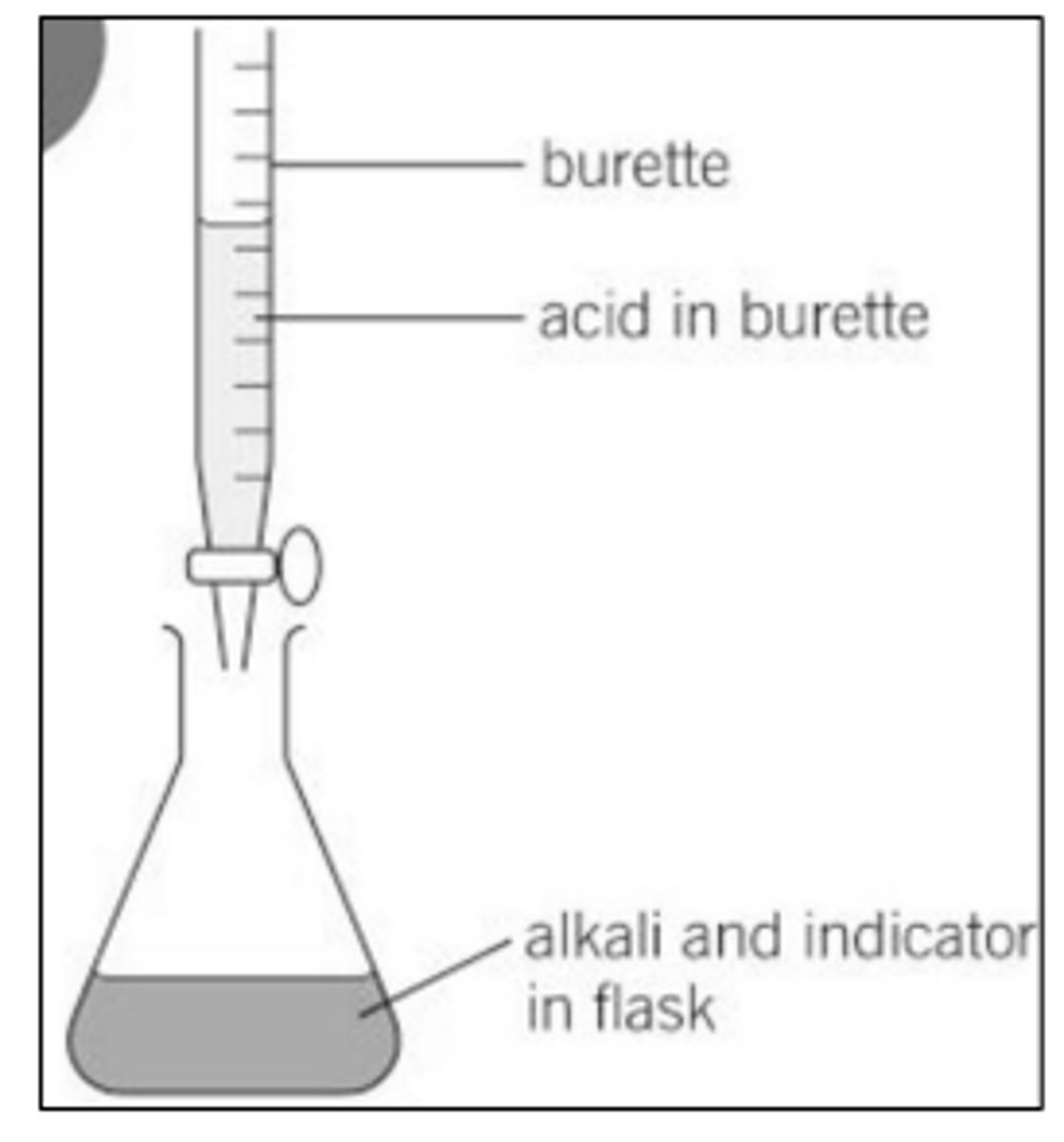
RP1b: Carrying out an acid-base titration
 Call Kai
 Learn
Learn Practice Test
 Spaced Repetition
 Match
Match Flashcards
 Knowt Play
1/15

There's no tags or description
Looks like no tags are added yet.
Name | Mastery | Learn | Test | Matching | Spaced | Call with Kai |
|---|
No analytics yet
Send a link to your students to track their progress
16 Terms
What equipment should be rinsed before starting a titration? (3)
- Burette with acid
- Pipette with alkali
- Conical flask with distilled water
What volume of alkali is pipetted into the conical flask for titration? (1)
25 cm³
How should the burette be prepared before starting the titration? (2)
- Fill the burette with acid
- Ensure the jet space in the burette is filled with acid
What is recorded before starting the titration? (1)
The initial burette reading
What is added to the alkali in the conical flask before titration begins? (1)
A few drops of indicator
Why is a white tile placed underneath the conical flask during titration? (1)
To help observe the colour change
How is the acid added to the alkali in the conical flask? (2)
- Add acid whilst swirling the mixture
- Add acid dropwise near the endpoint
When should the titration be stopped? (1)
When the relevant colour change is observed
What is recorded at the end of the titration? (1)
The final burette reading
How many titrations should be performed to obtain concordant results? (1)
At least two concordant results (two readings within 0.1 cm³ of each other)
Why must the jet space in the burette be properly filled? (1)
If not filled, it will result in a larger than expected titration reading
Why are conical flasks preferred over beakers for titrations? (1)
They are easier to swirl
Why should only a few drops of indicator be used? (1)
Indicators are weak acids, so using too much affects the titration result
What is the colour change for phenolphthalein in titration? (2)
Alkali: Pink
Acid: Colourless (endpoint: pink colour just disappears)
What is the colour change for methyl orange in titration? (3)
Alkali: Yellow
Acid: Red
Endpoint: Orange
Draw and label a diagram of the apparatus used in this experiment (3)