FP 15 - Metal Framework Design (Dr. Gotsis)
 Call Kai
 Learn
Learn Practice Test
 Spaced Repetition
 Match
Match Flashcards
 Knowt Play
1/88

There's no tags or description
Looks like no tags are added yet.
Name | Mastery | Learn | Test | Matching | Spaced | Call with Kai |
|---|
No analytics yet
Send a link to your students to track their progress
89 Terms
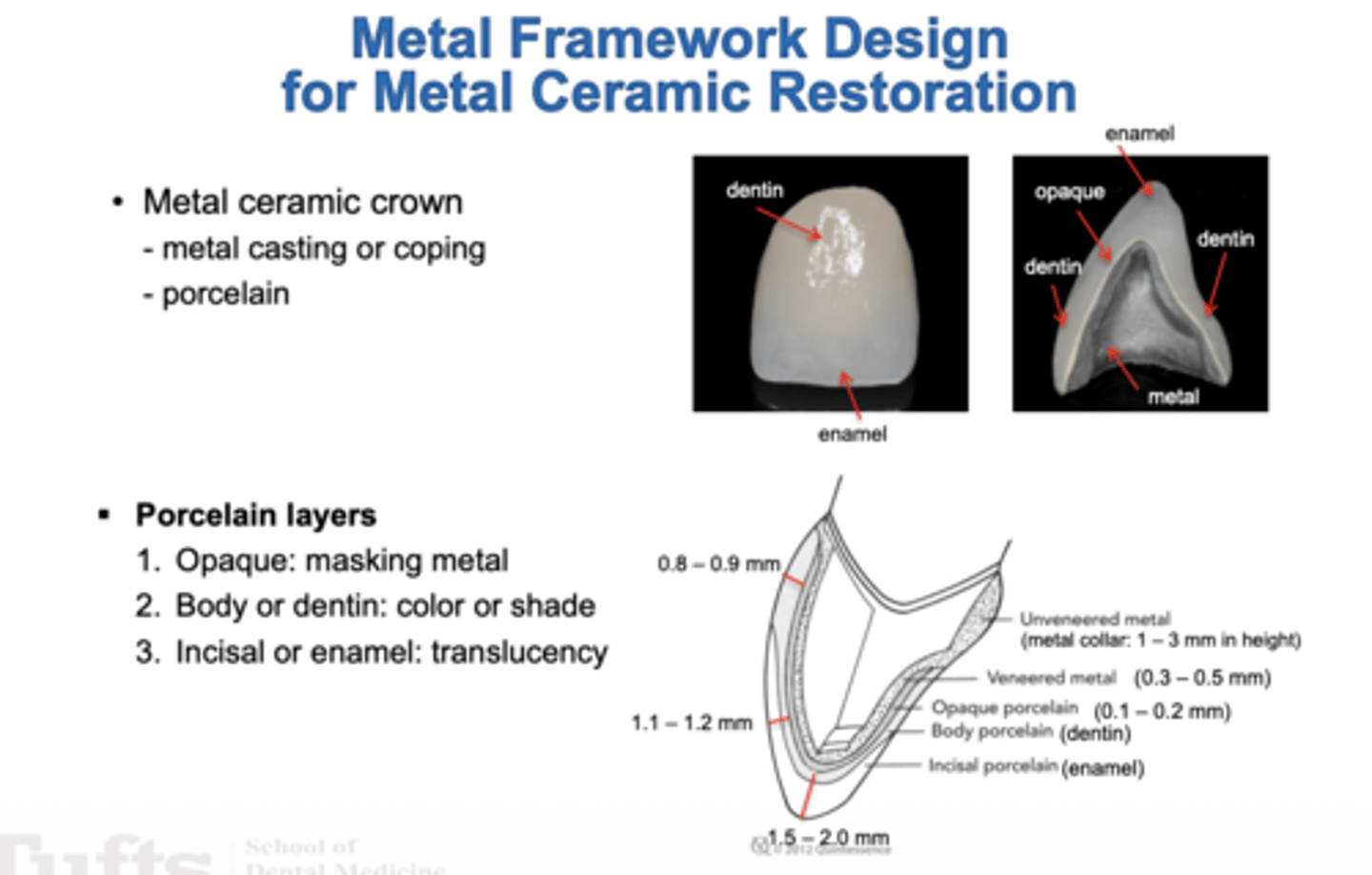
The porcelain in the PFM crown consists of what layers (from innermost to outermost)?
- Opaque (masking metal)
- Body or dentin (color or shade)
- Incisal or enamel (translucency)
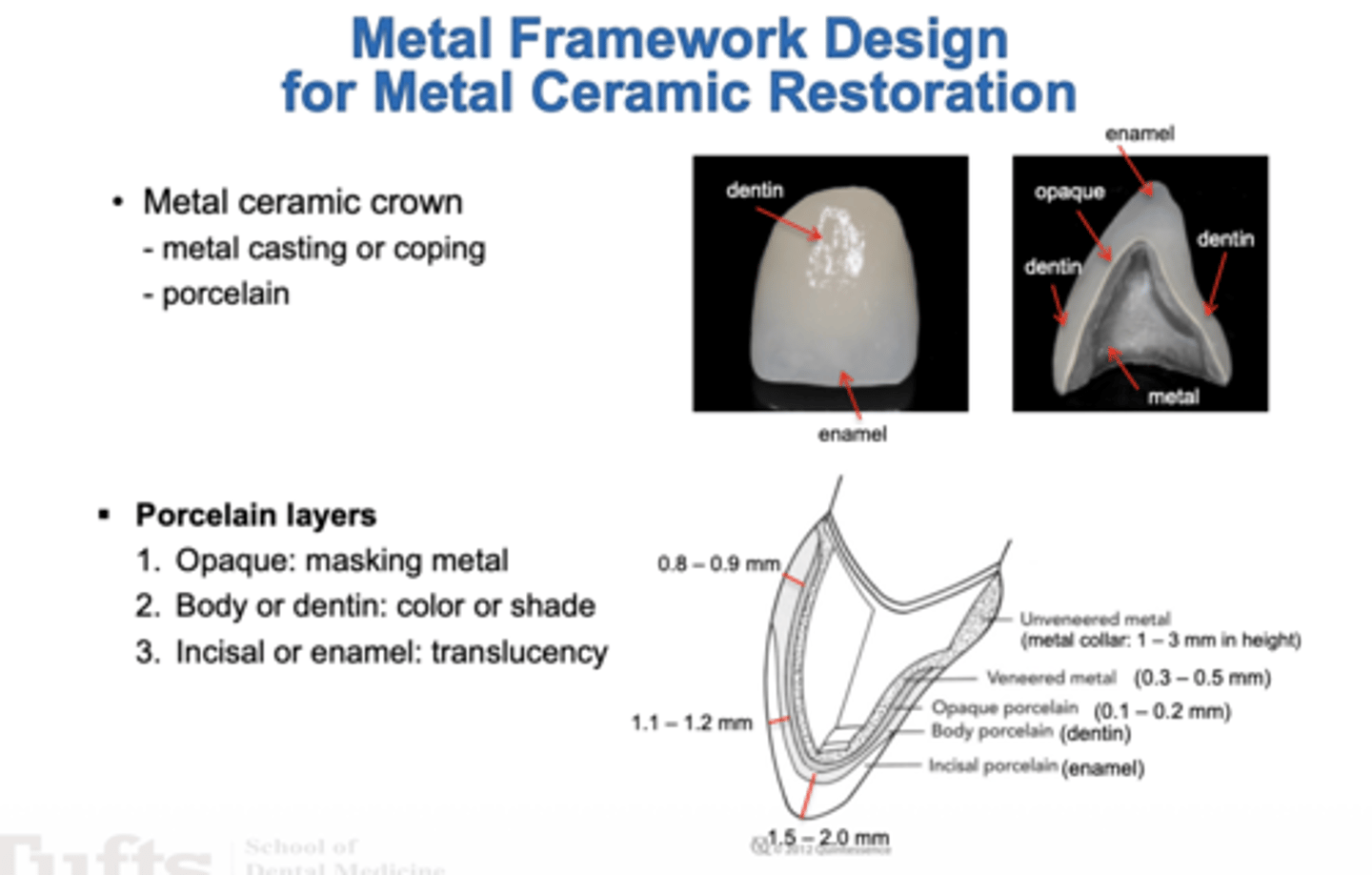
The metal collar is usually ____-____mm in height and is _____
a) veneered
b) unveneered
1-3mm in height
b) unveneered
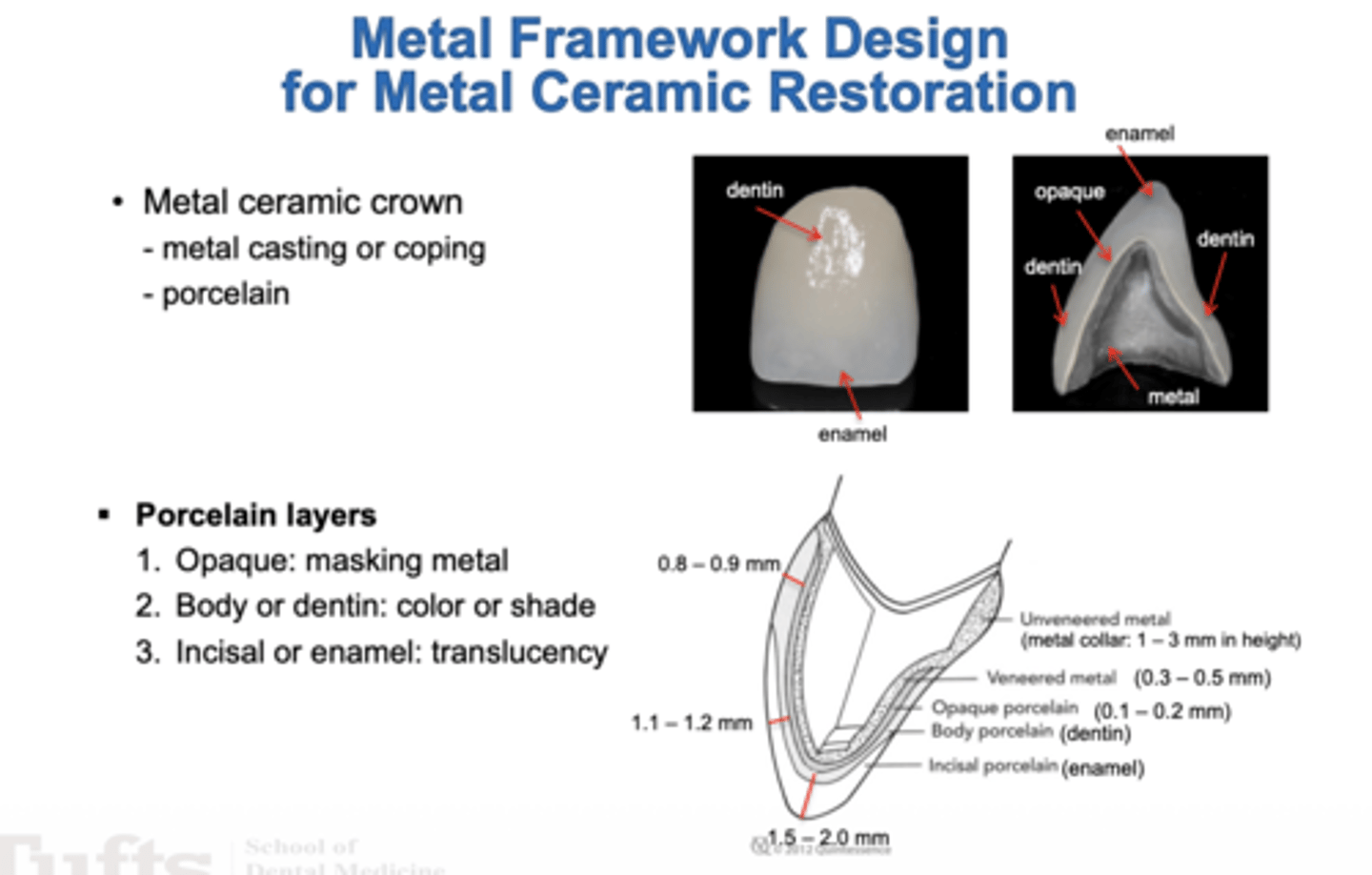
Opaque porcelain is ____-____ mm thick
0.1-0.2mm
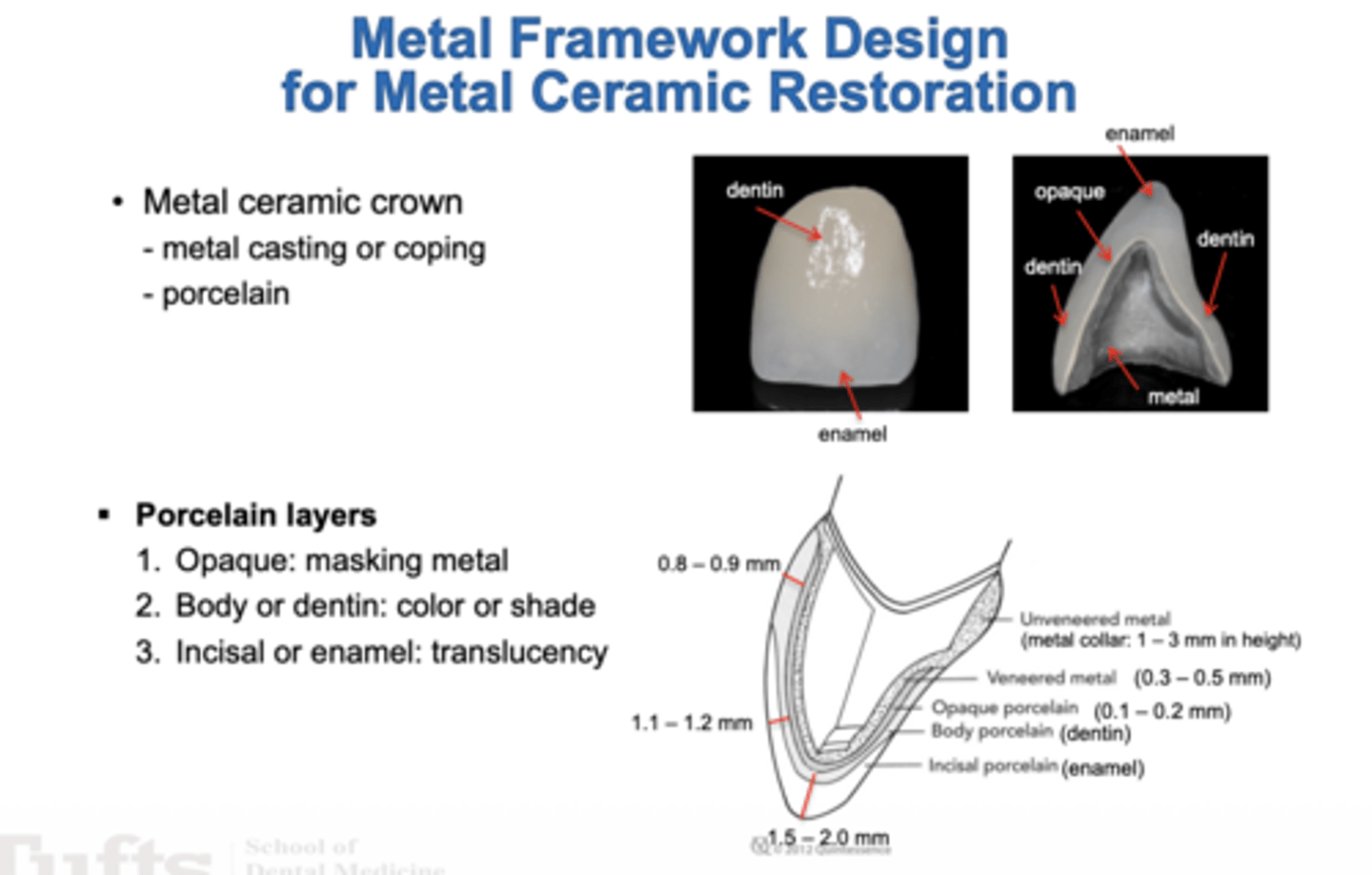
Body porcelain is applied on the ____-____ mm of the cervical aspect, and blended in with incisal porcelain towards the incisal aspects of the crown
0.8-0.9mm
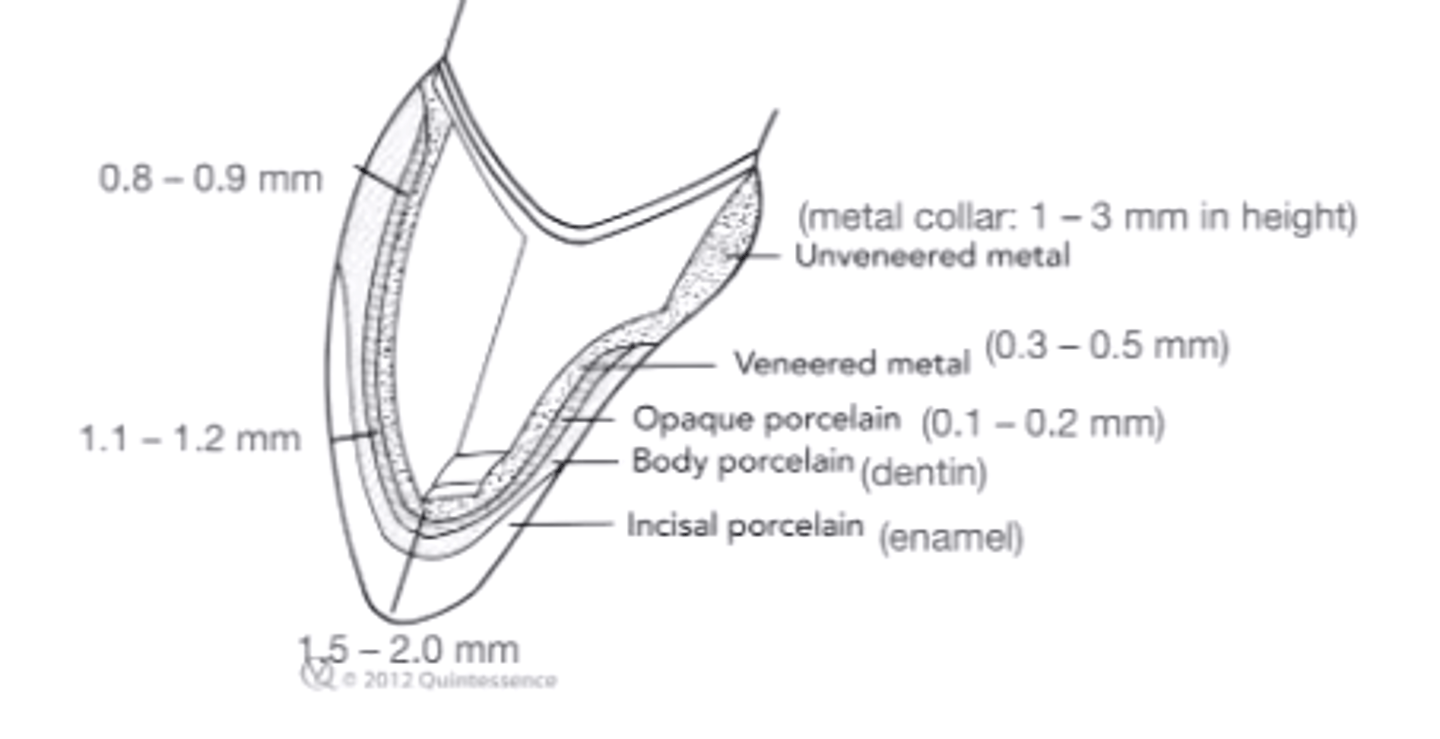
The incisal/enamel porcelain layer is ____-____ mm thick on the facial
1.1-1.2mm
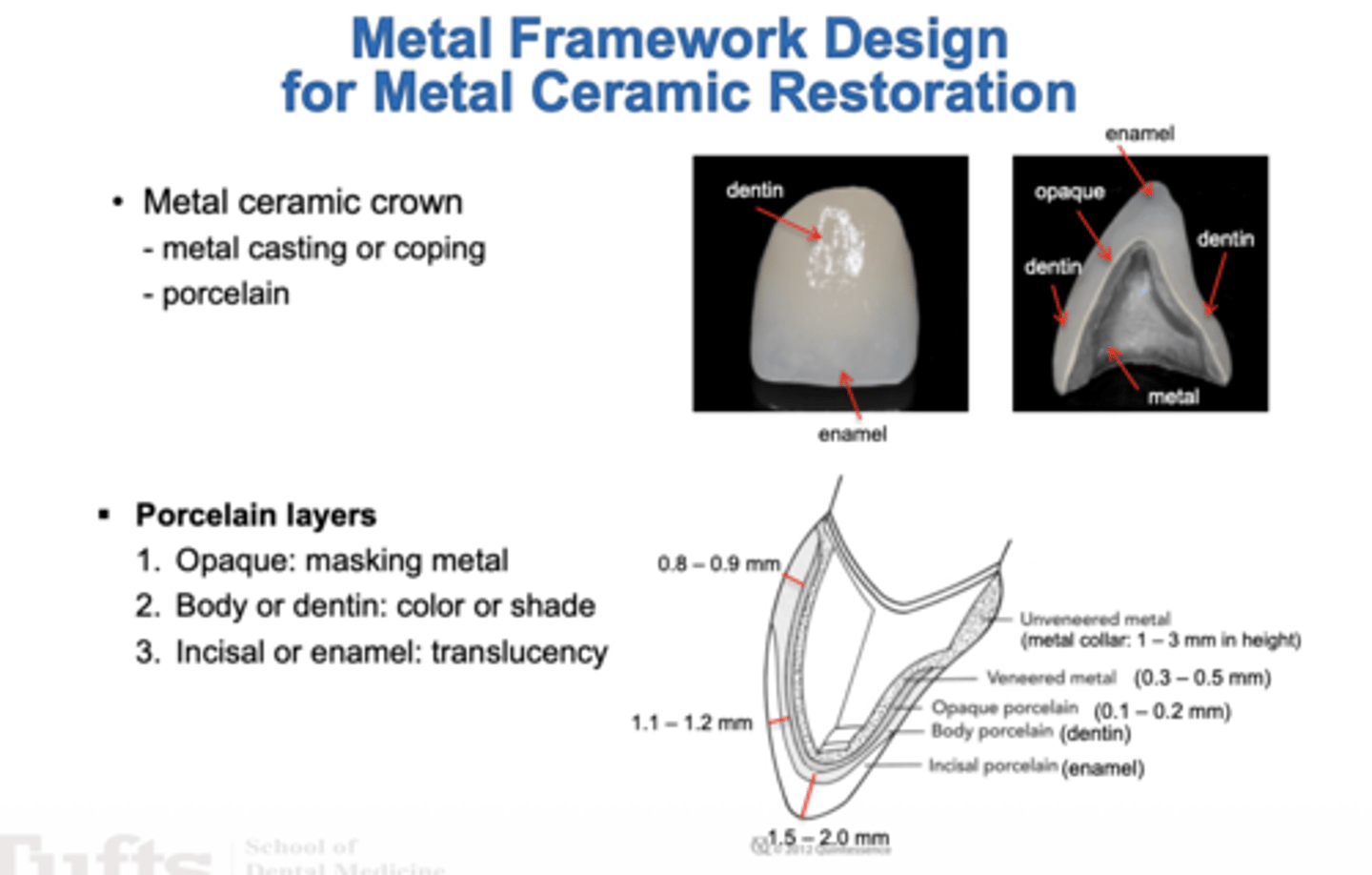
The incisal/enamel porcelain layer is ____-____ mm thick on the incisal
1.5-2.0mm
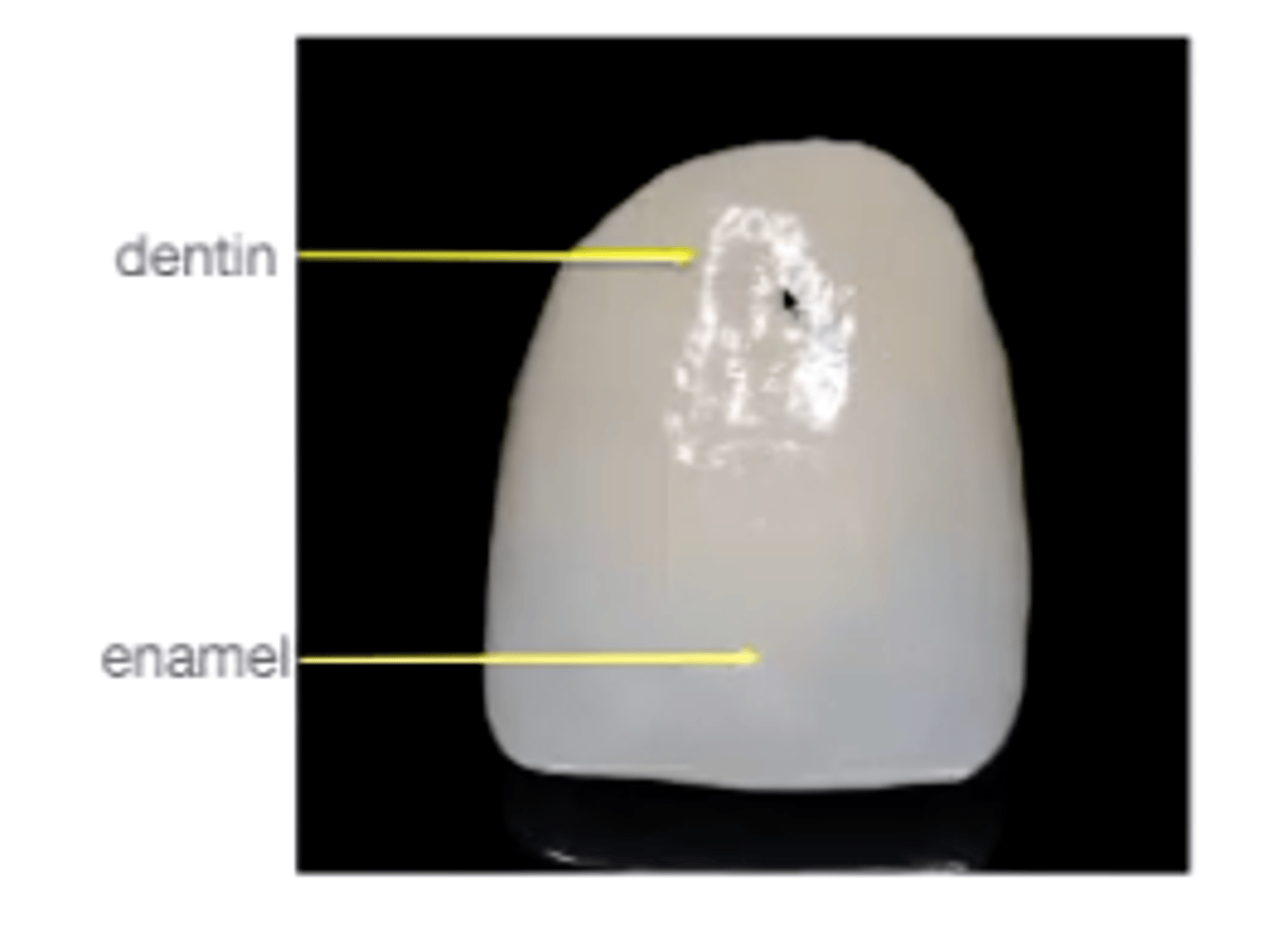
T/F: The color of the tooth gets lighter the more incisal you go, despite the same body/dentin shading
TRUE
What bonding mechanism for a metal ceramic restoration?
- Interlocking between porcelain and metal surface
- Finishing with stone or air abrasion
- Bonding agents such as platinum spheres
Mechanical
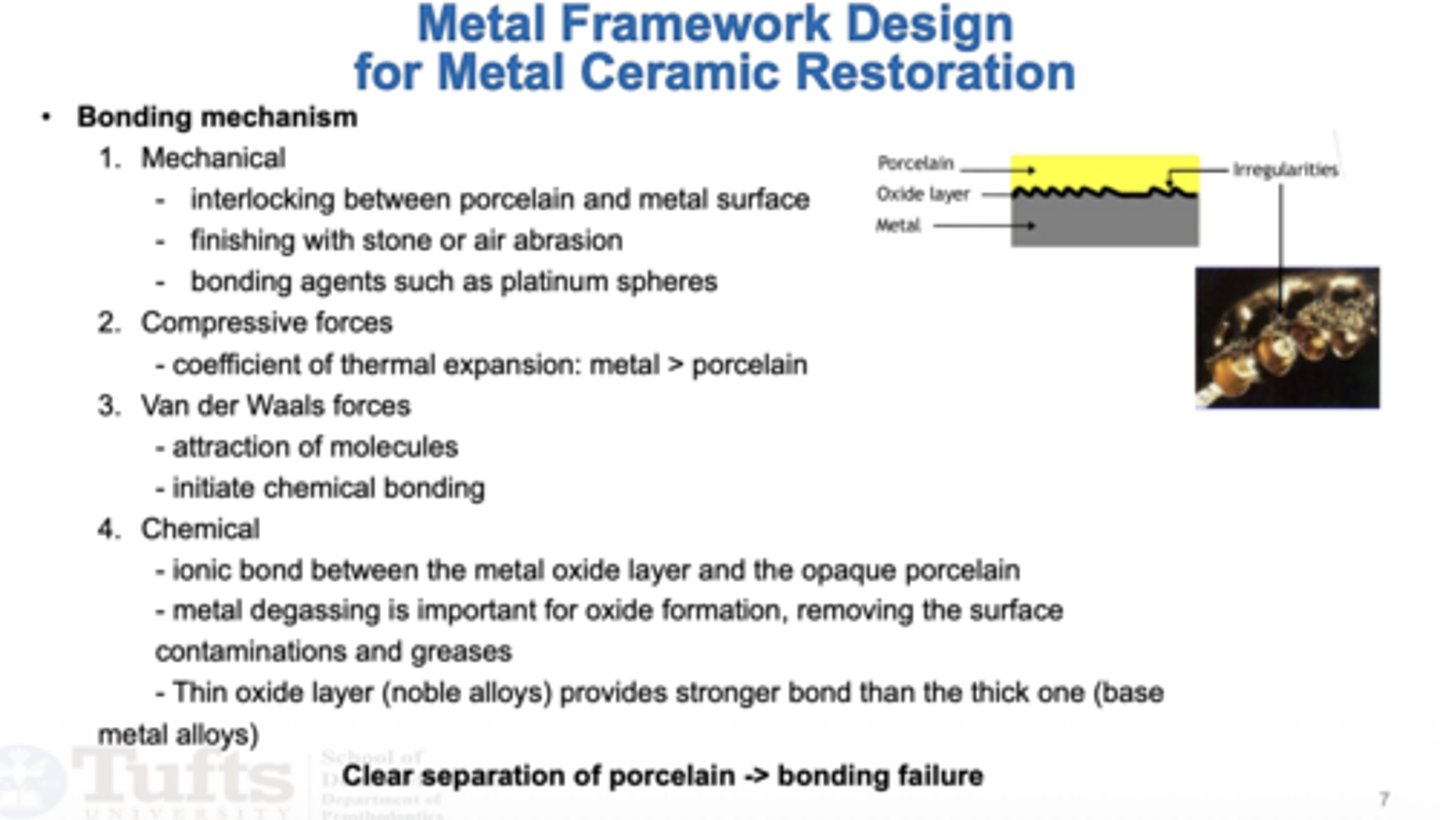
How do you increase mechanical retention for porcelain to metal?
Finishing with stone or air abrasion to create a textured metal for better mechanical retention
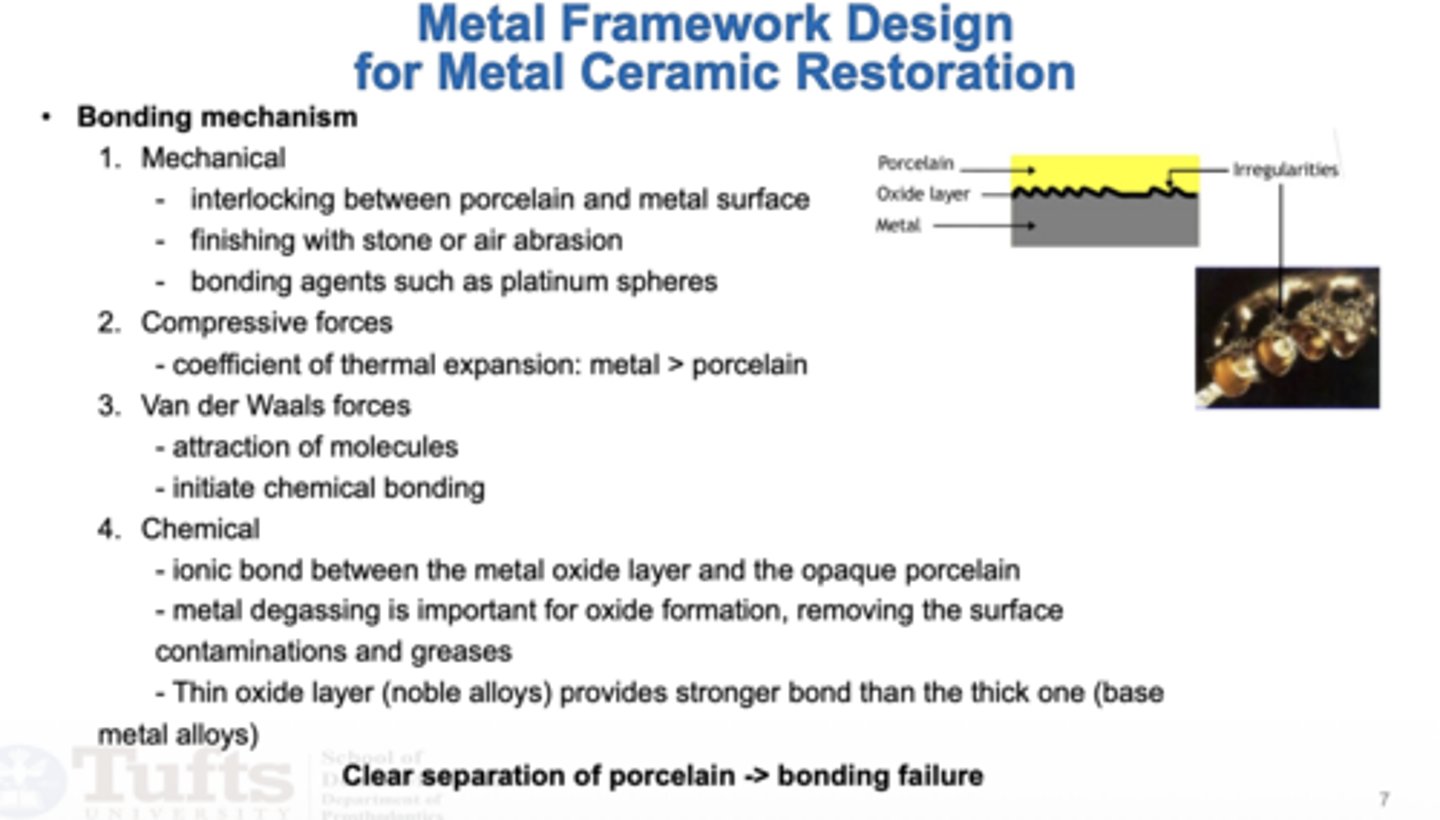
What is a mechanical bonding agent used to help with mechanical retention of porcelain to metal?
Platinum spheres
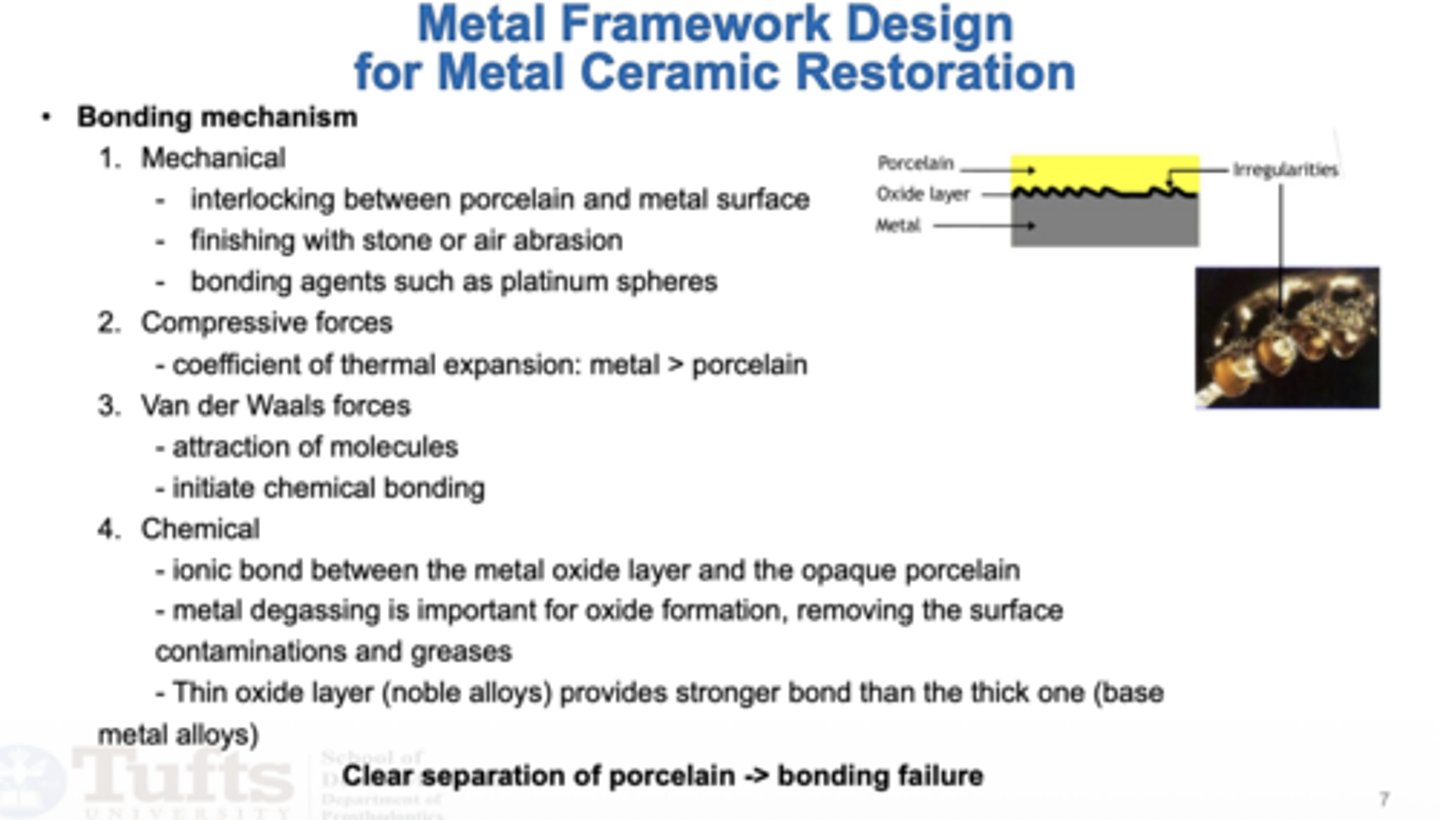
What is the primary factor in producing compressive forces that help with retention of metal to porcelain?
Coefficient of thermal expansion (metal > porcelain)
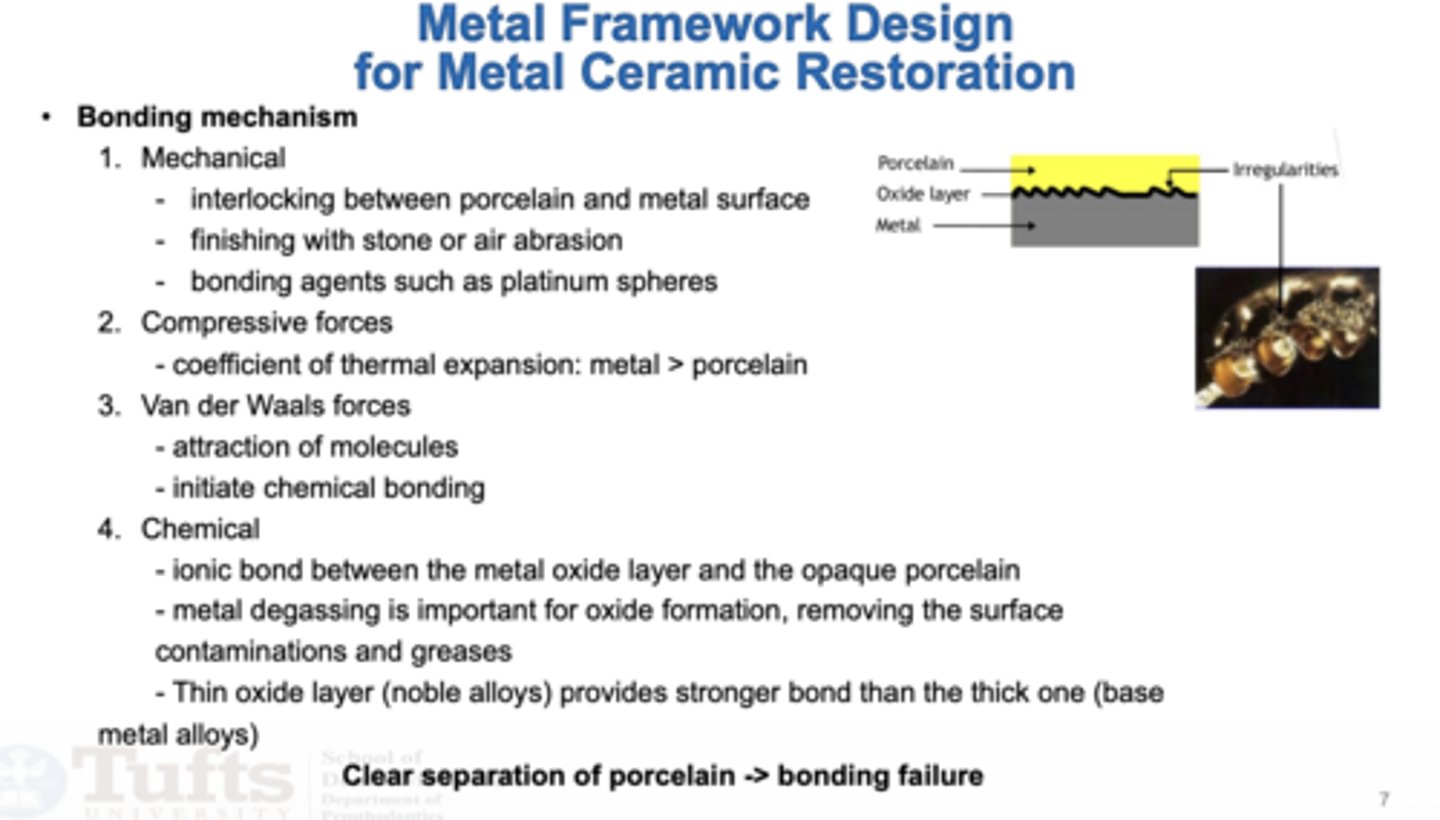
What bonding mechanism for a metal ceramic restoration?
- Attraction of molecules
- Initiate chemical bonding
Van der Waals forces
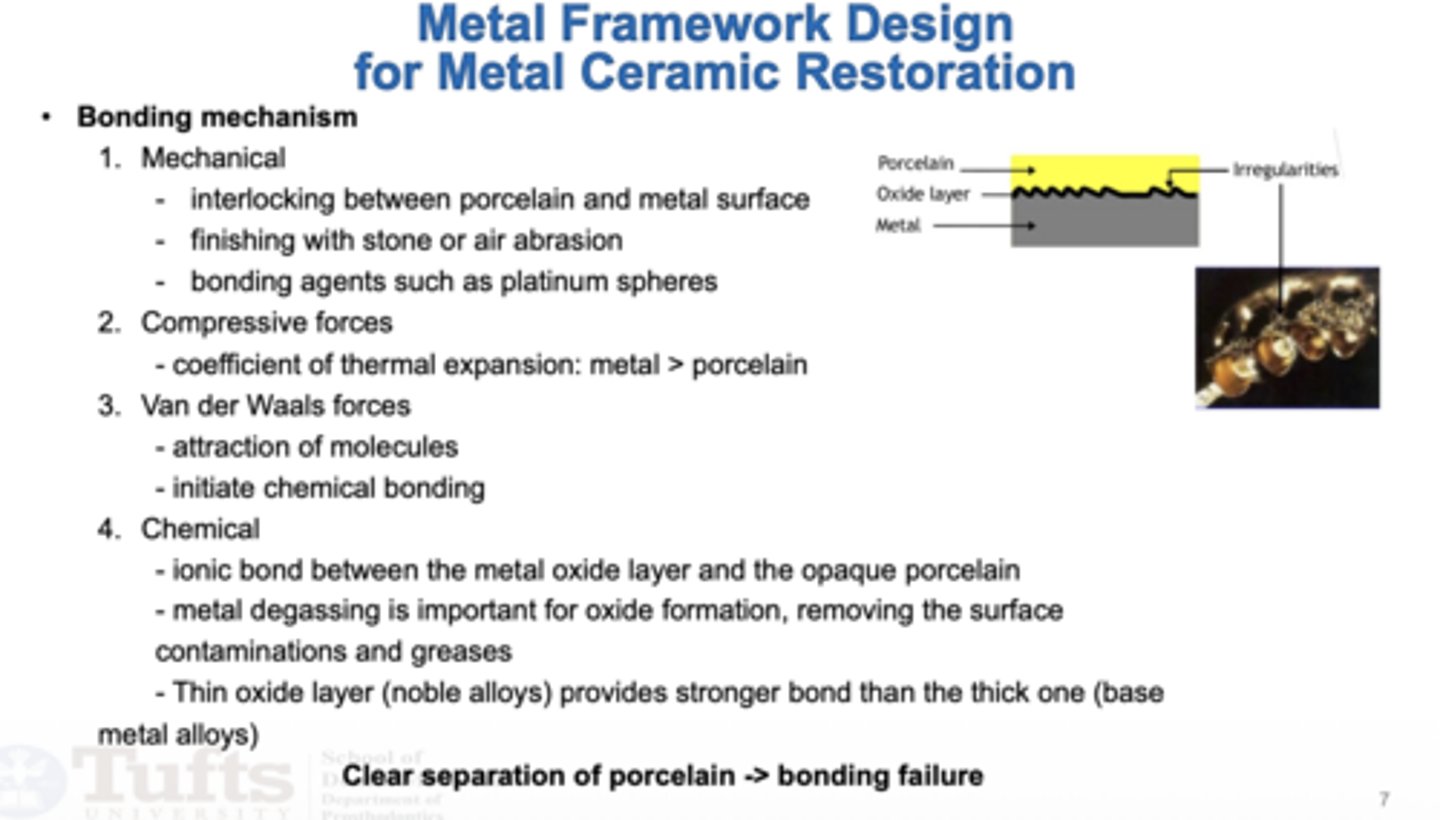
What bonding mechanism for a metal ceramic restoration?
- Ionic bond between the metal oxide layer and the opaque porcelain
- Metal degassing is important for oxide formation, removing the surface contaminations and greases
- Thin oxide layer (noble alloys) provides stronger bond than the thick one (base metal alloys)
Chemical
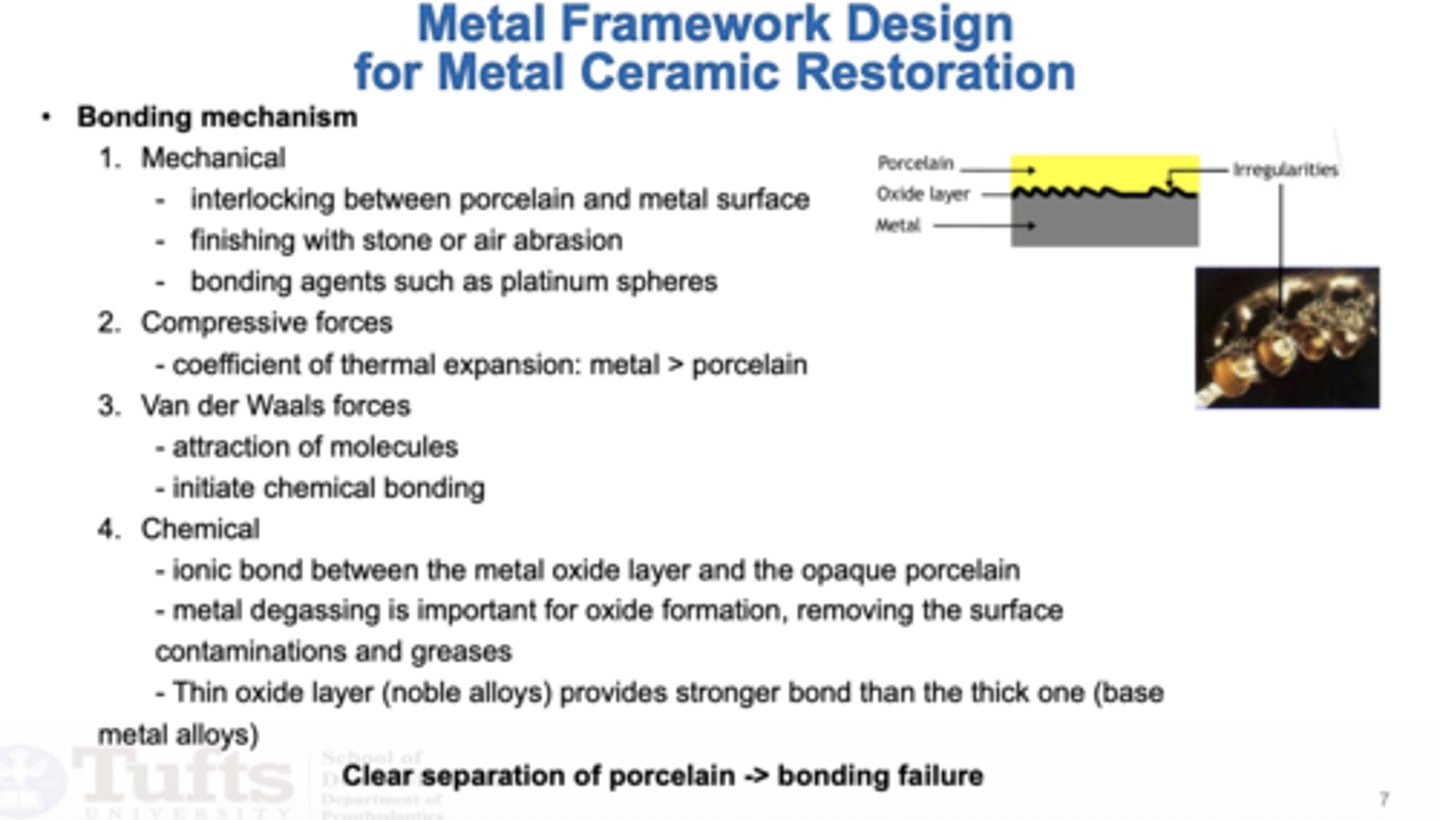
What provides chemical retention for metal to porcelain bonding?
Thin oxide layer: noble alloys tin, indium, gallium, or iron
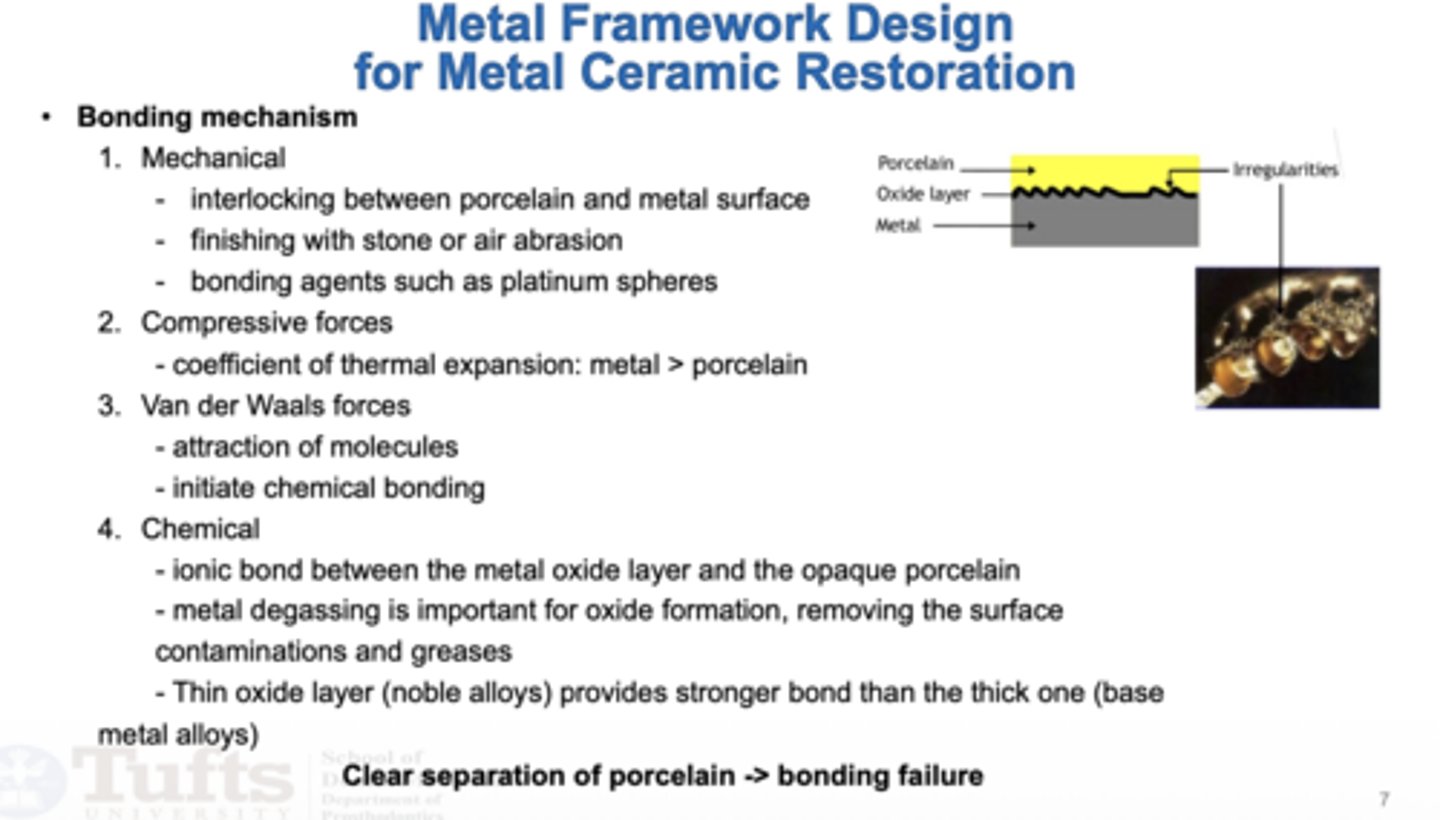
What does a clear separation of porcelain from metal indicate?
Bonding failure
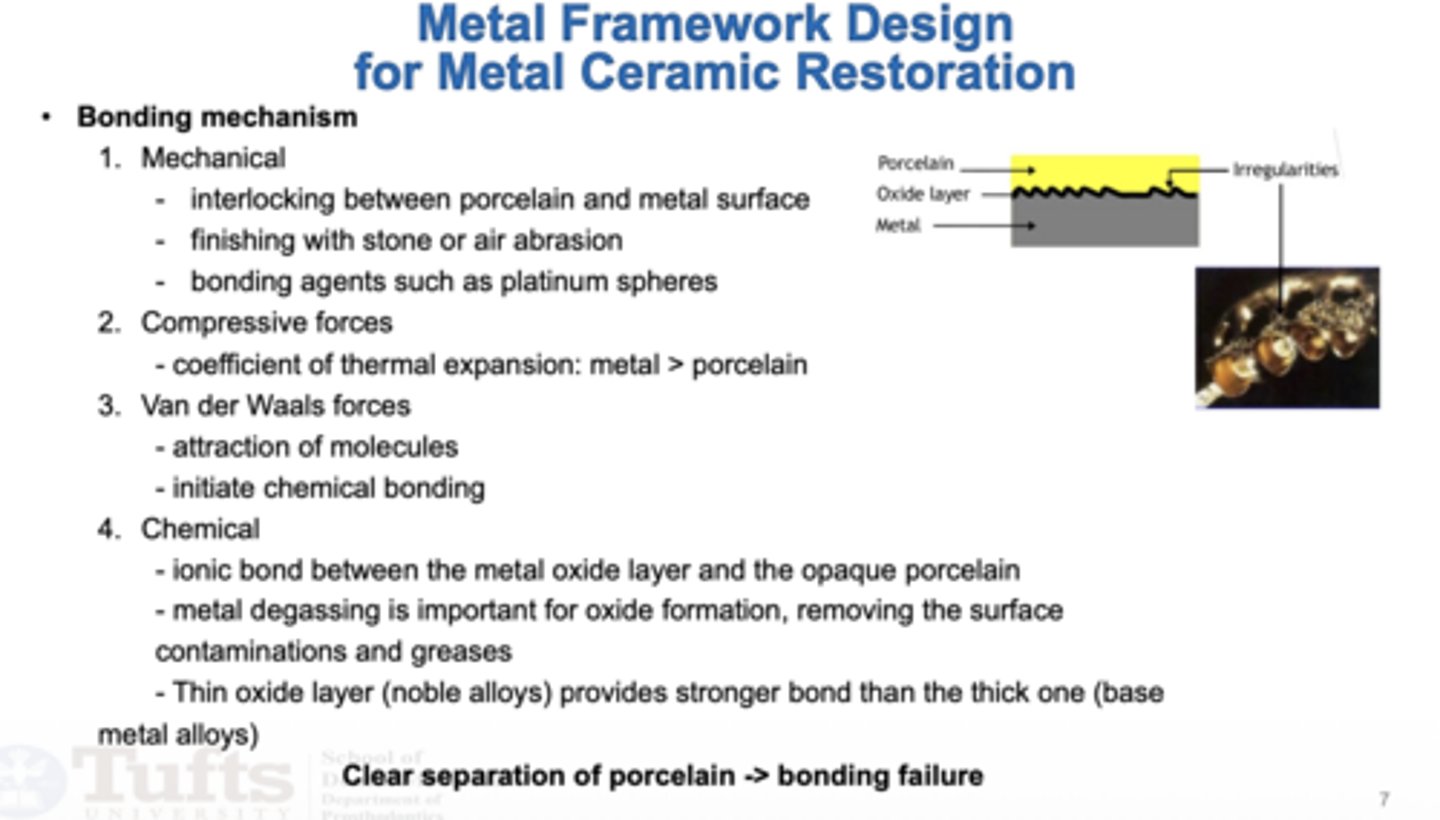
What are the three components of an FPD?
- Retainer
- Pontic
- Connector
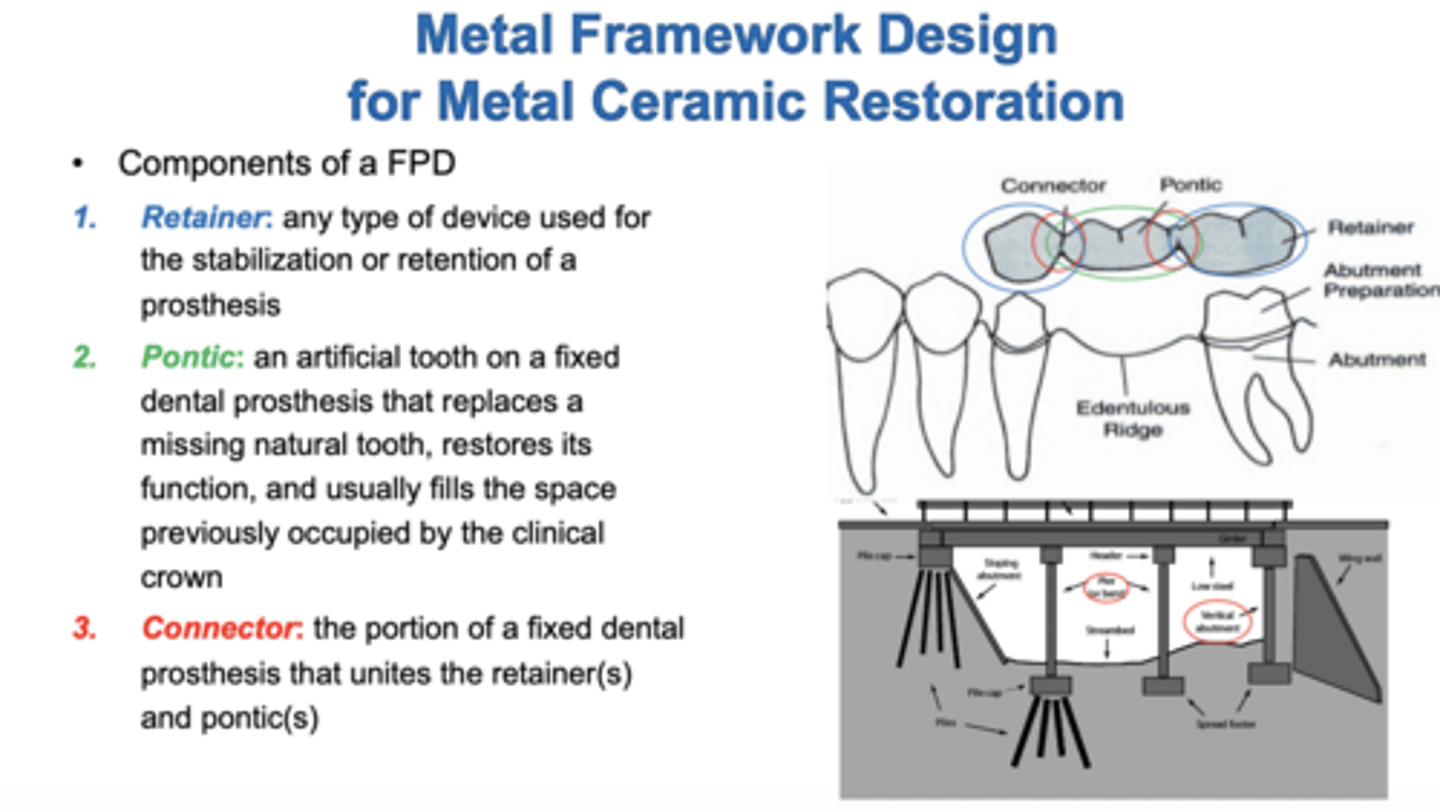
Define the following:
Any type of device used for the stabilization or retention of a prosthesis
Retainer
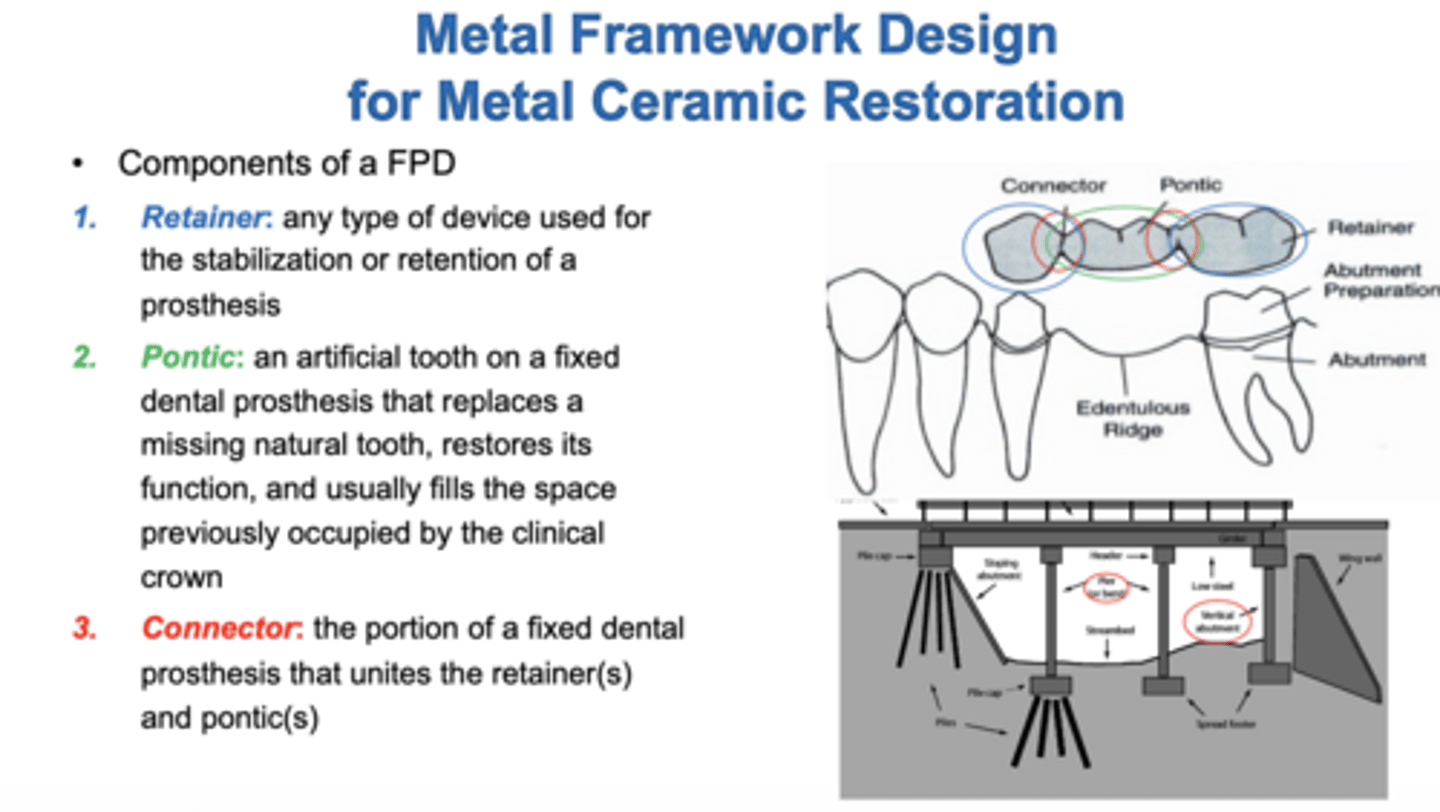
Define the following:
An artificial tooth on a fixed dental prosthesis that replaces a missing natural tooth, restores its function, and usually fills the space previously occupied by the clinical crown
Pontic
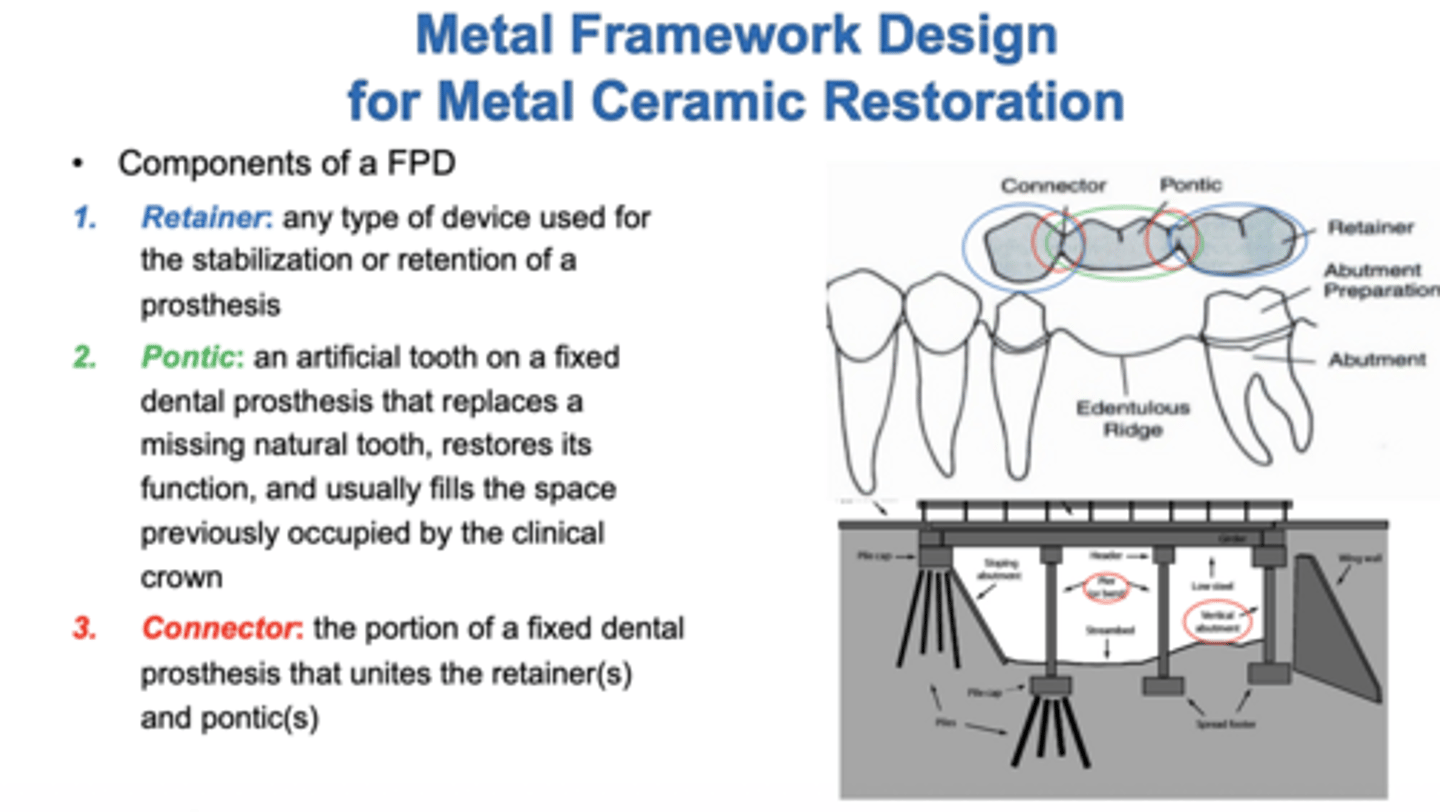
Define the following:
The portion of a fixed dental prosthesis that unites the retainer(s)and pontic(s)
Connector
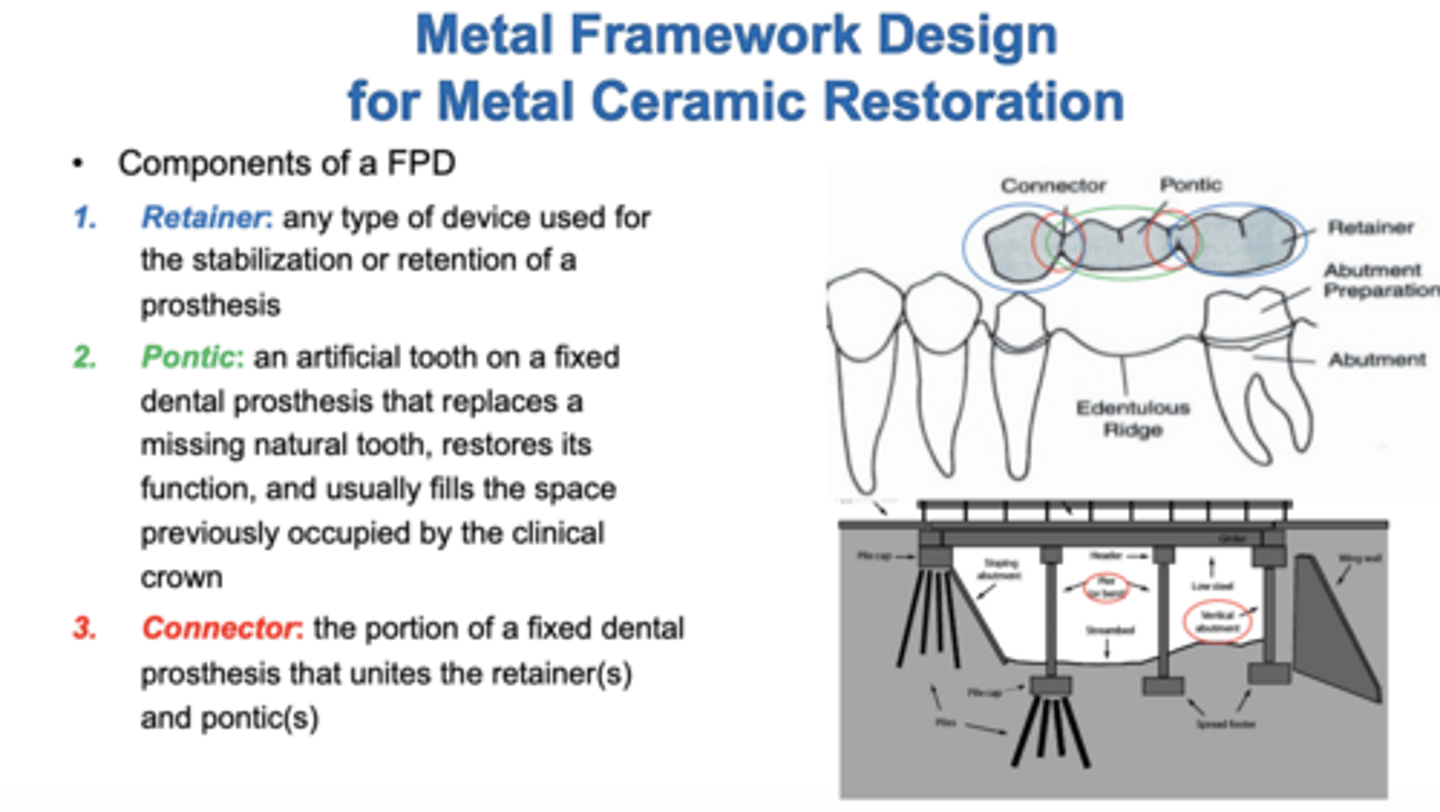
Define the following:
The ability to withstand an applied load without failure or plastic deformation
Material strength
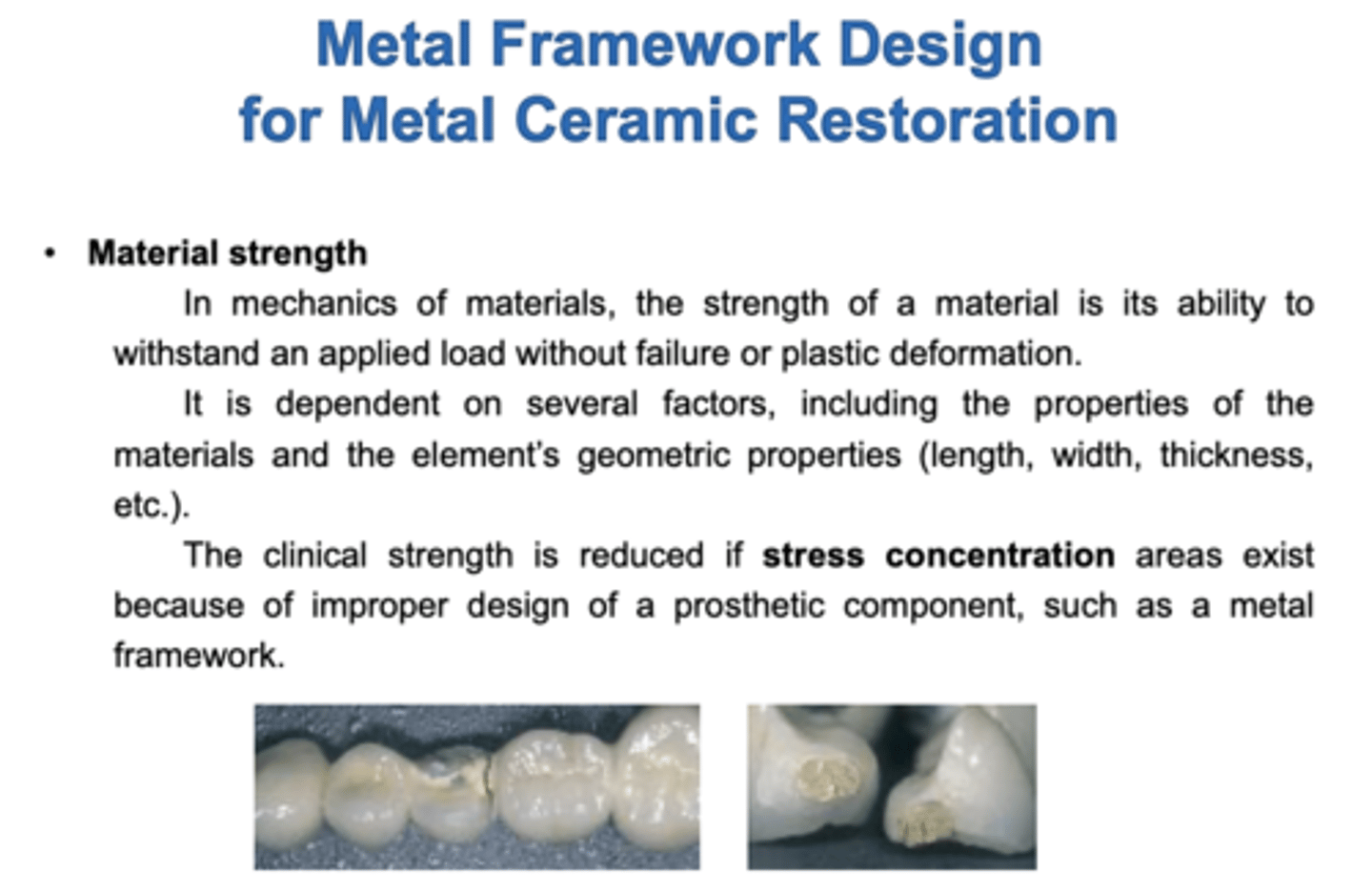
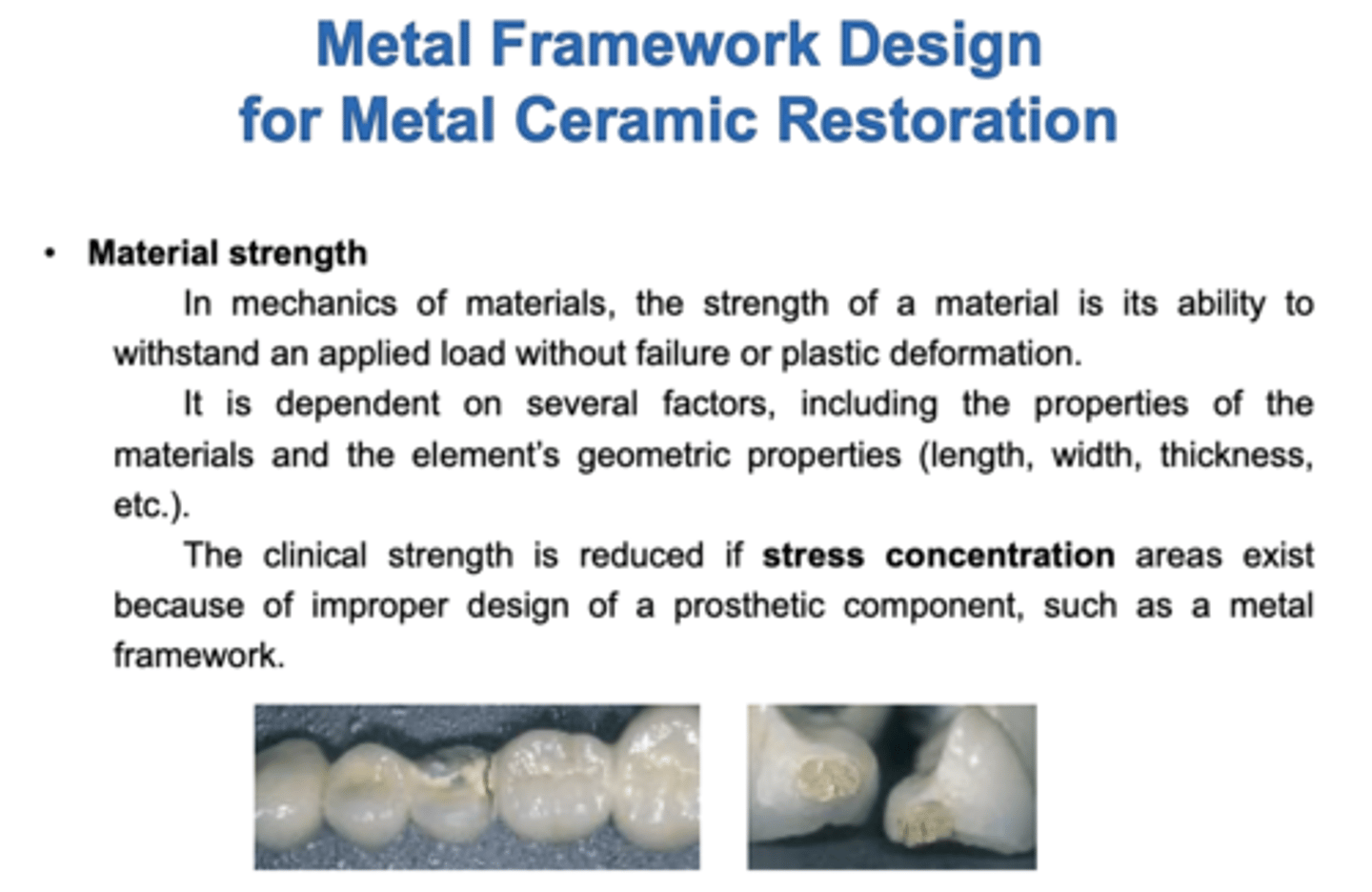
T/F: Material strength is dependent on properties of the materials, and the element's geometric properties (length, width, thickness, etc)
True
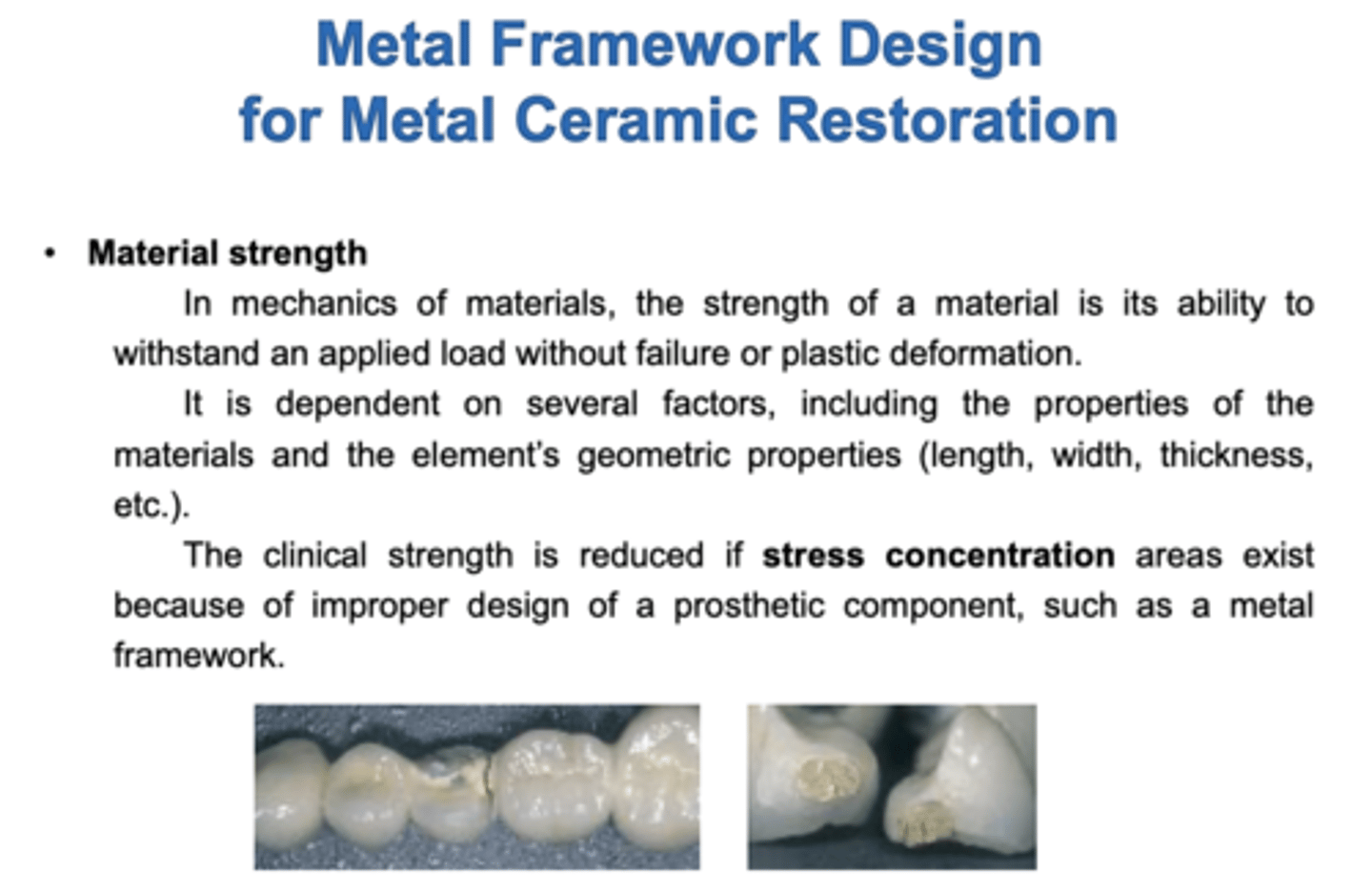
T/F: Clinical strength is reduced if stress concentration areas exist because of improper design of a prosthetic component, such as a metal framework
True
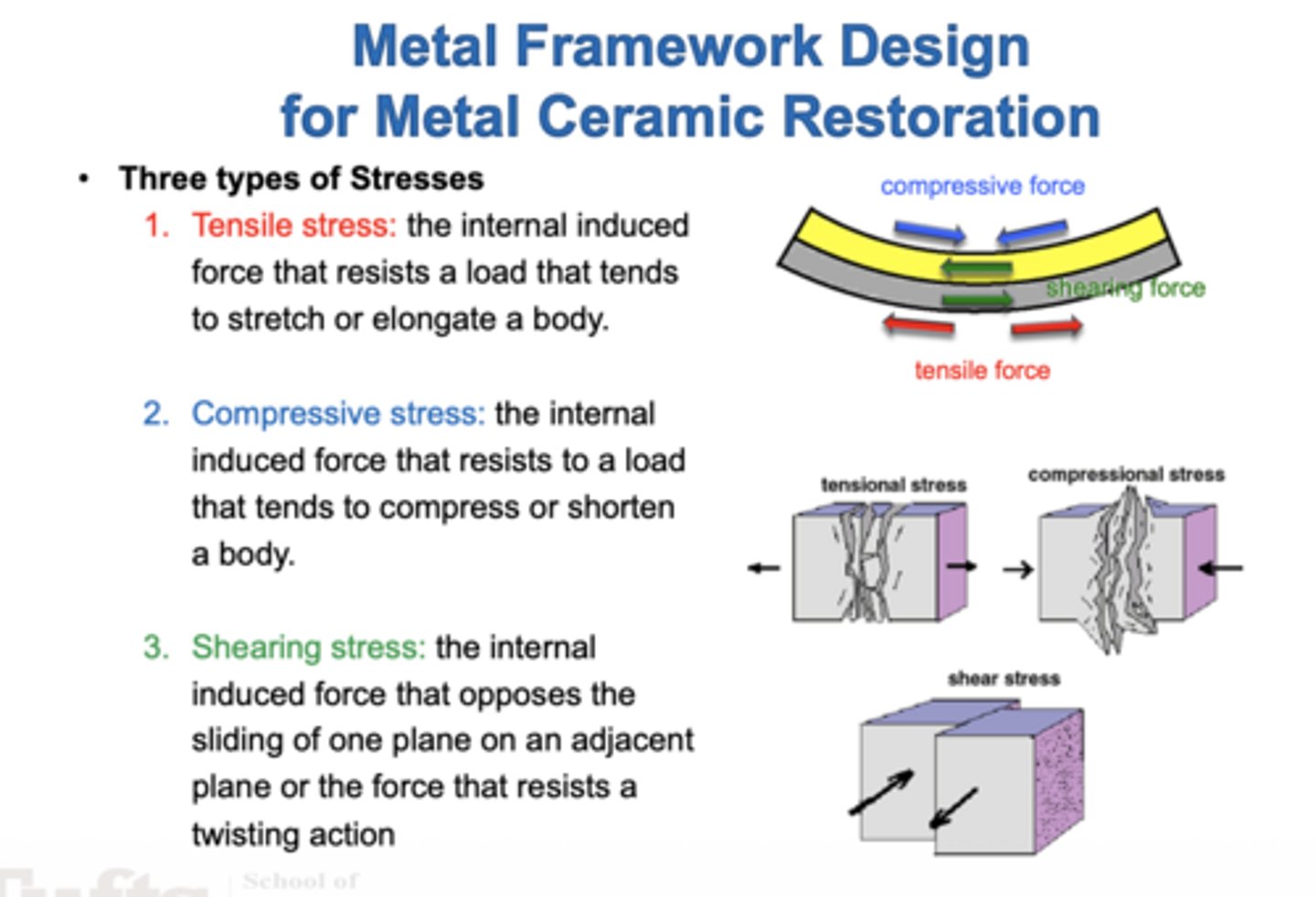
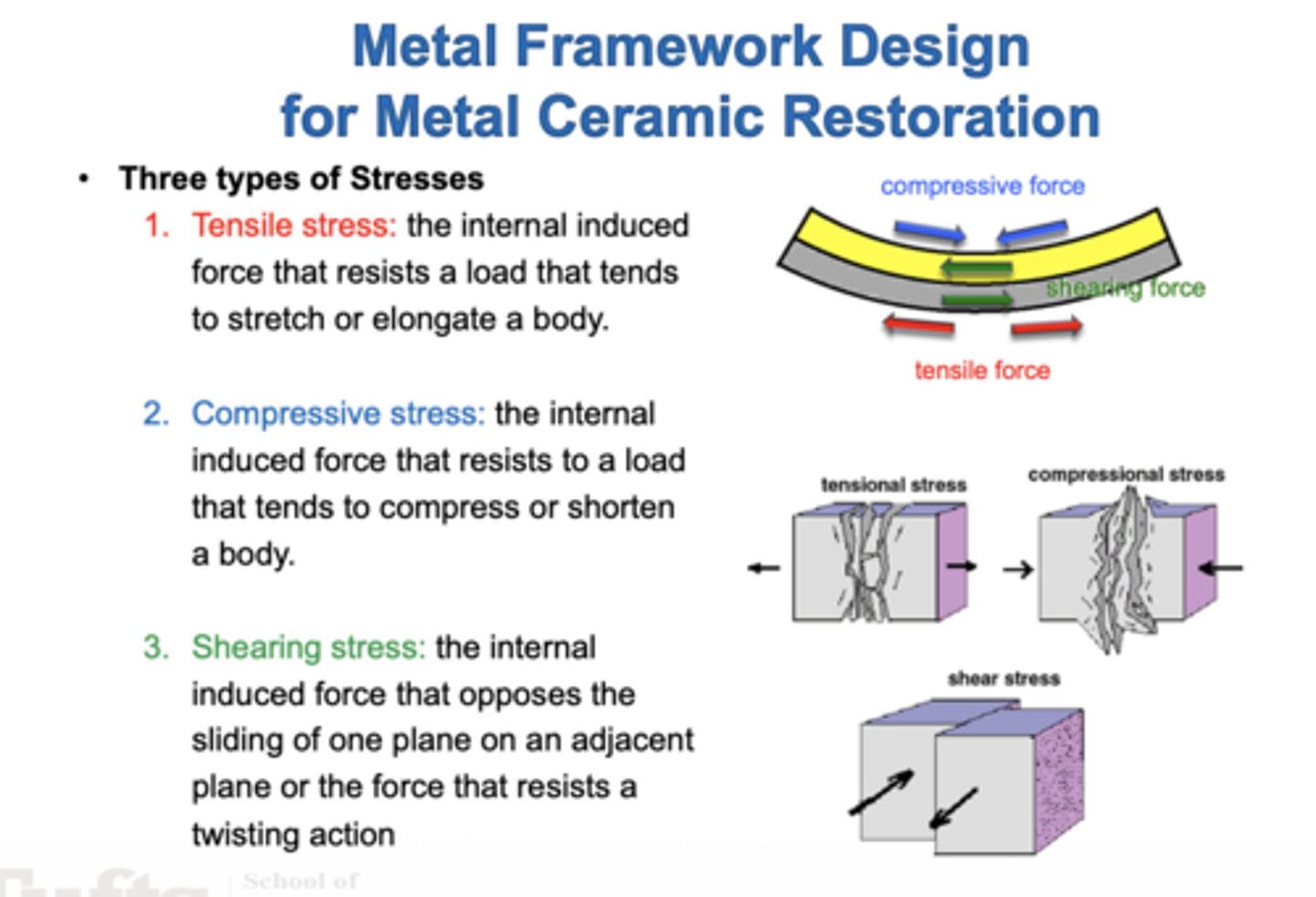
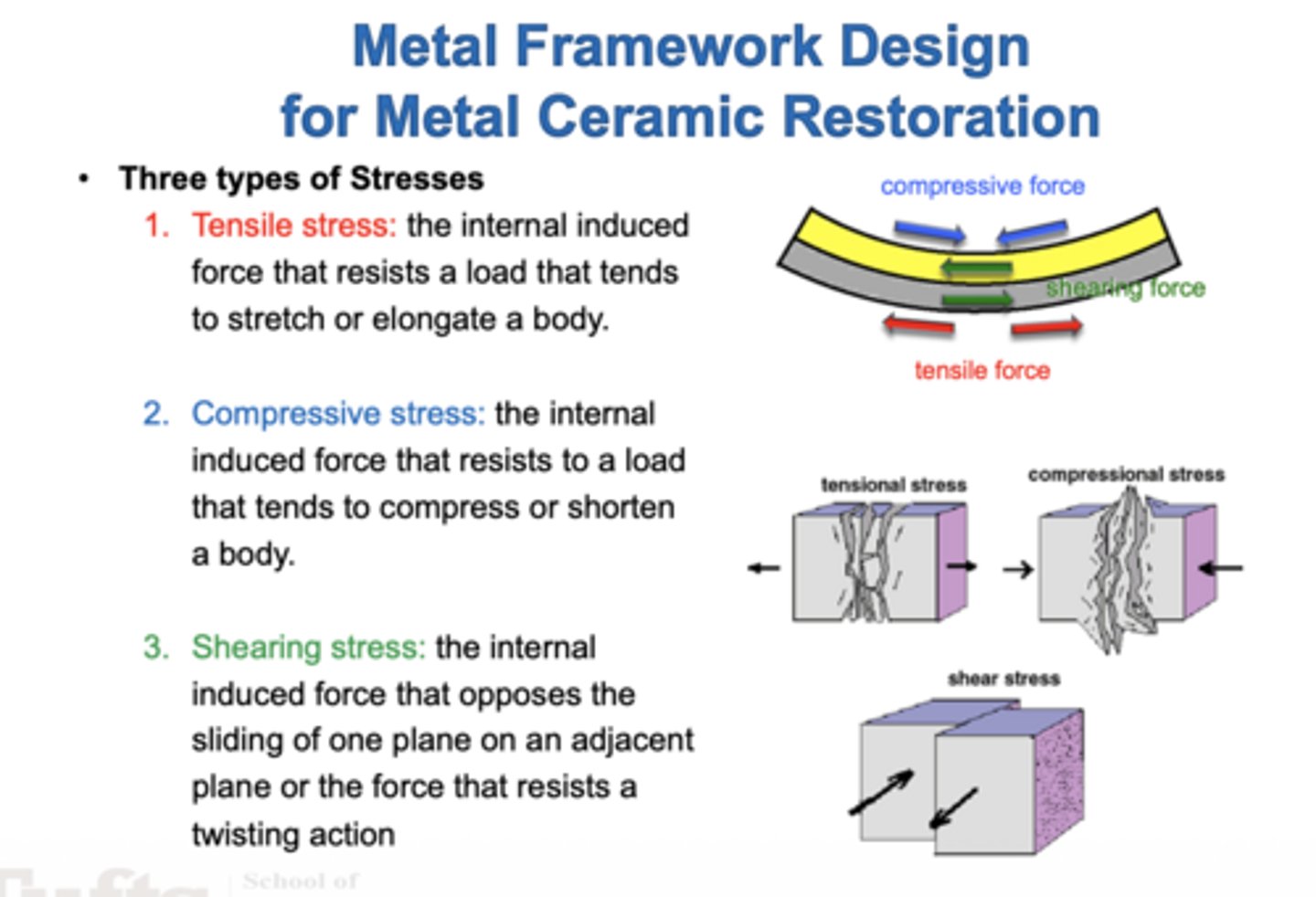
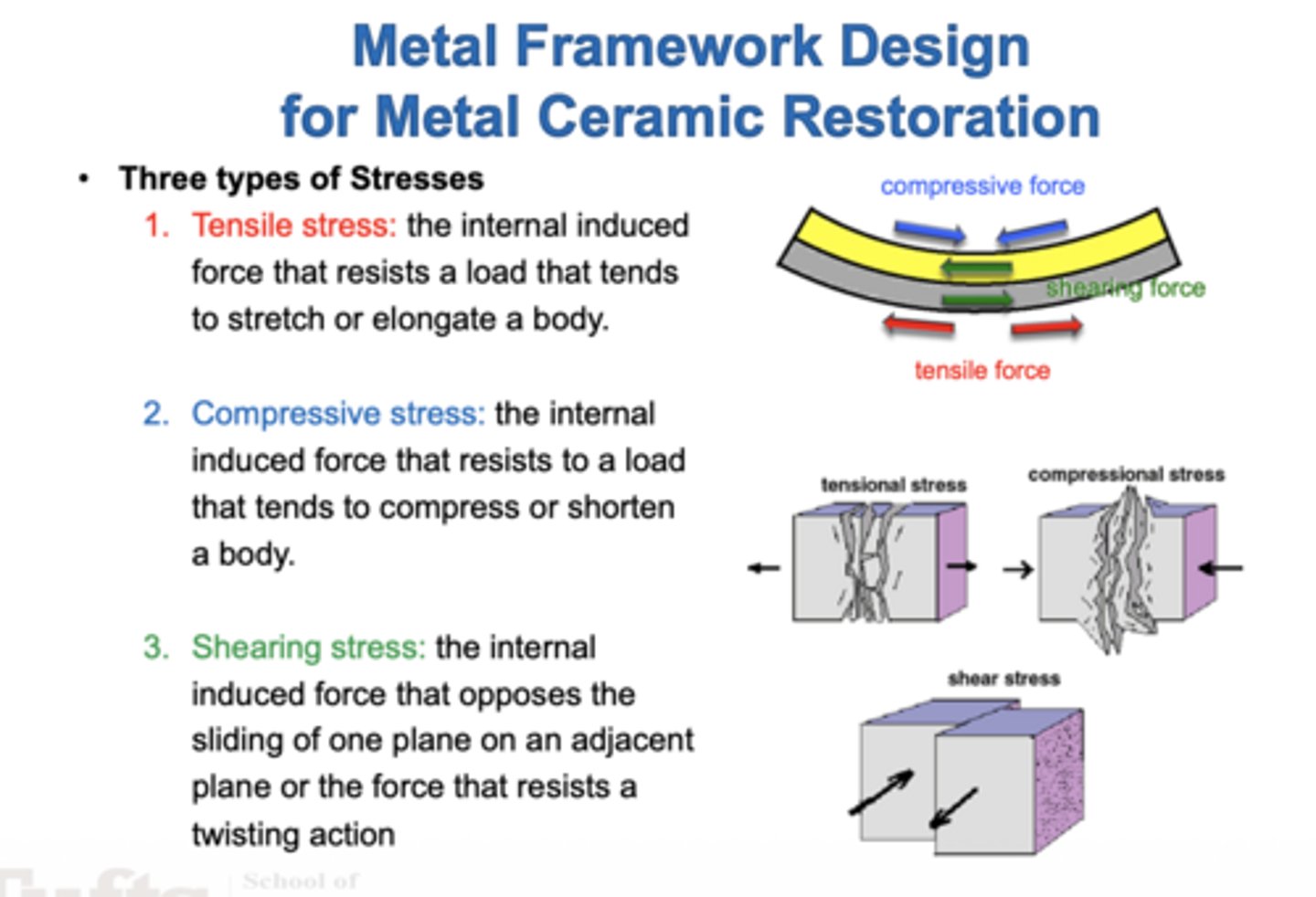
What are the three types of stresses exerted on a crown?
- Tensile stress
- Compressive stress
- Shearing stress
Define the following:
The internal induced force that resists a load that tends to strength or elongate a body
Tensile stress
Define the following:
The internal induced force that resists to a load that tends to compress or shorten a body
compressive stress
Define the following:
The internal induced force that opposes the sliding of one plane on an adjacent plane or the force that resists a twisting action
Shearing stress
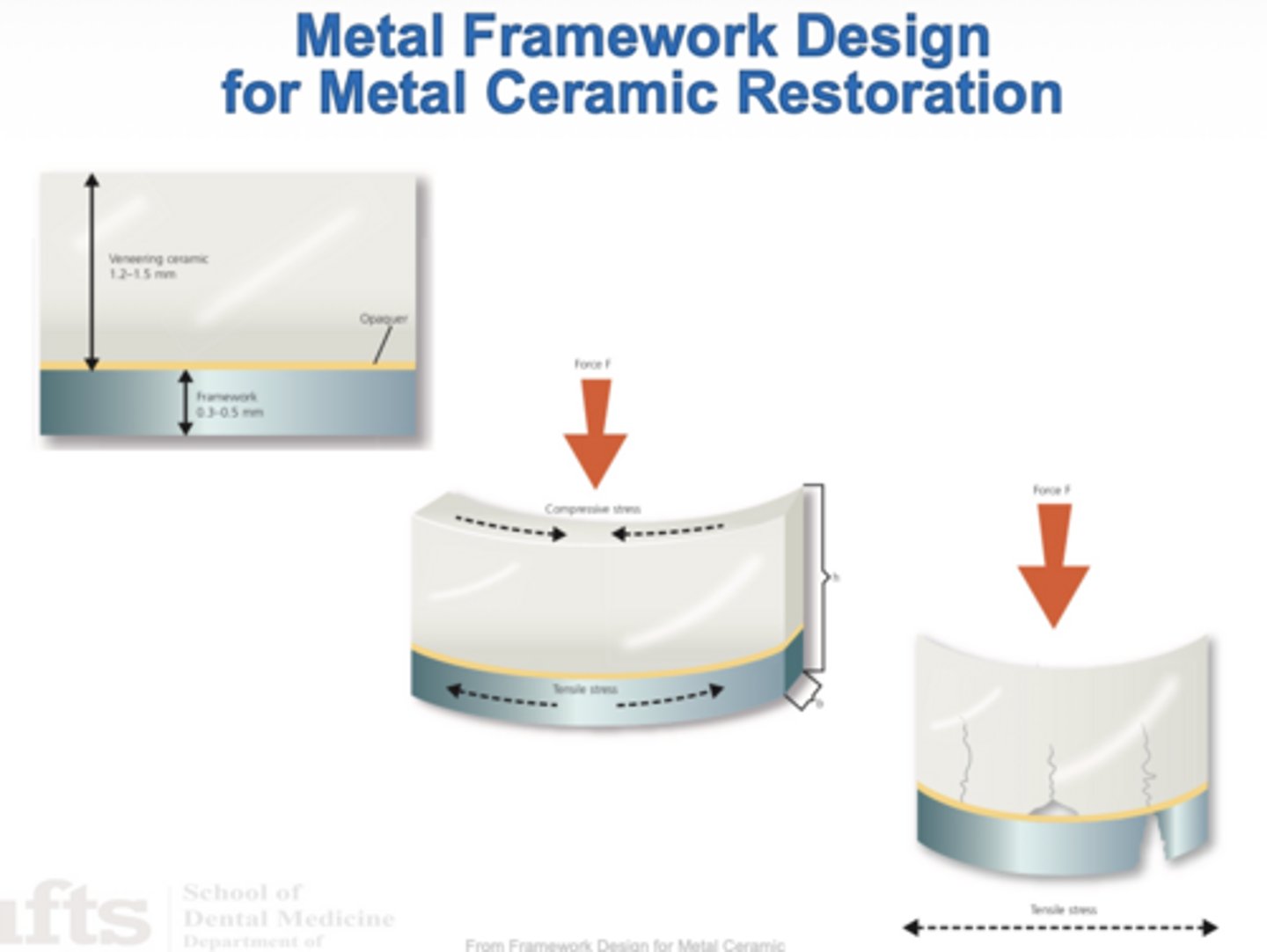
When the load is placed on the inciso-lingual portion of a crown, where are the compression and tensile stresses located?
When the force is released the opposite occurs
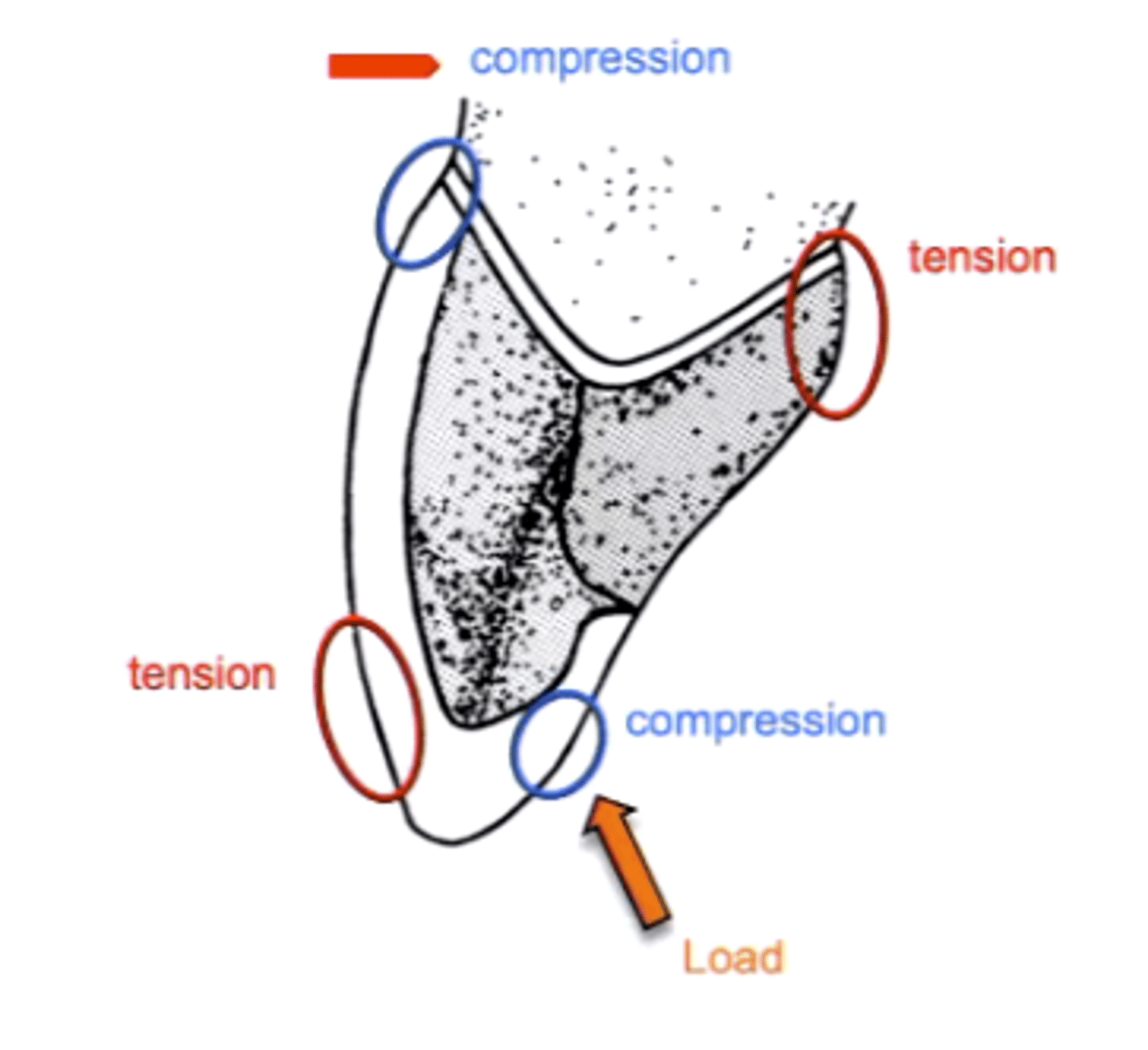
Porcelain is weak to ___________ stresses
A) Compression
B) Tension
B) Tension stresses -- that is why we have a metal collar on the lingual surface
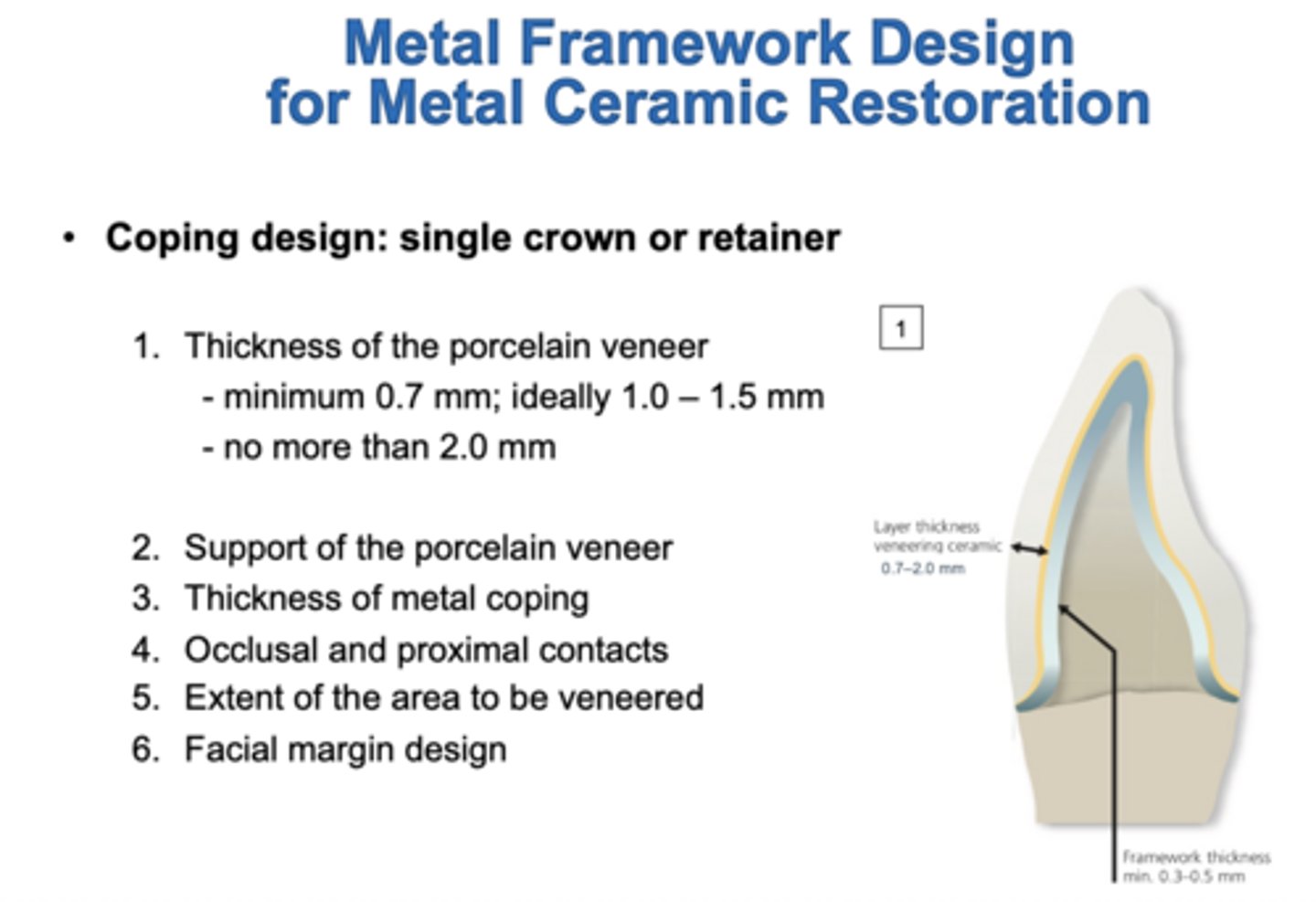
What is the ideal thickness of the porcelain veneer?
1.0-1.5mm
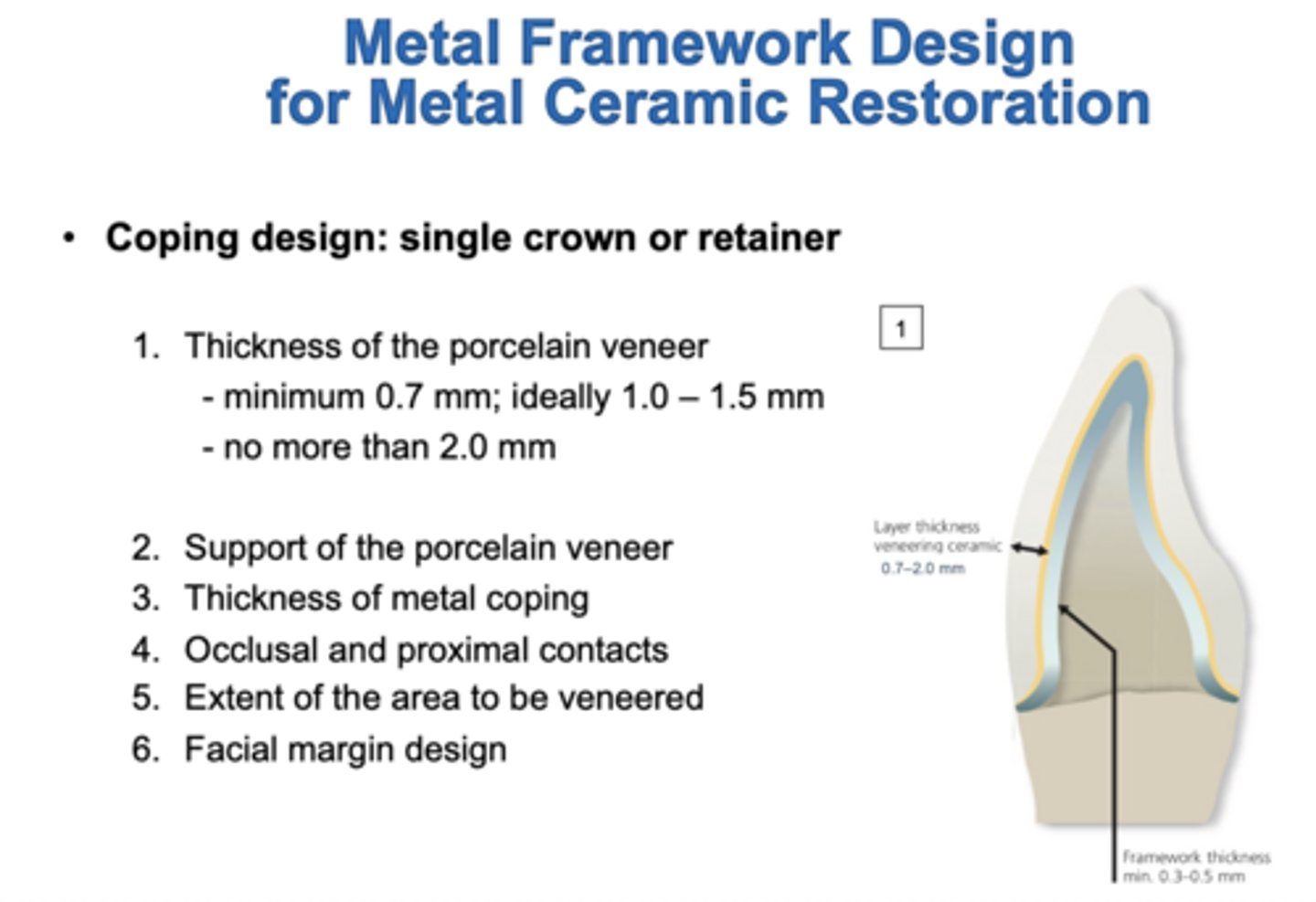
What is the minimum thickness of porcelain veneer?
0.7mm
What is the maximum thickness of porcelain veneer?
2.0mm
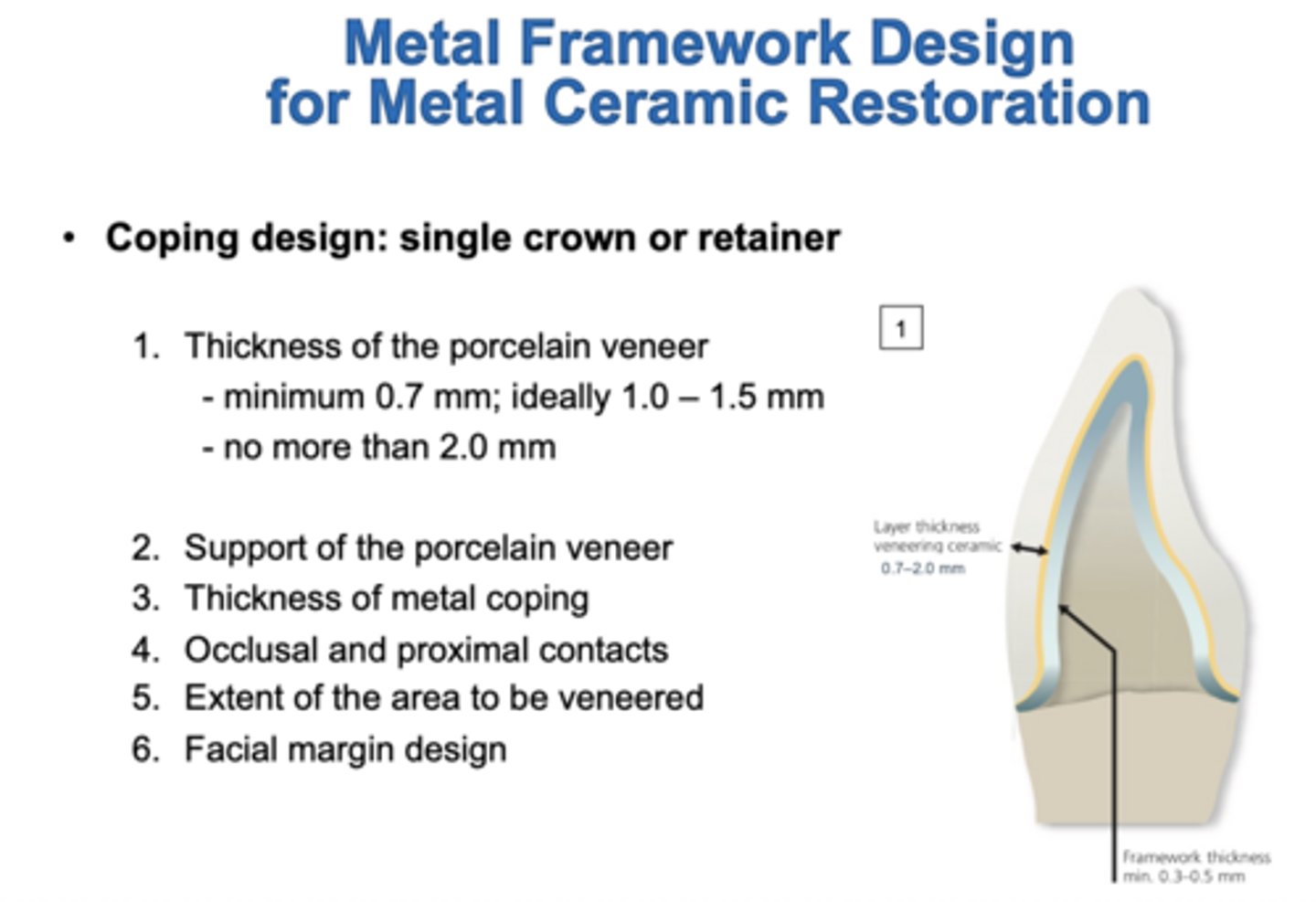
A porcelain veneer should have what type of support?
Incisal and occlusal support
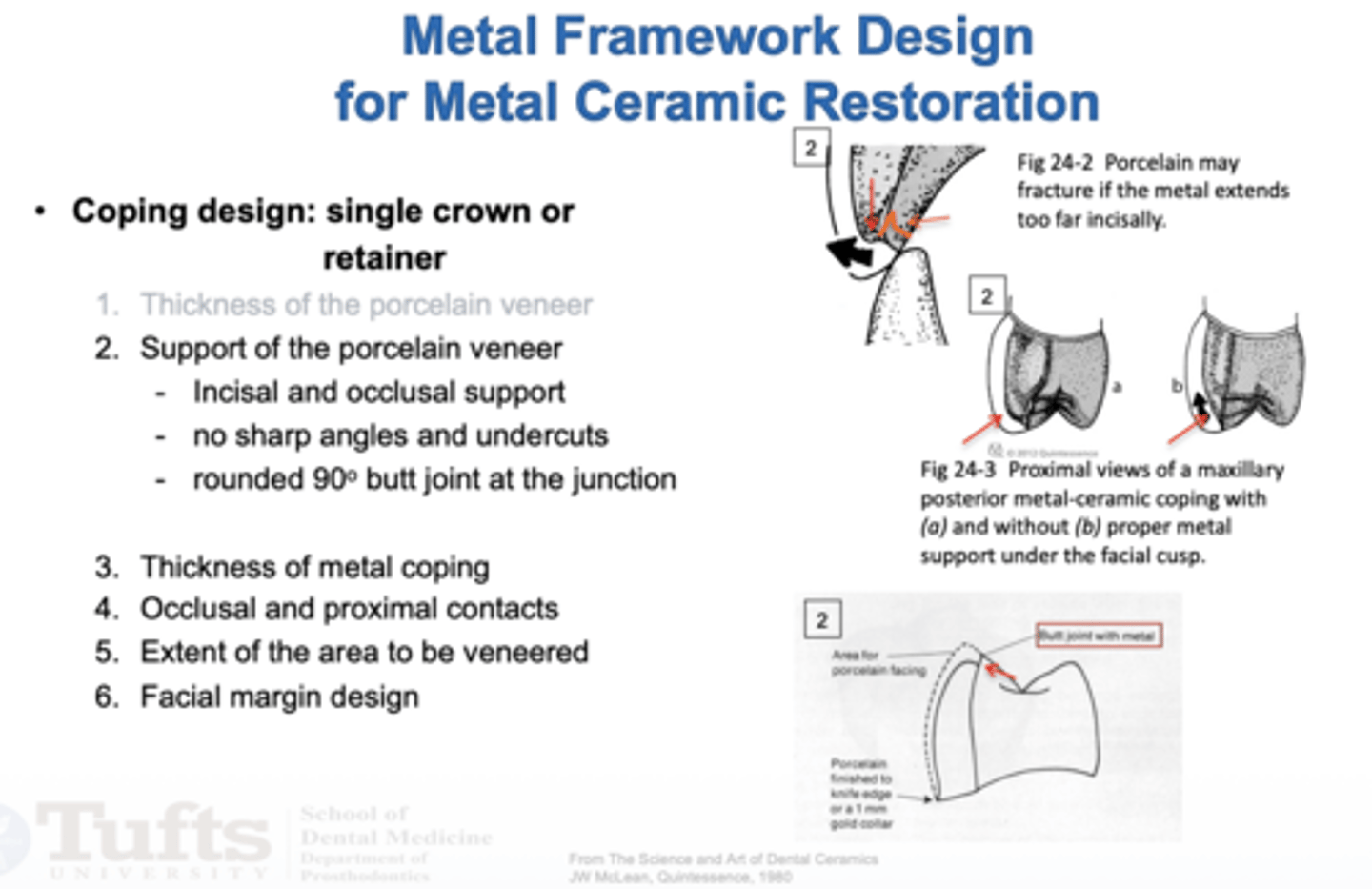
T/F: Porcelain should always be supported by metal
True
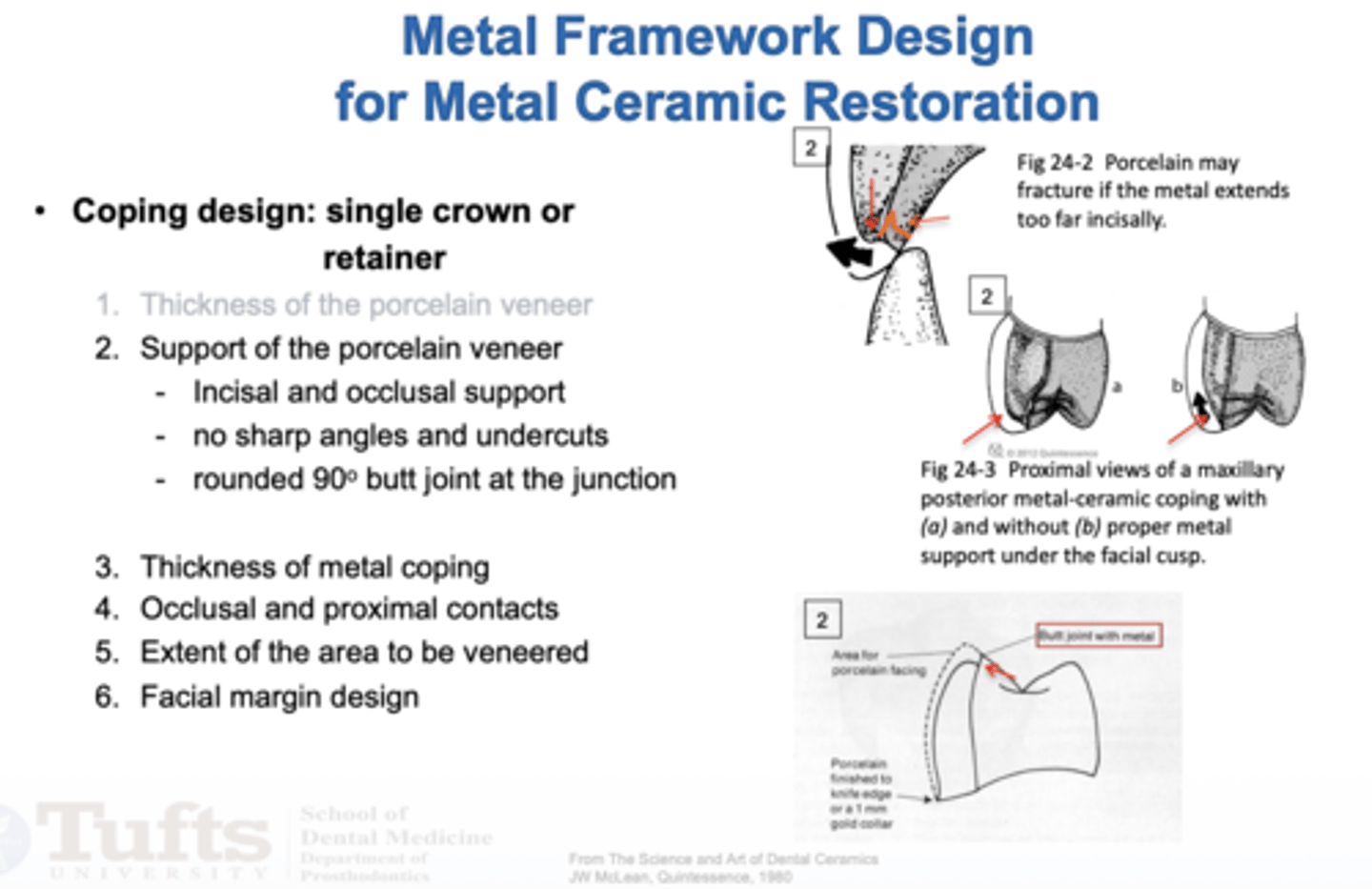
T/F: The support of a porcelain veneer should have sharp angles and undercuts
False - no sharp angles and undercuts
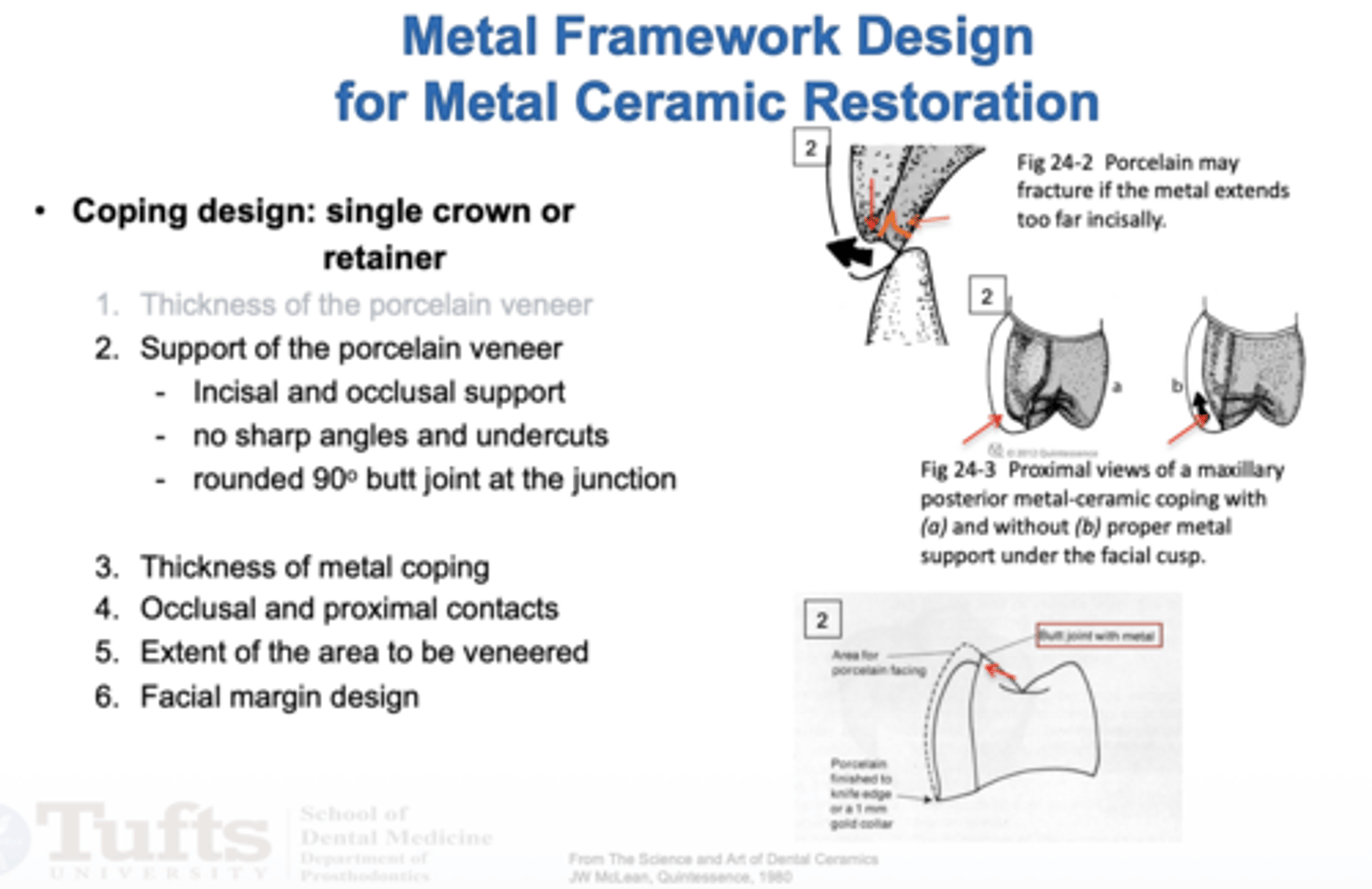
Porcelain veneers should be _______ at the junction
Rounded 90 degrees butt joint
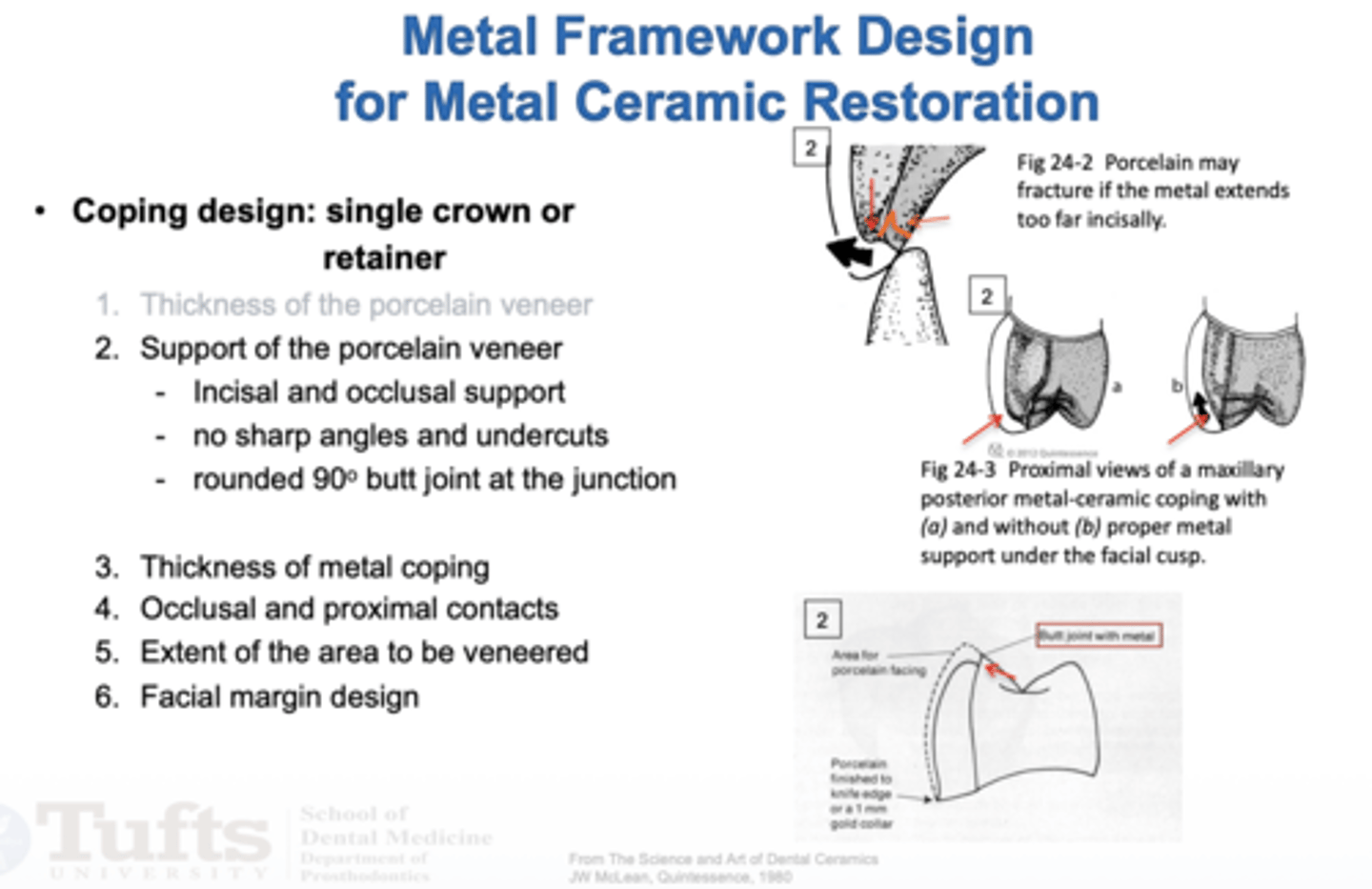
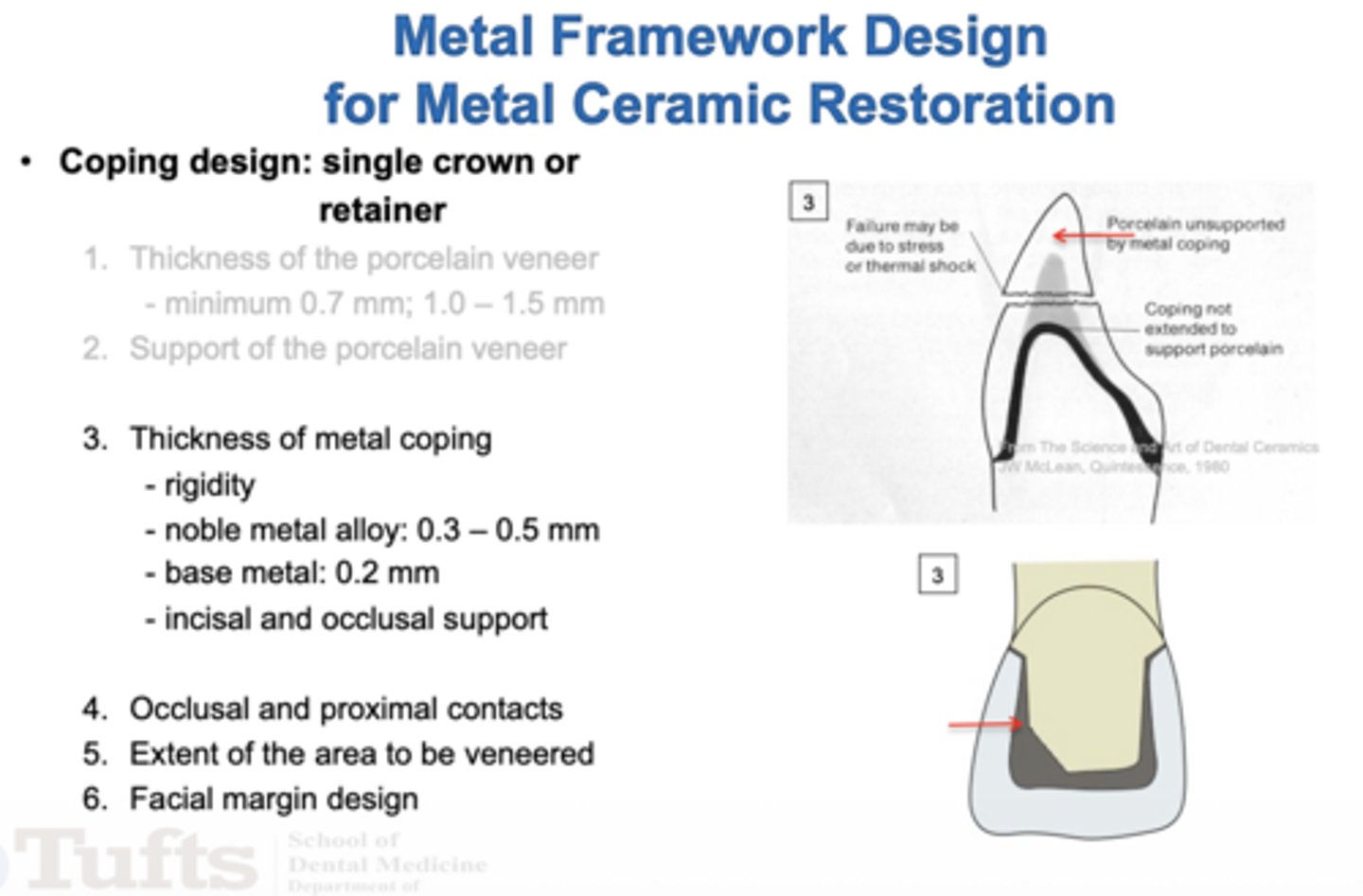
The following are the characteristics of what?
- Rigidity
- Noble metal alloy: 0.3 - 0.5 mm
- Base metal: 0.2 mm
- Incisal and occlusal support
Metal coping
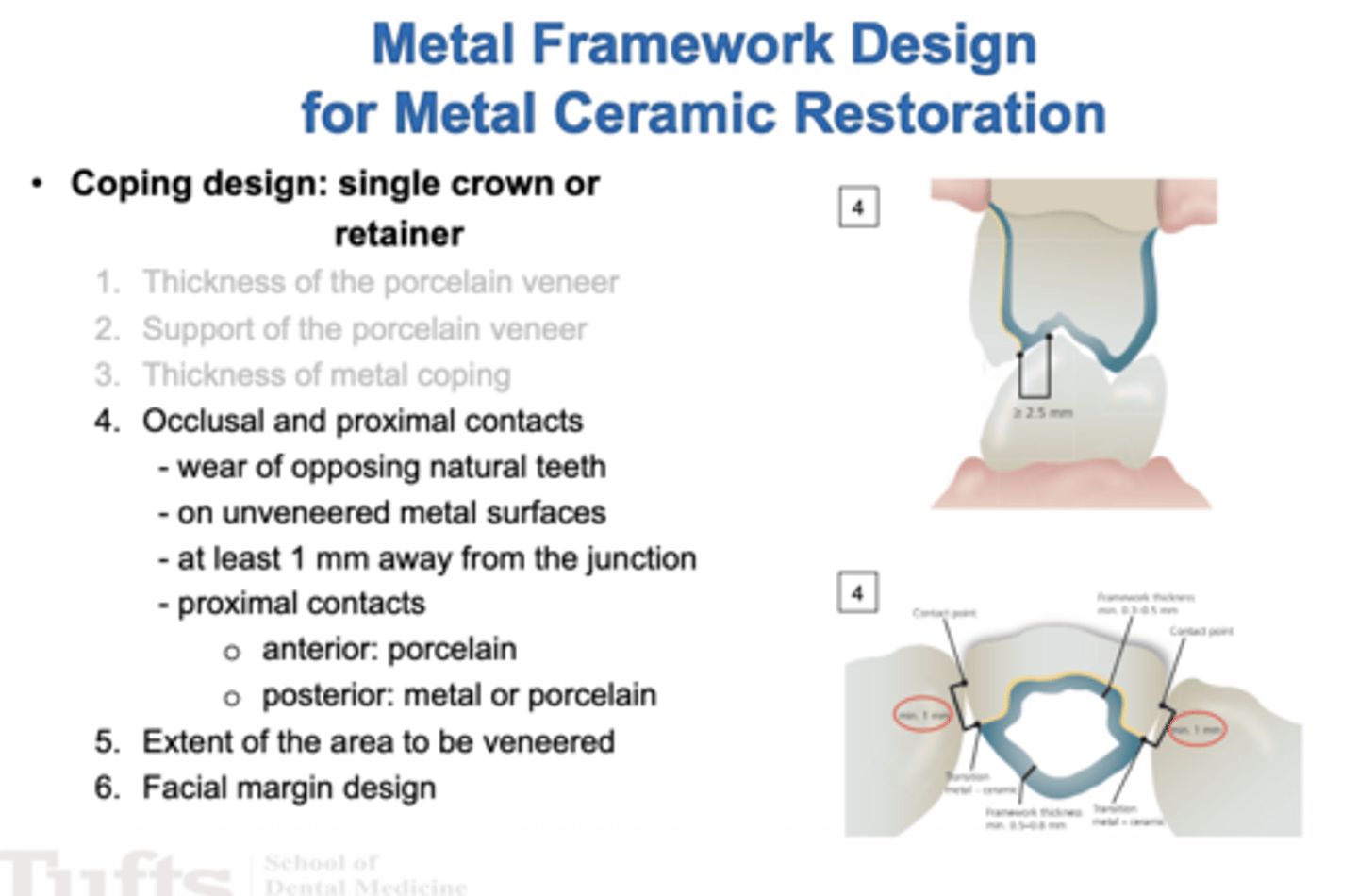
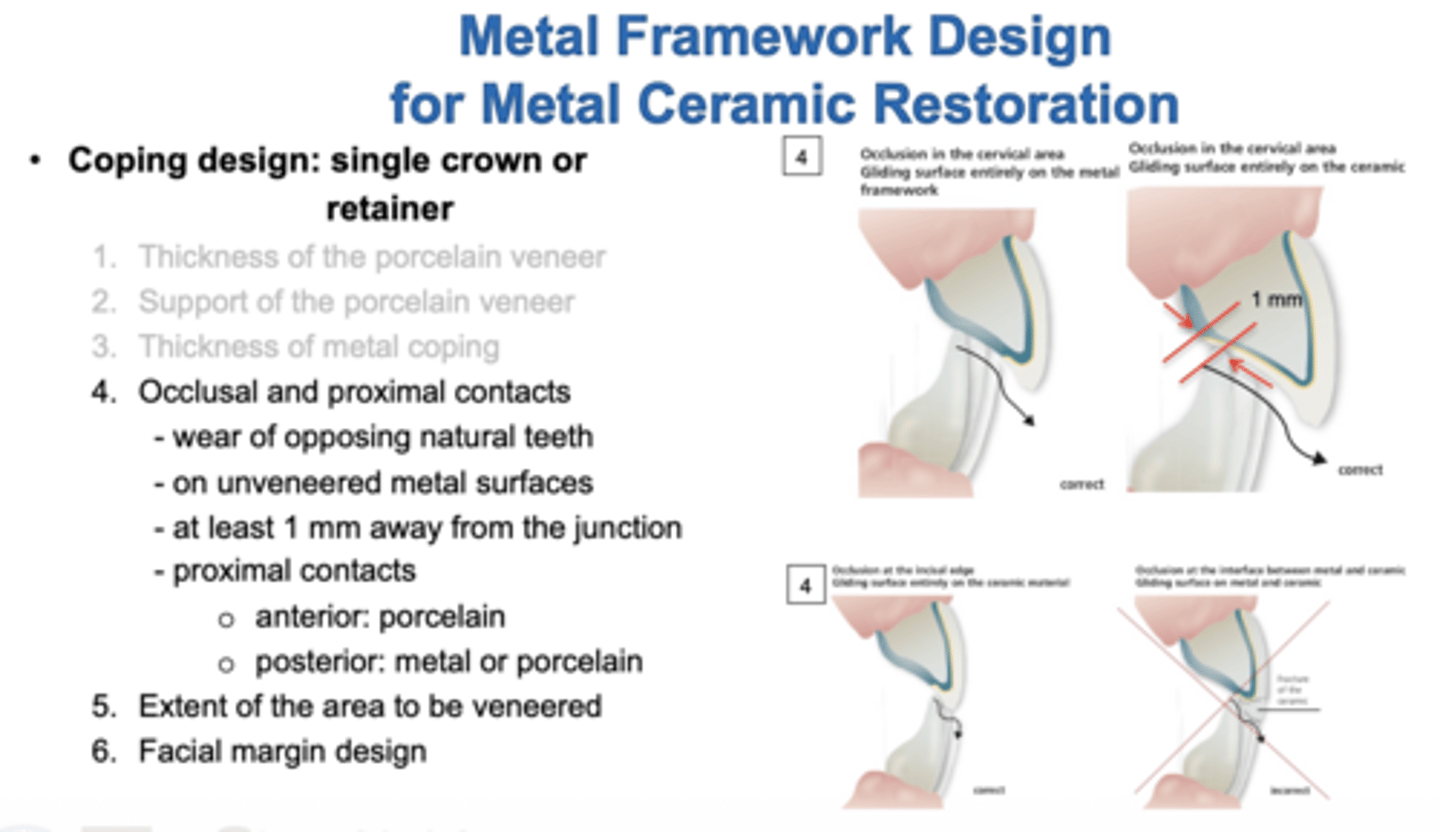
Occlusal and proximal contacts should always be on porcelain or metal, at least _____mm away from the junction between the metal and porcelain
1mm
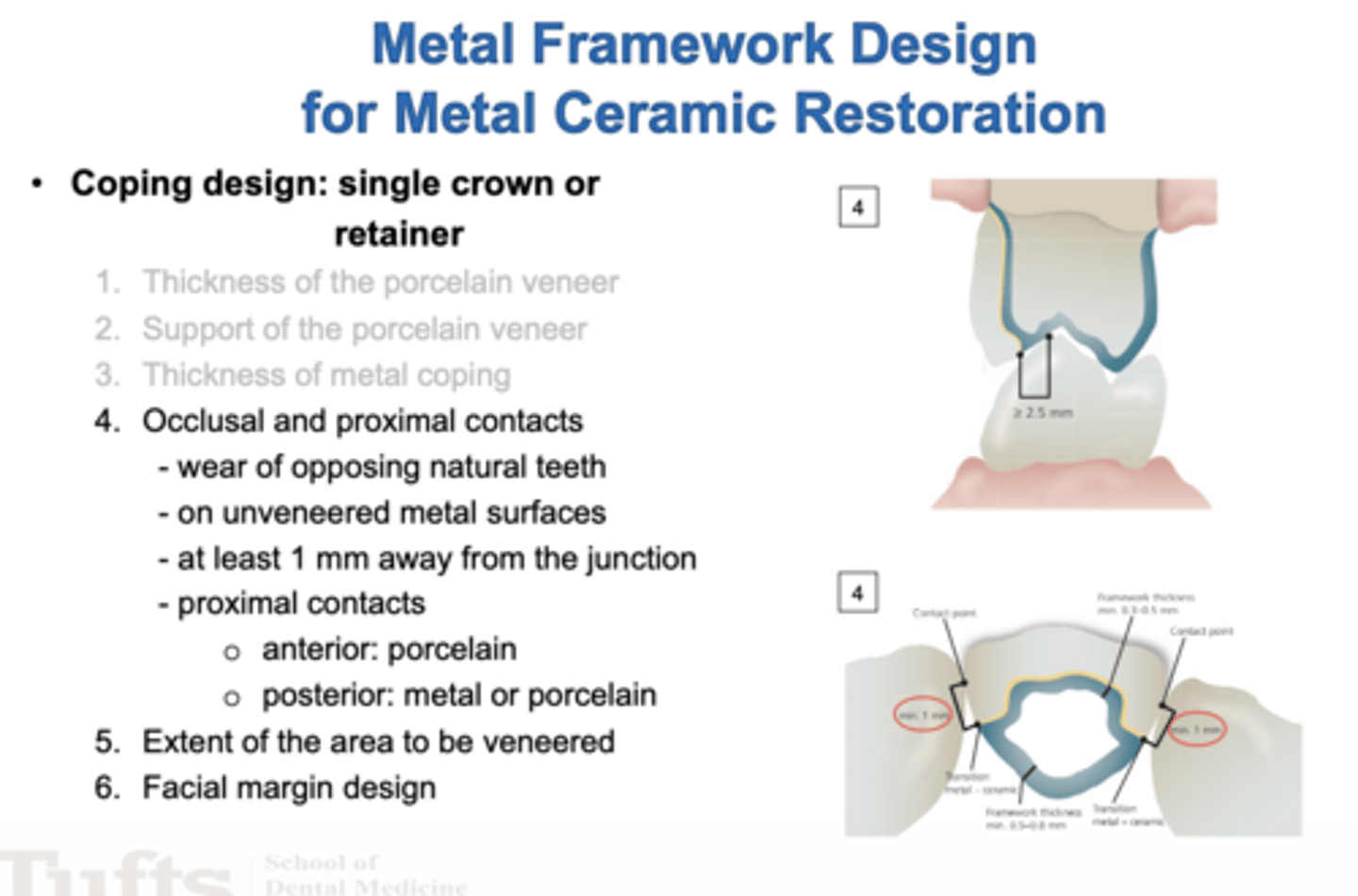
T/F: Anterior proximal contacts should be on porcelain (for esthetics), and posterior proximal contacts can be on metal or porcelain
True
T/F: While posterior proximal contacts can be on metal or porcelain, most will be porcelain, because it is easier to fix the proximal contacts when manipulating porcelain
True
The metal occlusal should be resistant to fracture. What is the extent of the area to be veneered?
Halfway down the lingual incline of the facial cusp
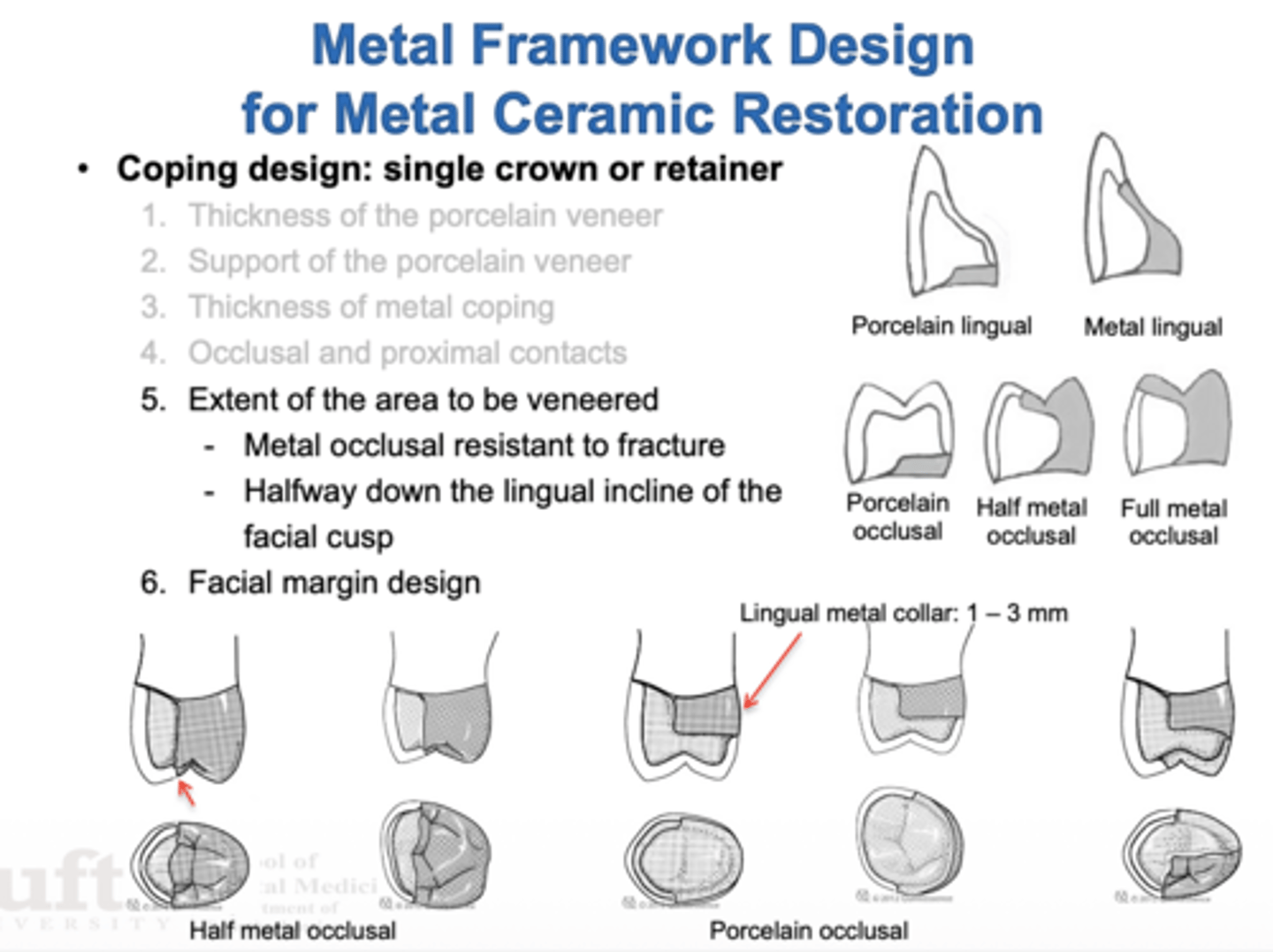
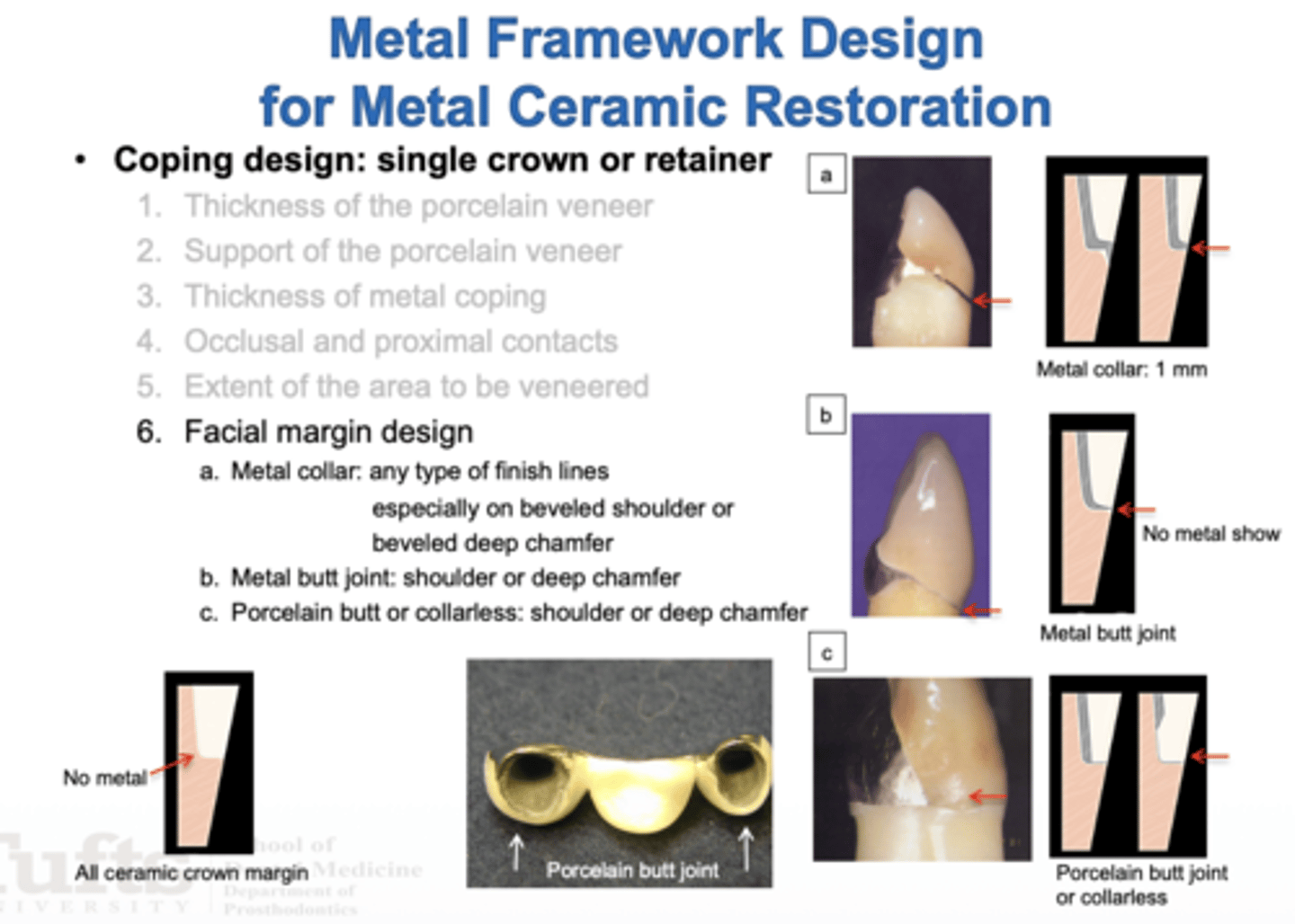
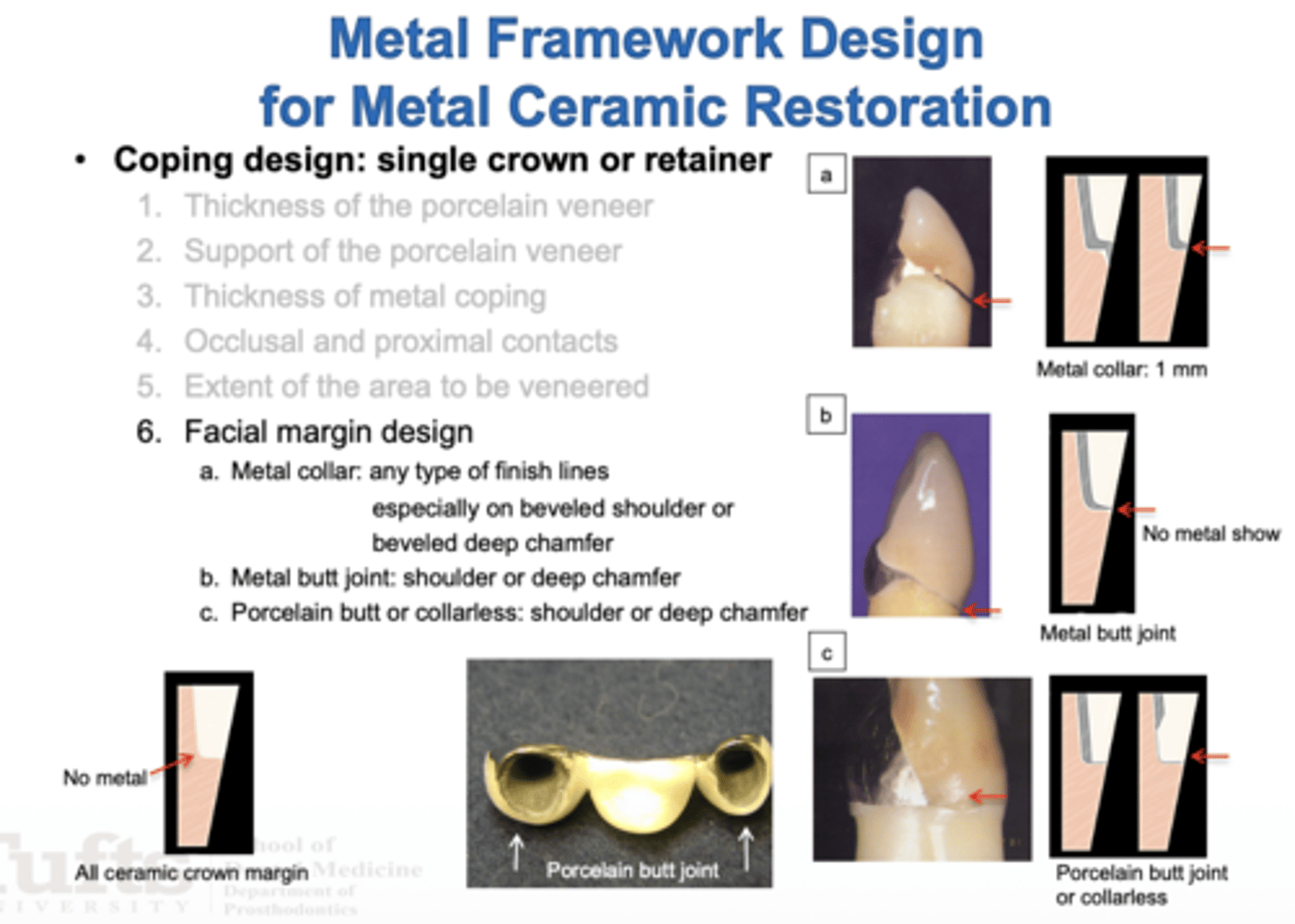
What are three types of facial margin designs?
- Metal collar
- Metal butt joint
- Porcelain butt joint or collarless
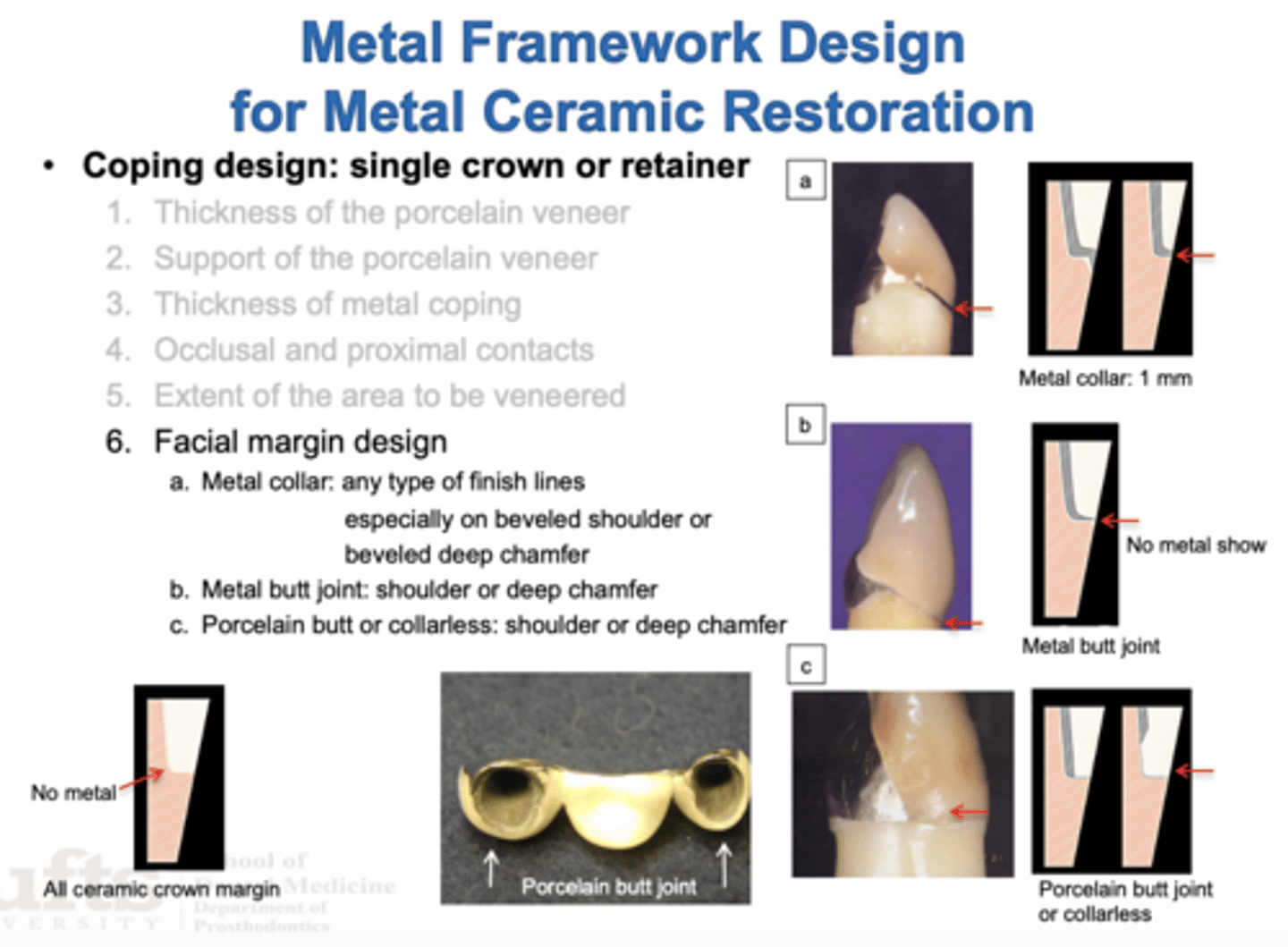
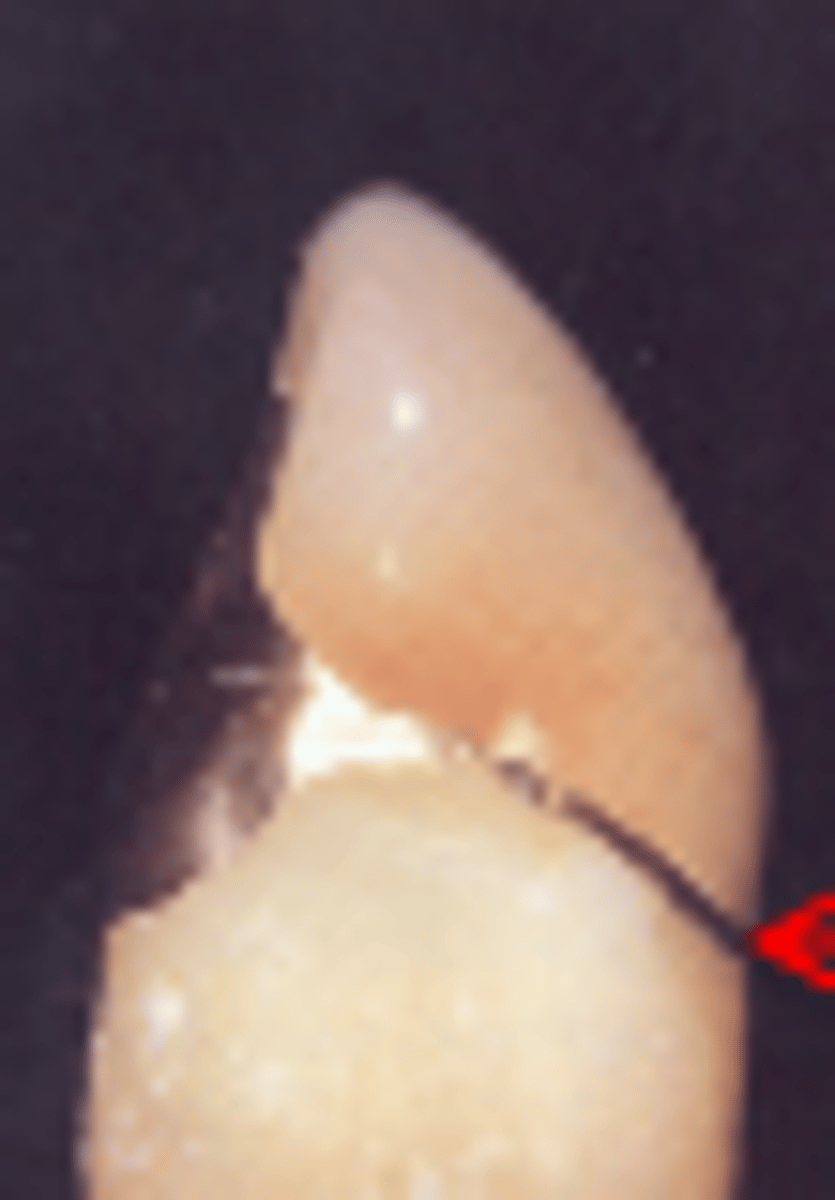
Metal collars have a band of metal around the margins (can be hairline thin). What type of finish line can/should these designs have?
Any type of finish line, especially on beveled shoulder or beveled deep chamfer
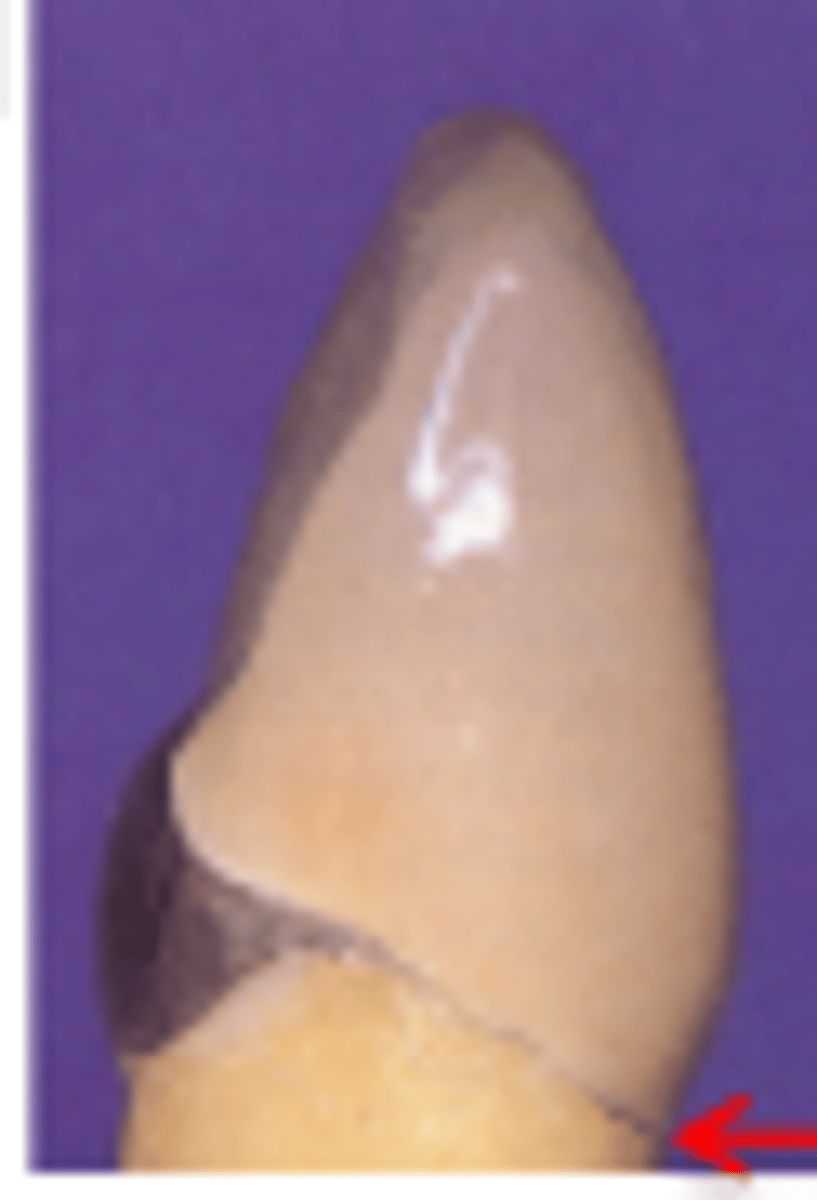
What type of margin design?
Metal extends to the finish line but tapers off so that the metal is not showing
Metal butt joint design
What kind of finish line should metal butt joints have?
Shoulder or deep chamfer
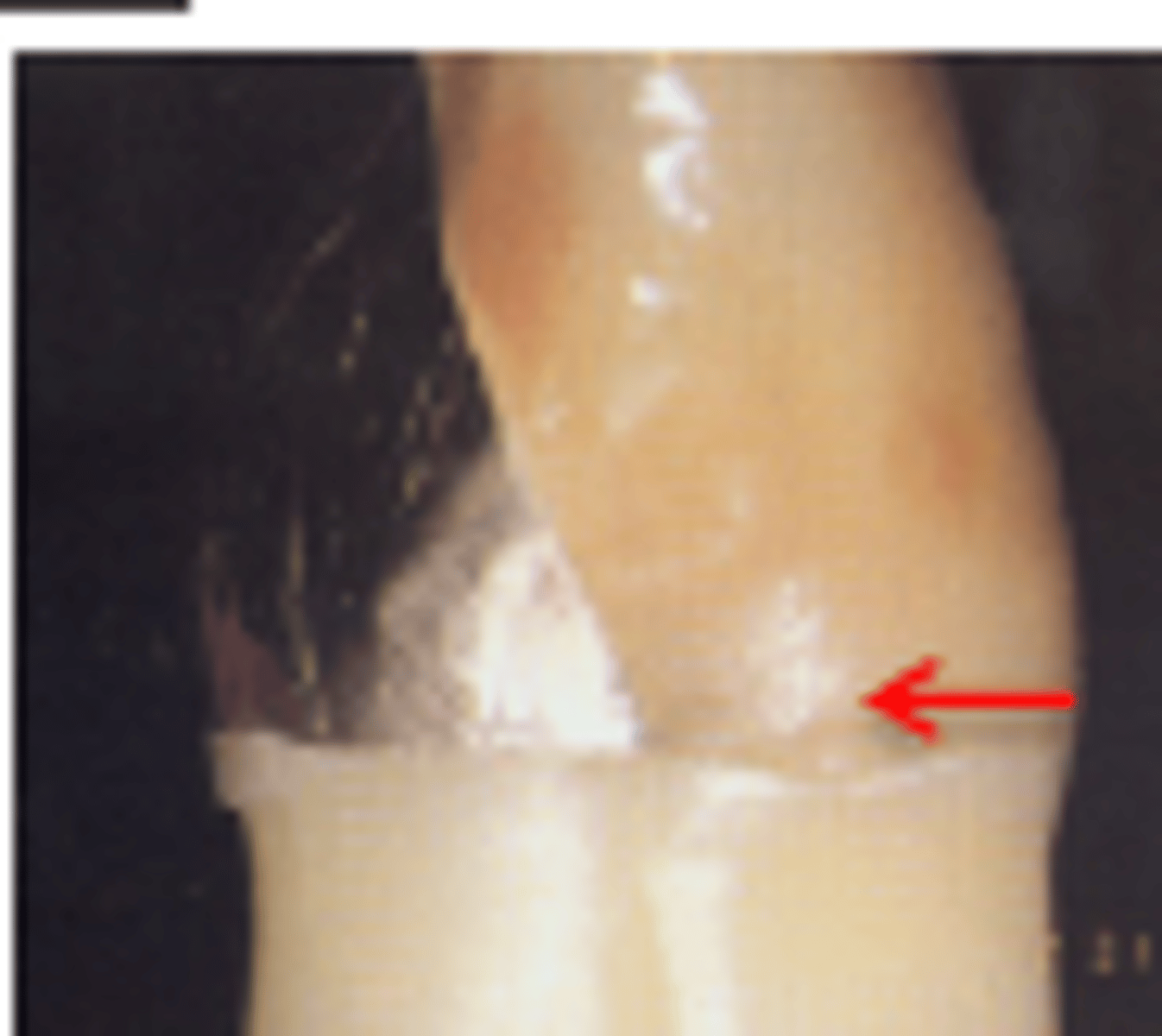
What type of margin design?
Metal ends at the axial wall and does not extend to the finish line
Porcelain butt joint or collarless design
What type of finish line should porcelain butt joints have?
Shoulder or deep chamfer
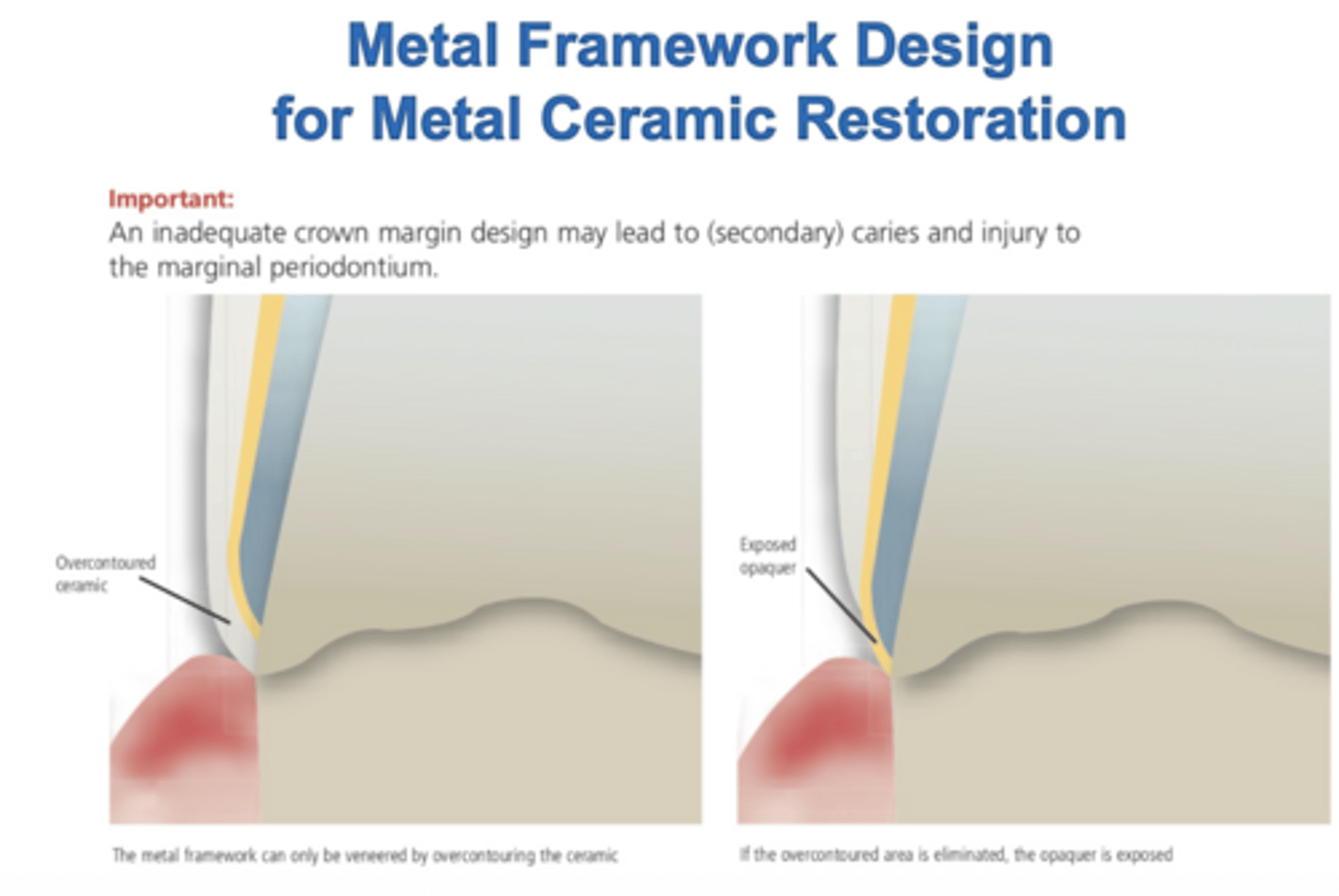
What might an inadequate crown margin design lead to?
- (Secondary) caries
- Injury to the marginal periodontium
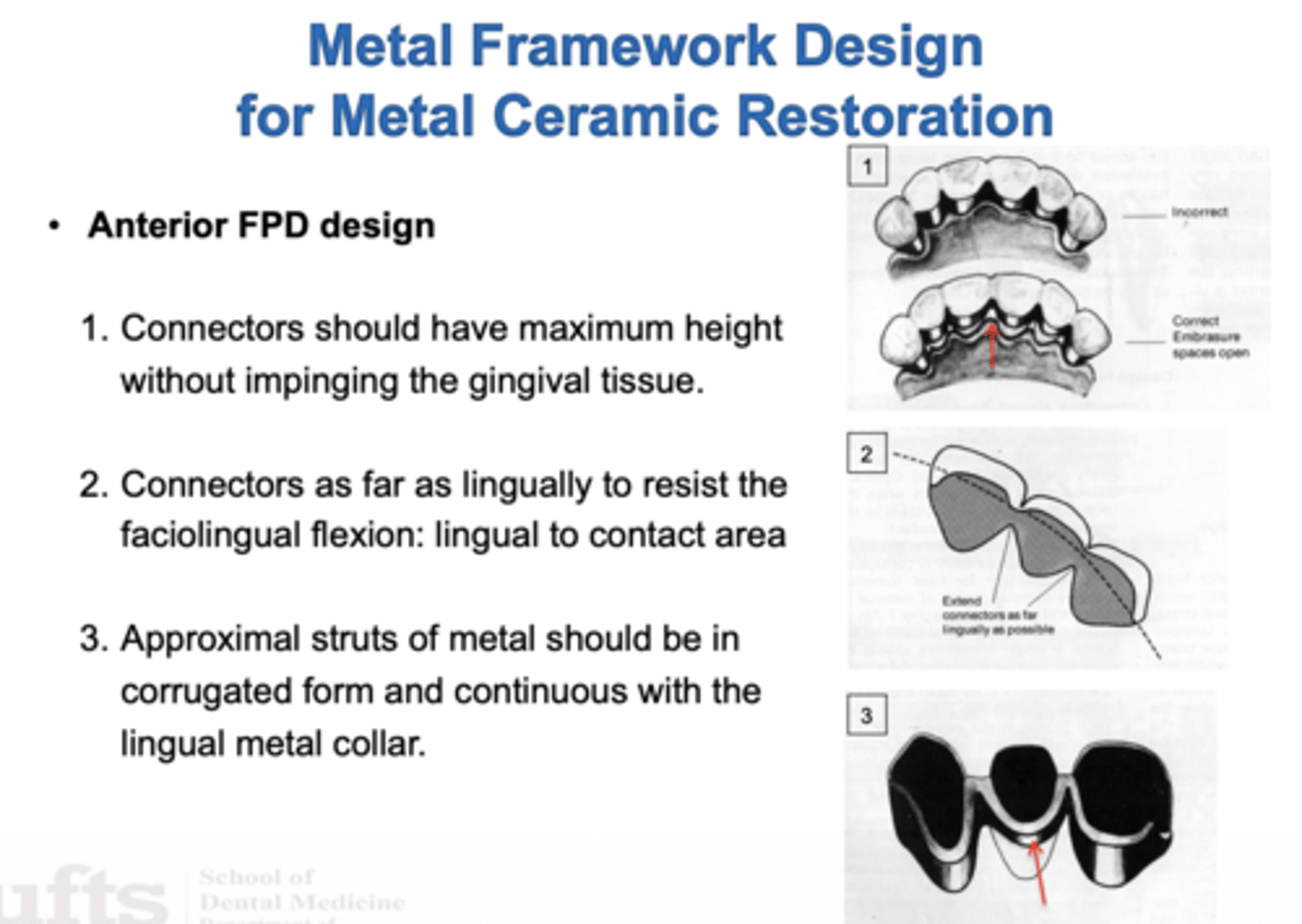
T/F: Anterior FPD connectors should have maximum height without impinging on gingival tissues
True
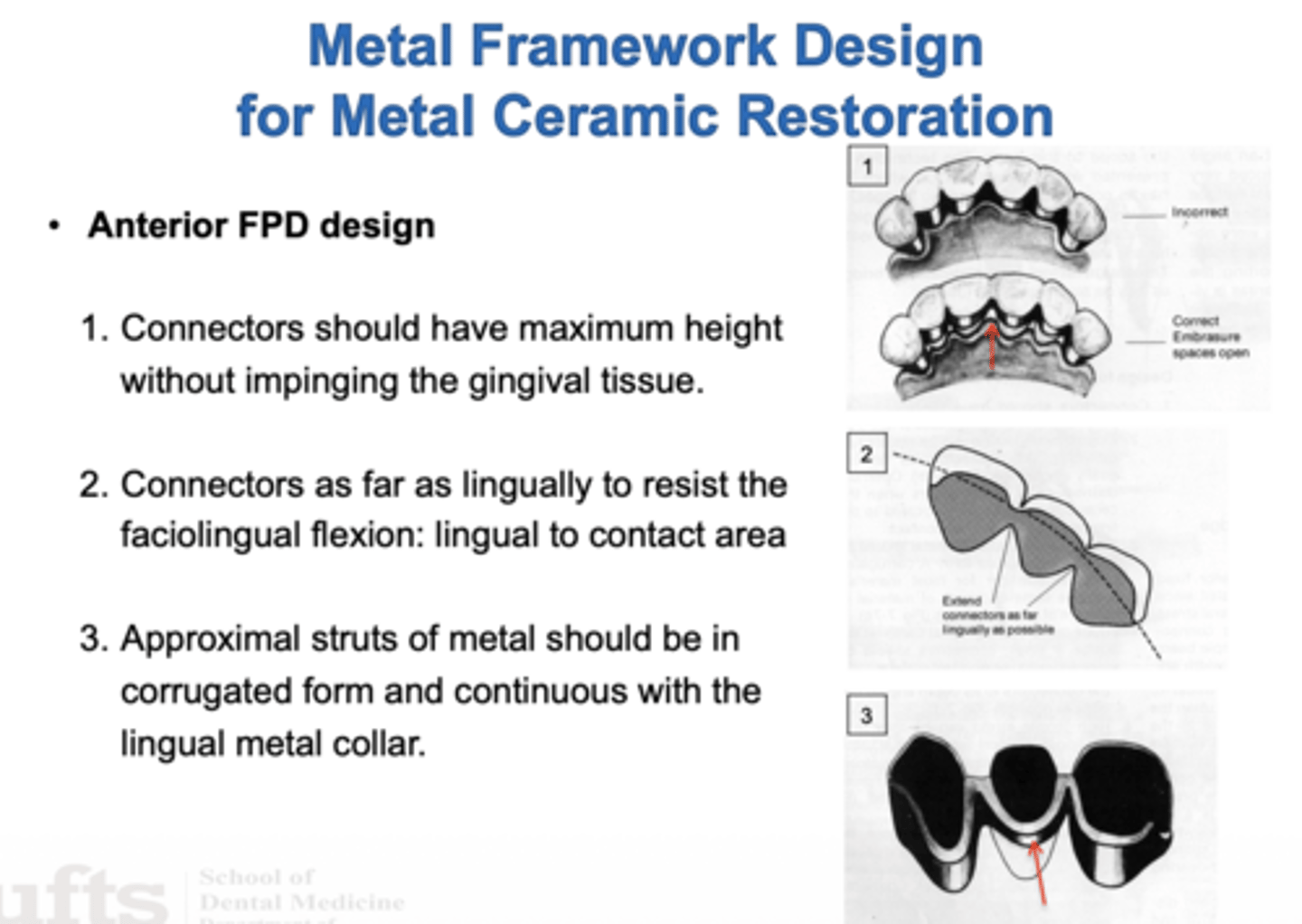
T/F: Anterior connectors should extend as far lingually as possible to resist faciolingual flexion
True
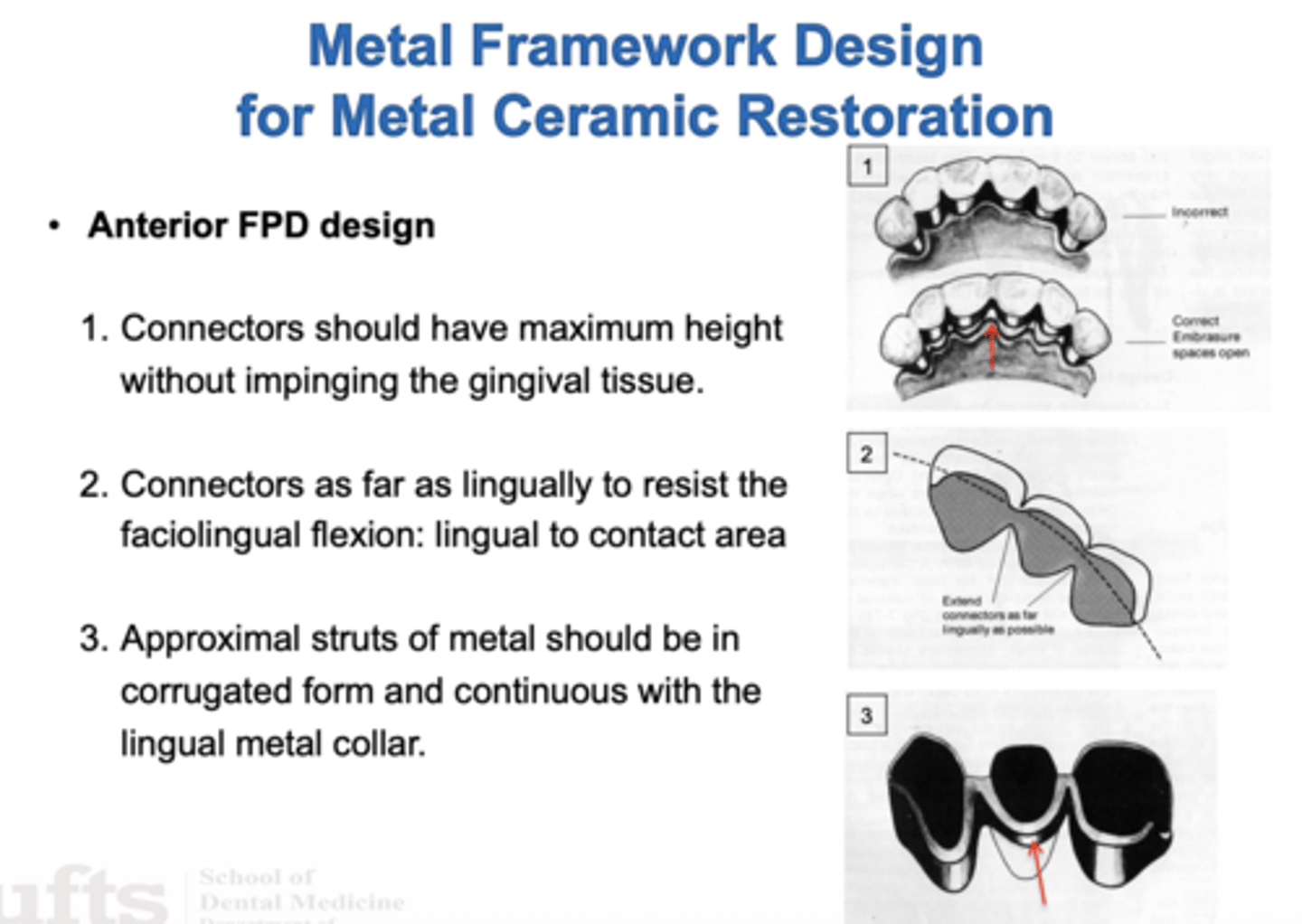
T/F: Approximal struts of metal in anterior FPDs should be in corrugated form and continuous with the lingual metal collar.
True
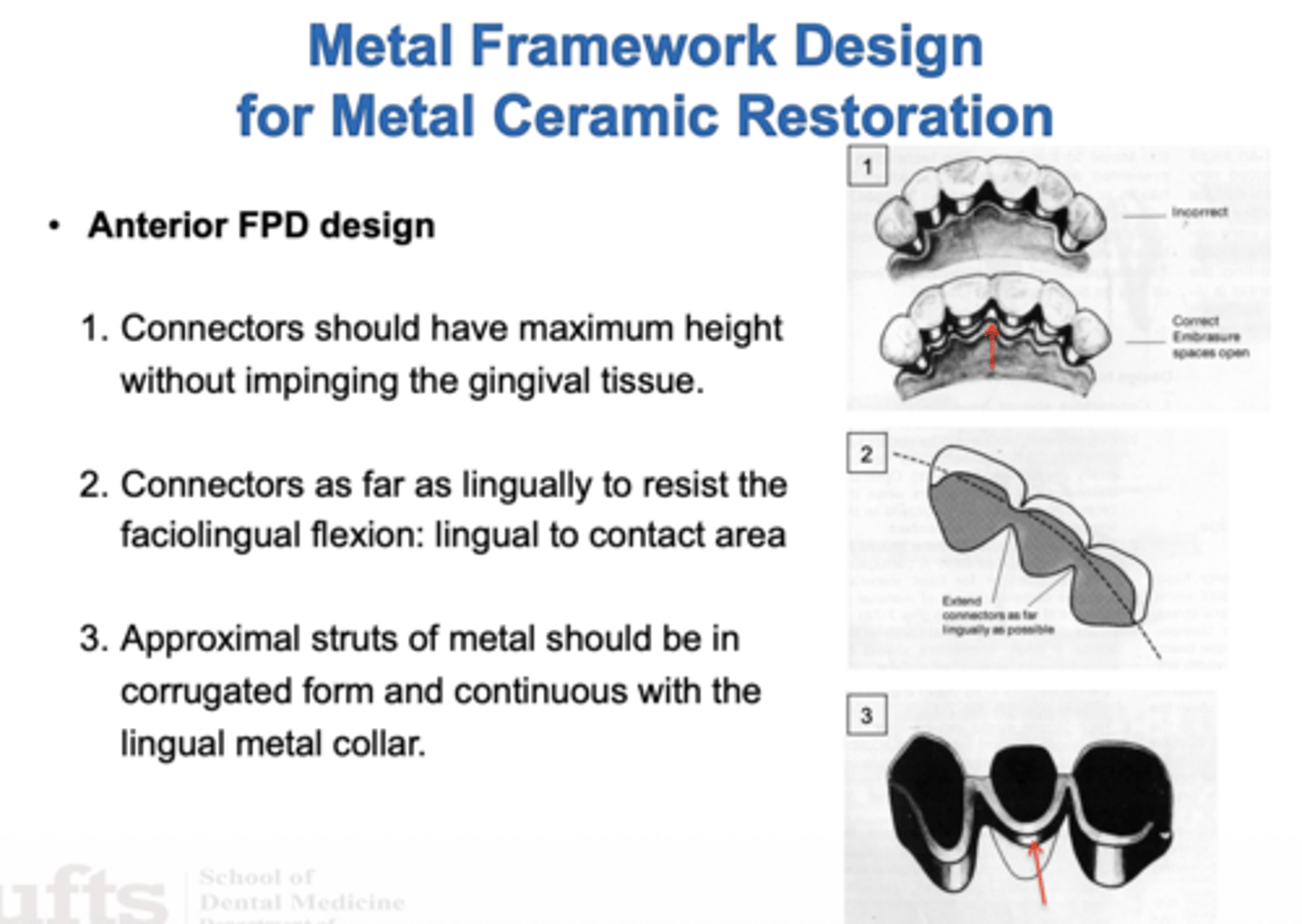
T/F: Anterior connectors should be shaped to keep embrasures open
True
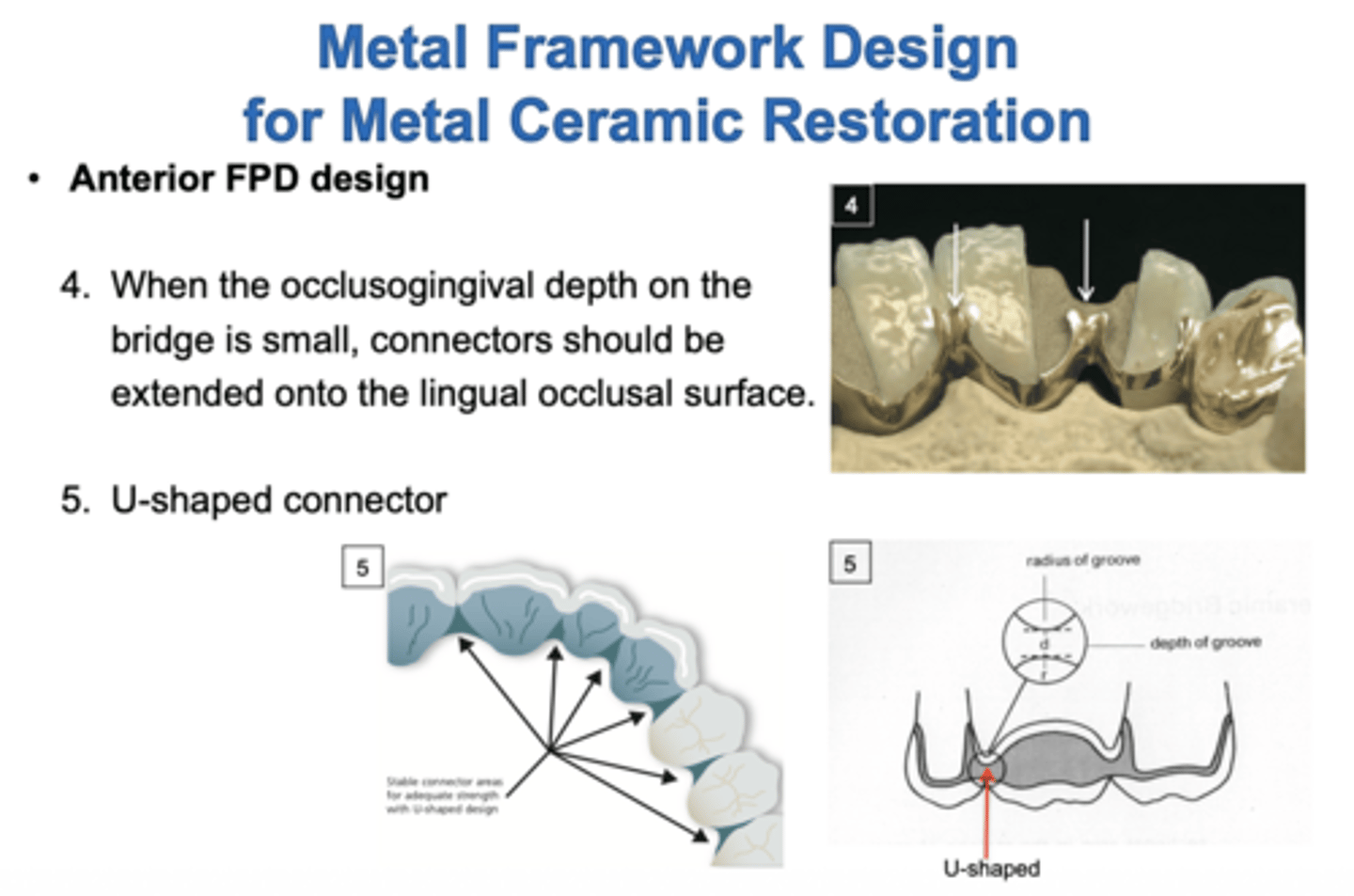
When the occluso-gingival depth on the bridge is small, where should the anterior FPD connector be extended to?
Lingual occlusal surface
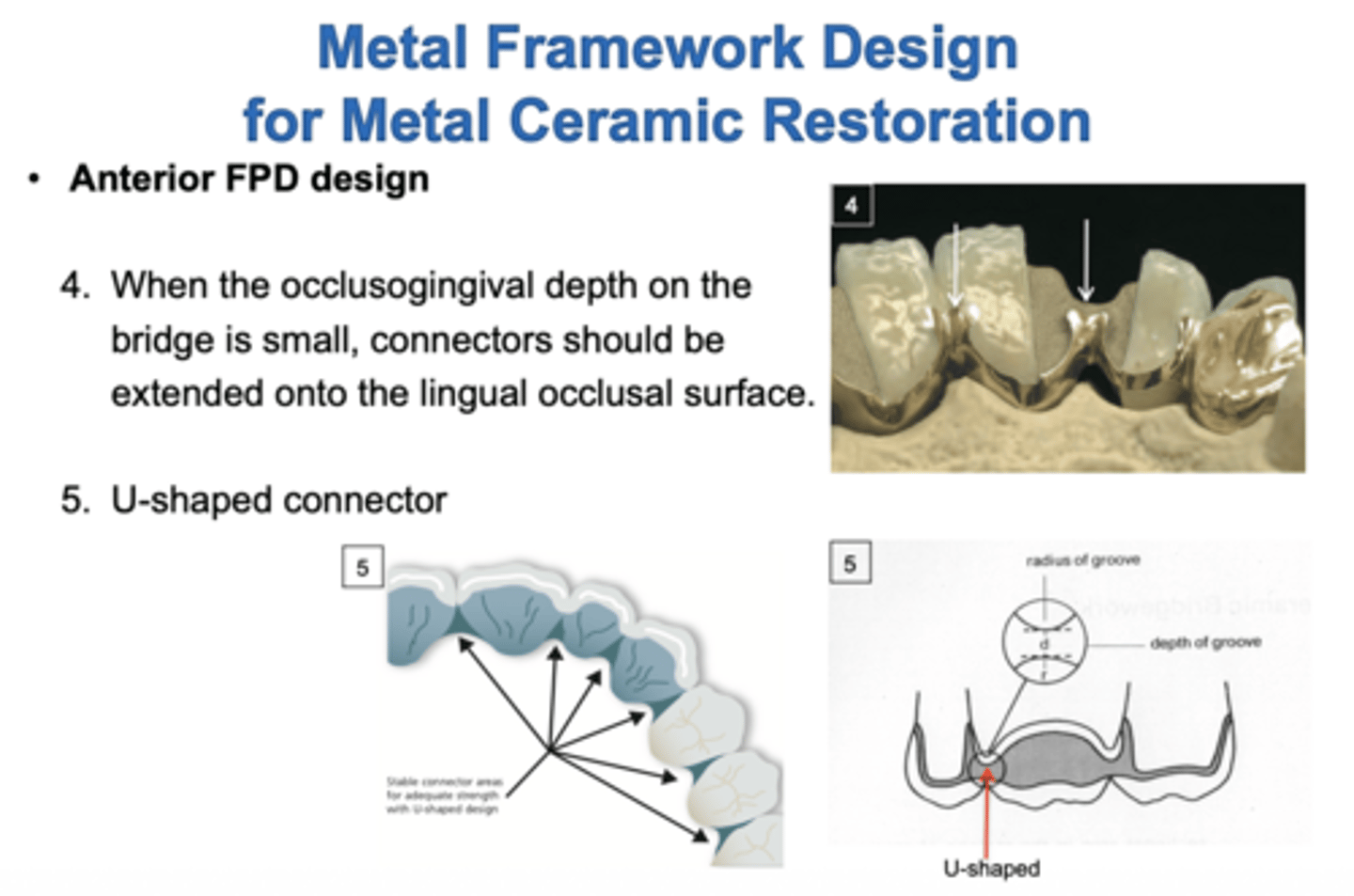
T/F: The anterior connectors should have a gradual U-shape to avoid stress joining at a singular point
True
_____ tensile stress can be incurred at the linguocervical area of the retainer. This area must be reinforced with metal.
High
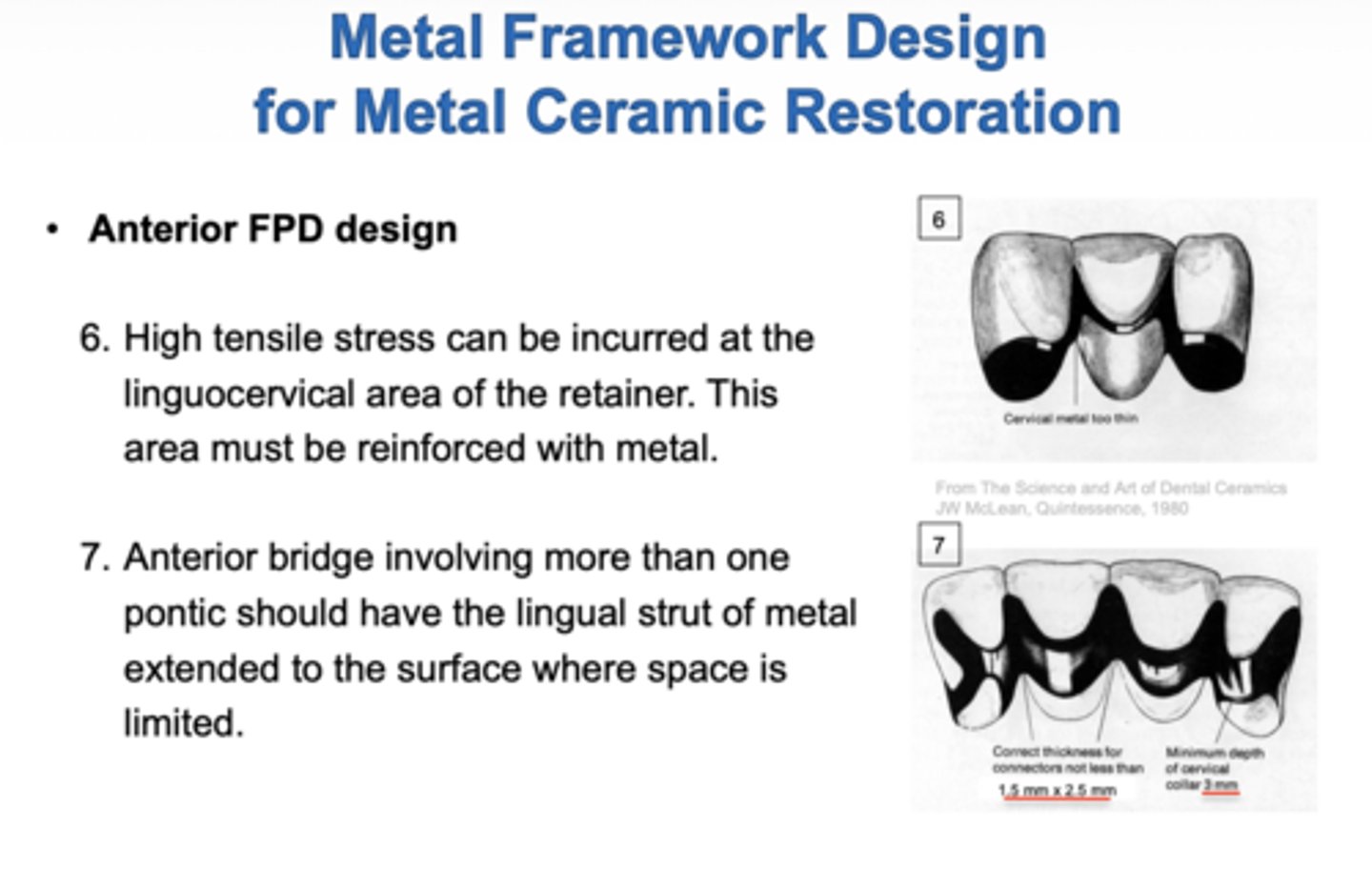
Anterior bridge involving more than one pontic should have the ________ strut of metal extended to the surface where space is limited.
Lingual
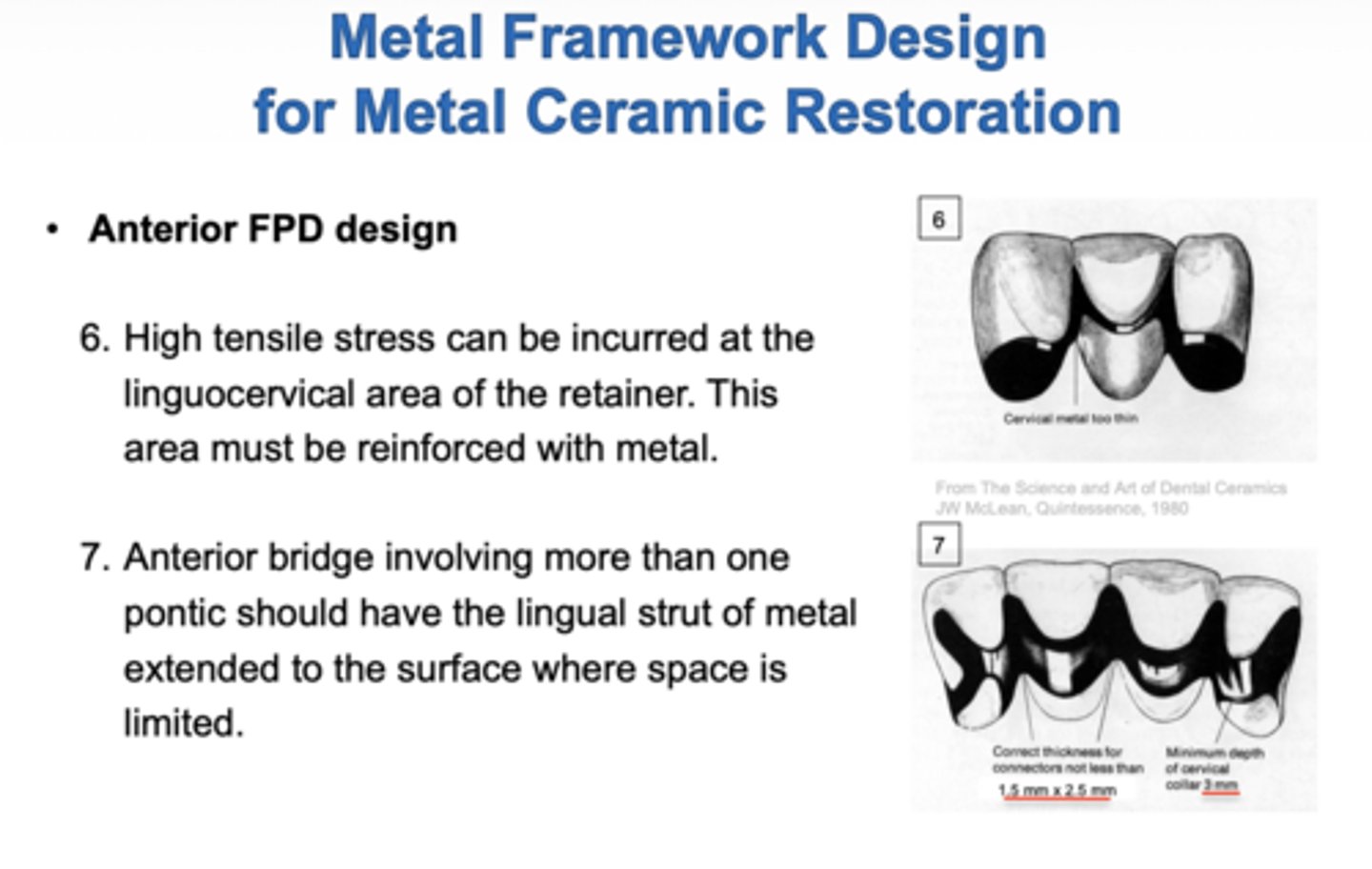
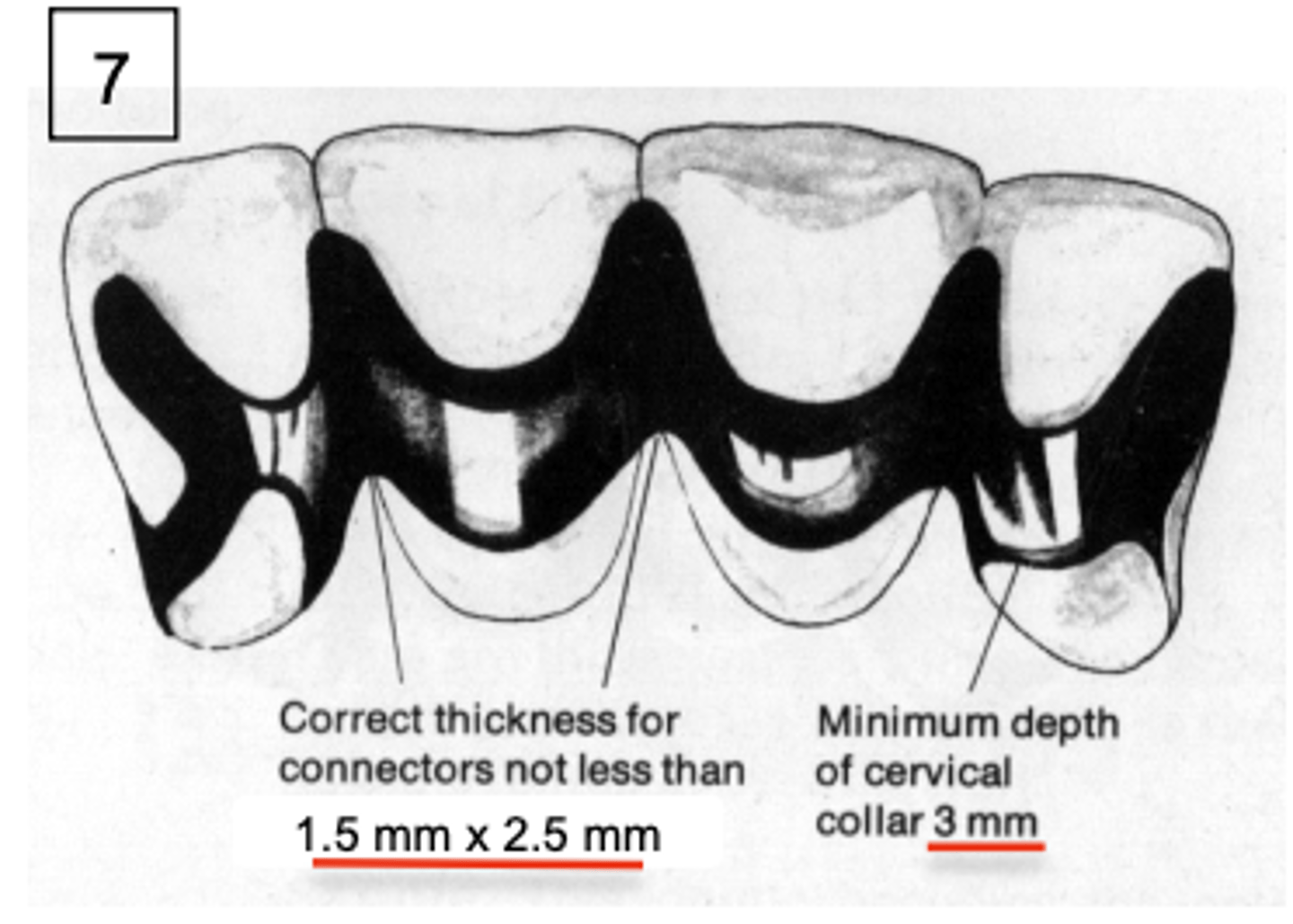
The correct thickness for connectors on an anterior FPD design should not be less than _____ mm x _____ mm
1.5mm x 2.5mm
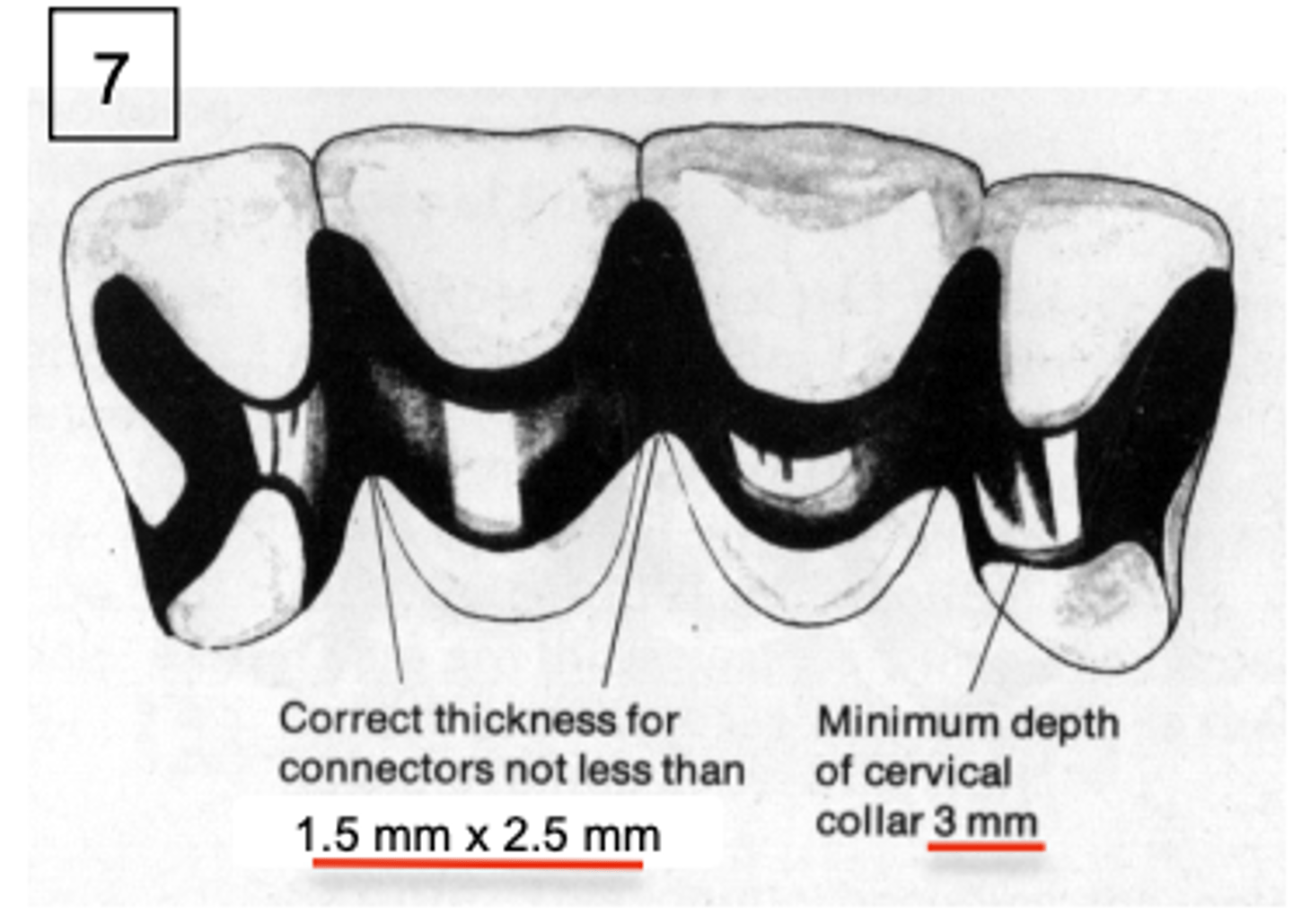
The minimum depth of cervical collar on an anterior FPD design should be ____ mm
3mm
Posterior FPD connectors should have the same design, but you have to account for ___________
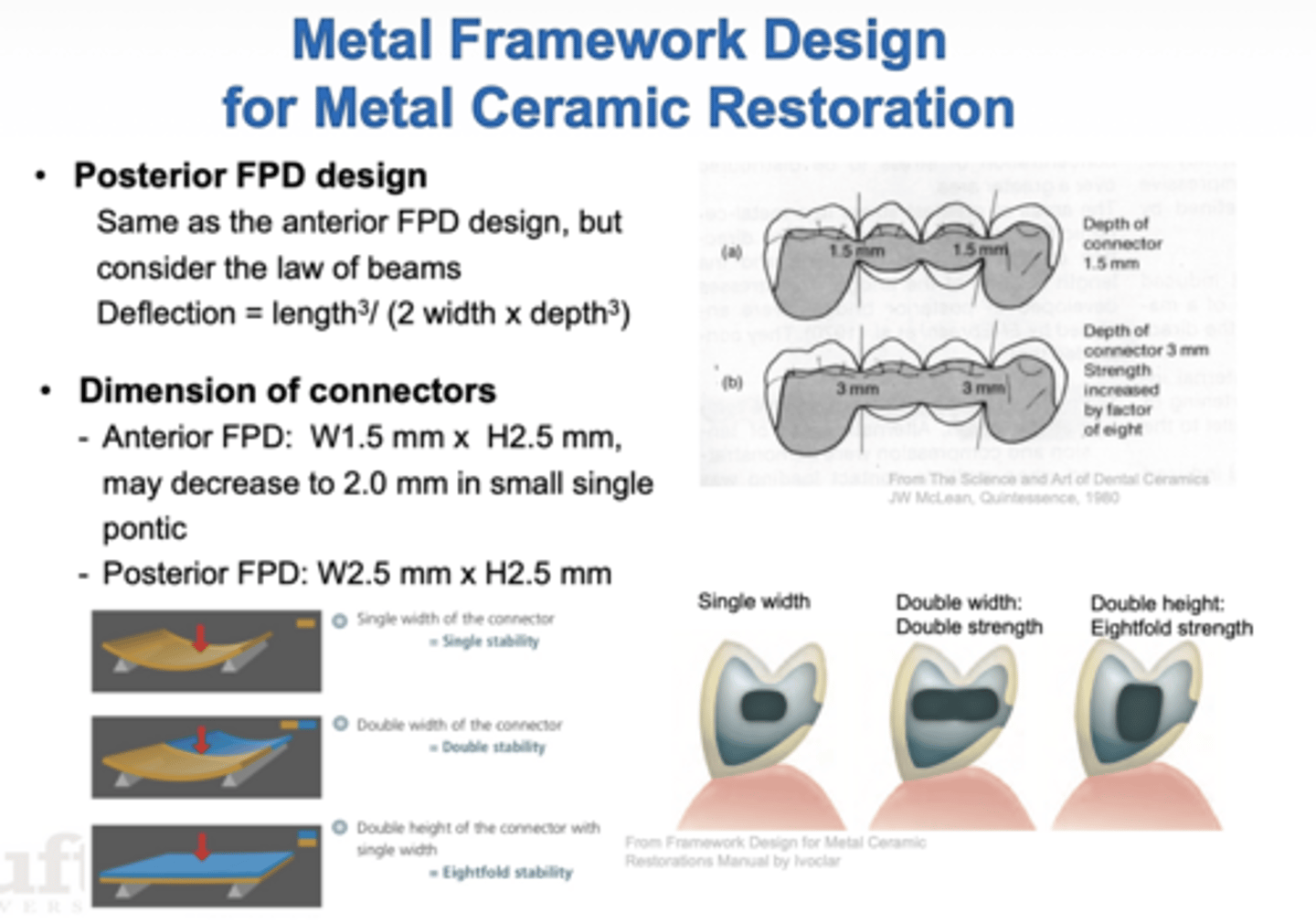
Law of beams:
Deflection = length^3 / (2 x width x depth^3)
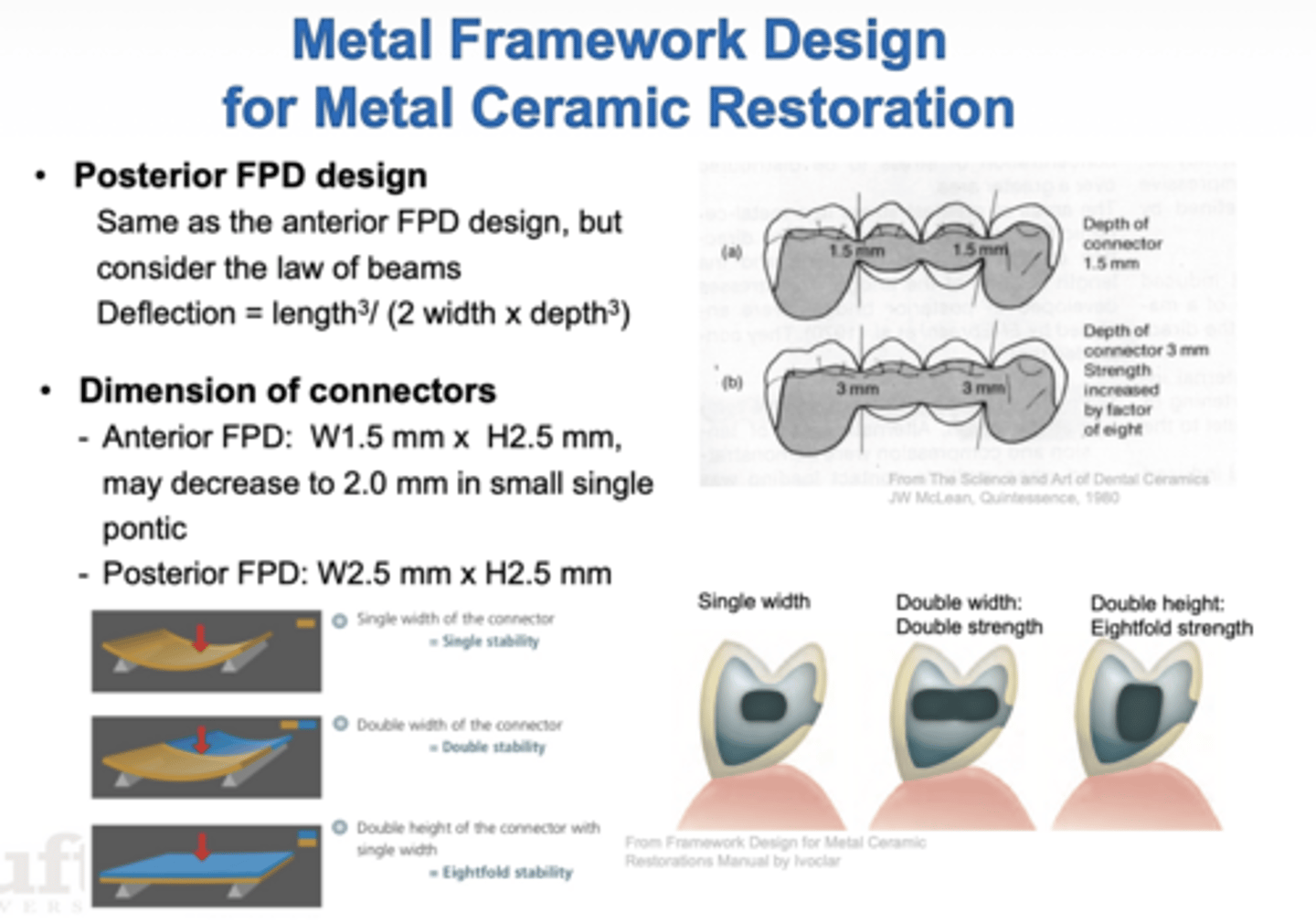
According to the law of beams, doubling the length of the FPD connector will affect the strength by...
a) 1/8
b) 1/4
c) 1/2
d) 2x
e) 4x
f) 8x
a) 1/8
- 8x deflection
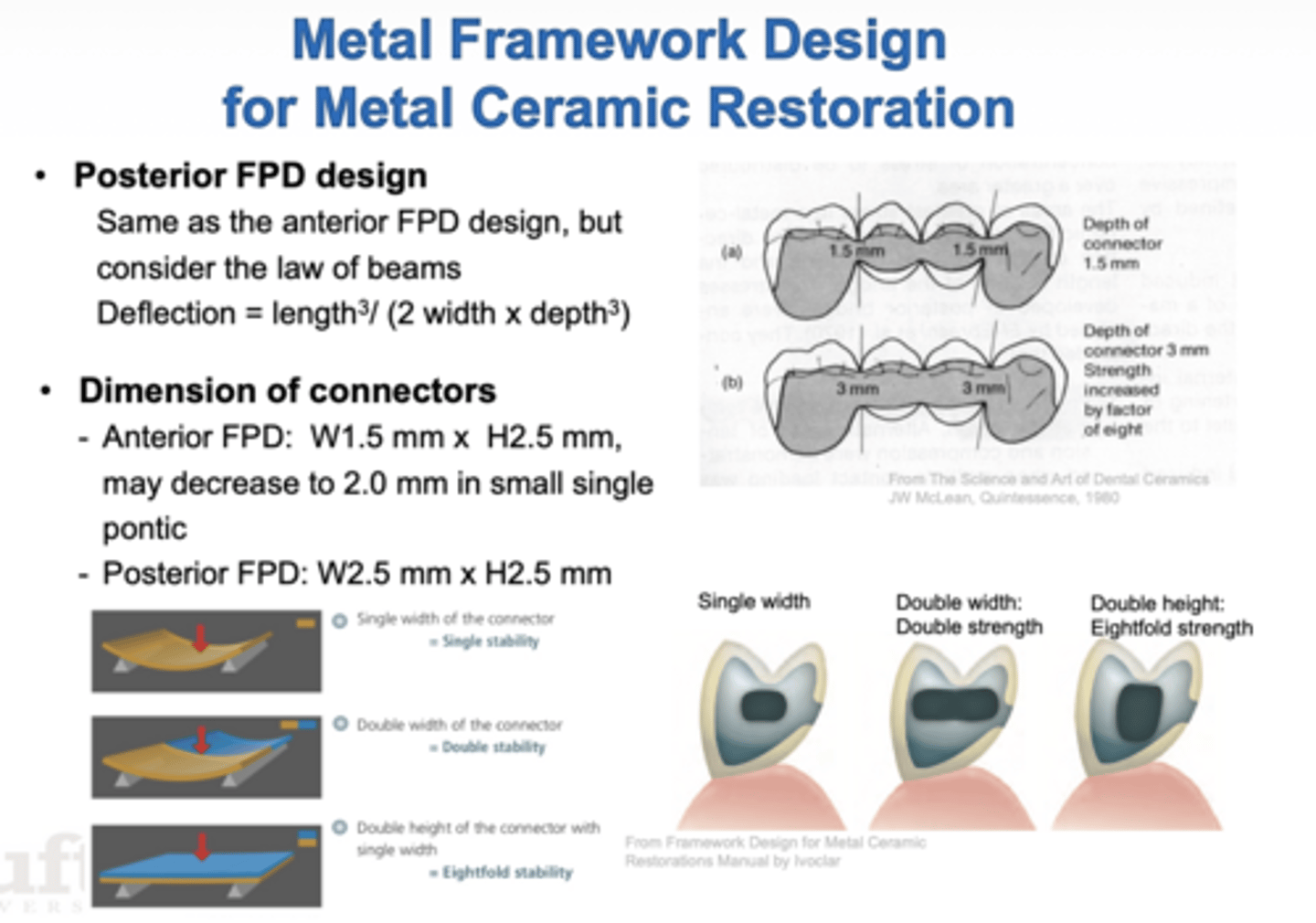
According to the law of beams, doubling the width of the FPD connector will affect the strength by...
a) 1/8
b) 1/4
c) 1/2
d) 2x
e) 4x
f) 8x
d) 2x
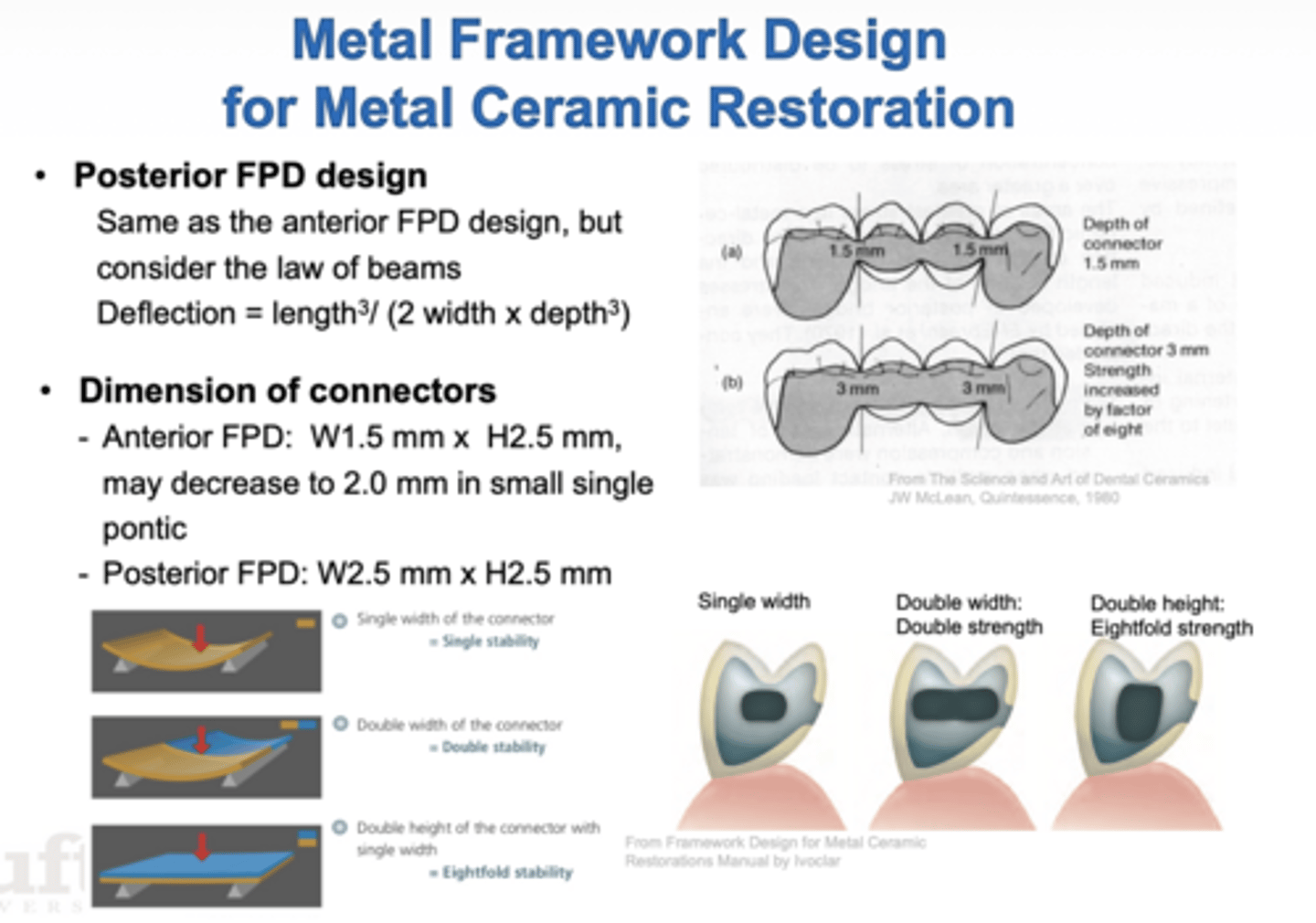
According to the law of beams, doubling the height of the FPD will affect the strength by...
a) 1/8
b) 1/4
c) 1/2
d) 2x
e) 4x
f) 8x
f) 8x -- eightfold strength
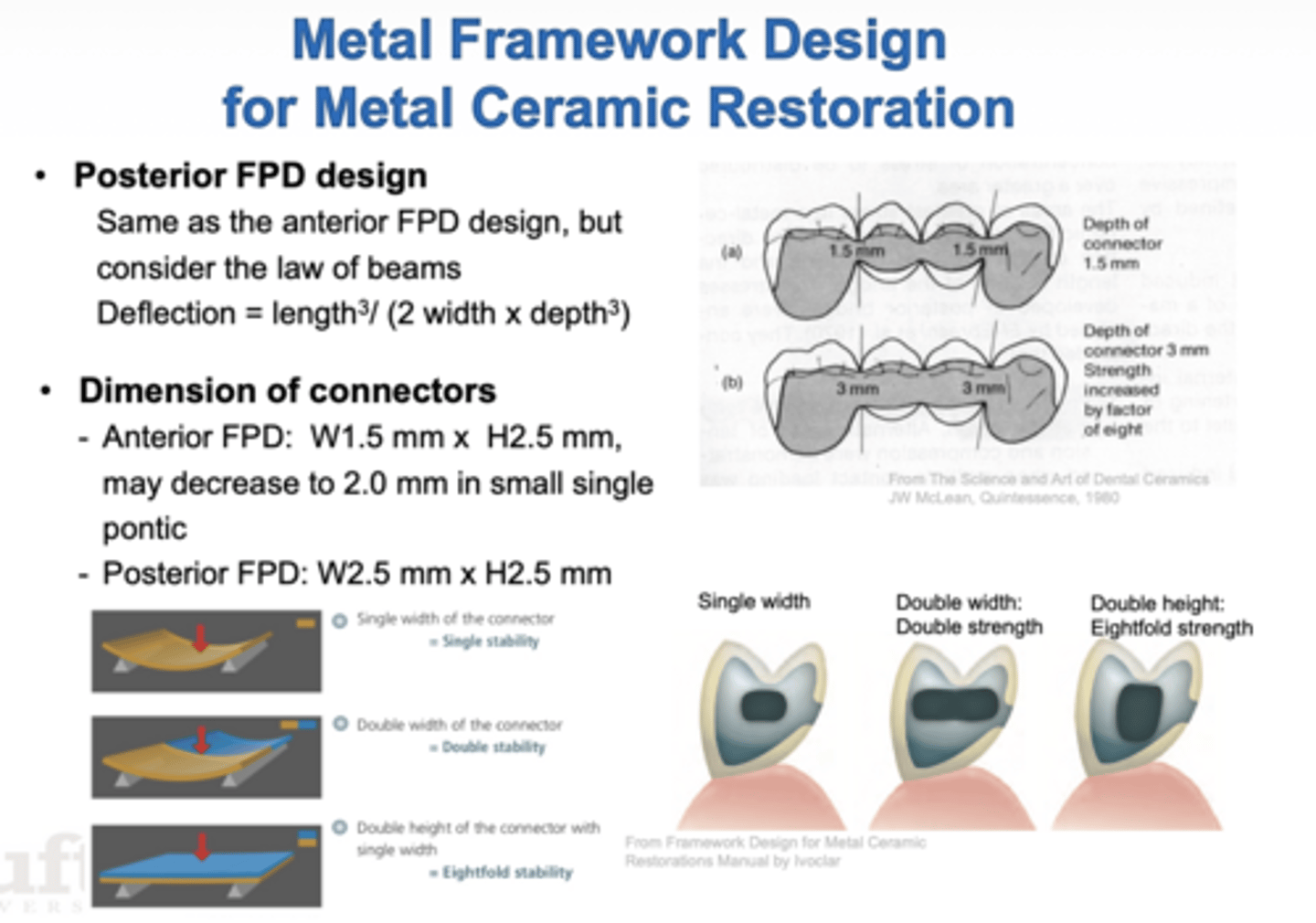
What is the ideal dimensions of anterior FPD connectors?
- Width: 1.5mm
- Height: 2.5mm (can decrease to 2.0mm in small single pontic)
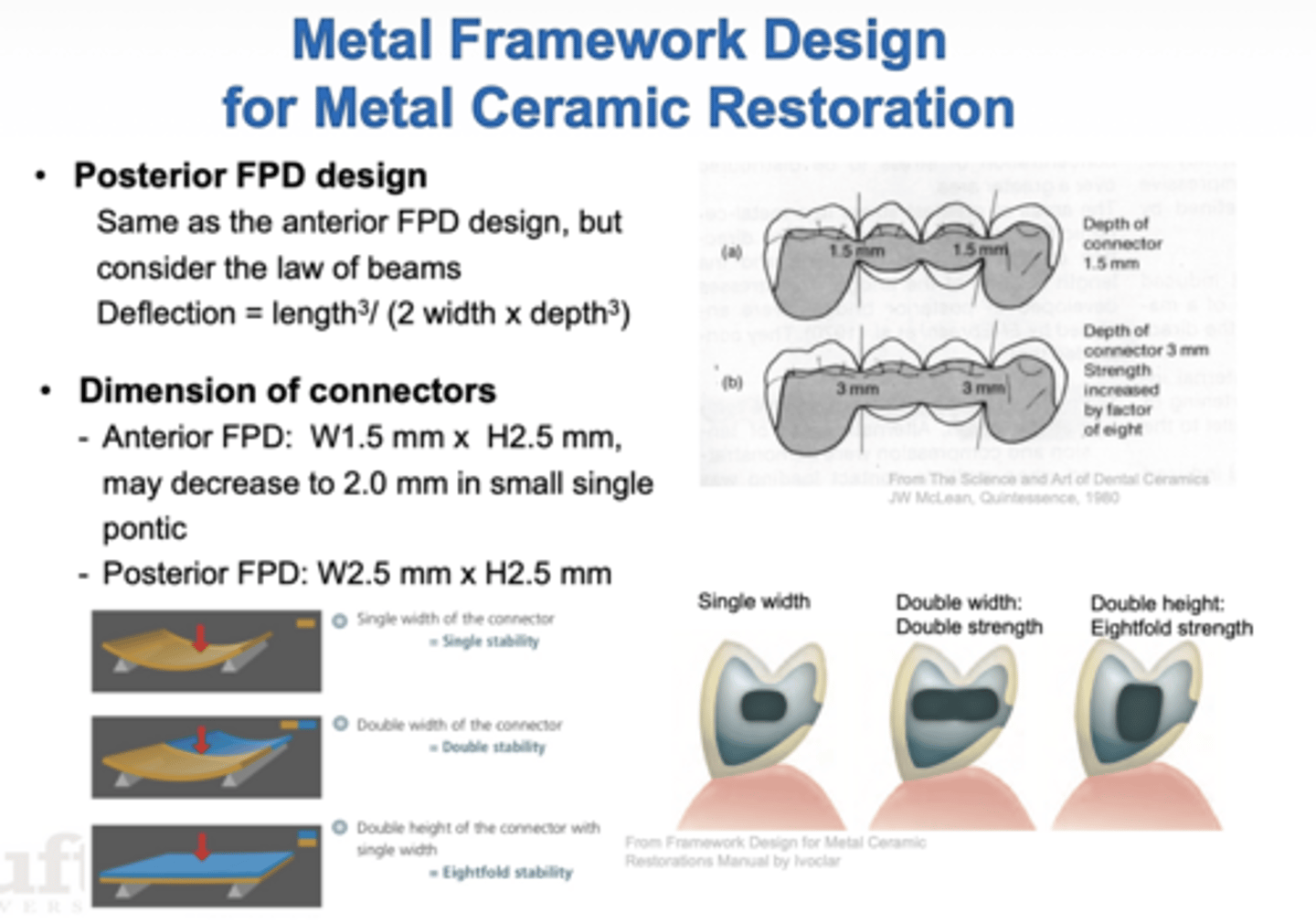
What is the ideal dimensions of posterior FPD connectors?
- Width: 2.5mm
- Height: 2.5mm
Rigid connectors can be separated into what type of connectors?
Cast and soldered connectors
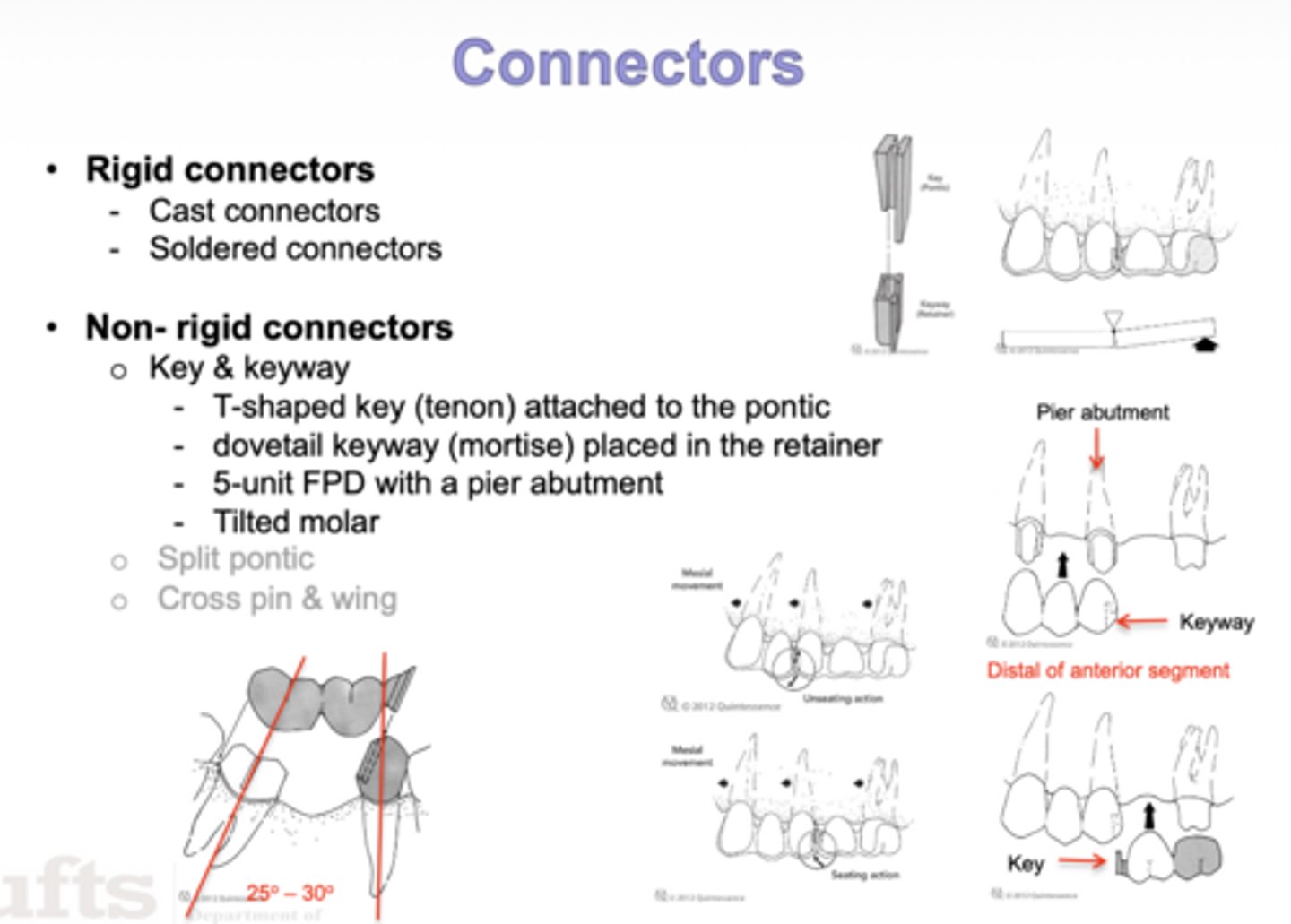
What are non-rigid connectors?
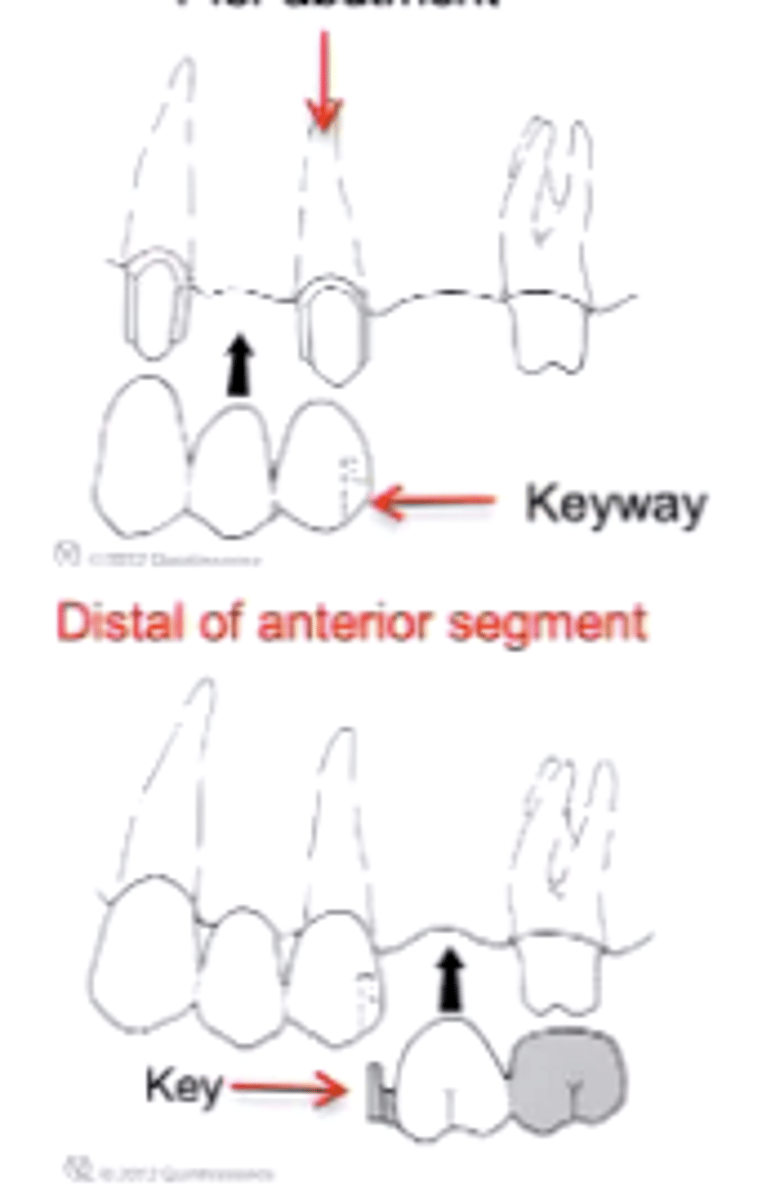
- Key and keyway (connectors that are used to connect 2 FPD together)
- Split pontic
- Cross pin & wing
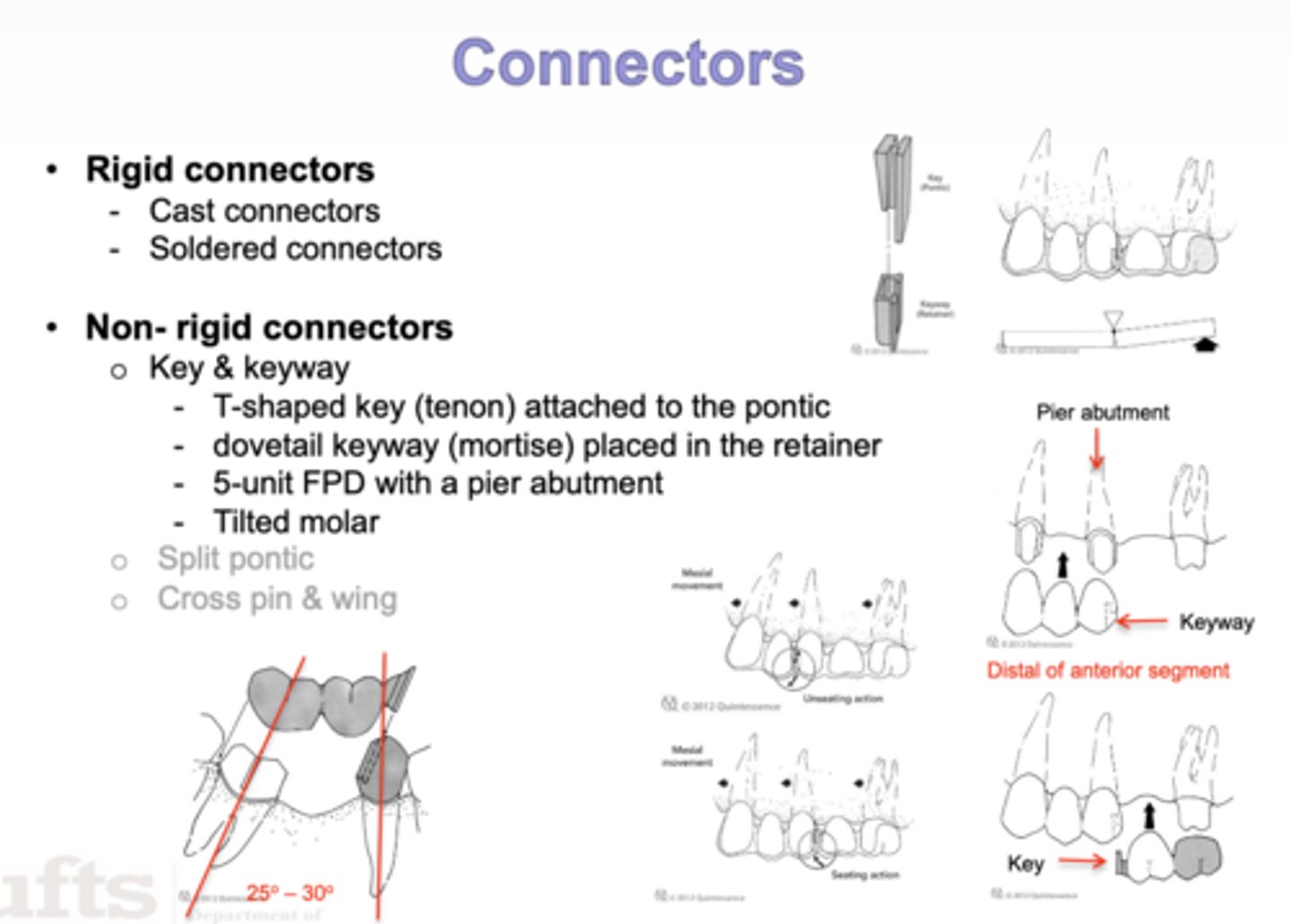
What type of non-rigid connectors?
- T-shaped key (tenon) attached to the pontic
- Dovetail keyway (mortise) placed in the retainer
- 5-unit FPD with a pier abutment
- Tilted molar
Key and keyway
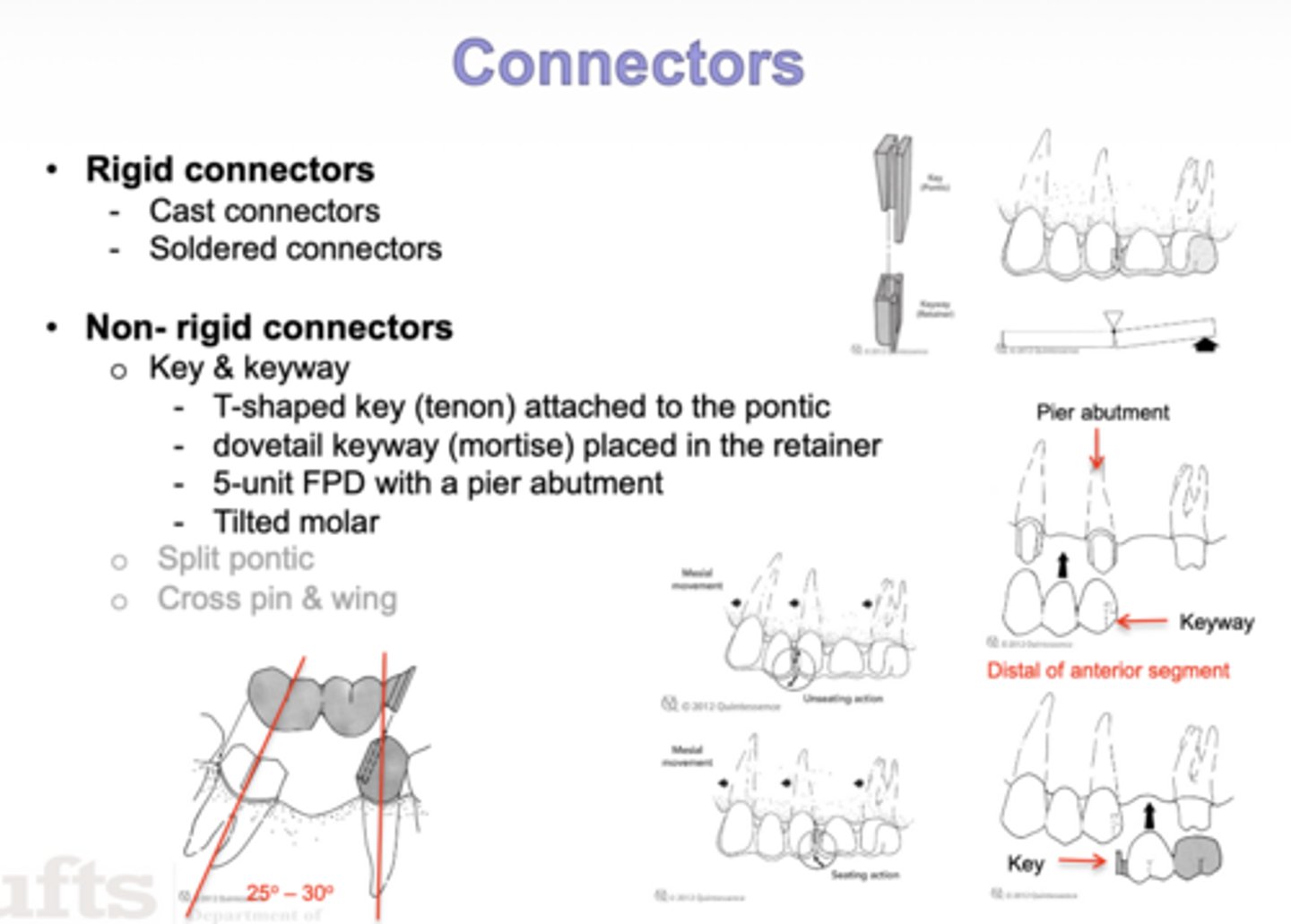
The "key" portion of the non-rigid connector should be
a) pontic
b) retainer
a) pontic
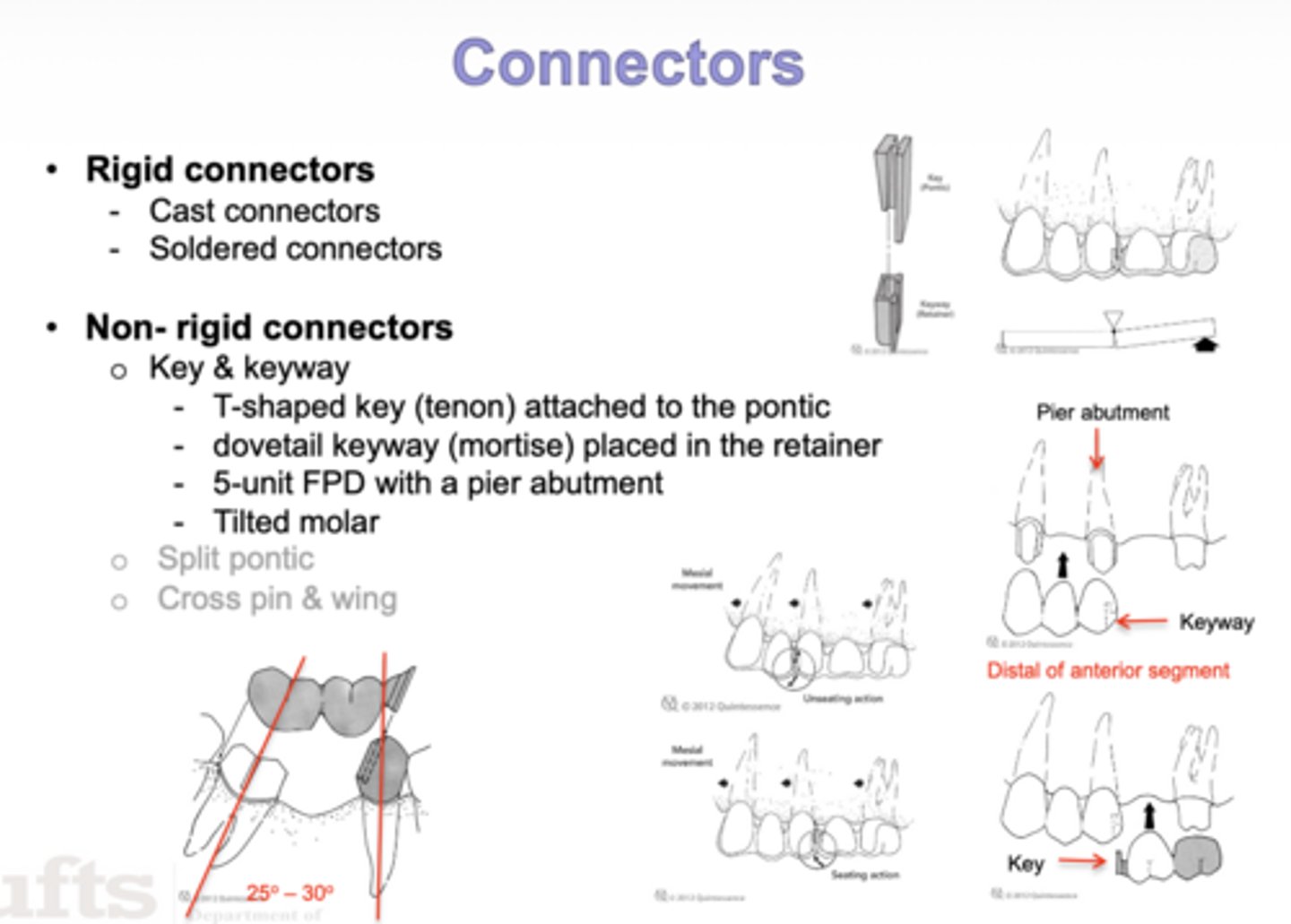
The "keyway" should be placed in the __________ of retainer
Distal of the retainer
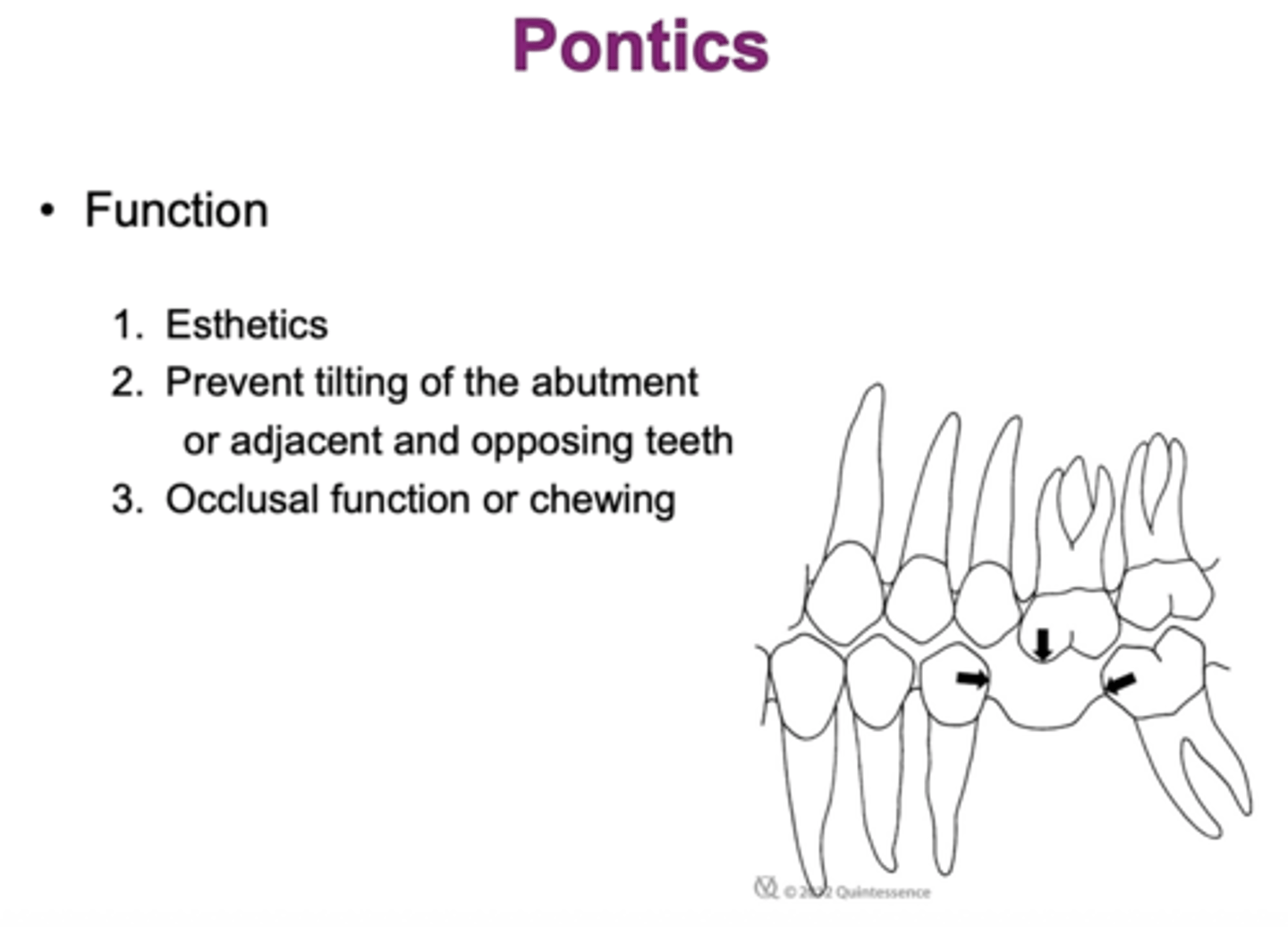
All of the following are function of a pontic EXCEPT:
A) Esthetics
B) Tilting of abutment or adjacent/opposing teeth
C) Occlusal function or chewing
B - PREVENT tilting
All of the following are ideal requirements of pontic EXCEPT:
a. function
b. esthetics
c. pt discomfort
d. easy to clean and maintain
e. biocompatibility
f. preservation of underlying mucosa and bone
C - COMFORT
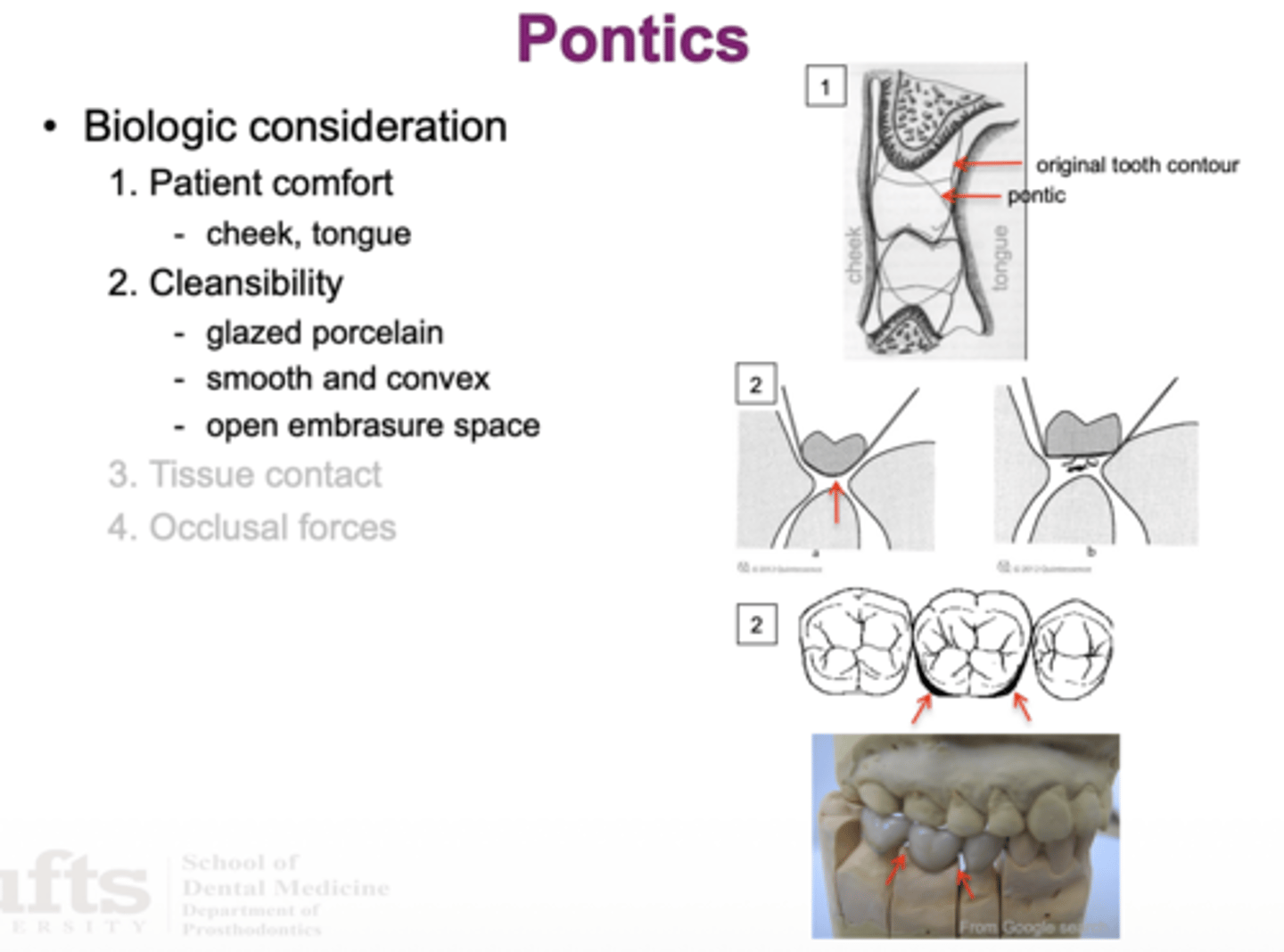
The surface of the pontic should have all the following characteristics for cleansibility EXPCEPT:
a. glazed porcelain
b. smooth and convex (to allow flossing)
c. closed embrasure space
C - OPEN embrasure space
T/F: There should be minimal contact of the pontic on the facial slope of the ridge
True
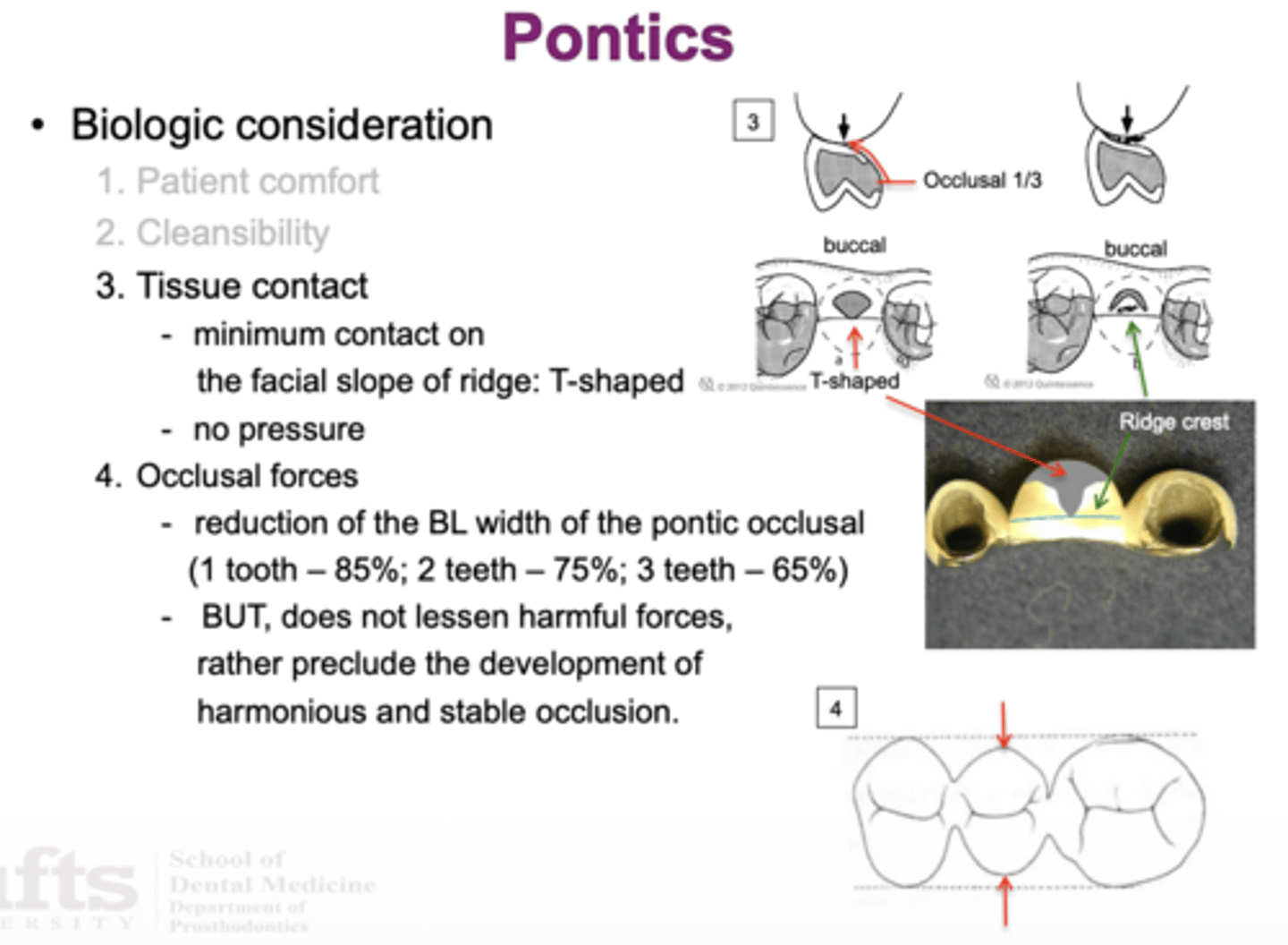
The contact of the pontic to the temporary bridge should be what shape?
T-shaped
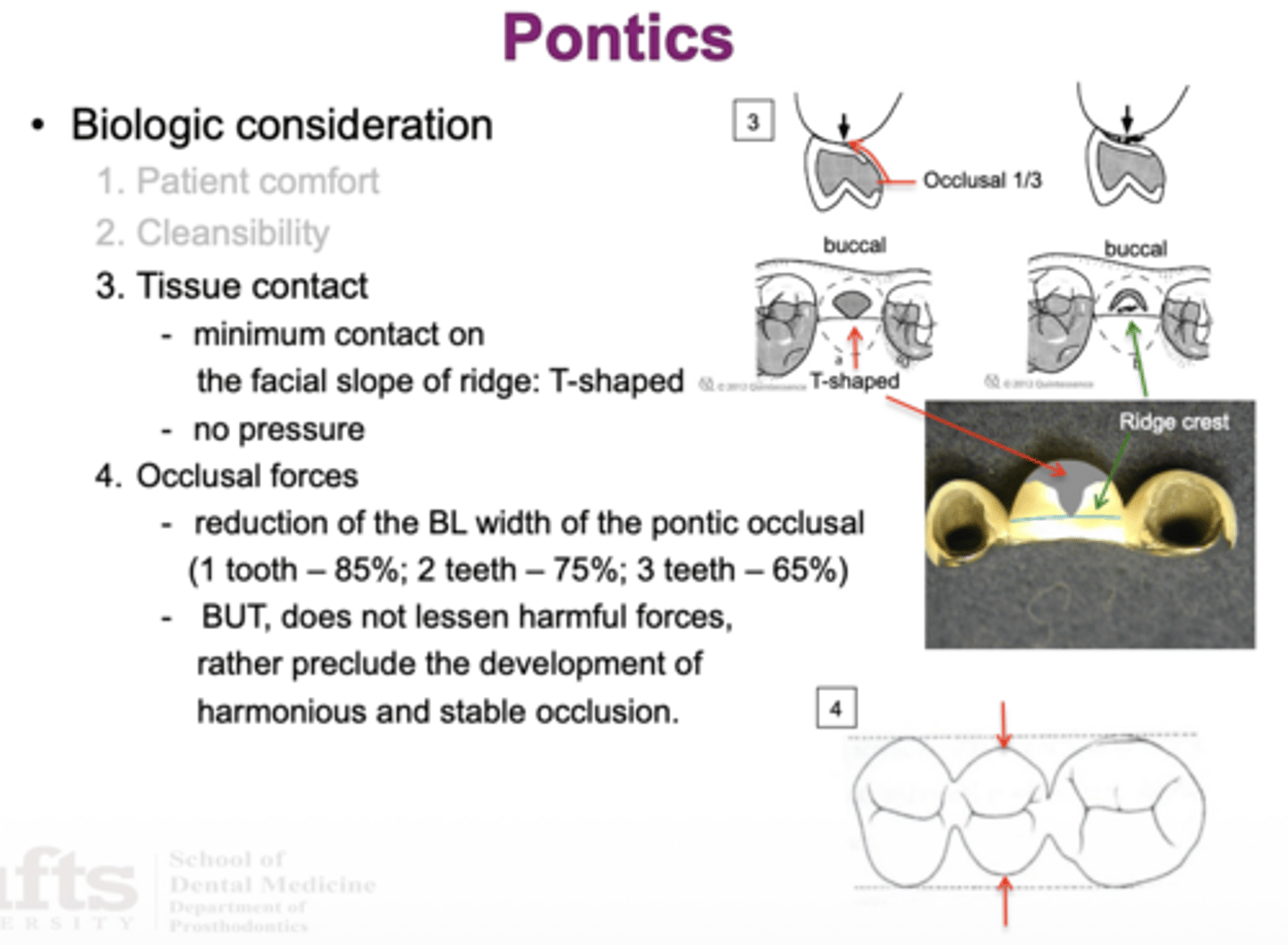
T/F: There should be no pressure exerted from the pontic onto the underlying tissues
True
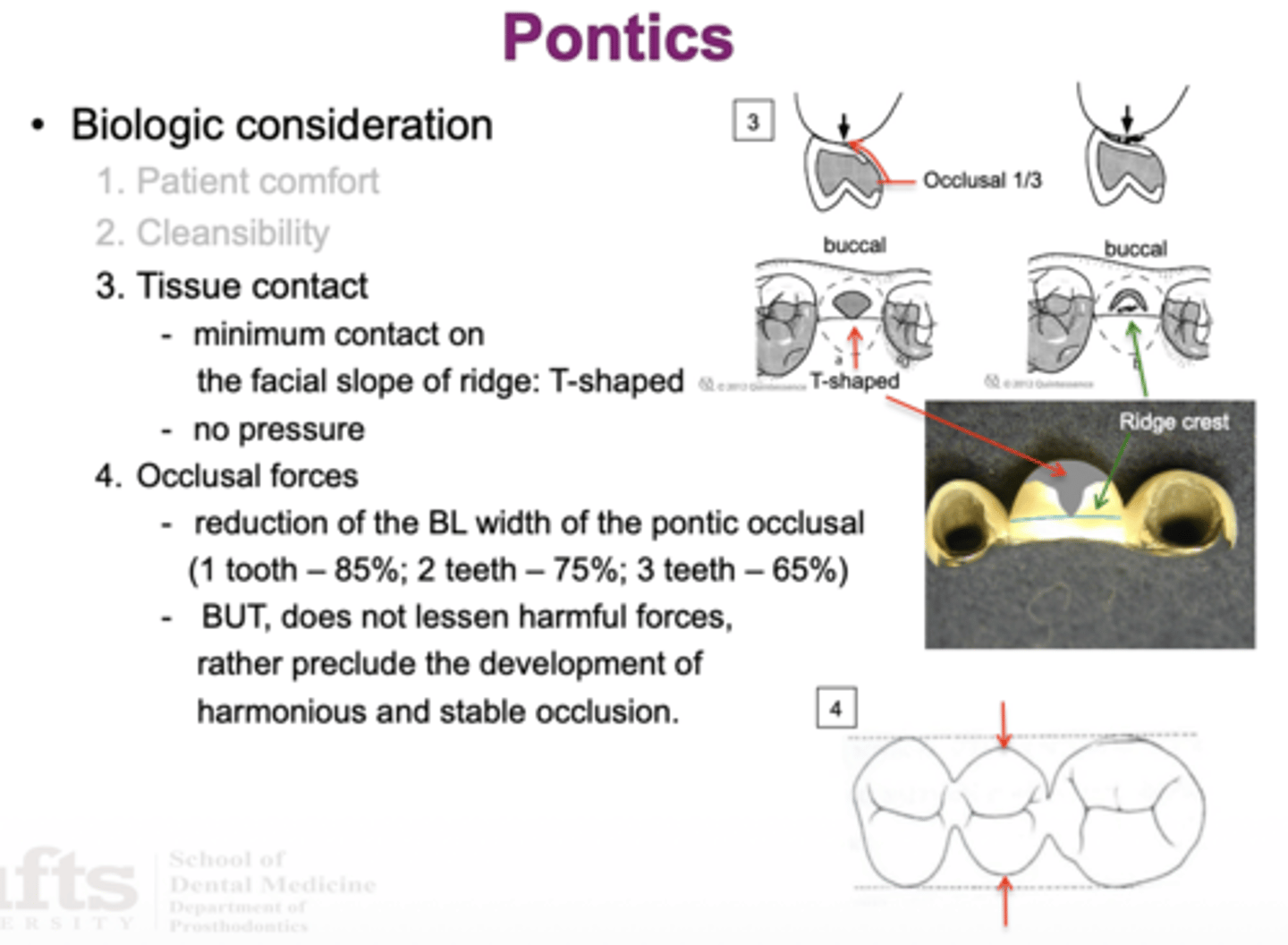
T/F: Reduction of the BL width of the pontic occlusal surface helps to lessen harmful forces, and does not preclude the development of harmonious and stable occlusion
FALSE -- reduction of B-L width does NOT lessen harmful forces. Rather, they preclude the development of harmonious and stable occlusion
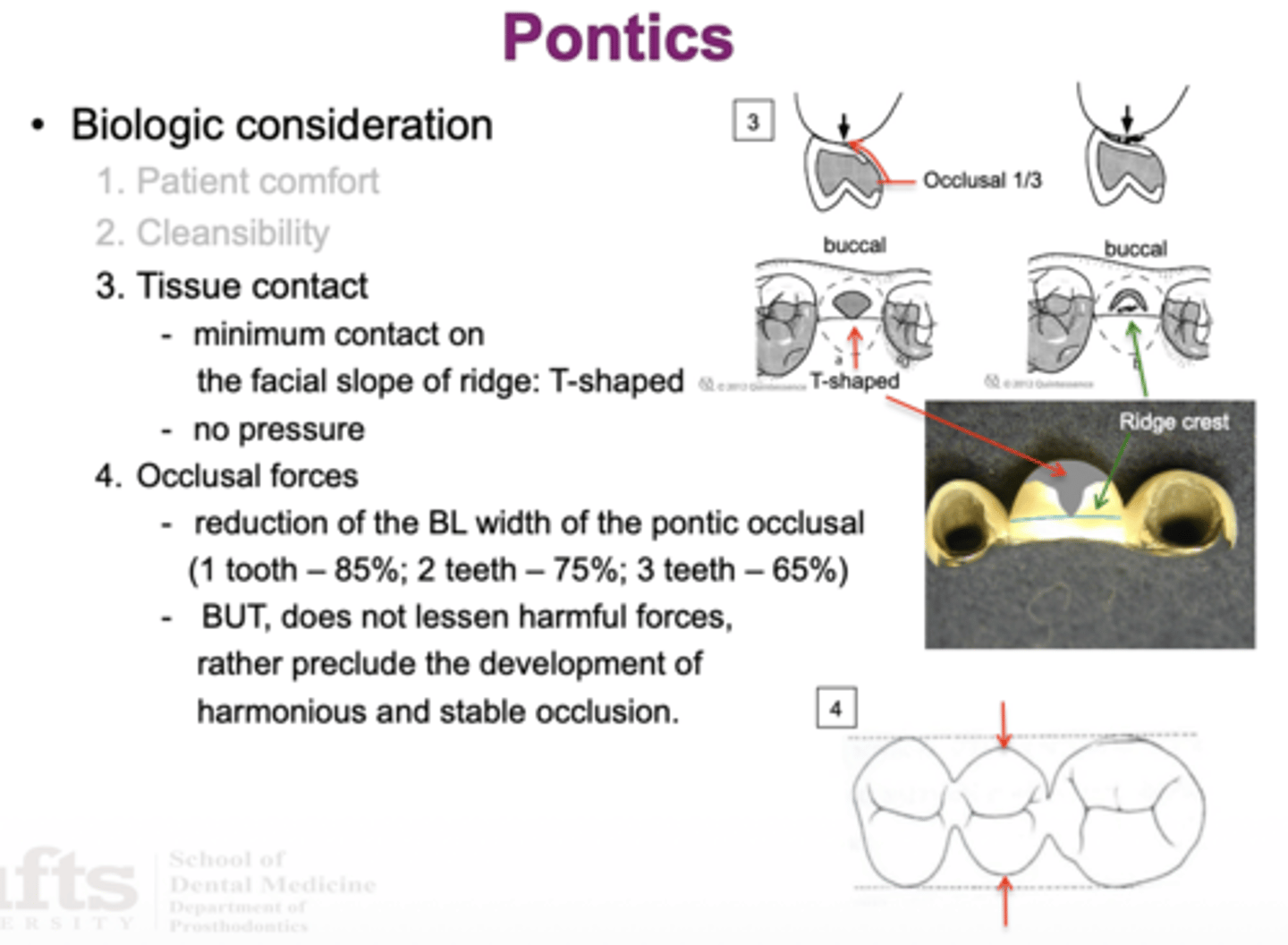
T/F: Pontics should be rigid to resist deformation, and should have a strong connector to prevent fracture. There are several metal-ceramic framework designs that are designed to resist porcelain fracture
True
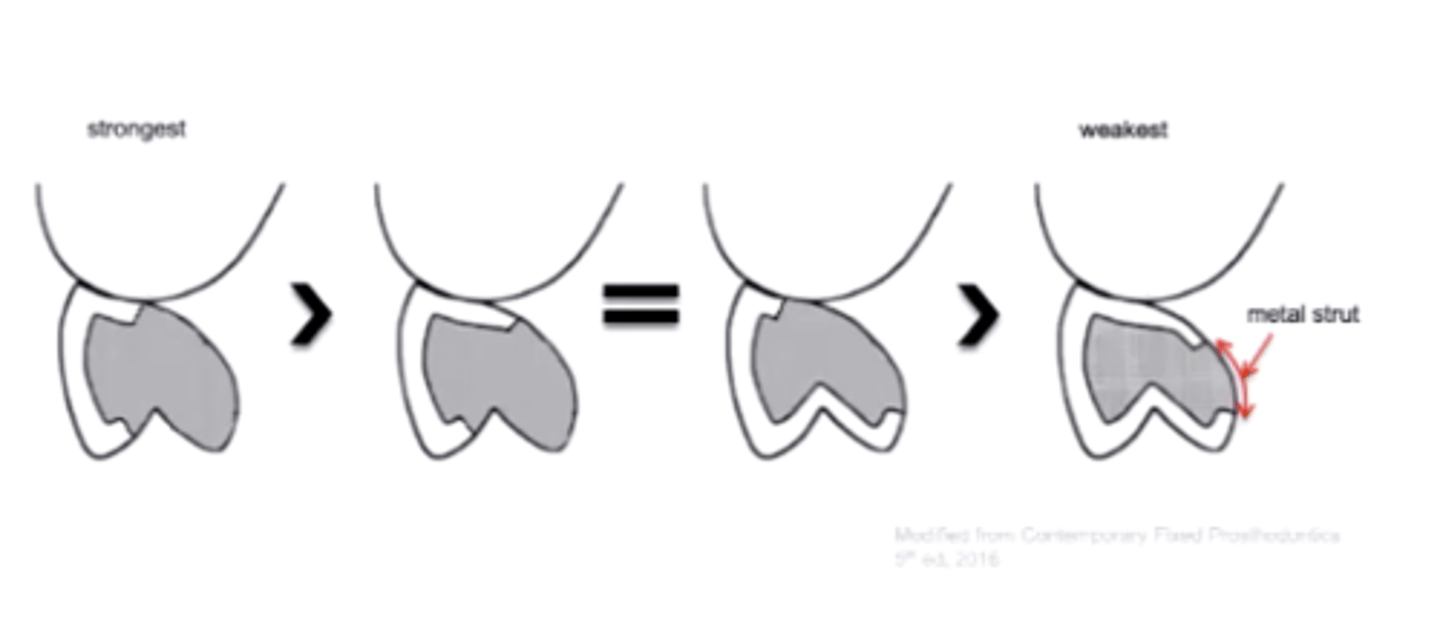
What can result from a poorly adapted tissue-pontic junction of the labial contour? (2)
- Shadow
- Food collection
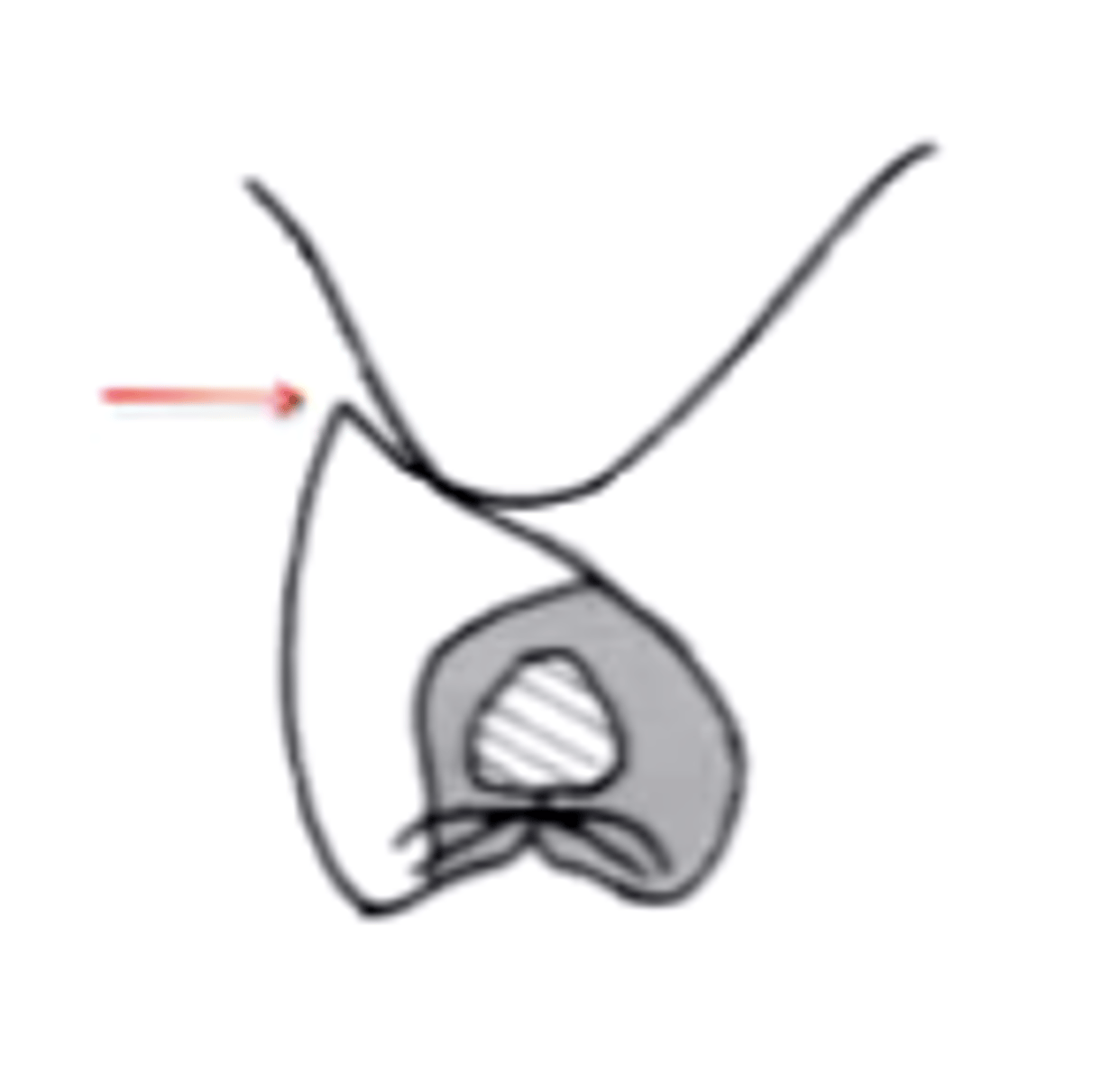
To properly adapt the tissue-pontic junction incisogingivally, what should you do ALL of the following EXCEPT:
a. pontic should be lengthened or shortened to decrease shadowing and food collection
b. recontour from gingival 1/3-1/2 and simulate the normal crown and root with emphasis on the CEJ (instead of cutting it horizontally)
c. can use pink porcelain to simulate gingival tissue
d. Nothing its fine as is
d. Nothing its fine as is
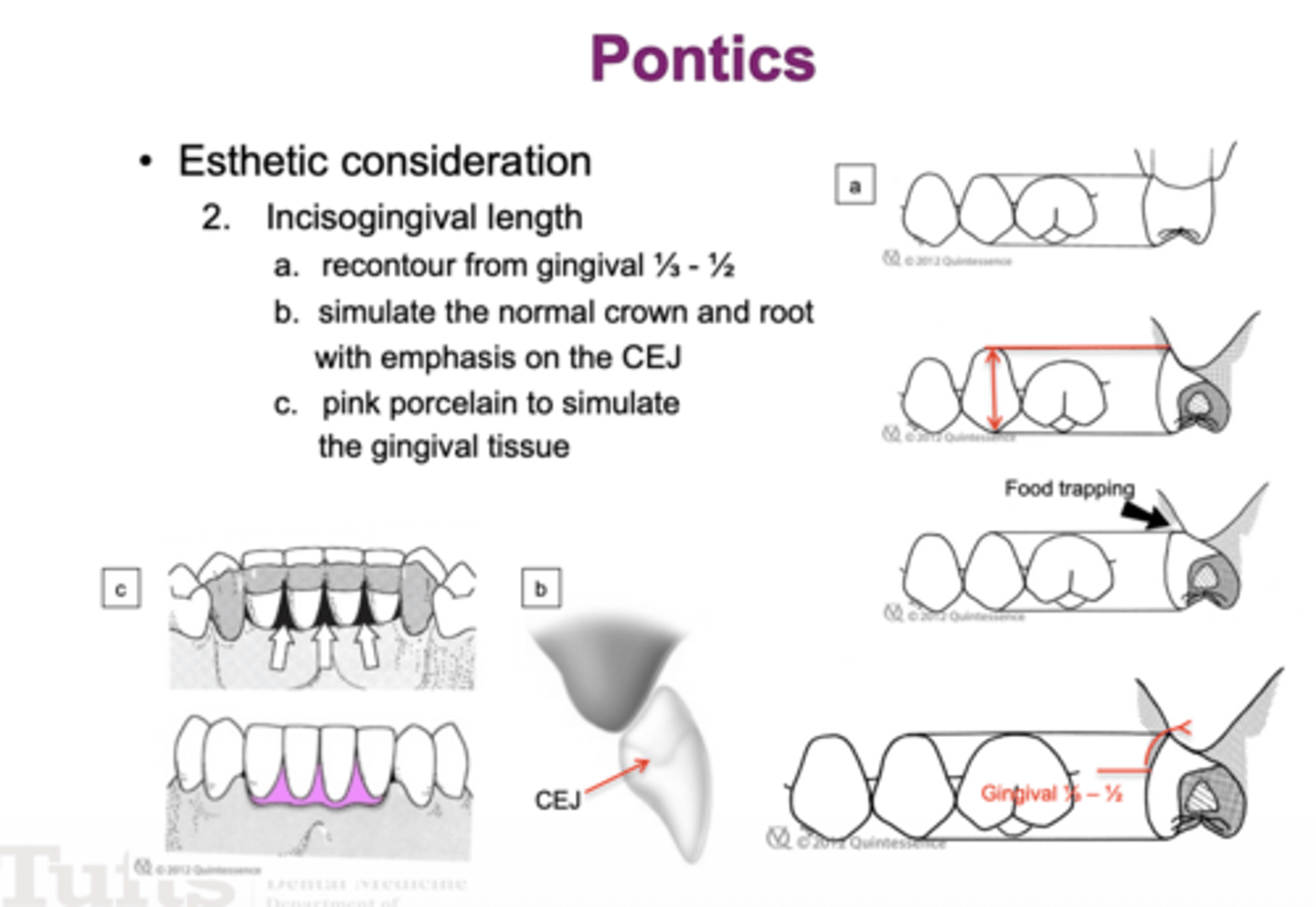
Making the M-D line angles farther apart will make the tooth look ________
a) wider
b) thinner
a) wider -- opposite is true too
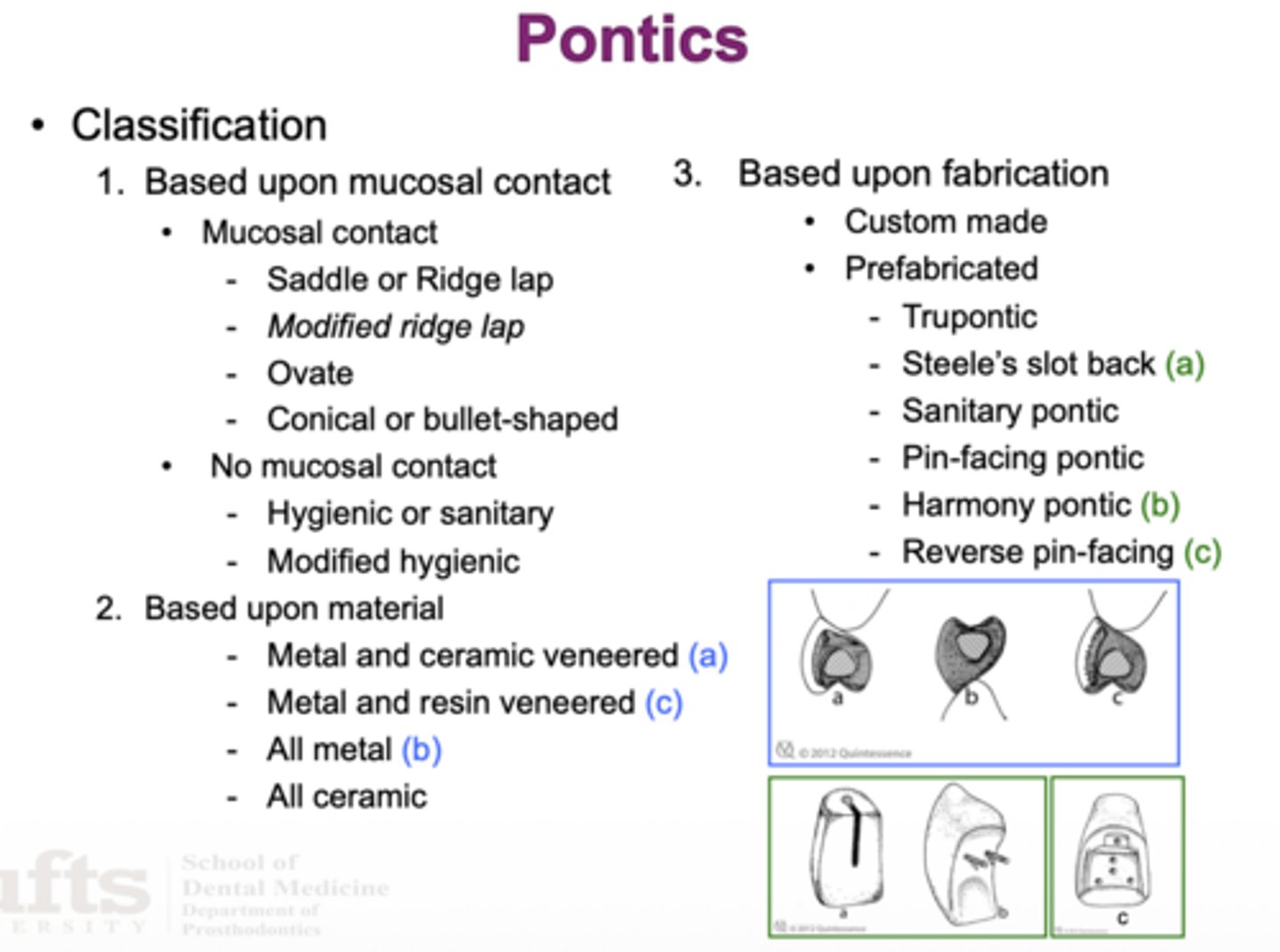
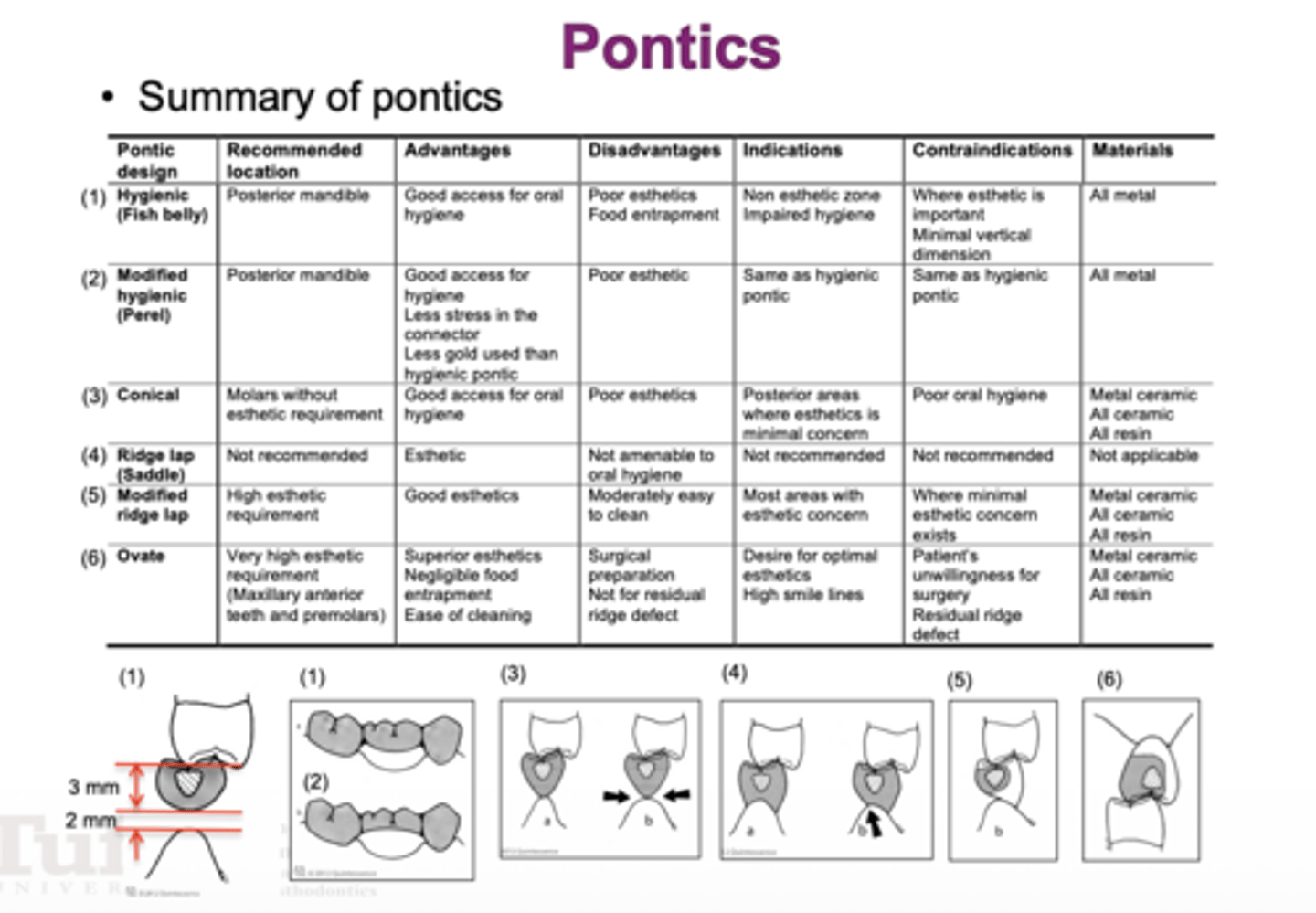
What three ways can you classify pontics by?
- Mucosal contact (most used classification)
- Material type
- Fabrication style
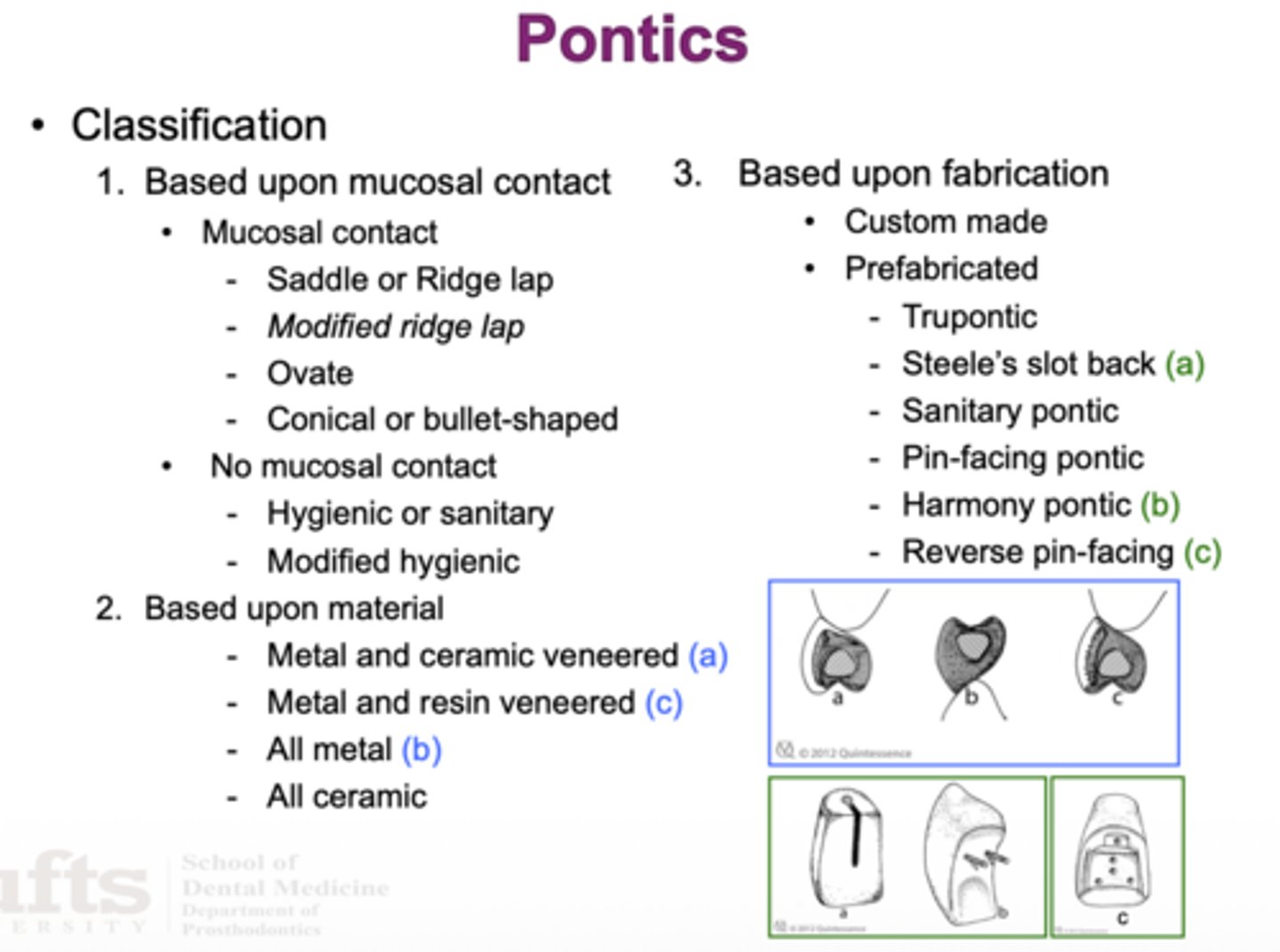
_________ is the pontic design that is most often used:
a) ridge lap (saddle)
b) ovate
c) modified hygienic
d) modified ridge lap
e) hygienic
f) conical
D) Modified ridge lap
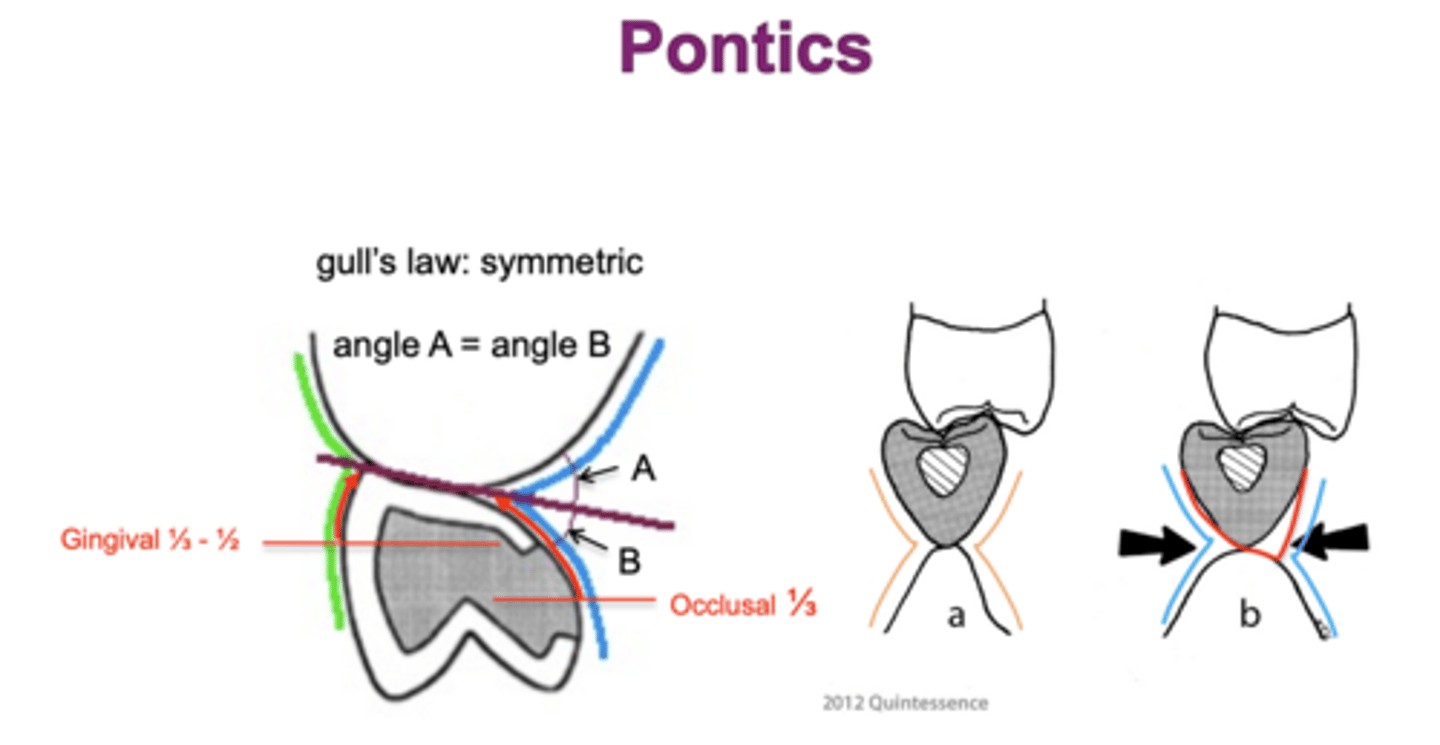
Define the following:
- Pontic contour needs to be symmetric to the contour of the ridge (facial and lingual)
- angle A = angle B
Gull's Law
ID pontic design
- Advantages: good access for oral hygiene
- Disadvantage: poor esthetics, poor entrapment
- Indicated for nonesthetic zones, impaired hygiene
- Contraindications: esthetic zone, minimal VDO
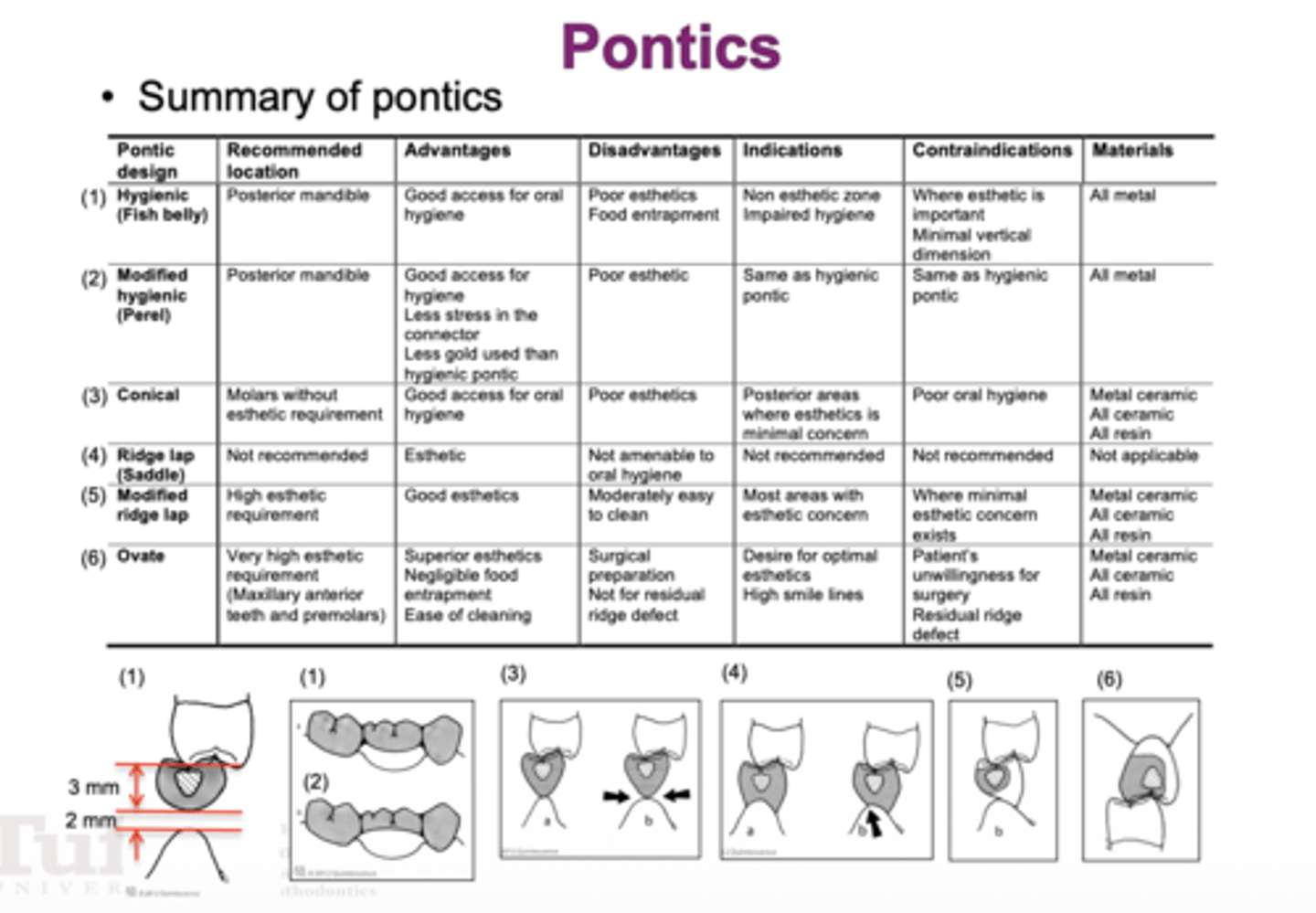
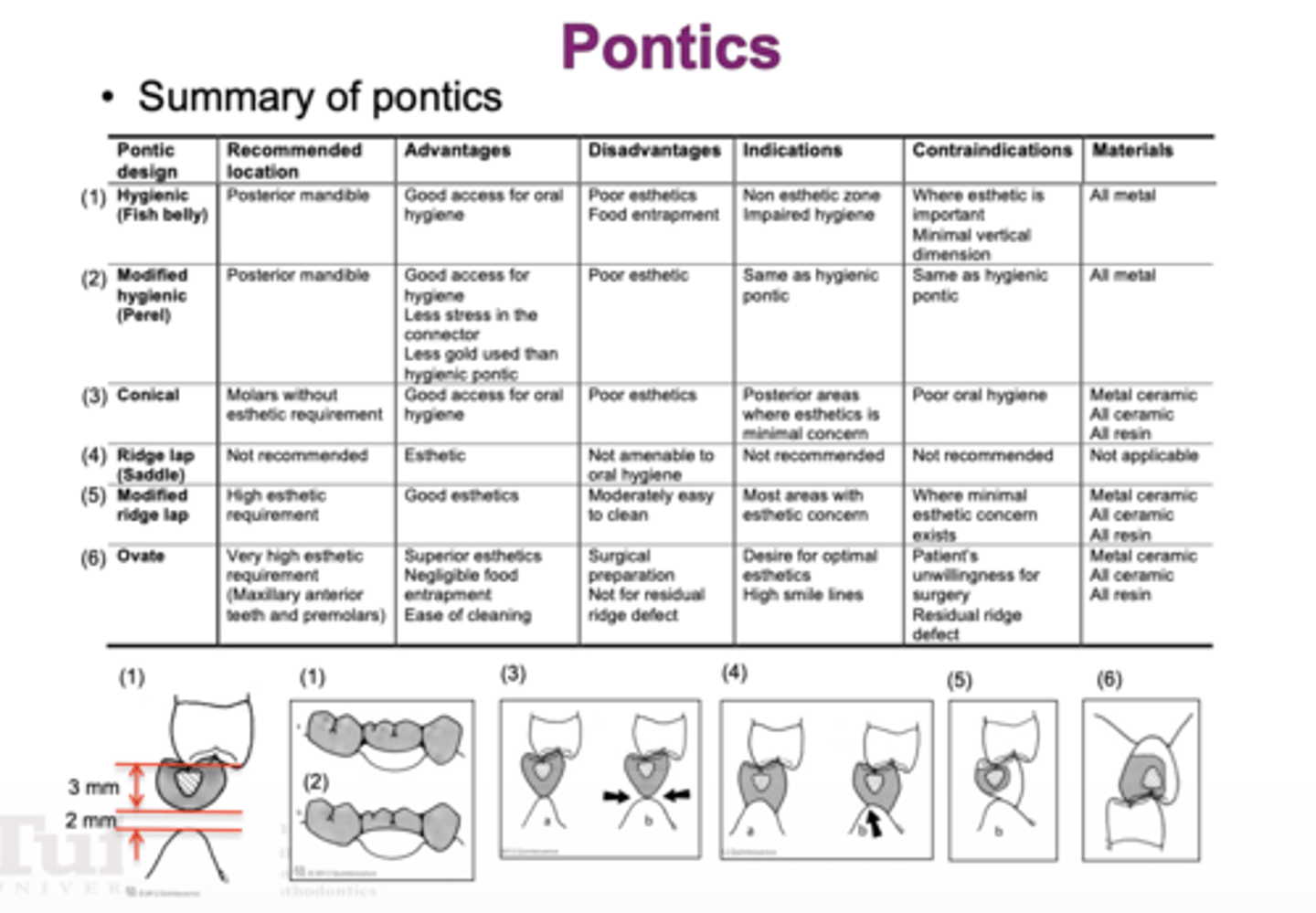
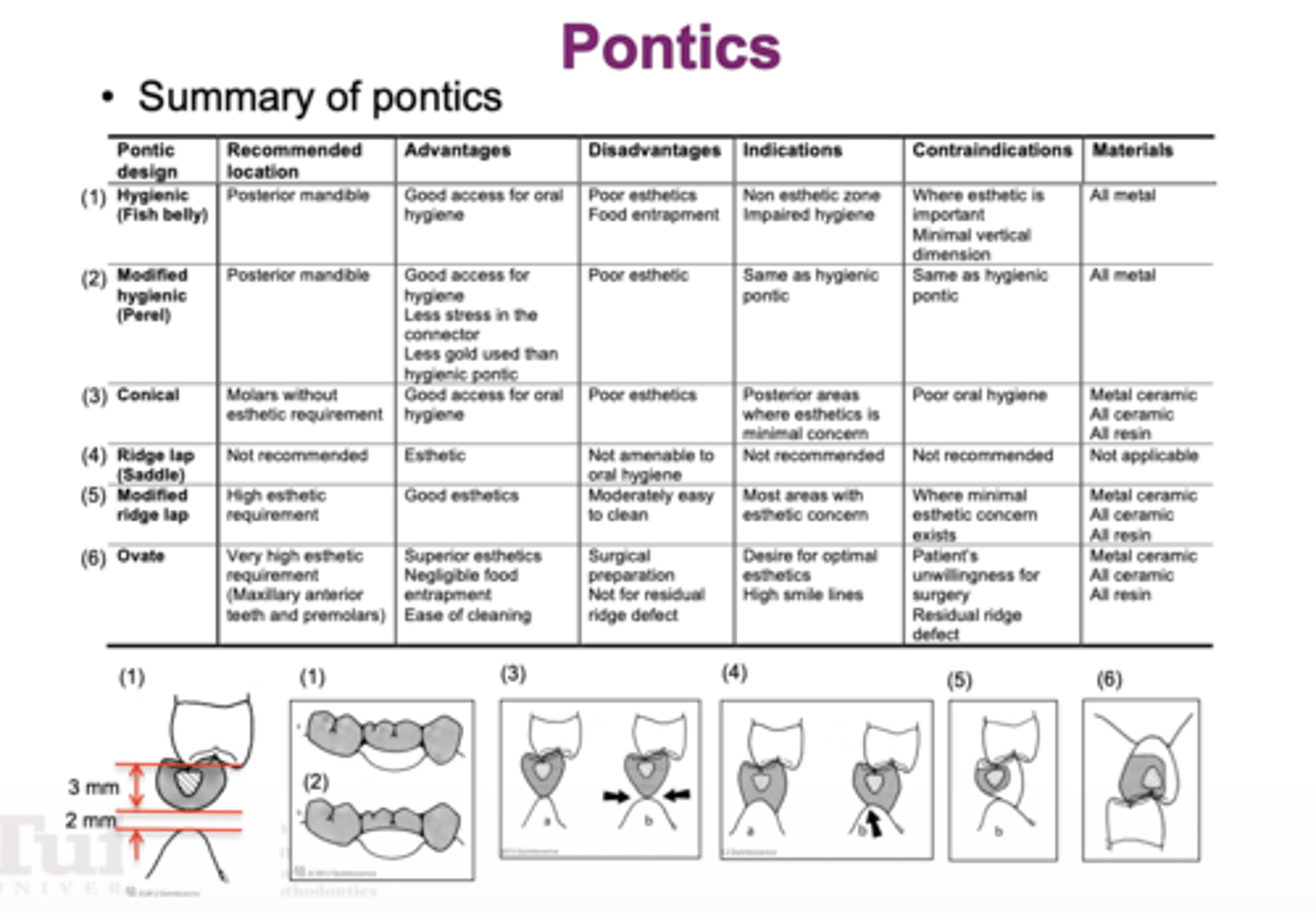
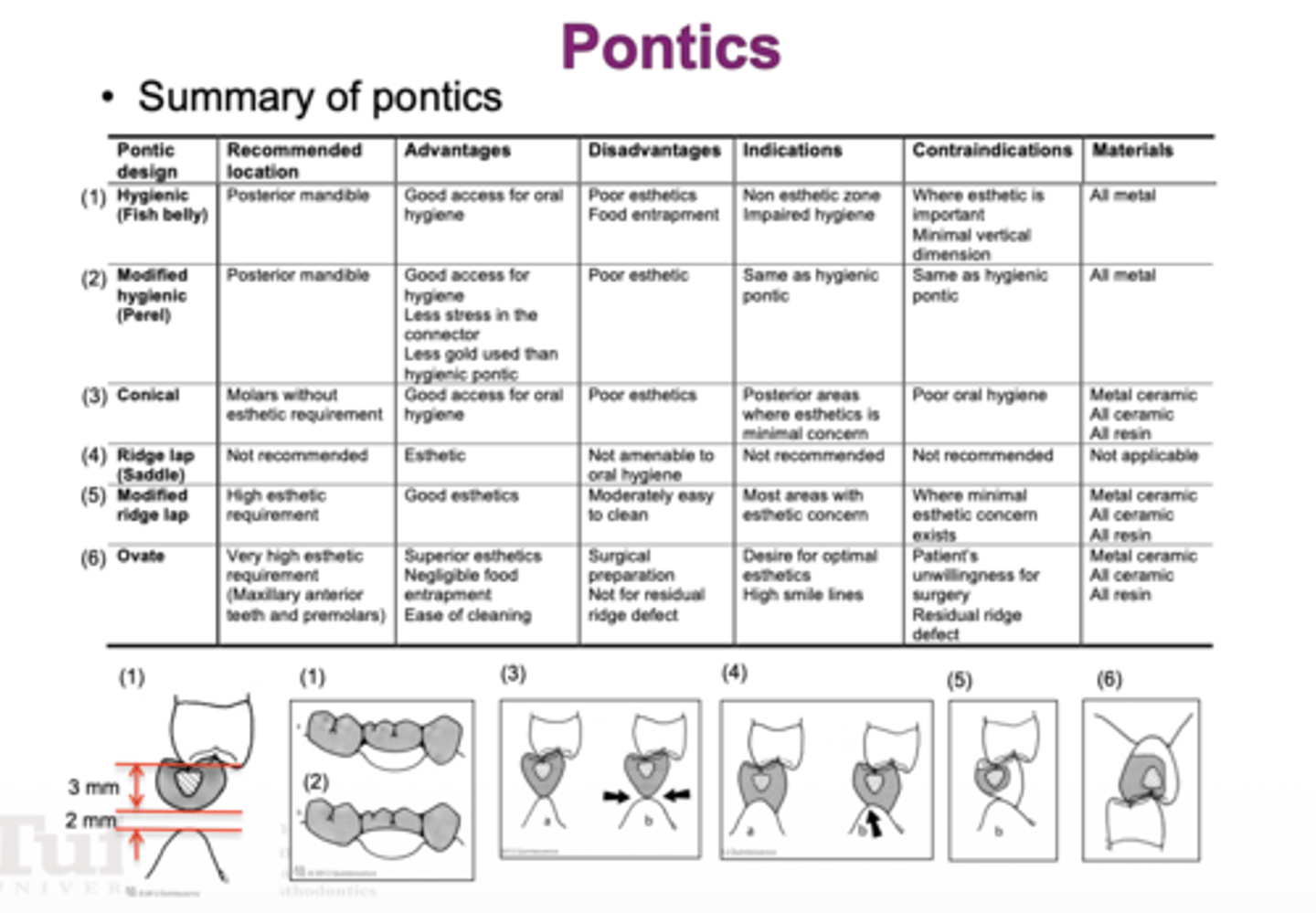
hygienic (fish belly)
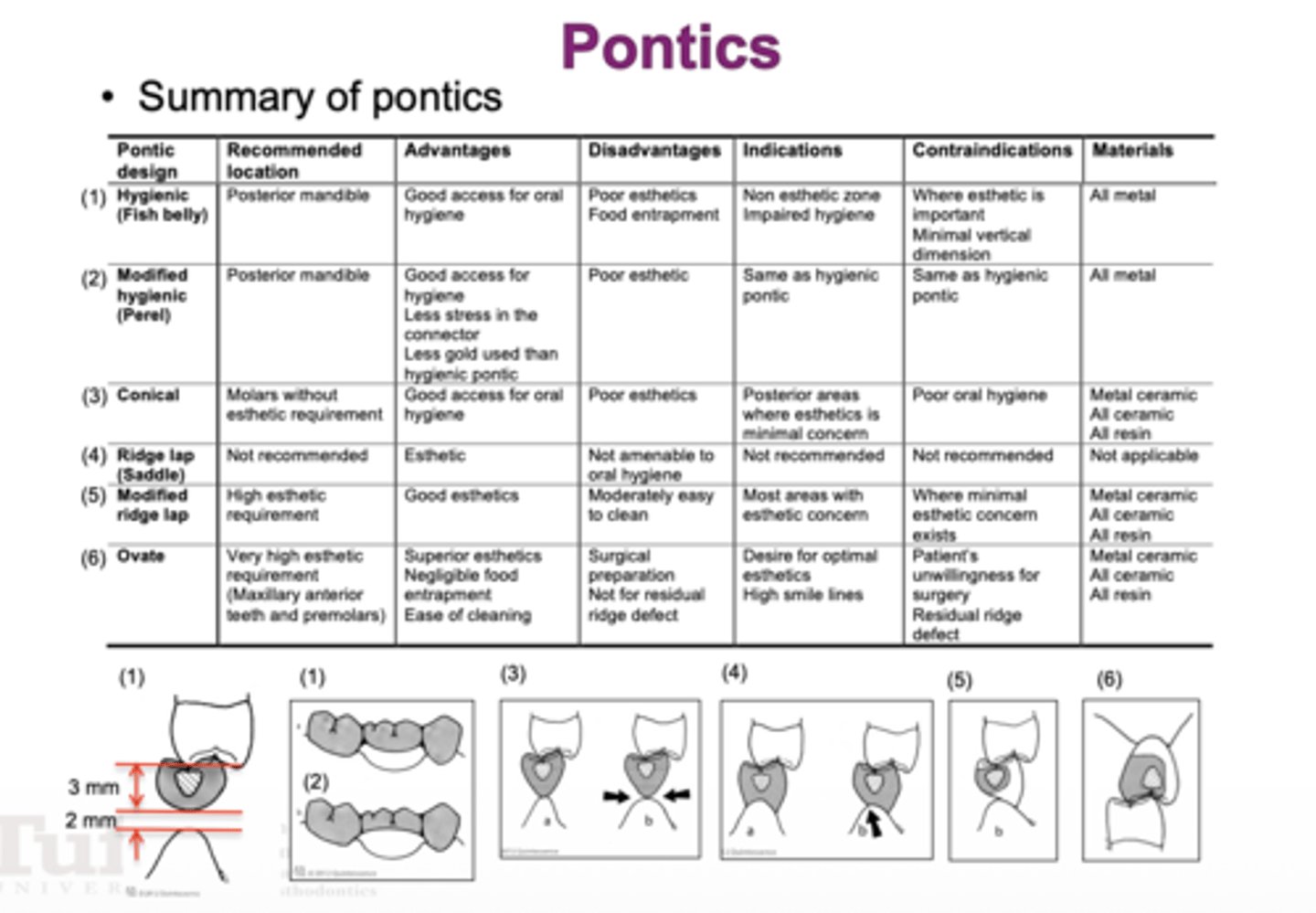
ID pontic design:
- Advantages: good access for hygiene, less stress in connector, less gold used
- Disadvantages: poor esthetic
- Indicated for nonesthetic zones, impaired hygiene
- Contraindications: esthetic zone, minimal VDO
modified hygienic
ID pontic design:
- Advantages: good esthetic
- Disadvantages: moderaterly easy to clean
- Indications: areas with esthetic concern
- Contraindications: minimal esthetic concern existed
modified ridge lap
ID pontic design:
- Advantages: good access for hygiene
- Disadvantages: poor esthetics
- Indications: posterior areas where no esthetics concern
- Contraindications: poor oral hygiene
conical
ID pontic design:
- Advantages: esthetic
- Disadvantages: not amenable to hygiene
ridge lap
ID pontic design:
- Advantages: superior esthetics, negligible food entrapment, ease of cleaning
- Disadvantages: surgical prep, not for residual ridge defect
- Indications: optimal esthetics, high smile line
- Contraindications: ridge defect, undesired for surgery
ovate
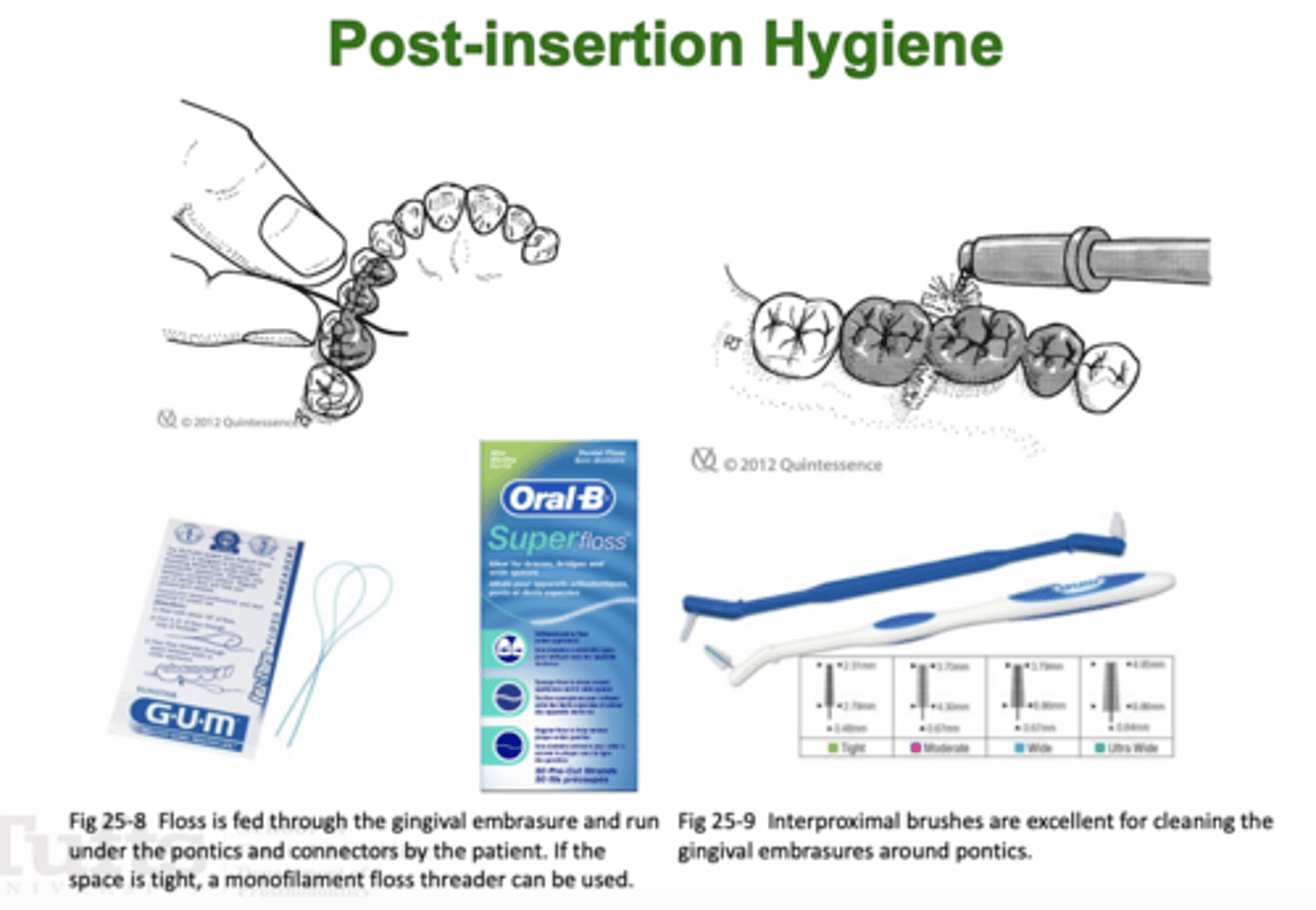
What are some methods to clean FPDs interproximal spaces? (3)
- Floss through the gingival embrasures
- Monofilament floss threader
- Interproximal brushes