Amino Acids, Proteins, and Enzymes
 Call Kai
 Learn
Learn Practice Test
 Spaced Repetition
 Match
Match Flashcards
 Knowt Play
1/55

Earn XP
Description and Tags
Chapter 21
Name | Mastery | Learn | Test | Matching | Spaced | Call with Kai |
|---|
No analytics yet
Send a link to your students to track their progress
56 Terms
Primary Structure
is the amino acid sequence from amino-to-carboxyl terminus (3 letter or 1 letter abbreviation)
Secondary Structure
is identified by the presence of α-helices and β-sheets
Tertiary Structure
is the three dimensional globular macromolecular structure
Quaternary Structure
is identified by the association of multiple globular units
What bonds form α-Helix in protein structure?
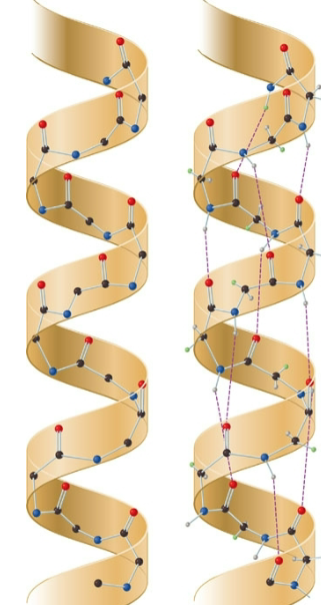
Results from hydrogen bonds between amide hydrogen and amide oxygen of proximal amino acids (about every 3.6 amino acids)
What bonds form β-Sheet in protein structure?
Result from hydrogen bonds between amide hydrogen and amide oxygen of distal amino acids along beta-strands
What are random coils in protein structure?
Regions void of secondary structural qualities
What bond stabilizes tertiary and quaternary structure?
The disulfide bond between two separate cysteine amino acid thiol groups
In an α-Helix the carbonyl oxygen and amide hydrogen interact every ___ amino acids via ___ bonds.
a. 3rd, b. hydrogen.
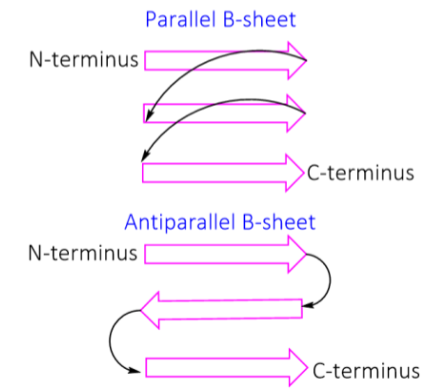
β-sheets have two significant forms, ___ and ___ .
Parallel and anti-parallel.
Significantly, parallel sheets have longer linking sequences that lack secondary structure, and antiparallel sheets have short β-turns connecting individual strands.
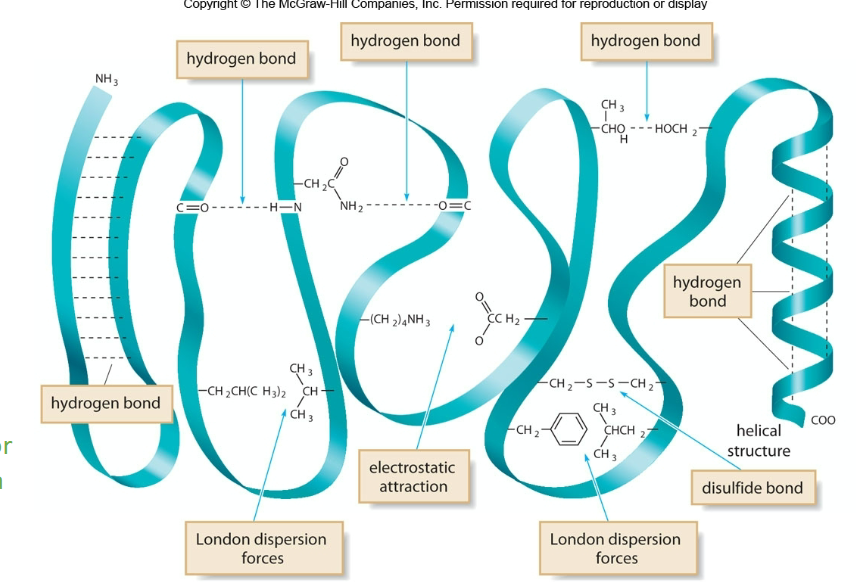
What do disulfide bonds do in globular units?
disulfide bonds (bridges) helps covalently stabilize the globular folds
Forces involved in protein structure.
hydrogen bonds, electrostatic attraction, London dispersion forces, disulfide bonds.
What is a super coil?
When 2 α-helices wrap around each other.
Where is a super coil notably present?
α-keratins (which are α-helices) make up hairs
Protein function for cellular movements:
Muscle Contraction, Vesicular Trafficking, Chromosome Segregation, and Cell Division rely on microtubule, microfilament, and motor proteins
Protein function for cellular scaffolding
DNA supercoiling in the nucleus, and the positioning + movement of cellular organelles
Protein function for membrane transport
Active and facilitated transport across the plasma membrane via transmembrane transport proteins
Protein function for ligand binding
oxygen transport in the blood by hemoglobin
Protein function for enzyme activity
catalysis of metabolic and physiological reactions
What causes a protein to denature?
Factors like pH and heat, and also chemical agents and heavy metals.
Describe peptide hydrolysis
The addition of equivalent water for every peptide bond within a protein in order to break the protein into it’s individual amino acids.
Amino acids structural functional group.
α-amino carboxylic acids
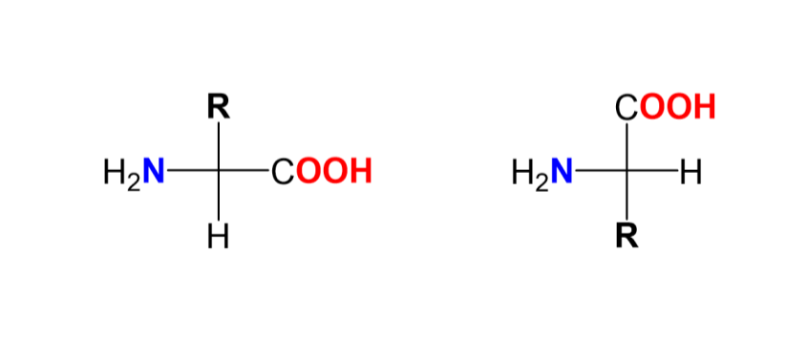
Biologically, amino acids have what stereochemistry?
Biological amino acids are L-stereoisomers. (The amino acid will be to the left side in a Fischer projection)
What is a zwitterion?
The neutral (or isoelectric) form of an amino acid. Different amino acid’s zwitterion occur at different pH levels.
What is protonated and what is deprotonated in a zwitterion?
The base is protonated (+ charge) and the acid is deprotonated (- charge)
Backbone and R-group protonization trends… better to just look at worksheet
Generally, the COOH is protonated below a pH of 4 and H3N group is deprotonated above a pH of 9.
Carboxylic acid R-groups typically ionize(-) between pH = 4-7
Amine (basic) R-groups typically lose (+) charge above pH = 9.0
In acidic amino acids, the zwitterion is formed around what pH?
3
In basic amino acids, the zwitterion is formed around what pH?
7.0
What is the role of an enzyme in the catabolic processes?
To decrease activation energy, allowing for a speedier reaction. 1 enzyme can be reused many times. They are specific for reactions.
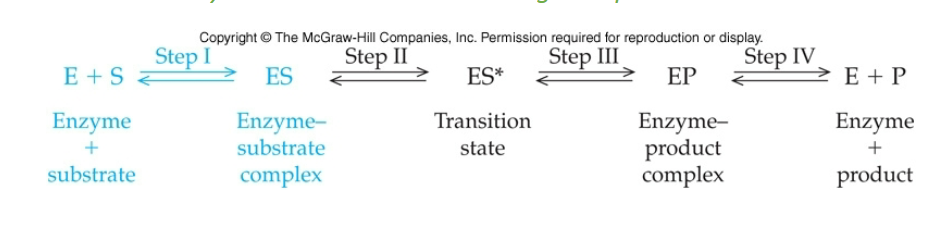
Steps for a reversible enzyme reaction.
Enzyme + Substate
Enzyme substrate complex
Transition state
Enzyme product complex
Enzyme + Product
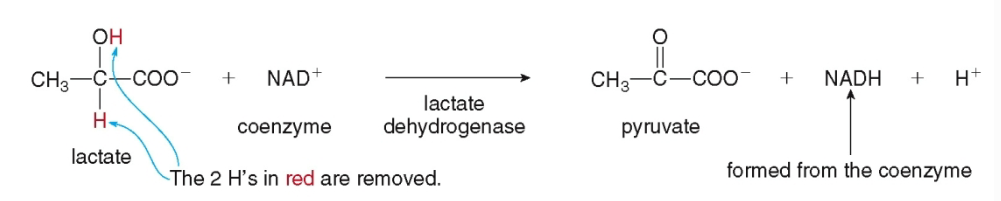
Oxidoreductases
catalyze redox reactions (oxidation-reduction). Also called hydrogenase. Is - O2 or + Hydrogen
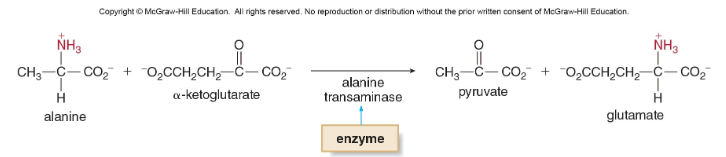
Transferase
transfer a substituent group between substrates.
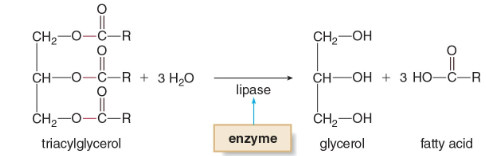
Hydrolase
By adding water, cleave bonds on a molecule.
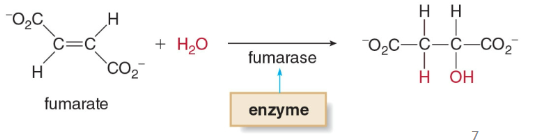
Lyase
addition to a double bond or elimination to give a double bond
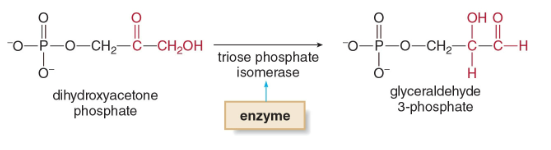
Isomerase
rearranges a molecule (changes the structure)
Ligase
catalyze the formation or breakage of C-C, C-N, C-O and C-S bonds

Kinase
adds a phosphate
Do enzymes have specific requirements?
Yes, they have specific requirements for heat and pH depending on the environment that they must catalyze a reaction.
Lock-and-key
active site requires substrate to have exact structural match.
Induced fit
active site structure modifies to accommodate substrate
Coenzyme or Cofactor
Non-protein prosthetic group required for the holoenzyme activity (apoenzyme + cofactor = holoenzyme)
Holoenzyme
The active form of the enzyme
Apoenzyme
The inactive polypeptide portion of an enzyme without a coenzyme or cofactor bound
Thiamine creates what cofactor?
Thiamine pyrophosphate (decarboxylation reactions)
Riboflavin creates what cofactor?
FMN and FAD+ (hydrogen atom carrier)
Niacin creates what cofactor?
NAD+ and NADP+ (Hydride atom carrier)
Pyridoxine creates what cofactor?
Pyridoxal phosphate and pyridoxamine phosphate (amino and carboxyl group carrier)
B12 creates what coenzyme?
deoxyadenosyl colbalamin (amino acid metabolism coenzyme)
Folic acid creates what coenzyme?
tetrahydrofolic acid (coenzyme for 1 carbon transfer)
Pantothenic acid creates what coenzyme?
CoA (acyl group carrier)
Biotin creates what coenzyme?
Biocytin (coenzyme in CO2 fixation)
What does ascorbic acid (unknown coenzyme) do?
hydrolation of proline and lysine in collagen.
enzyme inhibition
reversible or irreversible. either is competitive (directly bonds to active site) or noncompetitive (does not bind to active site)
Allosteric Control
affect’s enzyme’s ability to bind a substrate
Negative allosteric control - less able to bind substrate
Positive allosteric control - more able to bind substrate
Zymogens
inactive form of an enzyme that can be converted to the active form when needed. (inactive portion cut off)