Lecture 7 -- Kennel cough
 Call Kai
 Learn
Learn Practice Test
 Spaced Repetition
 Match
Match Flashcards
 Knowt Play
1/30

Earn XP
Description and Tags
These flashcards cover key vocabulary and concepts related to respiratory infections in dogs, including causes, symptoms, and treatments.
Name | Mastery | Learn | Test | Matching | Spaced | Call with Kai |
|---|
No analytics yet
Send a link to your students to track their progress
31 Terms
What is “kennel cough”?
Similar to the common cold in humans, affecting the upper respiratory tract
Not a single disease, but a clinical syndrome
Can caused by multiple viruses and bacteria
What are the common viruses that cause kennel cough (canine infectious respiratory disease complex, CIRDC)?
Canine parainfluenza virus (CPiV)
Canine adenovirus type 2 (CAV-2)
Canine herpesvirus
Canine influenza virus
Canine respiratory coronavirus
Which family does canine parainfluenza virus (CPiV) belong to? Which other canine virus belongs to the same family?
Belongs to family paramyxoviridae (Genus - Respirovirus)
Canine distemper virus also belongs to paramyxoviridae (but in different genus - morbilivirus)
What type of virus is canine parainfluenza virus (CPiV)?
Enveloped single stranded RNA virus
Mutate easily
Fragile in the environment
How does canine parainfluenza virus cause disease?
Excreted in oronasal secretions
Multiplies locally in epithelial and lymphoid cells of respiratory tract (NOT systemic)
Causes mild cough and clear nasal discharge
Are vaccines available for CPiV? If so, what type of vaccine is used?
Yes
Live attenuated vaccines
How does canine herpesvirus affect puppies less than 2 weeks?
Canine herpesvirus can generalise and cause fading puppy syndrome → High mortality
How does canine herpesvirus affect older puppies/ adults?
Virus is restricted to external mucous → Mild URT and genital tract infection → Clinical sign: Mild nasal serous discharge
How does equine influenza affect dogs?
H3N8 strain originally equine influenza → Antigenic shift → Can infect dogs = Canine influenza
What are the possible transmission routes of equine influenza to dogs?
Feeding raw horse meat contaminated with virus to dogs
What are the clinical signs of canine influenza?
80% mild kennel cough
Nasal discharge and cough (10-21days)
5-8% pneumonia and death
High fever, dyspnoea and lung consolidation
Are vaccines available for canine influenza H3N8? If so, what type of vaccines are used?
Yes
Inactivated vaccines against canine influenza virus (H3N8) is available
What are the common bacteria that cause kennel cough (canine infectious respiratory disease complex, CIRDC)?
Bordetella bronchiseptica
What type of organism is Bordetella bronchiseptica?
Gram-negative smal coccobacillus
What is the incubation period of Bordetella bronchiseptica?
~6 days
How does Bordetella bronchiseptica cause disease (pathogenesis)?
Attaches to ciliated respiratory epithelium
Replicates and produces virulence factors
Causes ciliostasis → stops cilia from beating → Impair mucociliary clearance → Compromise the ability to clear infection
What are the clinical signs of Bordetella bronchiseptica infection?
Goose like honking cough
Nasal discharge
Bronchopneumonia
How is Bordetella bronchiseptica diagnosed?
History and clinical signs
Nasal/oropharyngeal swabs
Transtracheal wash
Bronchoalveolar lavage
Culture on selective agar (charcoal 木炭 with antibiotics like cephalexin)
Why is cephalexin used in Bordetella bronchiseptica culture?
Cephalexin can suppresse growth of other bacteria normally present in the dog’s nose and throat
BUT since bordetella is resistant to cephalexin, so it can still grow on the medium
Why is PCR not routinely used to diagnose Bordetella bronchiseptica (Bb)?
Since bordetella bronchiseptica is a bacteria, instead of virus
How is Bordetella bronchiseptica treated?
Systemic antibiotics if clinical signs persist >10 days or the dog is systemically unwell (BSAVA guidelines)
Antitussives to reduce coughing
Bronchodilators if needed
Expectorants (e.g., bathroom with hot shower)
Can Bordetella bronchiseptica infect other species?
Yes. Cats in contact with infected dogs can become infected.
What vaccines are available against Bordetella bronchiseptica?
Avirulent live intranasal vaccine
How often should dogs be revaccinated for Bordetella bronchiseptica (Bb)?
Bordetella vaccines have a short duration of immunity → Annual revaccination
Is Bordetella bronchiseptica a zoonotic disease?
Yes, but rarely
Infection of a human from a rabbit previously reported
How is Bordetella bronchiseptica controlled in kennels?
Vaccinate dogs
Isolate affected dogs
Maintain good hygiene
Prevent direct contact between animals
Ensure adequate ventilation
Keep stocking density low
Which fungi can cause nasal problems in dogs?
Aspergillus species
Filamentous fungi, ubiquitous in soil, plant debris, and air
Causes nasal aspergillosis
Which dogs are most susceptible to nasal aspergillosis?
Young dogs
Dolichocephalic breeds (long-nosed dogs)
Dogs that are immunocompromised
What are the clinical signs of nasal aspergillosis ?
Chronic nasal discharge
Epistaxis
Depigmentation of the nose
Pain around the muzzle or on eating (due to bone erosion of nasal turbinates)
How is nasal aspergillosis diagnosed?
Radiography / CT → Detect bone erosion in sinuses
Serology → Detect antibodies against Aspergillus
Fungal culture
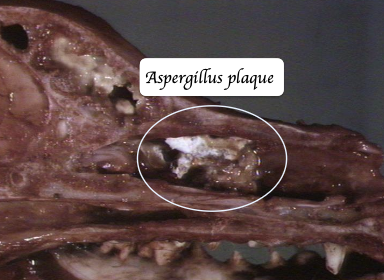
Direct examination / endoscopy → Visualisation of fungal plaques
Exclusion of other causes of chronic nasal discharge
How is nasal aspergillosis treated?
Systemic anti-fungals e.g. amphotericin B (belongs to polyene group)
Flushing the nasal passages and sinuses with topical anti-fungal
P.S. Systemic anti-fungals often are no able to clear the infection alone → Need to use with topical anti-fungals
Surgery (Remove affected turbinates)