ALLLL BIO
 Call Kai
 Learn
Learn Practice Test
 Spaced Repetition
 Match
Match Flashcards
 Knowt Play
1/45

There's no tags or description
Looks like no tags are added yet.
Name | Mastery | Learn | Test | Matching | Spaced | Call with Kai |
|---|
No analytics yet
Send a link to your students to track their progress
46 Terms
Define genetics
The scientific study of genes, heredity, and variation in inherited characteristics-how traits are passed from parents to offspring and why individuals differ.
dna structure
The shape of the molecule is described as a “double helix”. Can be understood more easily by untwisting the double helix and displaying the molecule as if it were a ladder. The side rails of the ladder (the “backbone”) are alternating phosphate and sugar molecules. The rungs are paired nitrogen base molecules held together by a hydrogen bond.
bases pairing rules
Each “rung” of the DNA ladder is formed from two nitrogen bases. There are four bases – adenine (A), thymine (T), cytosine (C), and guanine (G). The base adenine always bonds with thymine (A-T), and cytosine always bonds with guanine (C-G). The binding of two nucleotides forms a base pair. In DNA, cytosine and guanine are bound together by 3 hydrogen bonds, whereas adenine and thymine are bound by 2 hydrogen bonds.
Describe the steps in which DNA is used to synthesis proteins
Protein synthesis takes place over two stages. The first stage is called transcription and it takes place in the nucleus. First, a section of double-stranded DNA is unwound by the enzyme RNA polymerase. The strand that is read by this enzyme is called the template strand. This is used to build a complementary copy of messenger RNA (mRNA). Since it is RNA, thymine is replaced by uracil in the complementary RNA strand.
The second stage of protein synthesis is called translation. This takes place in the cytoplasm on a ribosome which can either be free-floating or on the rough endoplasmic reticulum. This stage leads to the creation of a chain of amino acids, called a polypeptide chain, which will fold into a protein.
Use models and diagrams to represent the relationship between DNA, genes and chromosomes
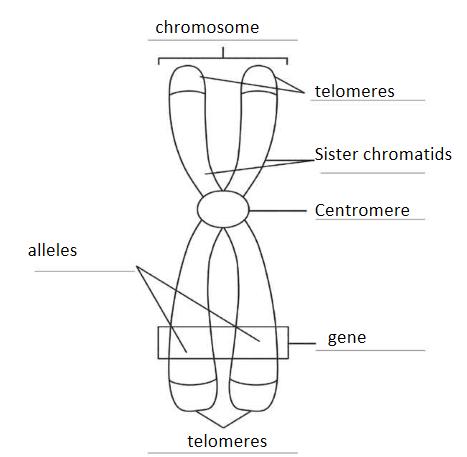
DNA, genes, and chromosomes are all different levels of the same genetic structure. DNA is the long molecule that carries hereditary information, and in the nucleus it exists as loose chromatin so the cell can easily access the genetic code. When the cell prepares to divide, this DNA coils tightly into chromosomes, which can be single-stranded (one chromatid) or double-stranded (two sister chromatids joined at a centromere). Along the length of this DNA are genes—specific segments that code for proteins or functional RNA and influence particular traits. So the relationship is: chromosomes are condensed packages of DNA, and genes are functional sections of that DNA that determine inherited characteristics.
Examining how the work of Rosalind Franklin, James Watson, Francis Crick and Maurice Wilkins contributed to the development of the double helix structure of DNA
Watson & Crick: James Watson was a young chemist from the US who went to University of Cambridge UK where he met Francis Crick, an English physicist. They worked as a team to unravel the secret of the structure of DNA which they identified as a double helix (two strand spiral) in 1953. talent lay in interpreting experimental results of others. Rosalind Franklin: Work helped determining the double-helix structure of DNA. Photo 51 provided crucial evidence used by Watson and Crick, who were told by Maurice Wiklins. Franklin's work was not acknowledged at the time.
Explain how the development of fast computers has made the analysis of DNA sequencing possible
has made DNA sequencing analysis possible by allowing scientists to process and compare billions of nucleotide sequences quickly. High-speed processors and advanced algorithms can assemble fragments of DNA into complete genomes, detect mutations, and identify genes with precision. This computational power transforms raw sequencing data into meaningful biological insights, enabling rapid discoveries in genetics, medicine, and biotechnology.
Mitosis Function
Growth, tissue repair, replacement of cells, and asexual reproduction in some organisms. Ensures genetic consistency.
Meiosis Function
Produces gametes (sperm/eggs) for sexual reproduction and introduces genetic variation through recombination and independent assortment.
mitosis vs meiosis types of cells produced
Mitosis — Somatic (body) cells. Meiosis — Gametes (sex cells).
Mitosis vs meiosis number of divisions
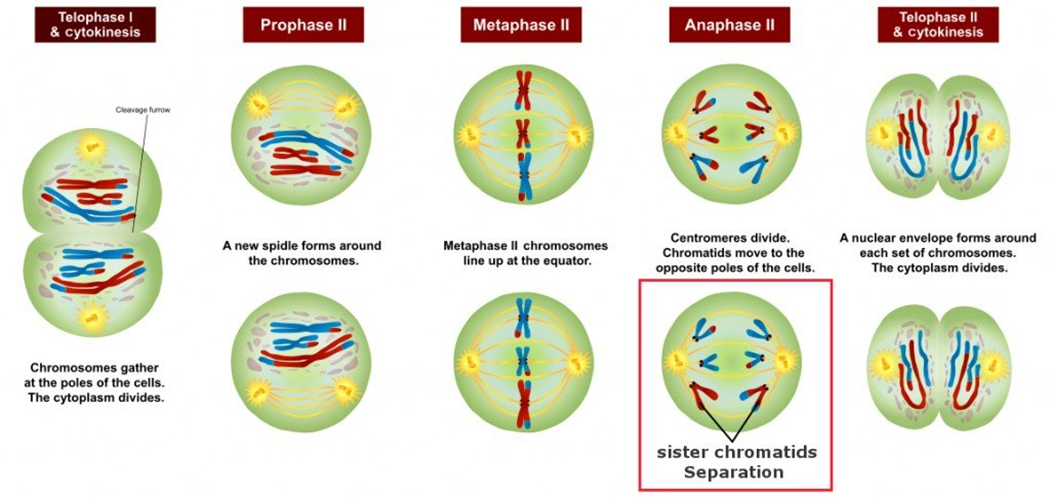
Mitosis — One cell division. Meiosis — Two consecutive divisions (Meiosis I and Meiosis II).
Mitosis daughter cells
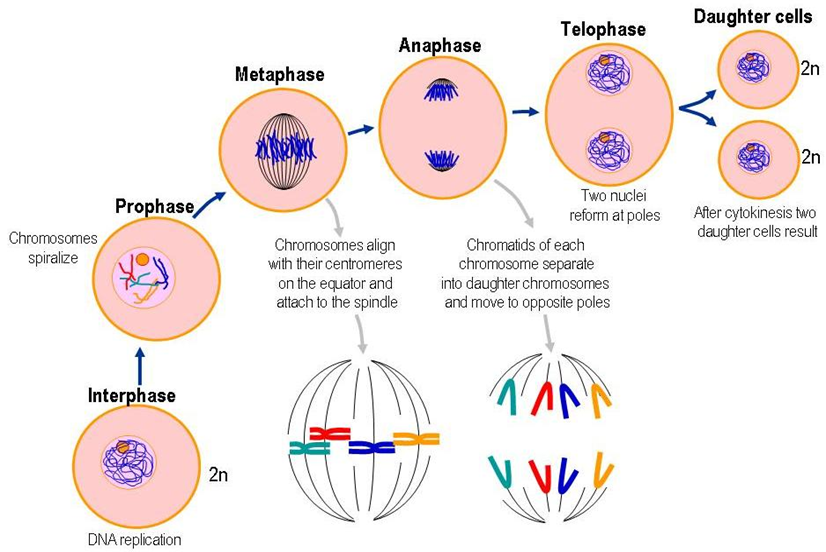
Mitosis — 2 daughter cells. diploid (2n). They have the same chromosome number as the parent cell. Daughter cells are genetically identical to each other and to the parent cell. (No crossing over, no independent assortment.)
Meiosis daughter cells
4 daughter cells. haploid (n). They have half the chromosome number of the parent cell. Daughter cells are genetically different from each other and from the parent cell. Variation arises from: Crossing over (prophase I) and independent assortment (metaphase I)
Use a karyotype to determine information about an individual
You identify sex by looking at the 23rd chromosome pair: xx - female, xy - male. A normal human karyotype has: 46 chromosomes total, 23 pairs. If the number differs, it indicates aneuploidy (an abnormal number of chromosomes) e.g. down syndrome. You can confirm whether the individual is: Diploid (2n) — normal for humans or Polyploid — rare and usually non-viable in humans.
Describe the role of gametes in sexual reproduction
Gametes are specialised sex cells used in sexual reproduction. In males, the gametes are sperm cells, and in females, they are egg cells (ova). Gametes contain half the normal number of chromosomes so that when fertilisation occurs, the offspring receives a full set of chromosomes. Their role is to carry genetic information from each parent to the offspring.
fertilisation
During fertilisation, the sperm and egg join together to form a zygote. This combines genetic information from both parents, meaning the offspring inherits characteristics from each. Each parent contributes one allele for every gene. Biological sex is determined by the sex chromosomes. Females have XX chromosomes and males have XY chromosomes. The egg always contributes an X chromosome, while the sperm contributes either an X or a Y chromosome. If the sperm carries an X chromosome, the baby will be female (XX). If the sperm carries a Y chromosome, the baby will be male (XY). This means the father determines the biological sex of the child.
Explain how heredity and the environment can affect phenotypes
Phenotype is shaped by both heredity and the environment. Heredity passes genetic information from parents to offspring through gametes, giving each individual a specific genotype made of inherited alleles that set the potential for traits. However, the environment—including nutrition, temperature, light, chemicals, lifestyle, and other external conditions—can influence how these genes are expressed. This means individuals with the same genotype (like identical twins) can develop different phenotypes due to differences in diet, exercise, or exposure. Because many traits are polygenic and multifactorial, the final phenotype results from a continuous interaction between inherited DNA and environmental influences.
Sex linked recessive
Sex-linked recessive inheritance occurs when the gene responsible for a trait is located on the X chromosome. Males are more likely to express sex-linked recessive conditions because they only have one X chromosome. Examples include red-green colour blindness and haemophilia. A male only needs one recessive allele on the X chromosome to show the condition, while a female would need two recessive alleles.
Dominant
An allele that is expressed in the phenotype when present, even if only one copy is inherited (A masks a).
Recessive
An allele that is only expressed in the phenotype when two copies are present (aa); masked by a dominant allele.
Genotype
the genetic makeup of an organism for a particular trait (the alleles it carries, e.g. Aa).
Phenotype
The observable characteristics or traits of an organism (e.g. brown eyes), resulting from the interaction of genotype and environment.
Heredity
The process by which genetic information is transmitted from parents to offspring through gametes, resulting in the inheritance of traits.
Deoxyribonucleic acid
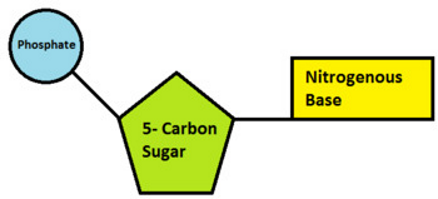
The double-stranded, helical molecule that stores genetic information in cells. It is composed of nucleotides with a deoxyribose sugar, phosphate group, and nitrogenous base (A, T, C, G).
Nucleotide
The basic building block of nucleic acids (DNA and RNA), consisting of a phosphate group, a five-carbon sugar (deoxyribose in DNA), and a nitrogenous base.
Autosomal
Refers to genes or traits located on autosomes (non-sex chromosomes). Autosomal traits affect males and females equally in terms of inheritance patterns.
Sex-linked
Refers to genes located on sex chromosomes (usually the X chromosome in humans). Sex-linked traits often show different patterns of inheritance in males and females (e.g. X-linked recessive traits more common in males).
Chromosome
A long, tightly coiled DNA molecule associated with proteins (histones), carrying many genes. In eukaryotes, chromosomes are found in the nucleus and are visible during cell division.
DNA sequencing
A laboratory process used to determine the exact order of nucleotides (A, T, C, G) in a DNA molecule, revealing the genetic code of a gene, chromosome, or entire genome.
Mitosis
A type of cell division that produces two genetically identical diploid daughter cells from one diploid parent cell. It is used for growth, repair, and asexual reproduction.
Meiosis
A type of cell division that occurs in sex organs and produces four genetically different haploid gametes from one diploid cell, involving two successive divisions (meiosis I and II).
Haploid
Describes a cell with one set of chromosomes (n), such as gametes (sperm and eggs) in humans (n = 23).
Diploid
Describes a cell with two sets of chromosomes (2n), one set from each parent; most human body cells are diploid (2n = 46).
Karyotype
An ordered display of the chromosomes in a cell, arranged in homologous pairs by size and shape, used to study chromosome number and structure and to detect abnormalities.
Punnett square
A grid used to predict the possible genotypes and phenotypes of offspring from a genetic cross by showing all possible combinations of parental gametes.
Gametes
Haploid sex cells (sperm and eggs) produced by meiosis, carrying one set of chromosomes and fusing at fertilisation to form a diploid zygote.
Genes
Segments of DNA that code for a specific protein or functional RNA and influence particular traits; they are the basic units of heredity located on chromosomes.
Homozygous
Having two identical alleles for a gene (e.g. AA or aa).
Heterozygous
Having two different alleles for a gene (e.g. Aa).
dna sugar, bases, number of strands, location of cells
deoxyribose
adenosine, thymine, cytosine, guanine
double-stranded
nucleus
RNA sugar, bases, number of strands, location of cells
ribrose
adenine, uracil, cytosine, guanine
single stranded
nucleus, cytoplasm, ribosomes
labelled chromosome
labelled nucleotide
mitosis diagrams
meiosis diagrams
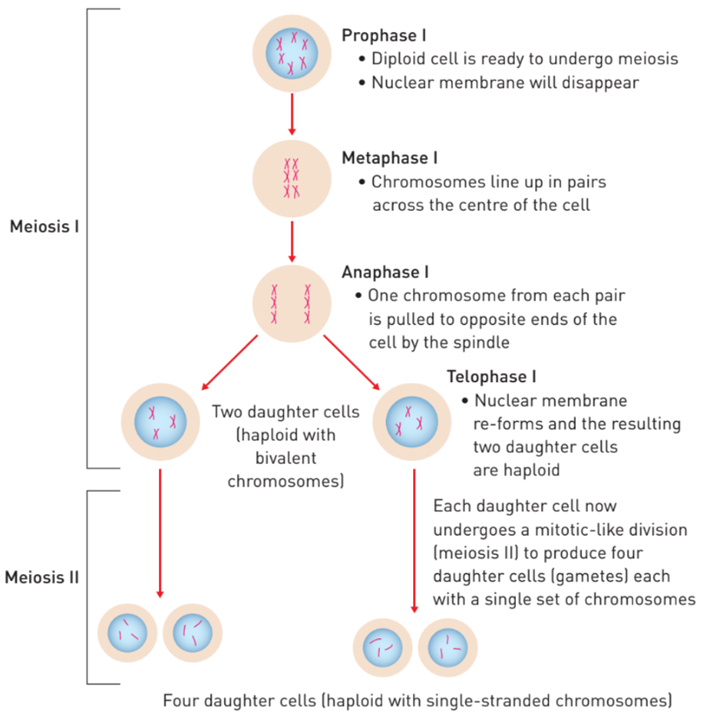
meiosis phase II diagrams