Hell World: Term 1 Week 7: Ptolemaic Egypt
 Call Kai
 Learn
Learn Practice Test
 Spaced Repetition
 Match
Match Flashcards
 Knowt Play
1/107

There's no tags or description
Looks like no tags are added yet.
Name | Mastery | Learn | Test | Matching | Spaced | Call with Kai | Chat |
|---|
No analytics yet
Send a link to your students to track their progress
108 Terms
Why did Ptolemy I assume command over egypt and what benefits did Egypt offer?
Egypt was very fertile and a wealthy area, very fertile due to the Nile. Military positives of egypt- far from the other kingdoms, very little land based connectivity, it was a very defensible area
What is one of the stories of how Ptolemy became the satrap of Egypt?
After Alexanders death he is appointed the satrap of Egypt at the Partition of Babylon
The partition of Babylon was chosen by allotment
Diodorus Siculus, 18.14.1:
“In Asia, of those who had shared in the division of the satrapies, Ptolemy took over Egypt without difficulty and was treating the inhabitants with kindness. Finding eight thousand talents in the treasury, he began to collect mercenaries and to form an army. A multitude of friends also gathered about him on account of his fairness. With Antipater he carried on a diplomatic correspondence that led to a treaty of co‑operation, since he well knew that Perdiccas would attempt to wrest from him the satrapy of Egypt.”
What is the other tale of how he became the satrap?
In another tradition it says he wasnt selected by allotment but he chose the region of Egypt, as he was concerned that he would be vulnerable to attack- one reason to believe this tradition is that he escapes to Egypt taking along with him Alexanders the Greats body. He takes it to memphis (the capital of Egypt). He seizes the bosy to legitimise his own position as a successor to Alexander. Its significant to seize the bosy in an egyptian context because there is a particularly important tradition where the successor would bury their predecessor.
Pausanias 1.6.3:
“He (Ptolemy I) crossed over to Egypt in person, and killed Cleomenes, whom Alexander had appointed satrap of that country, considering him a friend of Perdiccas, and therefore not faithful to himself; and the Macedonians who had been entrusted with the task of carrying the corpse of Alexander to Aegae, he persuaded to hand it over to him. And he proceeded to bury it with Macedonian rites in Memphis, but, knowing that Perdiccas would make war, he kept Egypt garrisoned. And Perdiccas took Aridaeus, son of Philip, and the boy Alexander, whom Roxana, daughter of Oxyartes, had borne to Alexander, to lend color to the campaign, but really he was plotting to take from Ptolemy his kingdom in Egypt. But being expelled from Egypt, and having lost his reputation as a soldier, and being in other respects unpopular with the Macedonians, he was put to death by his body guard.” (trans. W.H.S. Jones).
How was Ptolemy 1st shown to be an ambitious king?
Ptolemy shows himself to be an ambitious king early on, in 322 BCE he engages in conflict with the neighbouring region Cyrene (Slide 7 has a long quote from Diodaurus discussing this)- The capture of Cyrene expands Ptolemies satrapy and it captures a second of the great bread baskets of the ancient world, its notable for its extensive farmland.
Diodorus 18.21.5–9:
“Thibron, elated by the victory, laid siege to the port of the Cyrenians and made daily assaults on Cyrene. As the war continued a long time, the Cyrenians, who were in want of food, quarrelled among themselves; and the commons, gaining the upper hand, drove out the rich, who, bereft of their fatherland, fled, some to Thibron, others to Egypt. The latter, after persuading Ptolemy to restore them, returned bringing with them a considerable force, both infantry and naval, with Ophellas as general. The exiles who were with Thibron, hearing of the approach of these men and attempting to go over to them secretly at night, were detected and cut down to a man. The democratic leaders of Cyrene, becoming alarmed at the return of the exiles, made terms with Thibron and prepared to fight against Ophellas in common with him; but Ophellas, after defeating and capturing Thibron and also gaining control of the cities, delivered both the cities and the country over the Ptolemy the king. Thus the Cyrenians and the surrounding cities lost their freedom and were annexed to the kingdom of Ptolemy.”
(Diodorus wrote this about 60 BCE and the events occurred around 320 BCE)
What did the Ptolemaic dynasty have a lot of control over?
The ptolemaic dynasty had a lot of control over the grain trade
Who did Ptolemies growing influence gain the attention of?
His growing influence in Egypt attracted the attention of Perdiccas, who was concerned about the stability of his own position. Perdiccas apparently spread rumours about Polemy to turn public love away from him- question of how accurate this is because one of our accounts comes from Ptolemy 1st himself.
Write out the source from ptolemy
Arrian, Events after the death of Alexander Fr. 9.28–29:
“Perdiccas, setting out from Damascus to make war upon Ptolemy the son of Lagus, reached Egypt with the kings and a large force. He made many charges against Ptolemy, who publicly cleared himself, so that the accusations appeared ill-founded. Perdiccas, notwithstanding the opposition of his troops, decided to carry on the war. He was twice defeated, and, having treated those who were inclined to go over to Ptolemy with great severity, and in other respects behaved in camp more arrogantly than became a general, he was slain by his own cavalry during an engagement. After his death Ptolemy crossed the Nile to visit the kings, upon whom he bestowed gifts and treated them with the utmost kindness and attention, as well as the other Macedonians of rank. At the same time he openly showed sympathy with the friends of Perdiccas, and did all he could to allay the apprehensions of those Macedonians who imagined they were in peril, so that at once and ever afterwards he was held in great esteem.”
n.b. A major source for Arrian’s histories was a history of these events written by Ptolemy I. The passage above, certainly paints Ptolemy I in a favourable light.
Who is the aggressor in the situation between Ptolemy and Perdicass?
It is clear that perdicass is the aggressor against Ptolemy, he attempted to invade egypt twice and was killed the second time by his own cavalry.
Identify this object:
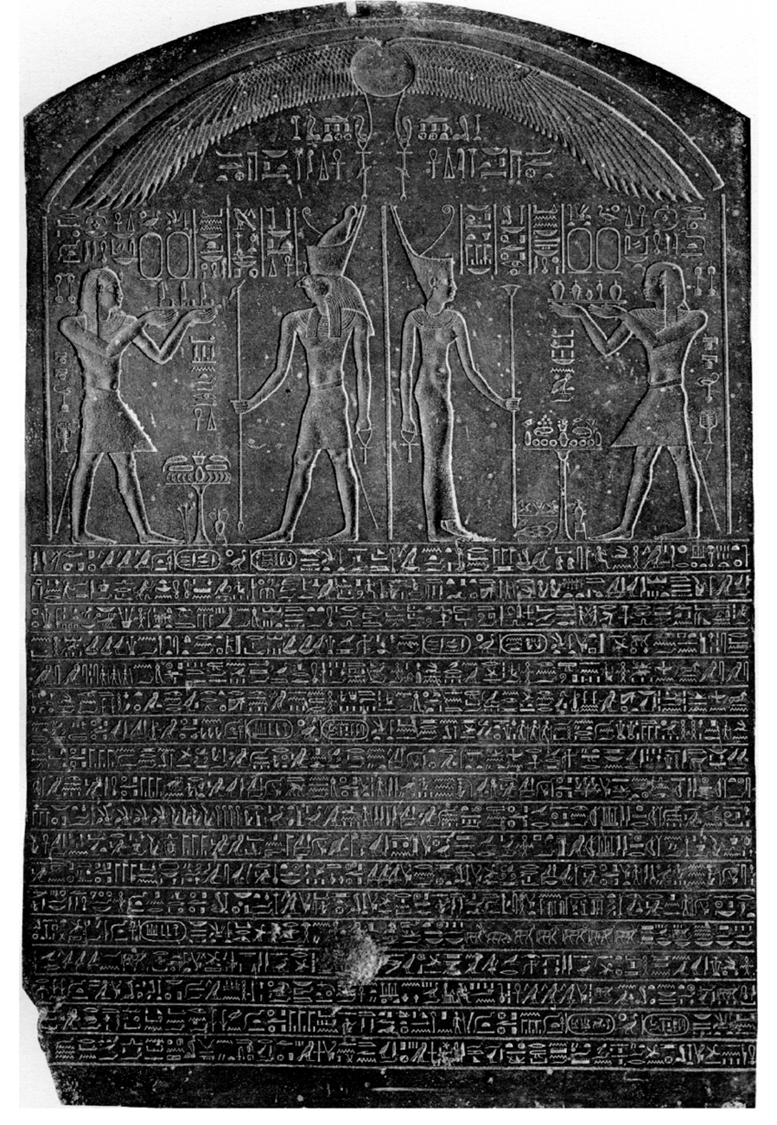
Satrap stele
Was ptolemy seen as the singular ruler in Egypt after the death of Perdicass?
Even after the defeat of Perdicass we see that ptolemy won a relatively conservative strategy in the Satrap stele from 311 BCE. We can see that in egypt ptolemy 1st styles himself only as a great prince (the equivalent title to satrap), so he is not yet claiming singular authority of egypt, even though after the defeat of Perdicass he essentially was an autonomous ruler over egypt.
Write out what the satrap stele says
“Regnal year 7, first month of Inundation season, under the Majesty of the Horus: "The youthful one, great of strength"; The Two Ladies: "The beloved of the gods, to whom was given the office of his father"; The Horus of Gold: "The ruler in the entire land"; the King of Upper and Lower Egypt, Lord of the Two Lands, Haaibre-Setepenamon, the Son of Re, Alexander (IV), living forever, beloved of the gods of Pe and Dep.
He is king in the Two Lands and the foreign countries. His Majesty is in the midst of the Asiatics, while a great Prince is in Egypt, whose name is Ptolemy (I). He is a youthful man, strong in his two arms, effective in plans, with mighty armies, stout hearted, firm footed, who attacks the powerful without turning his back, who strikes the face of his opponents when they fight, with precise hand, who grasps to himself the bow without shooting astray, who fights with his sword in the midst of battle, with none who can stand in his vicinity, a champion whose arms are not repulsed, with no reversal of what issues from his mouth, who has no equal in the Two Lands or the foreign countries...”
When did Ptolemy begin to call himself king?
It is not until the death of Phillip 3rd (alexander the greats half brother), that we find Ptolemy taking up the mantle of king, when he took this title- ‘basileus’ is unclear in our sources. We hear that he took this title in line with his siege of Rhodes, while others speculate that he took this title at least two years earlier.
Write out the text from Diodorus where Ptolemy begins to call himself king
Diodorus 20.53.1–4 [306/305 BCE]:
“Thereafter Ptolemy gave up the fight in Cyprus and returned to Egypt. Demetrius, after he had taken over all the cities of the island and their garrisons, enrolled the men in companies; and when they were organized they came to sixteen thousand foot and about six hundred horse. He at once sent messengers to his father to inform him of the successes, embarking them on his largest ship. And when Antigonus heard of the victory that had been gained, elated by the magnitude of his good fortune, he assumed the diadem and from that time on he used the style of king; and he permitted Demetrius also to assume this same title and rank. Ptolemy, however, not at all humbled in spirit by his defeat, also assumed the diadem and always signed himself king. And in a similar fashion in rivalry with them the rest of the princes also called themselves kings: Seleucus, who had recently gained the upper satrapies, and Lysimachus and Cassander, who still retained the territories originally allotted to them.”
Explain Antigonous invasion of Egypt
Antigonous is a rival claimant to the throne engaging in warfare against Ptolemy 1st
Like perdiccas invasion before, Antigonous is not prepared for the challenges that come along with campiagining in Egypt, and he is ultimately defeated by Ptolemy- this ends the final threat to the Ptolemaic dynastoes control over Egypt.
By control over egypt via land done, they are able to shift their attention to the sea. There was a reinforcement of the ptolemic fleet.
Who wrote about Antigonous invasion of Egypt?
Diodorus
Write out Diodorus’ writings
304 BCE.
Diodorus 20.76.3–7:
“Since Ptolemy, however, had already occupied every landing-place along the river with strong guards, since many river boats had been made ready for him, and since all of these were equipped with ordnance of every kind and with men to use it, Antigonus was in no little difficulty; for his naval force was of no use to him since the Pelusiac mouth of the Nile had been occupied in advance by the enemy, and his land forces found their advance thwarted since they were checked by the width of the river, and what was of greatest importance, as many days had passed, food for the men and fodder for the beasts were falling short. Since, then, his forces for these reasons were disheartened, Antigonus called together the army and its leaders and laid before them the question whether it was better to remain and continue the war or to return for the present to Syria and later make a campaign with more complete preparation and at the time at which the Nile was supposed to be lowest. When all inclined toward the quickest possible withdrawal, he commanded the soldiers to break camp and speedily returned to Syria, the whole fleet coasting along beside him. After the departure of the enemy Ptolemy rejoiced greatly; and, when he had made a thank-offering to the gods, he entertained his friends lavishly. He also wrote to Seleucus, Lysimachus, and Cassander about his successes and about the large number of men who had deserted to him; and he himself, having finished the second struggle for Egypt and convinced that the country was his as a prize of war, returned to Alexandria.”
Where did the Ptolemies have many innovations?
They had many innovations through naval warfare (this is how they developed such strong control of their navy)
What did the Ptolemies begin to dominate?
The Ptolemies come to dominate the seas in the early part of the 3rd century BCE, establishing a naval command over much of the Eastern Mediterranean and thus controlling many coastal areas.
How did the Ptolemies ship technology begin to develop?
Partly driven by innovations in ship technology; replacement of triremes/trieres with larger ships (quadriremes/tetreres and quinqueremes/penteres) better equipped for head-on ramming, as well as supporting artillery and siege equipment. This was likely encouraged by a shift in battle tactics from open-sea conflicts to besieging of coastal cities by the Ptolemies.
How was naval battle primarily conducted at this time and why does this matter?
Throughout the reigns of ptolemy 1st to the 4th we see many developments in their navy, throughout the eaerly reigns their ships get bigger in size and scale. This tiem naval battle is primarily conducted by ramming, the larger and more powerful ships would sink the opponents ship.
When does this naval innovation reach its peak?
This reaches its peak under Ptolemhy the fourth, who constructed the largest ship we knoe of from antiquity. It is supposedly a ‘40 bank ship’- 40 lots of oars. Hundreds of rowers would be require o move the ship.
What do sources attest to about this ship?
Many sources attest that the ship was so large it wasn’t practical and instead was used to essentially show off- but it gives us a sense of the massive scale of resources that the ptolemies are able to put into their naval stuff.
Plutarch, Life of Demetrius 43.4:
“Ptolemy (IV) Philopator built a ship of forty banks of oars, which had a length of two hundred and eighty cubits (ca. 130 m.), and a height, to the top of her stern, of forty-eight (ca. 22 m.); she was manned by four hundred sailors, who did no rowing, and by four thousand rowers, and besides these she had room, on her gangways and decks, for nearly three thousand men-at‑arms. But this ship was merely for show; and since she differed little from a stationary edifice on land, being meant for exhibition and not for use, she was moved only with difficulty and danger.”
What did they begin to focus on with their ships?
Began to focus less on ramming with the ships but instead on besieging other cities- they essentially become floating platforms with siege equipment used to attack the city.
What was one of the most important conflicts that the Ptolemaic dynasty was involved in?
The Syrian wars
Who fought in the Syrian wars and over what?
Series of conflicts between Ptolemaic Egypt and the Seleucid kingdom over control of coastal territories in Syro-Palestine region.
List the wars of consolidation
274–271 First Syrian War: Ptolemy II versus Antiochus I.
260–253 Second Syrian War: Ptolemy II versus Antiochus II and Antigonus II Gonatus.
253 Marriage between Antiochus II and Berenike Syra (daughter of Ptolemy II).
246–241 Third Syrian War: Ptolemy III versus Seleucus II. Capture of Seleukeia.
List the uneven results battles:
219–217 Fourth Syrian War: Ptolemy IV versus Antiochus III.
217 :Battle of Raphia. Encourages revolt in Egypt.
202–195 Fifth Syrian War: Ptolemy V versus Antiochus III and Philip V. Control of Syro-Palestine lost.
170–168 Sixth Syrian War: Ptolemy VI versus Ptolemy VIII versus Antiochus IV.
Which of these battles was a paticular turning point for Egypt?
The battle of Raphia was a turning point, Ptolemy 4th wins but the battle has a very destabalisign effect on egypt
Who fought for Ptolemy the 4th in the battle of Raphia?
Ptolemy 4th couldnt require enough mercenaries for it so trained the native egyptians.
What problems came from the Egyptians fighting for Ptolemy 4th
But after they won the loot was not shared equally amongst the native egyptians and this lead to tenisons which created a desire for a native egyptian king.
How long did this revolt go on for?
This revolte continued for approximately 28 yeras, into the early years of Ptolemy 5th reign, and it saw two successful indigenous egyptian phairos for the first time in nearly 200 years- major turning point int eh trajectory of the Ptolemic kingdom
Write out Polybius’ writings on this topic
Polybius 5.107:
“Ptolemy (IV) however immediately after these events became involved in a war with his Egyptian subjects. For in arming them for his campaign against Antiochus he had taken a step which, while it served his immediate purpose sufficiently well, proved eventually disastrous. Elated with their victory at Rhaphia they refused any longer to receive orders from the king; but looked out for a leader to represent them, on the ground that they were quite able to maintain their independence. And this they succeeded in doing before very long.”
When was this revolt finally crushed and what impacts did it have?
In 186 BC Ptolemy 5th is able to crush the revolte, he is never able to fully rebuilt the ptolemiac treasury that it had been from Ptolemy 1st-4th. After this point there is continuous tension between the egyptian priest hood and the ptolemaic/macedonian kings.
Cleopatra VII (dates of when alive, who was she the daughter of?)
Born in 69 BCE, died 30 BCE. She was teh daughter of Ptoelmy12th but no sources documenting who her mother was. She didnt just speak greek but also the ancient egyptian language- from this people speculate that her mother was a member of the local egyptian region
Was she the first queen to become ruler under the Ptolemaic dynasty?
She was not the first queen to become a ruler under the Ptolemaic dynasty, but she did become one of the most successful female rulers and certainly the one who has received the greatest amount of attention due to her famed romances with julius caesar and mark anthony
Who did Cleopatra face off against in the Battle of Actium and why did she lose?
She faced off against Octavian at the battle of Actium 31 BCE, one of the interesting recent developments in this battle is that the loss in this battle wasnt based in a tactical error but that the fleet the Anthony and Cleopatra were leading was intended to besiege Rome.
What is a reason for the argument about the besiege of Rome?
A reason for this argument is that the monument at Actium that was set up has rams that are larger than any surviving rams in existence, so much much larger than the ships that were employed by Octavian. It is likely that this fleet would have been vulnerable to attacks by swifter smaller fleets.
How does Cleopatra die?
She commtis suicide by poison- a critical aftermath of the battle was Octavians desire to have Cleopatra and her children paraded through the streets of rome- he didnt want her to die, but wished her to participate in this triumph.
What does this monument at Actium show?:
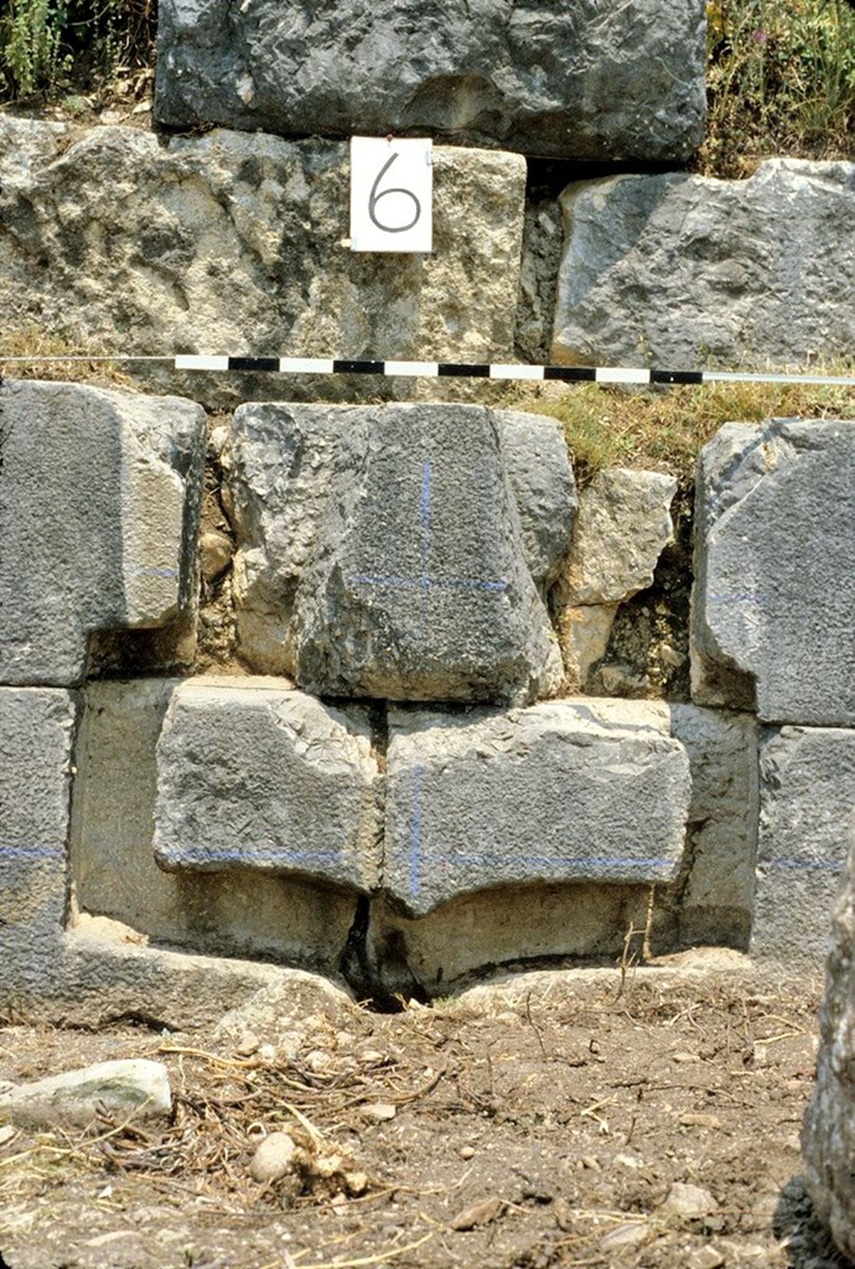
Built in 28 BCE to display rams from the captured ships of Antony and Cleopatra’s fleet. The size of the cuttings allows us to reconstruct the size of the ships that made up the captured fleet.
William Murray argues that large ships proved a hindrance in open combat against Augustus and that Anthony and Cleopatra may have intended to besiege coastal cities in Italy with this fleet.
When was Alexandria founded?
Founded in 331 BCE, it takes its name from its founder Alexander the great.
What were famous sites in Alexandria?
Among its most famous sites were the Sema (housing the tomb of Alexander) and the Pharos (or lighthouse).
What does Pliny allude to in his natural history?
Pliny in his natural history alludes to the fact taht there may have been an earlier site located there called Rhakotis
When did Alexandria really expand?
Despite is foundation under Alexander, it only received its larger layout under Ptolemy the first and especially the second.
What was one of the reasons for why the city became so famous?
One of the reasons the city became so famous was because it became the final resting place of Alexander the Great (although he was initially taken to memphis, he was later moved to have a madenonian style burial in Alexandria). Alexanders placement in the centre of this city supports the role for his burial monument in the city of Alexandria.
Who was responsible for the creation of the initial plan of Alexandria?
The initial plan of the city was created by Dinocrates, Alexanders great architect, who was responsible for many of alexanders big stuff
What did Plutarch write about the founding of Alexandria?
Plutarch, Life of Alexander 26.4–7:
“…in the night, as he (Alexander) lay asleep, he saw a wonderful vision…Accordingly, he rose up at once and went to Pharos, which at that time was still an island, a little above the Canopic mouth of the Nile, but now it has been joined to the mainland by a causeway. And when he saw a site of surpassing natural advantages (for it is a strip of land like enough to a broad isthmus, extending between a great lagoon and a stretch of sea which terminates in a large harbour), he…ordered the plan of the city to be drawn in conformity with this site.”
What did Vitruvius write about the founding of Alexandria?
Vitruvius, On Architecture 2.pref.4:
“Dinocrates was in constant attendance on the king, and followed him into Egypt; where Alexander having perceived a spot, at the same time naturally strong, the centre of the commerce of the country, a land abounding with corn, and having those facilities of transport which the Nile afforded, ordered Dinocrates to build a city whose name should be Alexandria.”
What was the Pharos ‘lighthouse’? (commissioned by and size)
The lighthouse was commissioned by Ptolemy I and completed during the reign of Ptolemy II. Cost 800 talents (Pliny, Natural History 36.17).
Ancient authors give varying descriptions of the height (from 102–118 m.) on a base of 30 meters square.
When was the lighouse damaged?
The lighthouse was damaged in an earthquake in 956 CE, but was still in a fairly intact state in 1166 CE, when the Arab traveller Abou Haggag Youssef Ibn Mohammed el-Balawi el-Andaloussi visited Alexandria and described the monument in detail.
What finally destroyed the lighthouse?
Earthquakes in 1303 and 1323 CE, however, finally toppled the tower and it became convenient building material for local projects. Nonetheless some remains have been found of the foundations now submerged.
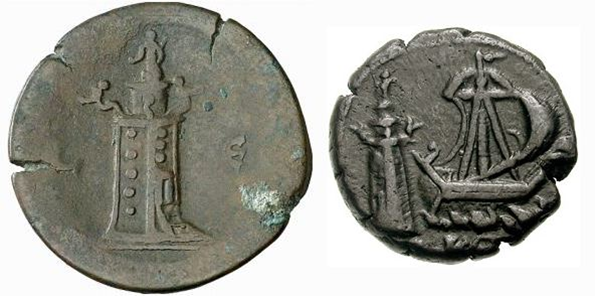
Identify these coins
Above: A coin of Antoninus Pius (left) and a coin of Commodus (right) depicting the Pharos in the 2nd century CE.
What does the lighthouse do?
This lighthouse allowed ships to find safe passage into the harbour of Alexandria, the island was essentially a giant sandbar. The pharos marked the end of the sandbar/island and the place for safe passage
What does Pliny tell us about the lighthouse?
Pliny tells us the construction of the lighthouse cost 800 talons, and that it was one of the wonders of the ancient world- slightly over 100m resting on a square base 30m on each side.
What is the Poseidippos Poem 23?
An epigram inscribed on the lighthouse, composed by the court sponsored poet (Poseidippos)
Write out the epigram
“Mighty Proteus, here, by the shore of Pharos, Sostratos of Dexiphanos the Knidian raised a light-house for the safety of the Greeks, were before there was no lookout among the islands. But now your great pile draws the ships to your shores, where the beacon rears its head above the clouds, so that at night the pilot, seeing the light flash over the waves and the fire burning brightly on the summit, will be able safely to steer his ship to royal Proteus, and, ploughing our sea, to come securely to the harbour of Tauros.”
What does the epigram provide us with?
This epigram provides us with the name of the architect of the lighthouse
What does the development of the city mirror?
The development of the city mirrors the expansion of the ptolemaic empire, reflects the wealth that came from the expansive maritime conquests of ptolemy the second and third.
What is the Serapieion?
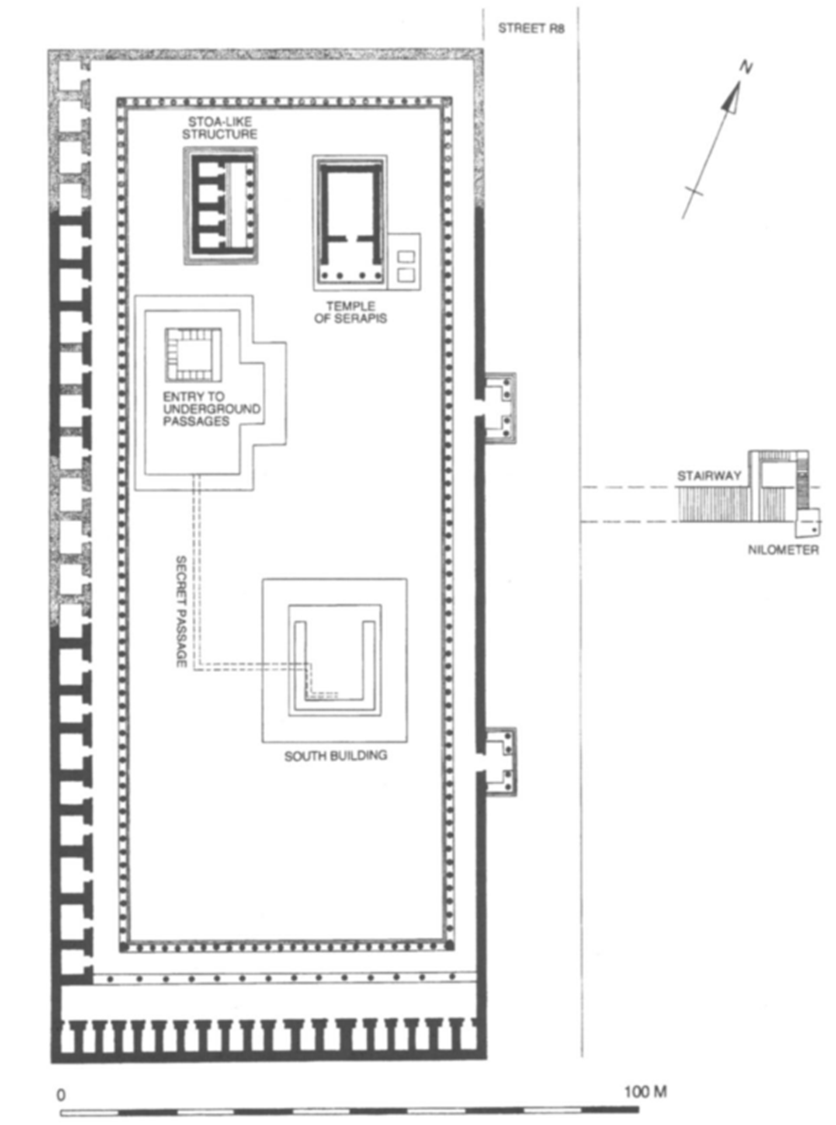
The Serapeum (or Serapieion) of Alexandria was a magnificent Ptolemaic-era temple dedicated to the syncretic Greco-Egyptian god Serapis, often considered the most beautiful temple in the city. Situated on a small hill (Acropolis) southwest of the city, it was famously destroyed by Christians in 391 AD, marking a pivotal moment in the decline of paganism
Altar from time of Ptolemy II. Monumental enclosure and Ptolemaic temple date to reign of Ptolemy III (246–221 BCE) as shown by foundation plaques. Design is “Greek” with large colonnaded temenos with prostyle temple.
Serapis was equated with Dionysos.
What did Tacitus write about the Serapieion?
Tactitus 4.83.1:
“the Egyptian priests tell the following story, that when King Ptolemy (I)…was giving the new city of Alexandria walls, temples, and religious rites, there appeared to him in his sleep a vision of a young man of extraordinary beauty and of more than human stature, who warned him to send his most faithful friends to Pontus and bring his statue hither.”
What is the boubasteion?
Founded by the reign of Ptolemy II (as demonstrated by an altar set up in honour of Ptolemy II and Arsinoe II).
Monumental enclosure, altar, and temple date to reign of Ptolemy III (246–221 BCE) as shown by foundation plaques.
Who was Boubastis and what form were they worshipped in?
Boubastis was an Egyptian god who came to be syncretized with Artemis. Discovery of Boubasteion, linked with the goddess Artemis,but Boubasteous was wroshipped in the form of a house cat.
When was the Library of Alexandria constructed and how much work was in it?
Library was constructed during the reign of Ptolemy II and rapidly grew into the largest collection in the world. Livy says that at the time of the fire in 44 BCE, there were some 400,000 scrolls in the library, perhaps representing as many as 100,000 works.
Who served as head librarian in the library of Alexandria?
Callimachus (310–240 BCE), although famous for his poetry, also served as head librarian.
What was the Pinakes?
Callimachus' most famous prose work is the Pinakes (“Lists”), a bibliographical survey of authors of the works held in the Library of Alexandria. The Pinakes was one of the first known documents that lists, identifies, and categorizes a library’s holdings. By consulting the Pinakes, a library patron could find out if the library contained a work by a particular author, how it was categorized, and where it might be found.
Write out Letter of Aristeas 9–10 (2nd c. BCE):
“Demetrius of Phalerum (ca. 350–280 BCE), the president of the king's library, received vast sums of money, for the purpose of collecting together, as far as he possibly could, all the books in the world. By means of purchase and transcription, he carried out, to the best of his ability, the purpose of the king. On one occasion when I was present he was asked, How many thousand books are there in the library? and he replied, 'More than two hundred thousand, O king, and I shall make endeavour in the immediate future to gather together the remainder also, so that the total of five hundred thousand may be reached.”
Identify this:

One of the most famous surviving texts, this is a rare example of an excavated papyrus found in a tomb in 1902. This papyrus can be dated to the last half of the fourth century, it was written int he lifetime of the author
Who was Timotheus?
Timotheus (446–357 BCE) was a proponent of “new music” and is known to have innovated with the lyre, adding one or two new strings. His work otherwise survives only in later quotations.
Where was Timotheus popular?
He was popular in the Macedonian court under Philip II and Alexander III. He is even said to have played at the Susa Weddings organized by Alexander III (Athenaeus 12.54.538).
Identify this:
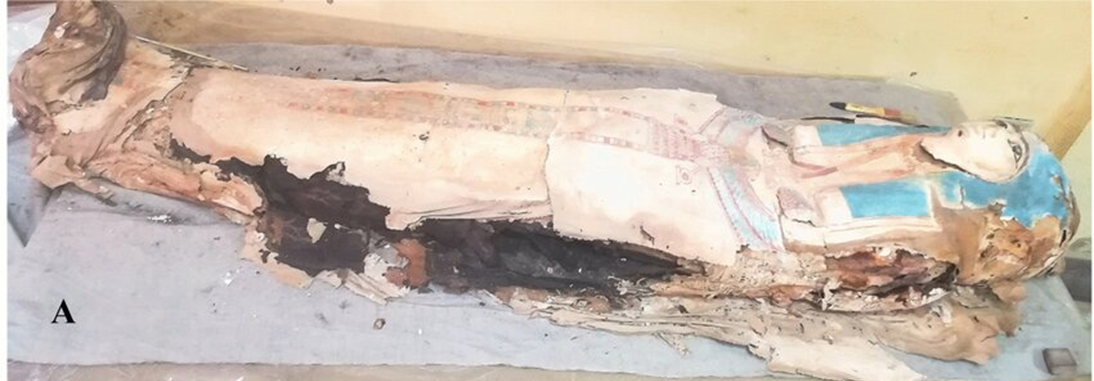
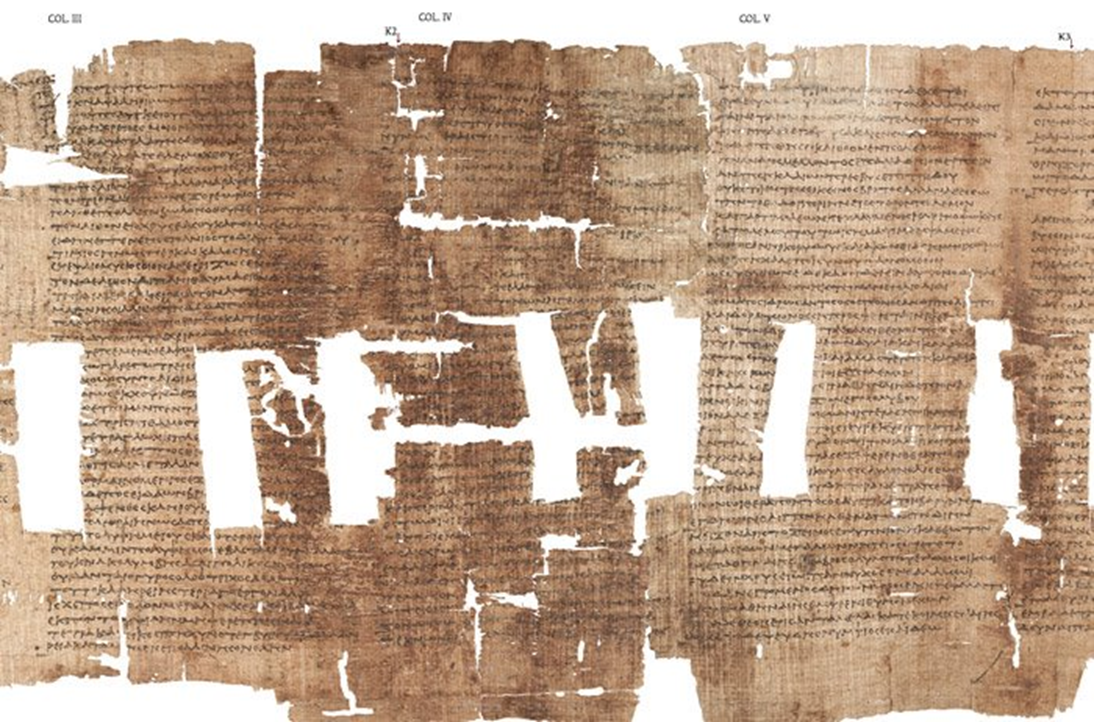
The Milan Papyrus
When was it discovered and when does it date to?
Discovered in the 1990s through discolvign mummy cartonage (an ancient version of paper mache)
Late 3rd–early 2nd century BCE. Dissolved from mummy cartonage and sold on the European market in 1992 to the University of Milan.
What does the book roll preserve?
The book roll preserves around 112 complete and fragmentary epigrams, two of which are attributed to Posidippos of Pella by later authors. Shows emergence of Alexandrian tradition. Poems organised by topic.
When was Posidippos of Pella active?
Posidippos of Pella was active only slightly before the papyrus was created (310–240 BCE), making the papyrus a near-contemporary witness to his work.
What does this raise questions about?
Raises a number of questions about attribution, the quasi-illegal trade of papyri, and the ethics of mummy cartonage dissolution.
Identify this:
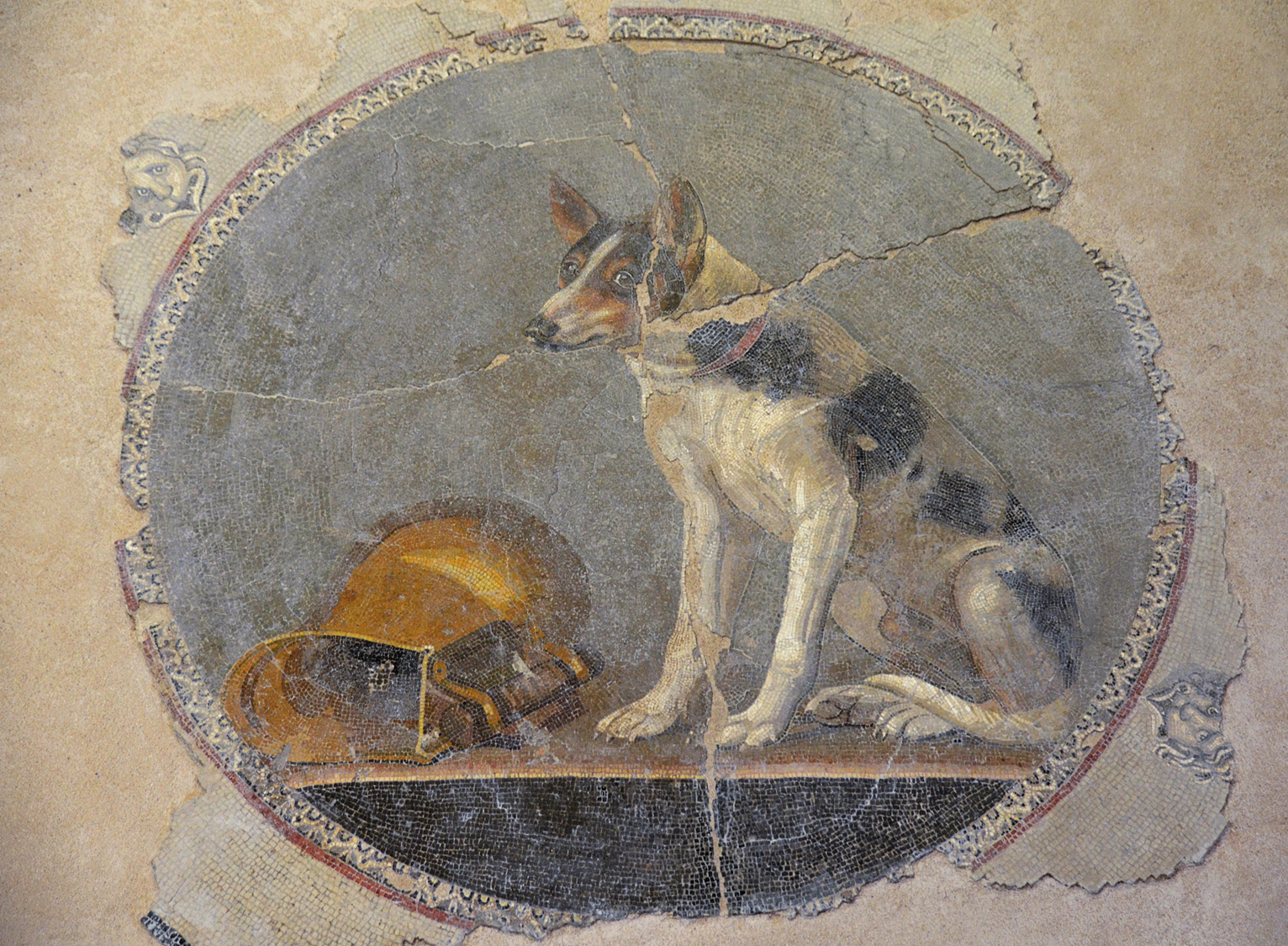
Mischievous Dog Mosaic
2nd century BCE.
3.25 x 3.25 metres preserved.
Dog shown in three-quarter profile with bronze jug lying on its side.
Opus vermiculatum = Use of darker halo effect to foreground subjects.
Highest quality mosaic work indicative of high status household.
Discovered in 1994 during excavations for the construction of the new Library of Alexandria.
Mosaic discovered in the Royal district and likely would have decorated an elite residence or even palace.
An attempt to remove the central panel was made in antiquity but was apparently abandoned when the mosaic split in half.
Shows that mosaics were valued as art.
The Fayoum Oasis:
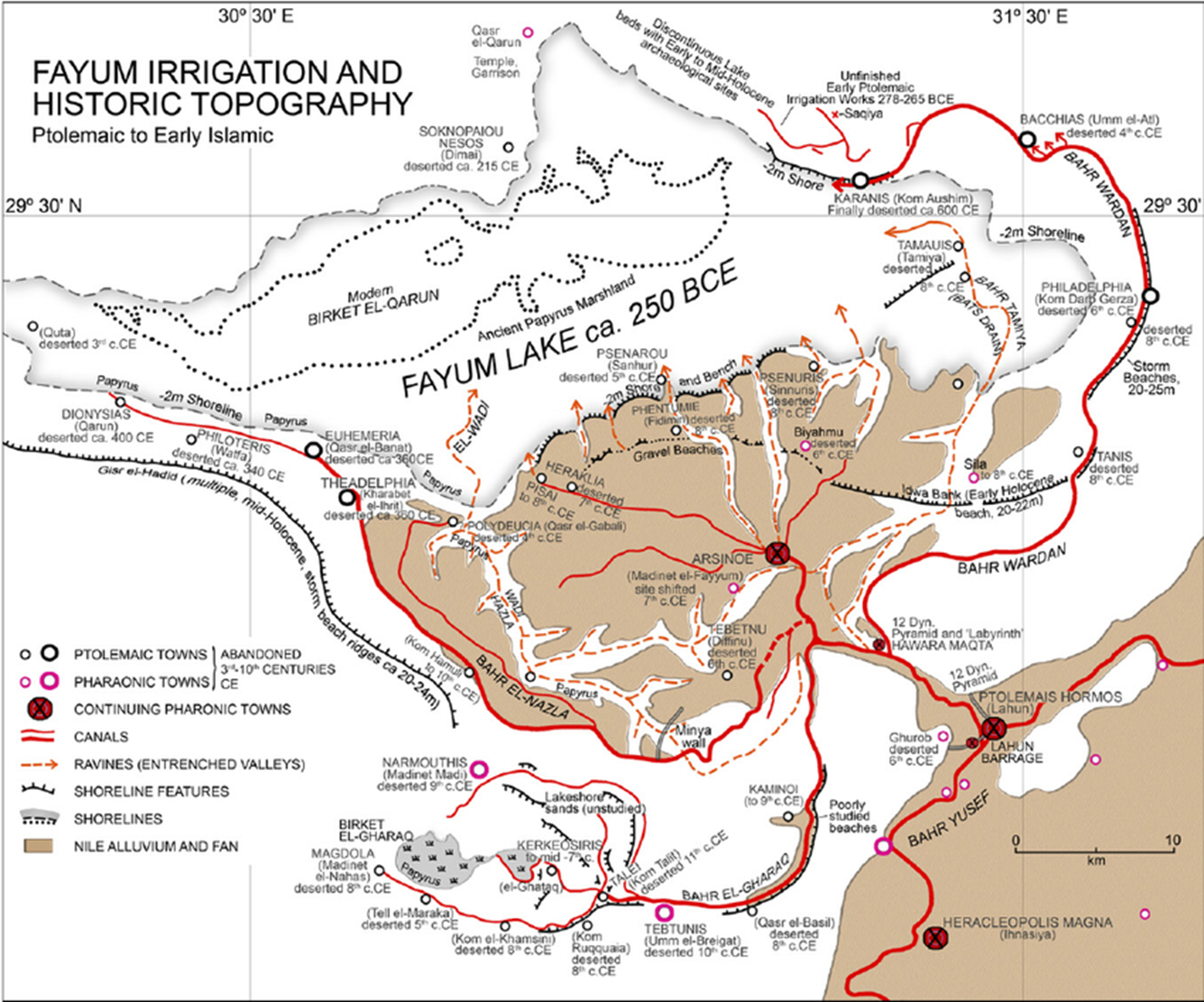
Under the Ptolemies, the canal network was extended significantly transforming desert land into arable farmland.
This created new plots of land (cleruchies) that could be awarded to Greek and Macedonian soldiers in exchange for military service.
Migrants brought new crops with them including new strains of durum wheat that quickly replaced Egyptian emmer wheat.
Emphasis on Mediterranean triad of olive, grape, and wheat.
What are cleruchies?
Cleruchies were a specialized type of colony used by Athens in classical Greece, where citizens settled in foreign territories (e.g., Andros, Naxos, Samos) while retaining their Athenian citizenship
Explain the Cleruchies of Ptolemaic Egypt
Earliest cleruchies (sing. cleruchy, Gk. κλῆρος) founded by Ptolemy I but significant land offerings seem to have been delayed until the reign of Ptolemy II, when draining of the Fayoum and canal works in the Delta allowed for new plots to be offered.
Theocritus, Idylls 14.57–59:
“I wish your hopes were coming to pass, Aeschinas; but if you really think you should go abroad, Ptolemy (II) does pay a free man very well indeed.”
How did the Ptolemies use grain as a political commodity?
The ptolemies used grain as part of their political strategy, it allowed them to gain the good will of people in contested or conquered parts of the mediterranean region
Write out three texts that show grain as a political commodity used by the Ptolemies
Honours for Zenon, commander of the Ptolemaic fleet (IG II3 1 863: 286 BCE):
“Epicharmos son of Kallistratides of Kolonai proposed: since Zenon, put in command of the transport ships by king Ptolemaios (Ptolemy I), continues to be of good will to the People collectively and takes care individually of each Athenian with whom he comes into contact, both saying and doing whatever good he can on behalf of the city, and takes care of the delivery of grain to the People so that it is delivered with maximum security, making common cause for the preservation of the People…”
Honours for Kallias of Sphettos (IG II3 1 911: 270 BCE):
“…Kallias set sail himself at his own expense for Cyprus, and meeting with the king (Ptolemy II) there, with love of honour on behalf of the People he delivered to the People fifty talents of silver and twenty thousand medimnoi of wheat as a gift which was measured out on Delos to those despatched by the People.”
Polybius 5.89.1–2 (After a major earthquake on Rhodes in 227 BCE):
“Then too Ptolemy (III) offered them three hundred talents of silver; a million medimnoi of grain; ship timber for ten quinqueremes and ten triremes, consisting of forty thousand cubits of squared pine planking; a thousand talents of bronze coinage; three thousand talents of rope; three thousand pieces of sail cloth; three thousand talents for the repair of the Colossus (of Rhodes); a hundred master builders with three hundred and fifty workmen, and fourteen talents yearly to pay their wages. Besides this he gave twelve thousand medimnoi of grain for their public games and sacrifices, and twenty thousand medimnoi for outfitting ten triremes.”
Who is Zenon of Kaunos?
Lived during the middle of the 3rd century BCE.
A native of the Greek town of Kaunos in Asia Minor.
Where did Zenon live and what did he do?
He lived in the village of Philadelphia on the edge of the Faiyum in Egypt and became a private secretary and estate manager for Apollonius, the finance minister to Ptolemy II Philadelphus and Ptolemy III Euergetes.
What was Zenons personal archive and what information do we gain from it?
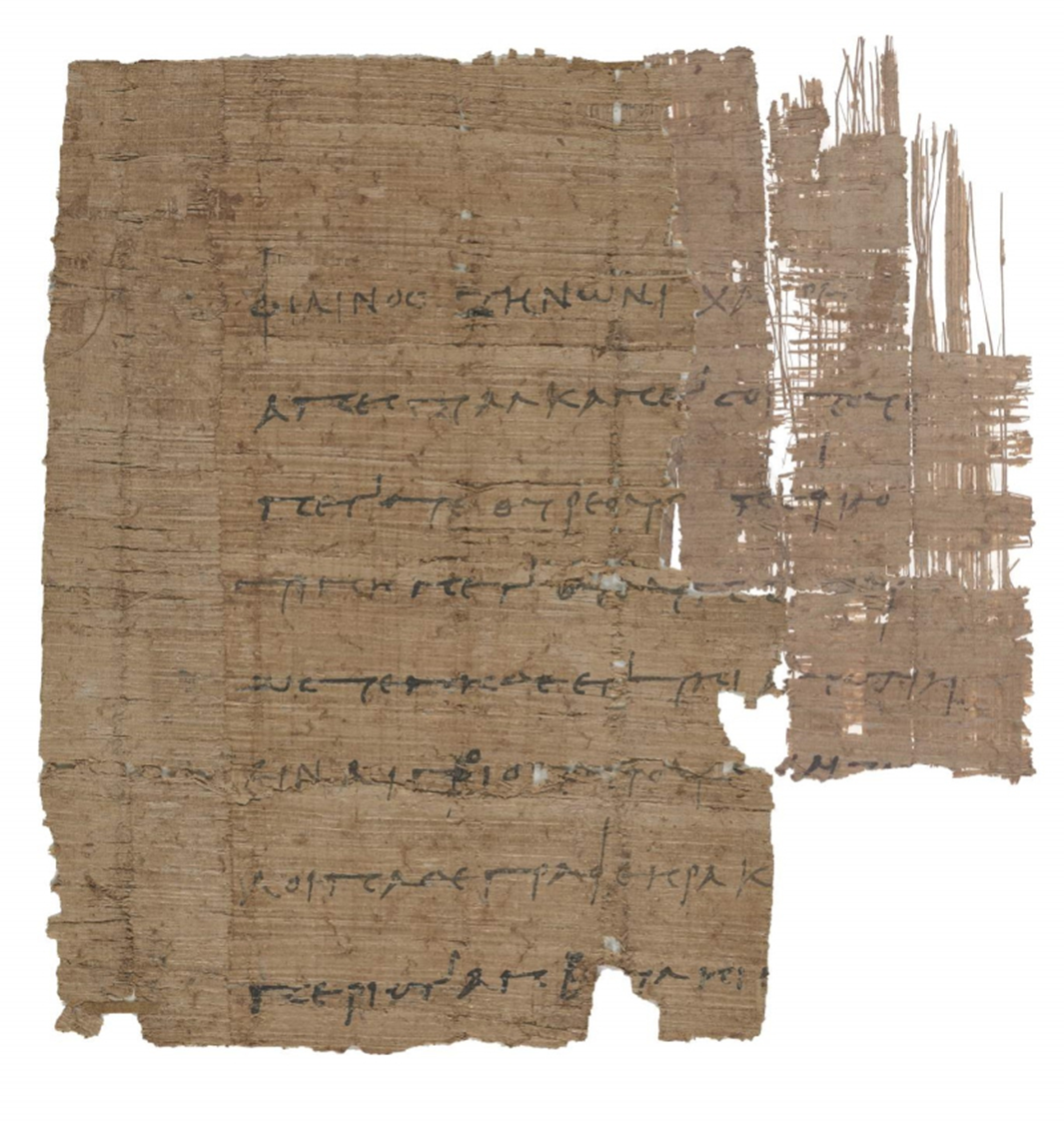
Through his extensive personal archive, discovered by local farmers in 1914–1915, we have a huge amount of information about the Fayoum and its local elites during the reigns of Ptolemy II and III.
The archive was sold off in batches to various collections but approximately 2,084 documents (per Trimegistos) can be attributed to the original find. The texts cover the period from 261–229 BCE.
What is the totoes archive?
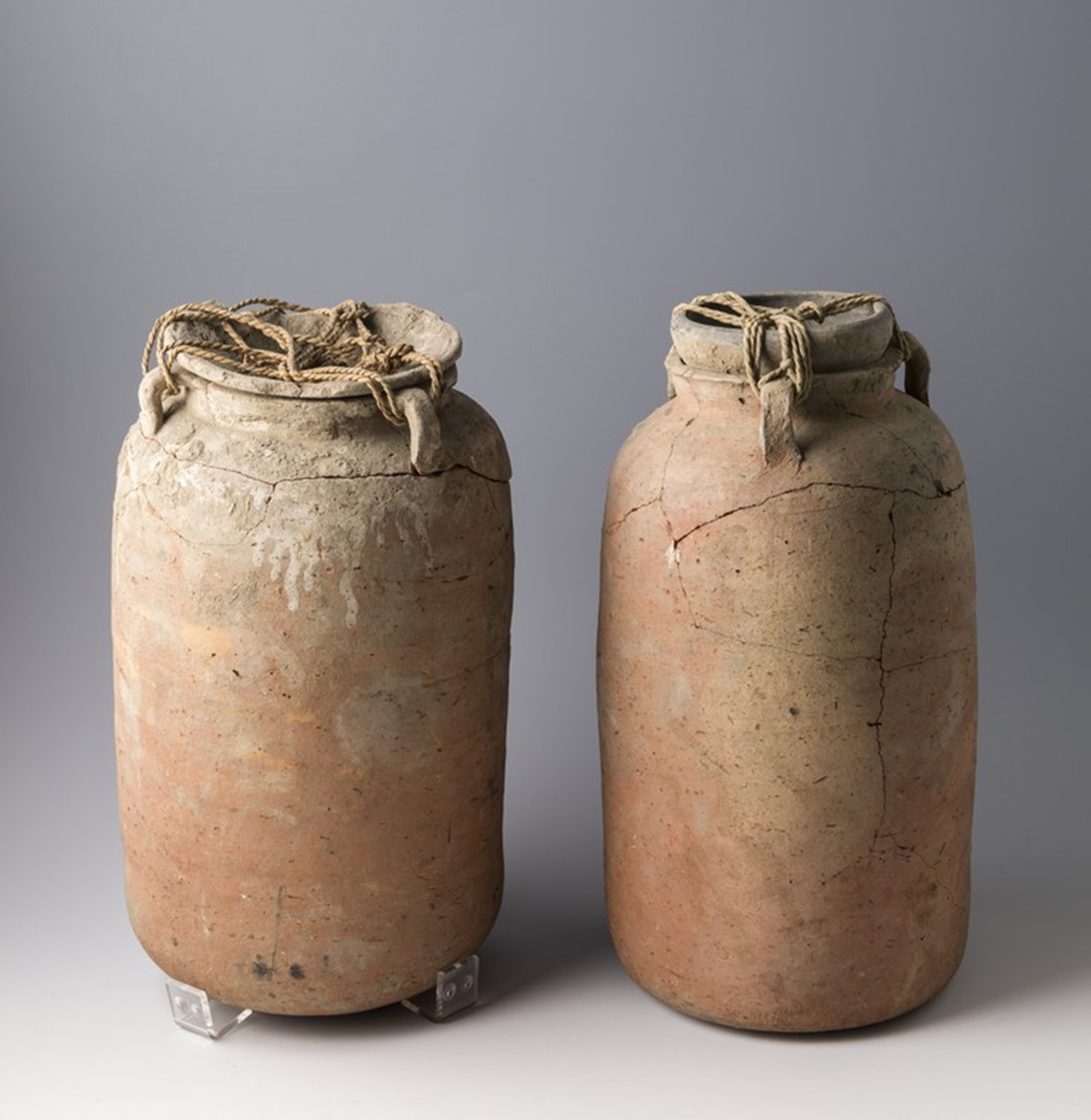
Rare example of a sealed archive found in its architectural setting. Large archives such as Zeno’s would have filled many jars and their organization would be of great interest for understanding archive management. 189-100 BCE
When and where was the totoes archive excavated from?
Excavated in 1905 from a household adjacent to the Temple of Hathor at Deir el-Medina. Because the archive is of Totoes, the high priest of Hathor, it is presumed that this was his house (or an heir to his estate).
What does the totoes archive attest to?
Attests to the bilingual culture of Ptolemaic Egypt (documents in both Demotic and Greek).
What is this notice and where is it from?
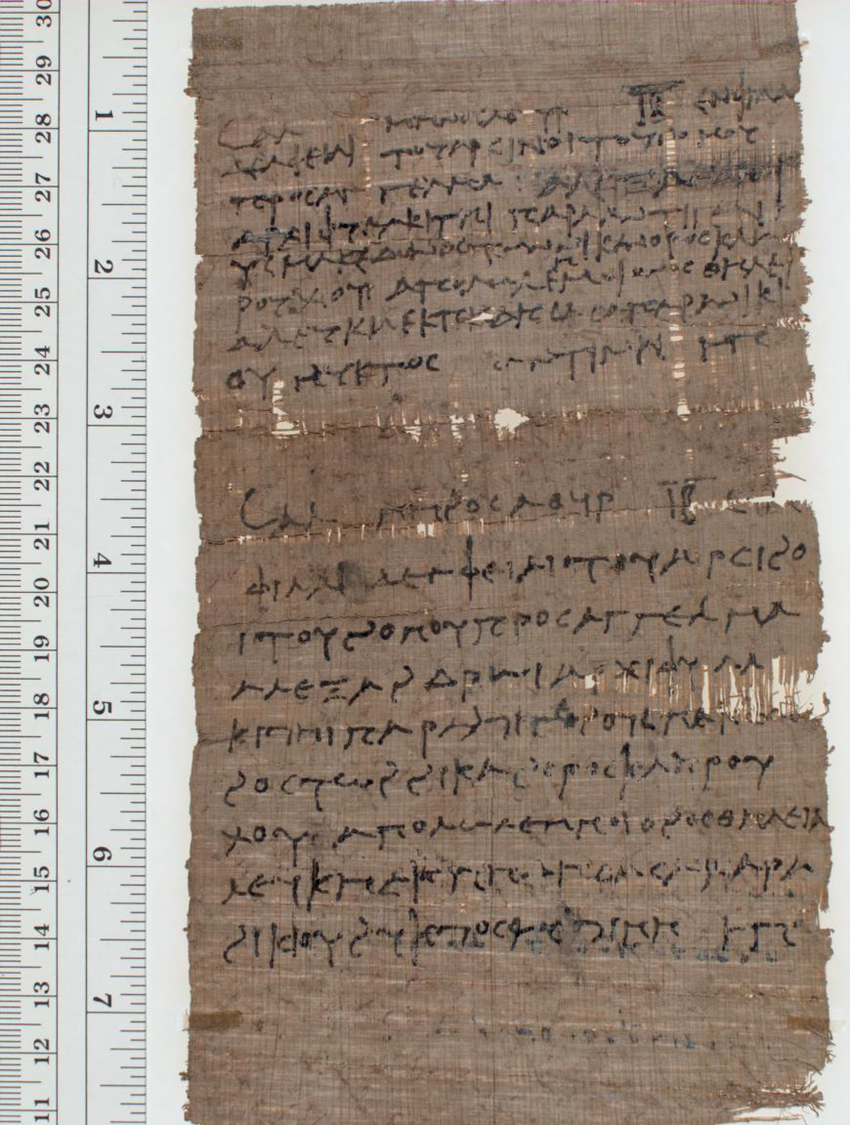
Notice of a lost donkey
Part of Zenon’s archive.
What does the notice say?
“Year 31, Hathor 12 (January 5, 254 BCE) in Philadelphia of the Arsinoite Nome. A notification to Alexandros, chief policeman, from Antigenes, a Macedonian, of the troop of Nikanor, cleruch. I have lost a white female donkey, which escaped from Nikias by night, of which the value is 80 drachmas.”
Why are documents like this important for us today?
Documents such as this create a rich picture of Ptolemaic bureaucracy in action.
Important information can be gleaned about taxation, demography, marriage patterns, integration of Greek and non-Greeks in veteran colonies, etc.
What is the Oxyrhynchus Papyri
Excavated by Bernard P. Grenfell and Arthur S. Hunt from 1897– 1907.
In that time they recovered more than 500,000 papyri fragments now mostly housed in Sackler Library at Oxford.
Only about 10% literary texts. The rest consist of paraliterary (lists, commentaries,school exercises, etc.) or documentary texts.
Identify this coin:
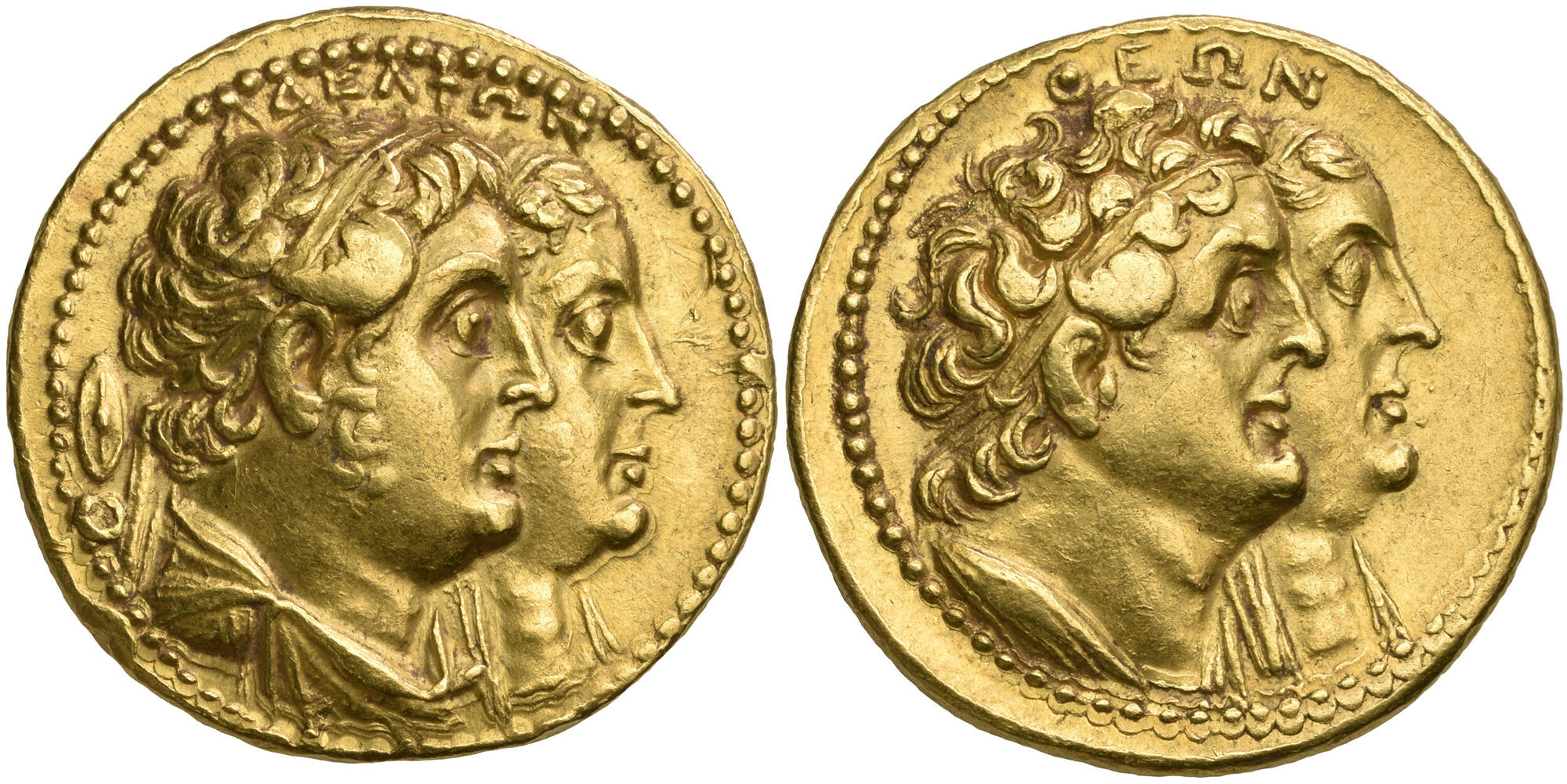
Coin of the Adelphoi Theoi issued by Ptolemy II and Arsinoe II (270s BCE)
The Theoi Adelphoi (Greek: Θεοὶ Ἀδελφοί, "Sibling Gods" or "Brother-Sister Gods") refers to the divine cult title adopted by the Ptolemaic rulers of Egypt, specifically Ptolemy II Philadelphus and his wife (and sister) Arsinoe II
Did Ptolemaic women have more independence?
Macedonian women always had a higher degree of autonomy then women in classical Athenian society- this is a through line into the ptolemaic period as well
What was a development that bolstered the role of royal women in society?
A major development that bolstered the role of royal women in society was their billing as a child of a god, there is coinage from Ptoelmaic II where hima nd his sister are described as the divine children- this title was adopted for them because in the 270s Ptolemy II proclaimed his father Ptolemy I to be a god and created a festival in his honour.- This was not unusual in an Egyptian context
What is Evidence for the festival that ptoelmy II made?
The Faience Oinochoe
Identify this object:
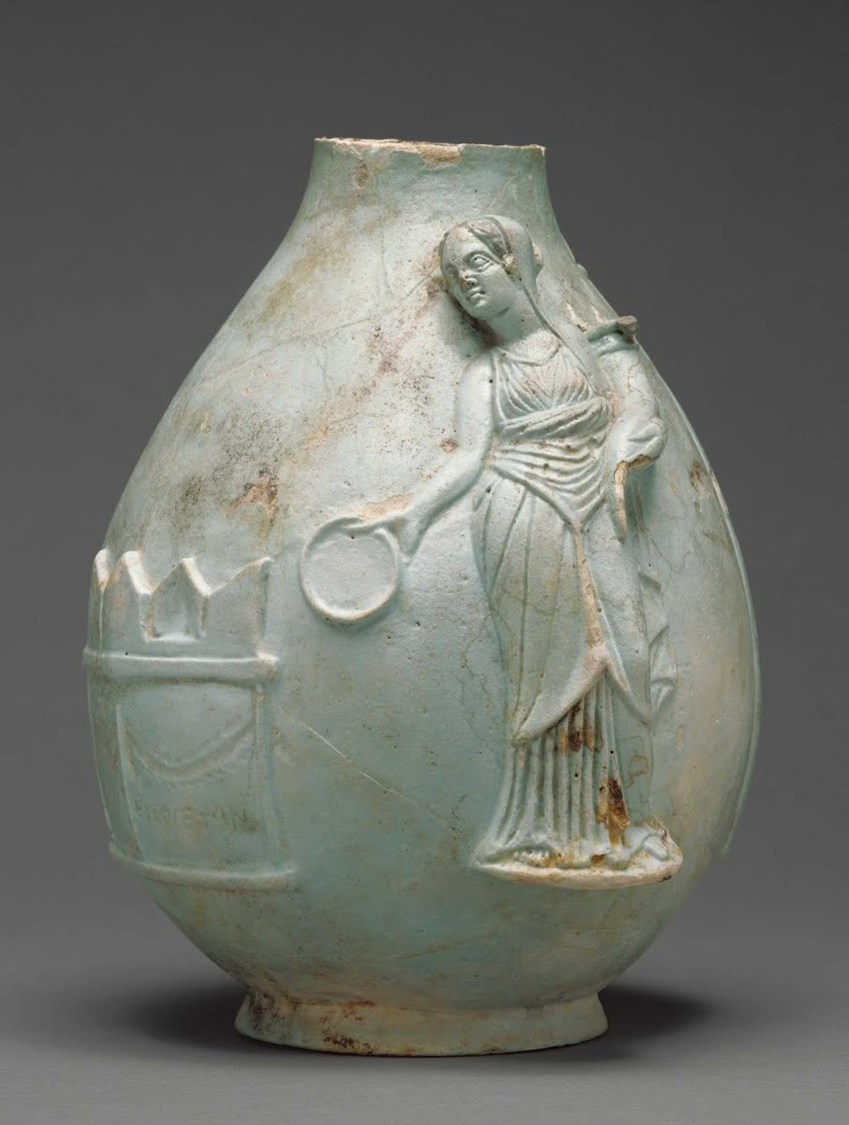
The Faience Oinochoe
Analyse this oinochoe (who does it depict, Egyptian or Greek?)
Possibly depicts Berenike II. Inscription on altar reads: "To the good fortune of Queen Berenike."
Faience was a traditional Egyptian material for offering vessels, but the oinochoe shape, the subject matter, and the style of the depiction are Greek.
Oinochoai such as this appear to have been produced for use in the Ptolemaic ruler cults linked to the celebration of the Ptolemaia (founded by Ptolemy II in 278 BCE).
Where do we see female Ptolemaic victories attested in ancient sources?
Elite women competed in the Olympic games, they competed through equestrian events not physical events where they would have to be there, but by sponsoring equestrian teams where the prize goes to the owner/the sponsor rather than the horses or athletes
This was not just the women of the royal bloodline
List these women
Berenike I (Perhaps won a chariot competition in 284 BCE?)
Berenike II (participated in Olympics and presumably won, but we do not know when; was definitely victorious at Nemea and celebrated by one of Callimachus’ fragmentary epinician poems)
Arsinoë II (She won all three chariot events in 272 BCE)
Bilistiche (268 BCE in polikon tethrippon (four-foal chariot race); 264 BCE polikon synoris (two-foal chariot race)
Berenike Syra (She competed in Nemean, Isthmian, and Olympic competitions; Olympic victory should likely be placed around 256 BCE)
Write out Posidippos Epigram 78: (For Berenike Syra)
“Recount, all poets, my glory, if [ever it pleases you]
to tell of what is known, as my renown [is ancient];
for with the chariot my forefather [Ptolemy] won
driving his horses through Pisa's [stadium],
and Berenike, my father's mother. With the chariot again
my father scored victory, a king descended from a king,
named after his father. And in a single competition
Arsinoe scored all three victories for harnessed races;
Now I, the virgin [queen, revered] above all women,
[order] that my father's holy family [be called divine].
These victories from a single house Olympia beheld
children's children victors with their chariots.
Her crown for the victorious four-horse chariot,
sing, Macedonians, for your queen Berenike”
What is evidence of Egypt as a multi-cultural society?
There is evidence for this from literary documents- Bilingual letter from Ptolemaios to Achilles. This demonstrates the presence of bilingual officials within ptoelmaic administration.
Suggests that both the writer and recipient were native Egyptian speakers
Shows the persistence of Egyptian cultural traditions (emphasis placed on dreams)
Write out and date this bilingual letter:
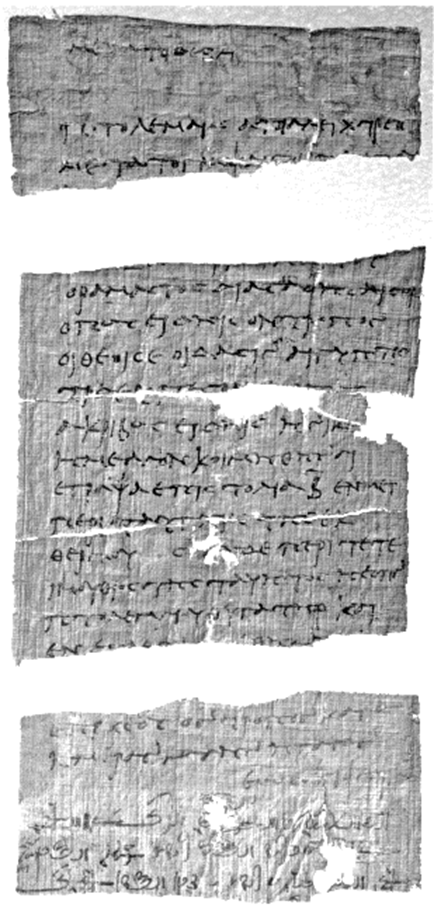
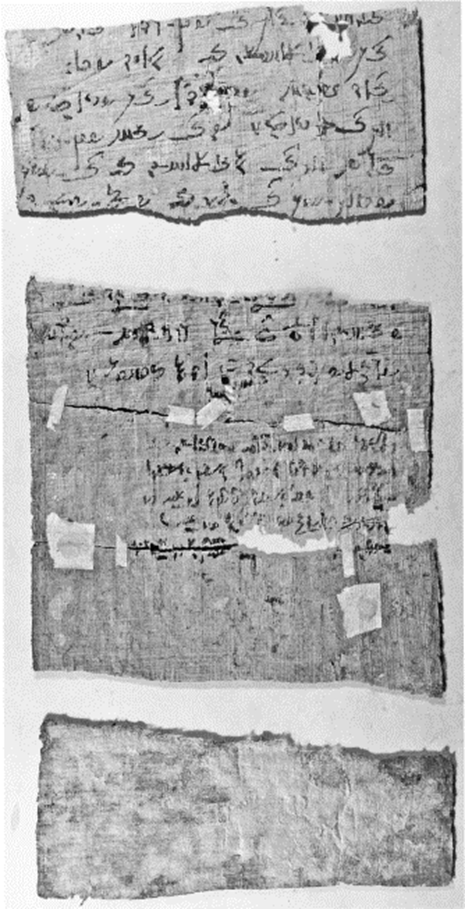
Bilingual letter from Ptolemaios to Achilles (Cairo Mus. Inv. Nos. 30961, 10328, 10313):
Ca. 221 BCE.
“After having received (?) (a letter from you),
Ptolemaios gives Achilles greetings. After having written to you concerning the…[gap in papyrus]... it also (?) seemed good to me that I should fully inform you about my dream, so that you will know in what way the gods know you. I have written below in Egyptian so that you will know precisely…” (trans. G. Renberg and F. Naether)
Demonstrates the presence of bilingual officials within Ptolemaic administration.
Suggests that both the writer and recipient were native Egyptian speakers.
Shows the persistence of Egyptian cultural traditions (emphasis placed on dreams).