BIOS 1163: Speech Physics
 Call Kai
 Learn
Learn Practice Test
 Spaced Repetition
 Match
Match Flashcards
 Knowt Play
1/60

There's no tags or description
Looks like no tags are added yet.
Name | Mastery | Learn | Test | Matching | Spaced | Call with Kai |
|---|
No analytics yet
Send a link to your students to track their progress
61 Terms
what is voice in physic terms?
sound wave generated by vibration of the vocal cords
sound waves require what 2 things? what must molecules in the second part have?
Vibrating Element: which is immersed in a conducting medium
Conducting Medium: the material which through the sound waves propagate >> mostly gas, then liquid or solid
Molecules in a conducting medium must have:
Elasticity: allows the medium to resist deformation + generate a restoring force that returns it to its equilibrium. This causes the medium to vibrate > key in the transmission of sound waves
Mass: required for energy transfer > one mass collides with another = transfer of energy > propagation of sound over distance
what is a vibration?
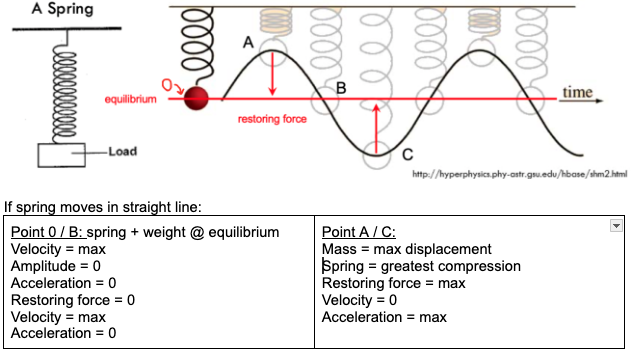
oscillatory motion about an equilibrium position
Occur naturally when a particle (physical system) is displaced from its equilibrium > restoring forces act to return it back
Restoring force: directed towards equilibrium, ↑ with displacement
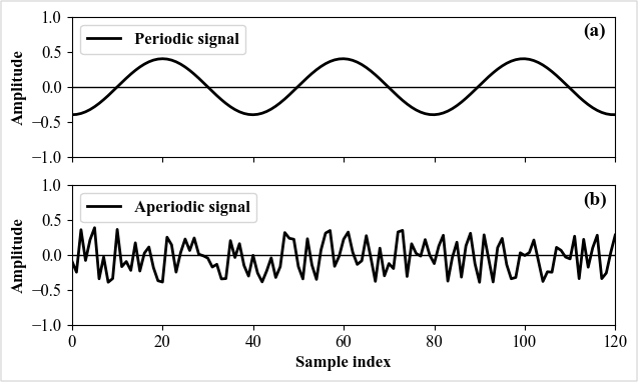
what is the difference between periodic and aperiodic waves?
Periodic Vibrations | Aperiodic Vibrations |
Regular + repeating in time
| Irregular + non-repeating
|
Vowels | Many consonant sounds
|
what is sound?
Series of pressure changes that our ear can detect
how do humans produce sound waves?
Air pressure system to produce air flow → respiratory system = exhaling places the conducting medium (air) into the sound tract
Vibrating element → vocal folds = modify the flow of air by vibrating / creating vibrations in the surround air
Resonating system → vocal tract (incl. Larynx, pharynx, oral cavity + nasal cavity) = resonates + shapes sound waves
what is simple harmonic motion?
) type of periodic motion where an object moves back and forth about an equilibrium position under a restoring force that is directly proportional to its displacement
F = -kx
produces a sinusoidal waveform
Pure tones (e.g single musical note) are produced by SHM
what is displacement?
Distance of object from its equilibrium position (in metres)
what is amplitude?
Maximum displacement (metres)
Greater amplitude = loudness
energy of vibration =
Energy of a vibration = amplitude2
what is wavelength?
Distance b/w successive crests of a wave (metres) = cycle length
what is the period?
The time for 1 completed vibration (or cycle, in seconds)
Not dependent on amplitude, only dependent on physical properties = mass + stiffness
Measured from one crest to another / or 1 trough to another
what is frequency? and its link to pitch? and how the humans make it?
Number of completed vibrations in one second → measured in cycles / second (Hz)
Frequency = reciprocal of the period: F = 1/T
Determines the pitch: directly proportional
Low frequency = low pitch
High frequency = high pitch
Vocal folds wiggle 100 times / sec > produce puffs of air with frequency of 100 beats / sec (Hz)
Additional motions of the vocal folds (e.g collisions with each other) create additional frequencies – harmonics at 200Hz, 300Hz …
what is velocity?
Speed at which the disturbance travels through the medium / speed at which the sound wave travels in the air
V = distance / time
For a wave: one wavelength (distance) / one period (T)
V = λ / T, f = 1/T hence: v = fλ
V = wave velocity (ms-1)
F = frequency (Hz)
λ = wavelength (m)
what happens to sound as it travels through different mediums?
Velocity of sound is the same for all frequencies in one medium
Once a sound wave is produced, the frequency / pitch does not change as it travels through different media
HOWEVER, the speed of sound (velocity) + wavelength in that medium will change
E.g v sound of a rock = 5100ms-1
what are factors that influence sound wave velocity? for all solids / gases / liquid mediums
Elasticity (rigidity): ↑ elasticity (or stiffness), faster the wave propagates
Density (mass): ↑ density, slower the wave velocity
If medium is:
Solid: faster speed
Liquid: intermediate speed
Gases: slower speed
If the Medium is Gaseous: velocity of sound is affected by temperature + humidity
NOT affected by pressure:

Temperature: ↑ Temp = ↑ elasticity, ↓ density = ↑ velocity
Increases by ~0.6ms-1 for each 1oC increased
Humidity: ↑ humidity = ↓ air density = ↑ velocity of sound
Density = mass / volume
Humidity is water vapour → mass of water < mass of air ∴ humidity reduces air density
how do humans hear sounds?
Pressure reaches our ear
cause the ear drum (tympanic membrane) to vibrate
vibrations transmitted through middle ear bones > to cochlea (inner ear)
In the cochlea: basilar membrane carries hair cells > different regions of this membrane move in response to different f(x)
The movement bends hair cells in that region > stimulates the attached auditory nerve fibres
Different neurons are activated = perceive pitches
define harmonics / resonance / timbre / pitch
Harmonics | Sinusoidal waves where that is related to a fundamental frequency (f) as an integer multiple = 2f, 3f etc. |
Resonance | The quality of a sound being full / reverberating
|
Timbre | quality, "color," or texture of a sound that allows the ear to distinguish between two sounds with the same pitch and loudness |
Pitch | the perceptual quality of a sound that allows us to classify it as "high" or "low." |
what is natural frequency?
the frequency at which an object naturally vibrates without any external influence
All objects have a natural tendency to oscillate when particles are displaced from their equilibrium position
E.g just pushing a child on a swing normally, after it reaches its amplitude
Natural Vibrations in the Human Body:
Head or Neck: ~ 30Hz
Eyeball: ~ 80Hz
Vocal Folds: ~ 125Hz (male), ~ 210Hz (female), ~>300 Hz (child)
what influences natural frequency?
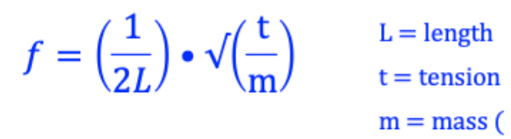
Determinants of Natural Frequency: determined by mass / restoring forces → stiffness / tension / length
Longer an object = lower the fundamental frequency
Greater the mass = lower the fundamental frequency
More stiff / tense an object = higher the fundamental frequency
what are some examples of natural frequency ?
Guitar String: longer string = lower f, thicker string = lower f, tighter string = higher f
Tuning Fork: the vibrating tines generate a sound wave
Longer tines = lower f, greater mass = lower f
Flute: the longer the air column = lower f
what is forced vibrations?
(Def.) external periodic force drives the object = causes oscillation at the frequency of the applied force rather than its natural frequency
E.g you move the bars of the swing by yourself
explain based on the driving frequency and the natural frequency when an energy transfer is efficient?
If driving f goes further from natural f → energy transfer is inefficient + oscillations are small
If driving f comes closer to natural f → energy transfer increases + amplitude becomes larger
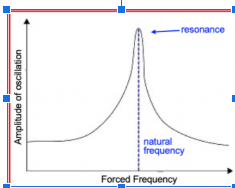
If driving f = natural f→ maximum energy transfer = RESONANCE
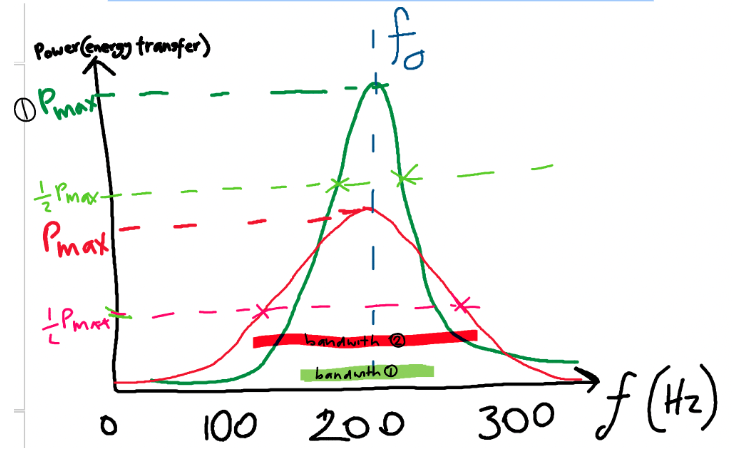
looking at a frequency-response curve, what is the natural frequency? what is its shape? its bandwidth?
What is the natural frequency in the system (f0)
What is its shape?
Narrow peak = responds strongly to a specific frequency
Wide peak = responds to a broader range of frequencies
Bandwidth: how selective a resonant system is
Large bandwidth = not good for clear enunciated sounds
To calculate: find peak power, half it draw line there / Find points of intersection with graph = draw lines down = gives the range of the bandwidth / bandwidth = biggest - smallest
what is resonance?
occurs when an object vibrates in response to an applied periodic force whose frequency = object’s natural frequencies
Most vibrating systems have multiple resonant frequencies
When driven by complex / random vibrations → objects tend to vibrate at the resonant f >> acts as a filter
Resonance > produces very large oscillations when energy is continuously added at the right f
E.g the Tacoma Bridge > the wind was continuously blowing > the oscillations of the bridge increased
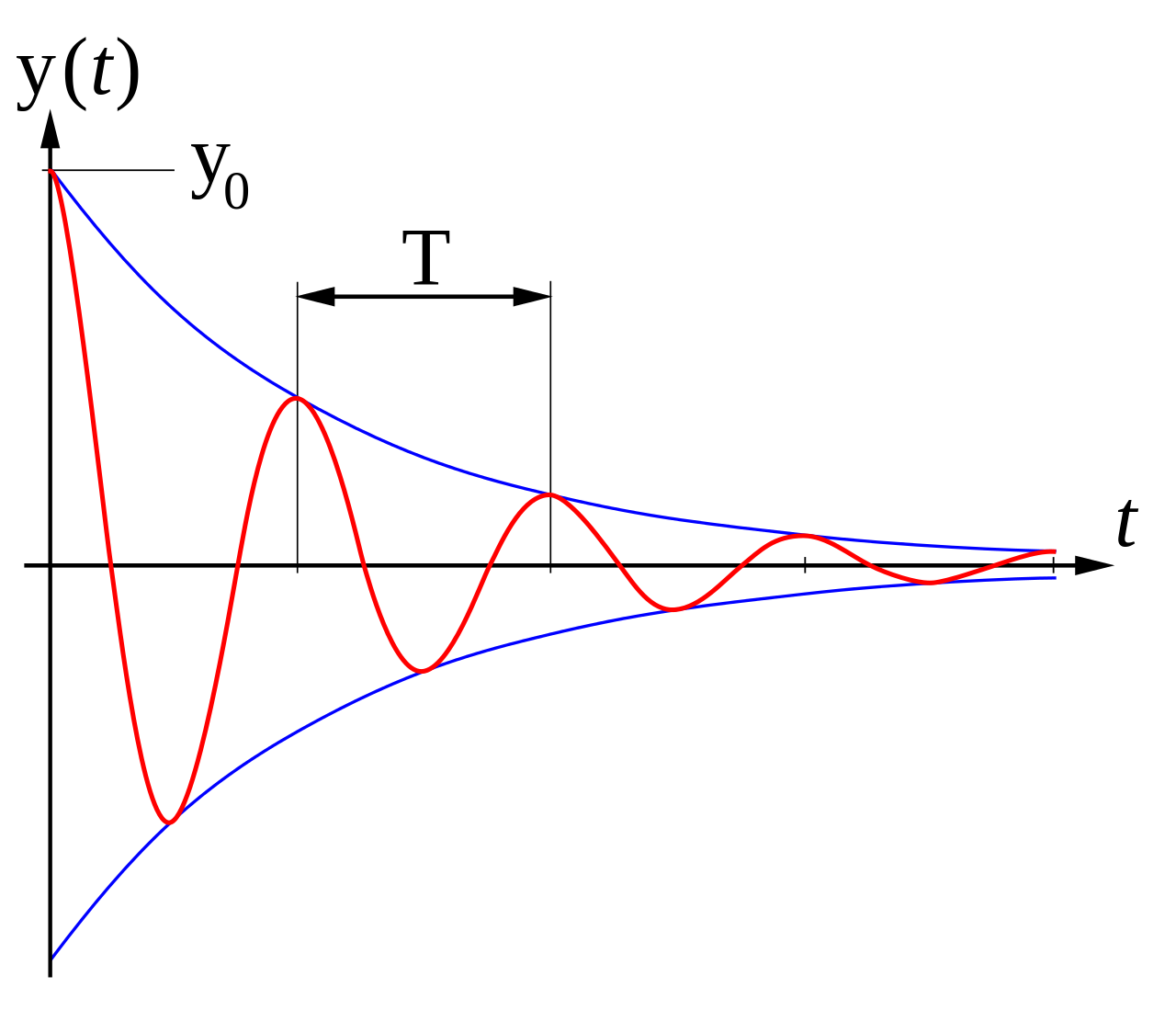
what is damping? what is the damping effect in air and water? is the period affected? what is affected?
energy is removed from a vibrating system (like frictional effects) = causes oscillations to decrease in amplitudes
Makes f less sharp + more broad
In sound amplitude = loudness
The period is NOT affected = the frequency + pitch of a sound wave will not change
In the air = relatively low friction = damping is low
In water = higher friction = damping is greater
what is superposition of a wave? and its 2 resultant waves?
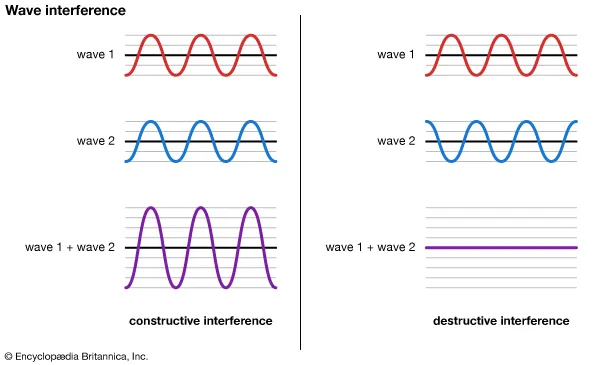
when 2 or more waves meet, their displacements combine to form a new wave
The resulting wave = sum of individual waves
Resultant Wave:
Constructive Interference: Waves add together = larger amplitude
Destructive Interference: Waves cancel = smaller / zero amplitude
How noise cancelling headphones work
what is a beat?
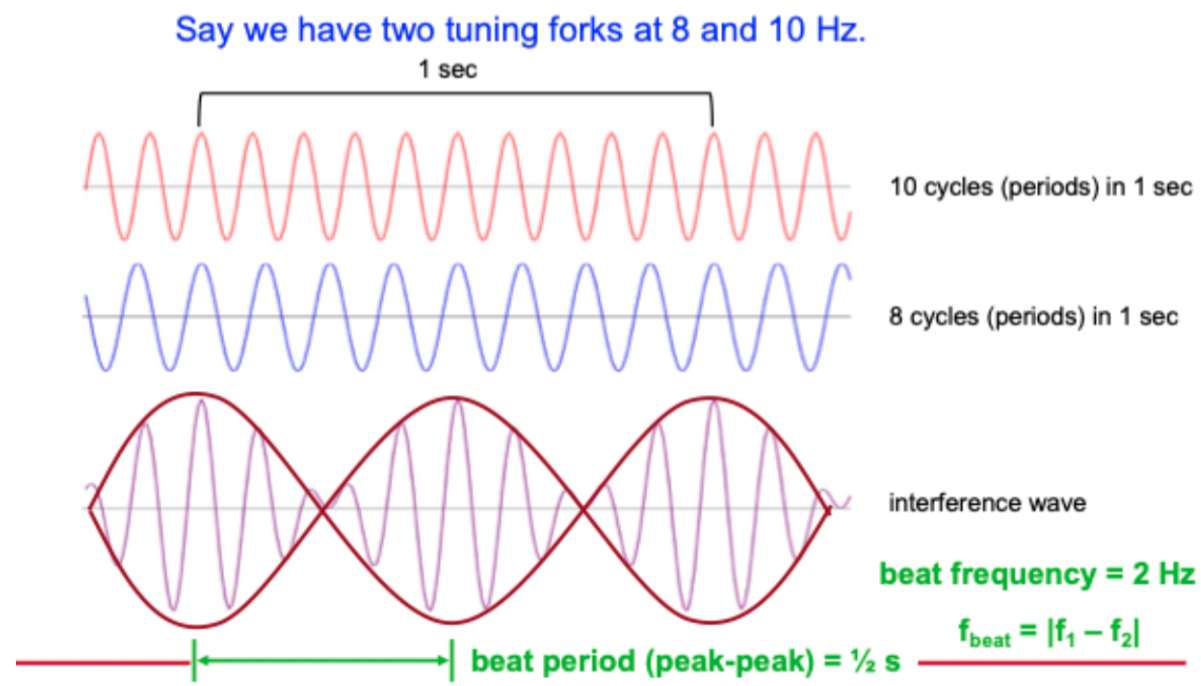
Occurs when 2 sound waves of slightly different f combine = produces an interference wave whose amplitude varies over time = characteristic pulsing / throbbing sound
what is a progressive wave?
Moves through a medium, transfers energy from one place to another continuously |
All particles oscillate with same amplitude and frequency |
Pressure waves travel through the air > In a perfect case, it would continue for ever
|
what happens if a progressive wave encounters a boundary?
@ Boundary: wave encounters a boundary = part (or all) of the wave is reflected.
Produces two waves in the medium: incident (travelling towards) and reflected wave
These waves move in opposite directions
pass through each other = they superpose = regions of constructive and destructive interference.
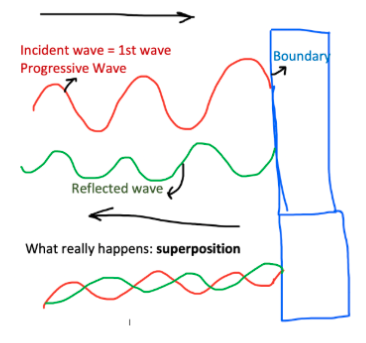
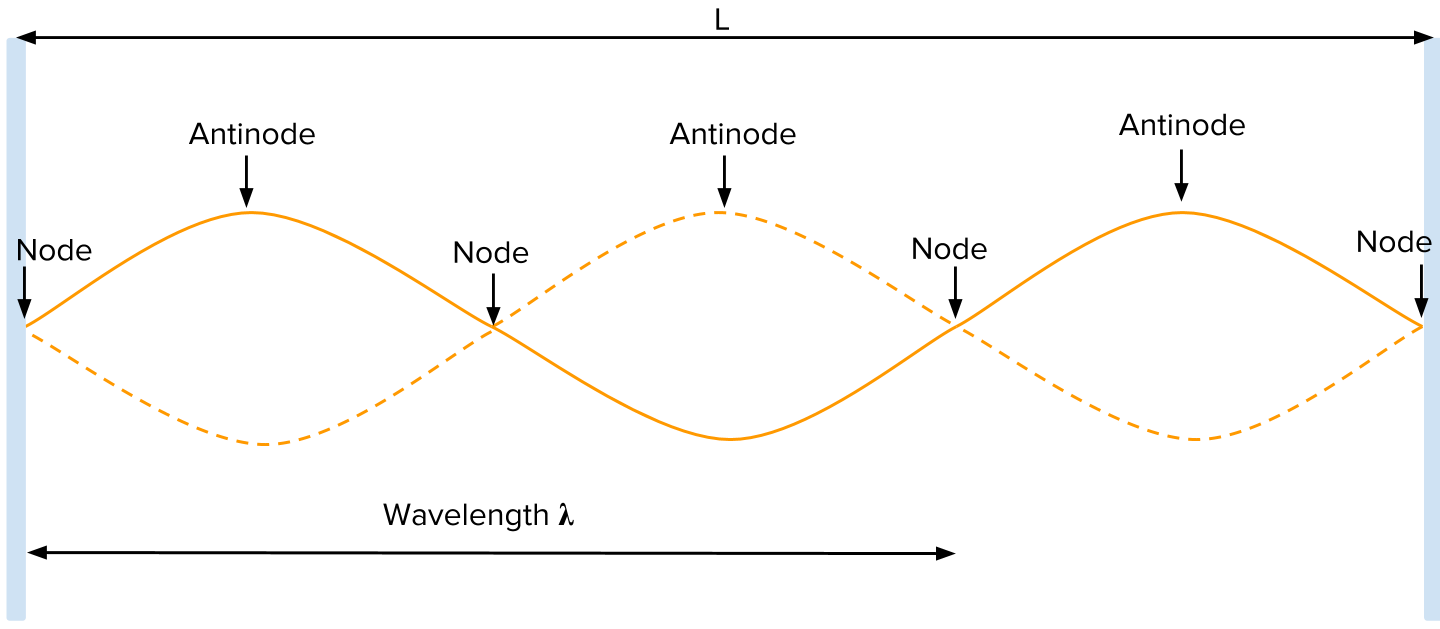
what is a standing wave? how is it formed? what are the particles doing? what frequencies are needed? how is each standing wave measured in terms of wavelength?
Standing Wave |
Remains confined, storing energy without transferring it forward
|
Particles oscillate with different amplitudes, same frequency
|
For a standing wave to occur:
|
what are transverse waves?
Molecules in the wave move at right angles to (or across) the direction of the wave (BASICALLy move up and down)
Medium must be able to support sideways force & transfer this energy to neighbouring molecules
possible in solid objects
Possible on the surface of liquids
NOT possible in gases
what are longitudinal waves?
what sound waves are
molecules oscillate in the same direction to the wave’s direction of travel (sideways)
Forms regions of compression and rarefaction
ALL solids, liquids and gases have these properties