4 - capacitor
 Call Kai
 Learn
Learn Practice Test
 Spaced Repetition
 Match
Match Flashcards
 Knowt Play
1/14

There's no tags or description
Looks like no tags are added yet.
Name | Mastery | Learn | Test | Matching | Spaced | Call with Kai |
|---|
No analytics yet
Send a link to your students to track their progress
15 Terms
give the formula for capacitance across plates
C = q/V [F]
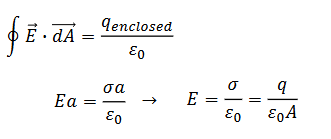
calculate E of plate capacitor
choose Gaussian cylinder with top touching (+) plate and bottom in air
=> flux through upper surface = 0
=> flux through side = 0 (E is parallel)
=> flux through lower surface = “formula“
*σ is charge per WHOLE area A
*a is cylinder area
*dA points down - always take from inside to outside
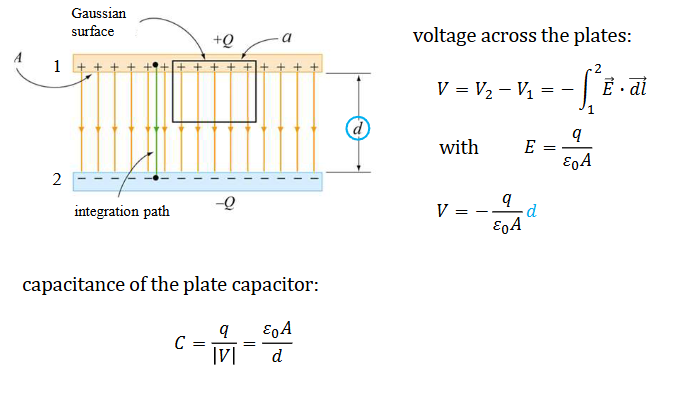
calculate V and hence C of plate capacitor
V = - qd / ε0 A
C = ε0 A/d => smaller distance between plates makes larger capacitance
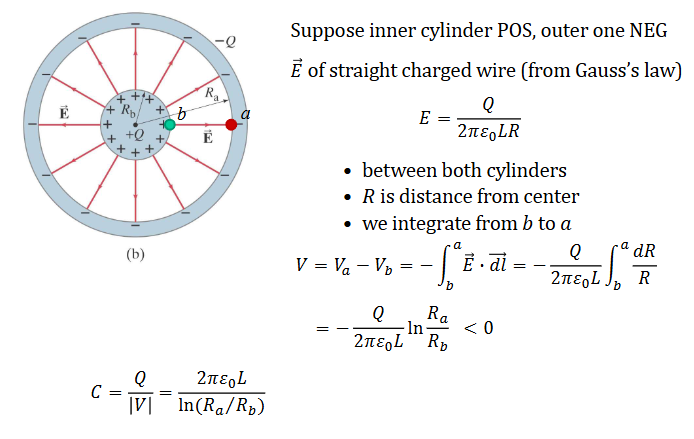
calculate E hence V hence C for cylindrical capacitor
=> E of straight wire from Gauss where L is wire length and R is wire radius
what is q and what is V for capacitors in parallel - what is the total capacitance then
q1 and q2 but V is SAME
C = C1 + C2
what is q and what is V for capacitors in series - what is the total capacitance then
V1 and V2 but q is SAME
1/C = 1/C1 + 1/C2
what is current between two capacitors in series
I = 0: In DC circuit, when the capacitors are fully charged, they act like an open circuit. Because no more charge moves through the system, the current drops to zero
how does work play into capacitors
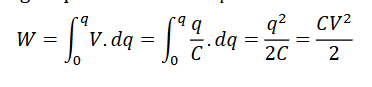
capacitors store energy = work done to get net charge on the two plates
give the total work to charge capacitor from 0 to q
what is energy density given total work to charge a capacitor from 0 to q
w ~ E2
w = [J/m3]
![<p>w ~ E<sup>2</sup> </p><p>w = [J/m<sup>3</sup>]</p>](https://assets.knowt.com/user-attachments/4e93c587-6aad-4c13-af69-746b57c63bbc.png)
define dielectric
an insulator that transfer an electric field without electric conduction
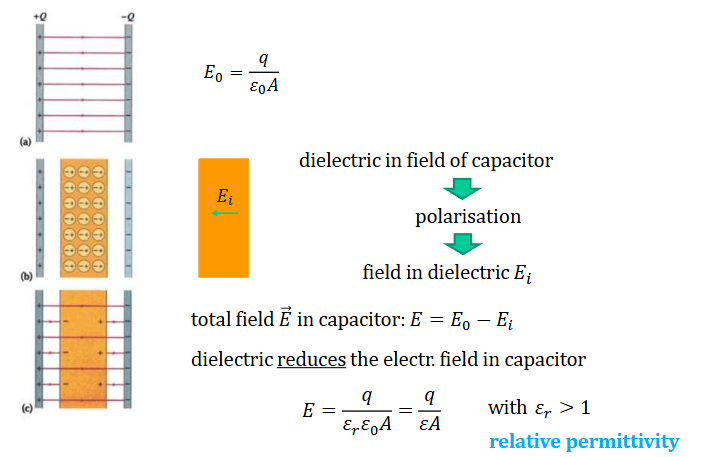
what happens when put a dielectric in an E field?
E induces a macroscopic dipole
polarisation: the molecules align with each side taking a polarity while whole remains neutral
what happens to the electric field when there is a dielectric?
dielectric reduces the E field in the capacitor by εr : when polarisation occurs, it makes its own field Ei that opposes the initial Eo
what happens to the capacitance when there is a dielectric?
C becomes εr times larger since C= q/V = q / Ed
define dielectric field strangth
max field strength without dielectric breaking down = becoming a conductor