Community Structure in Space:Biodiversity
 Call Kai
 Learn
Learn Practice Test
 Spaced Repetition
 Match
Match Flashcards
 Knowt Play
1/17

There's no tags or description
Looks like no tags are added yet.
Name | Mastery | Learn | Test | Matching | Spaced | Call with Kai |
|---|
No analytics yet
Send a link to your students to track their progress
18 Terms
What are the 6 factors that act jointly to enhance and maintain species richness in communities?
Ambient energy hypothesis, temperature water and solar energy, Evolutionary speed hypothesis. Interspefic interaction
What is biodiversity?
The number of species in a community or region, which may be weighted by their relative abundance, used as a umbrellla concept for total biological diversity.
What is species richness?
The number of species present
What is heterogeneity?
Combines both species richness with relative abundance (add evenness)
What is the Sequential Niche breakage hypothesis?
Log-normal distribution
Assume that a community has a set of total niche requirements, which enables us to define a communal niche space. This space can be likened to a unit mass that is sequentially split up by various component species such as that each fragment denotes relative species abundance
The most abundant for a particular niche are usually the ones with the bigger impact (Big red ants (fire ants)
What are the series of simplifying assumptions in the Neutral Theory of Biodiversity?
(Hubbell 2001)Theory for biodiversity based off of chance
!. All species are assumed to be ecologically equivalent
Species arise at random when an individual mutates and becomes a new species
As individuals die, they are replaced by offspring of another at random
Communities are saturated with species in equilibrium
What are good examples of a complex gradient in regards to Species divinity patterns of North America
North south gradient(pocket gophers, shrews and ungulates) are most diverse in temperate zone and becomes less diverse towards the tropics.
Topographic relief- Rocky Mountains and Appalachians support a higher than average number of mammal species (Elevation shift for more habitats and niches)
East-west trends
Fronts of abrupt change- areas of rapid change in species diversity are often associated with mountain ranges ( Western US and East side is a rainshadow)
Peninsular lows: Florida, Baja California, Alaska Peninsula,Nova Scotia
What are Hotspots?
How species specificate (Barriers and seperate)
Measure used to define a hotspots is the number of endemic species that it contains because of its isolation
What is a umbrella species?
One species or group of species that serves as a guide to many other groups of species that are less well known or less studied (Madagascar-Lemurs )
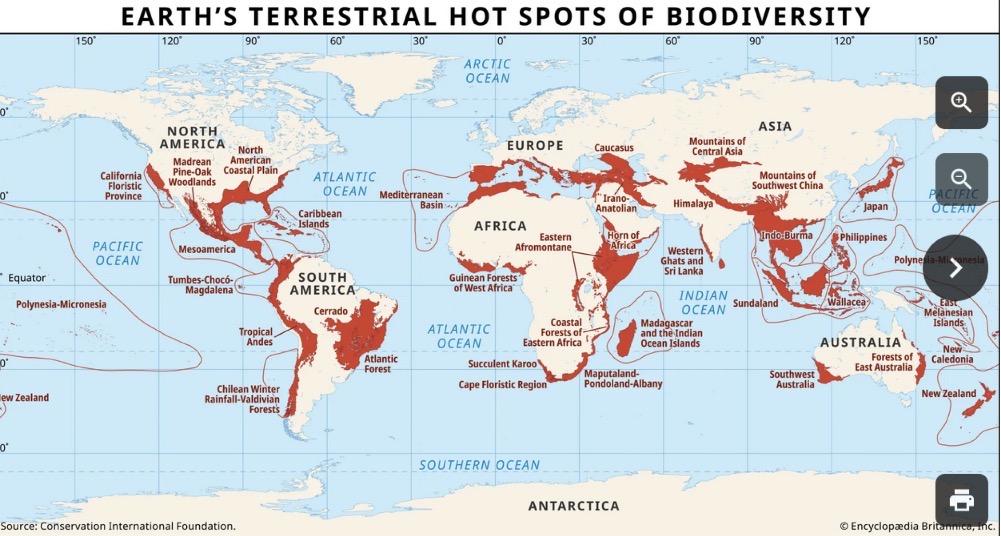
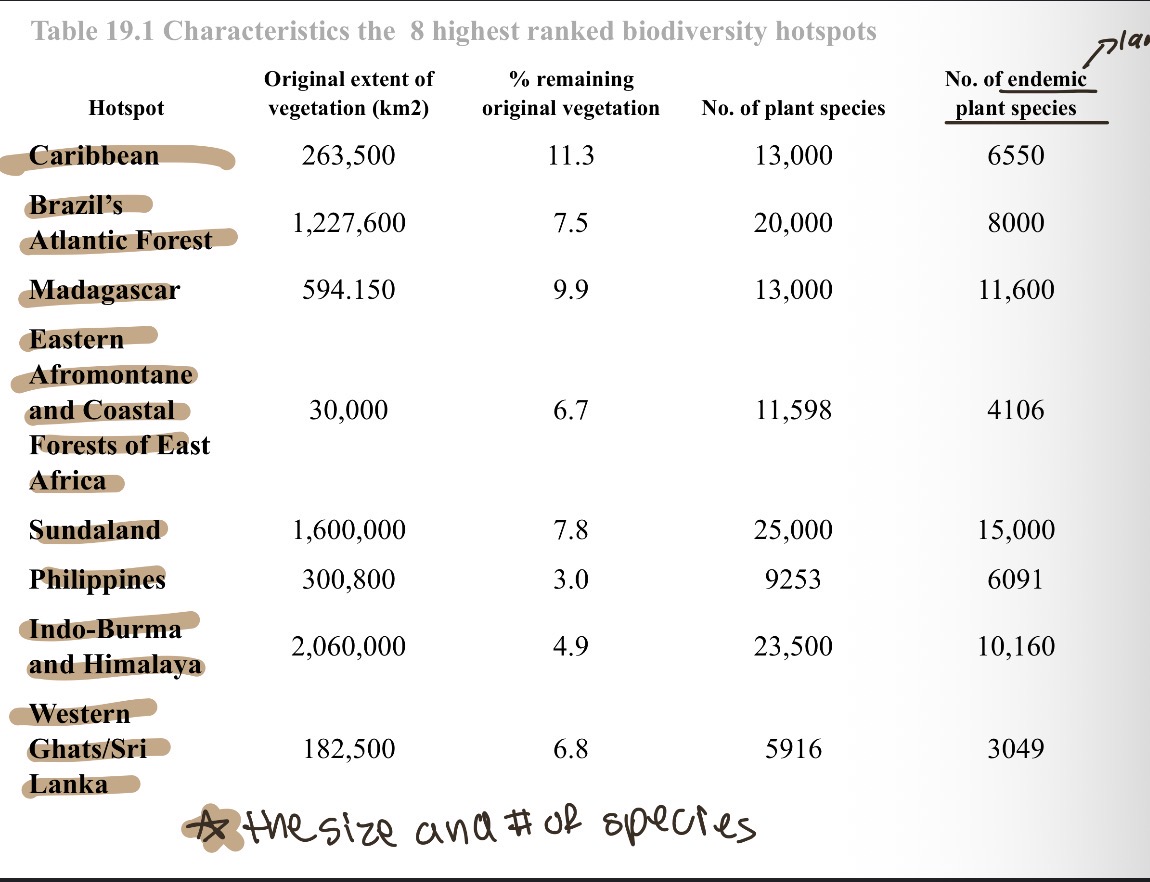
Study this chart.
This chart is now studied.
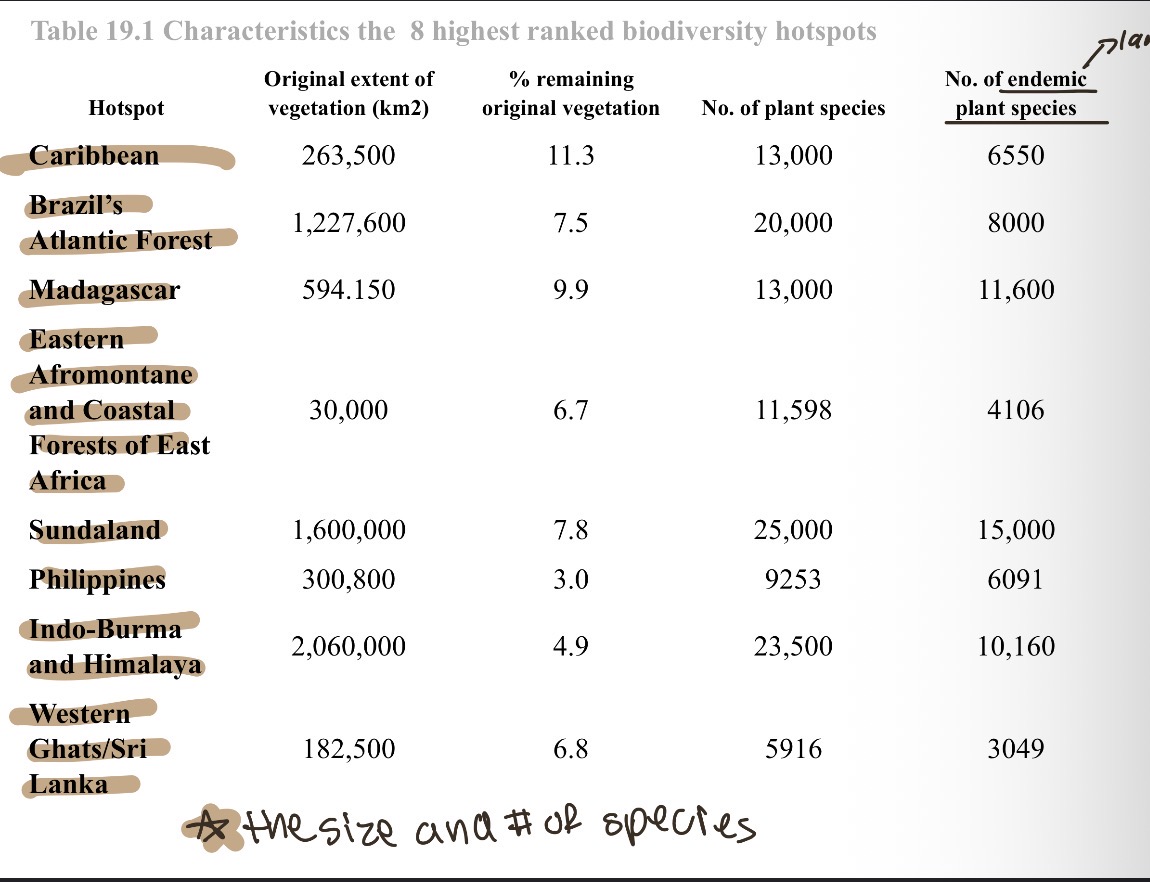
What are the 6 factors that cause diversity gradients
1.Evolutionary speed- more time and more rapid evolution permits the evolutionary of new species
Geographic area-Large areas and physical or biologically complex habitats furnish more niches
Interspecific interactions-competition affects niche partitioning
4. Ambient energy- fewer species can tolerate climatically unfavorable conditions
Productivity- Richness is limited by partitioning of production of energy among species
Disturbance- moderate disturbance overcomes completive exclusions
What is the evolutionary seed hypothesis?
Idea that history affects diversity via evolutionary speeds, proposed chiefly by zoogeographers and paleontology
Biotas in warm humid tropics are likely to evolve and divsierfy more rapidly than those in temperate and polar regions because of constant favorable environments and relative freedoms
Biotic diveristy is a product of evolution and therefore is mire dependent in the length of time through which the developed in a uninterrupted fashion
What is the difference between older communities and younger ones.
All communities overtime diversify, and the difference is that older communities have more species than younger ones it changes and gets more diverse
What are the two general hypothesis with different explanations for diversity gradient?
Either competition is keener in the tropics, compared to more polar ecosystems.
Second is that the Predataion is stronger in the tropics, so there is less competition and species can coexist in tropical communities.
What are the two niche measurements that are critical in diversity gradients?
Niche breadth- refers to the resources used or tolerated by an individual,population and species
Niche overlap- Which different species share the same core niche in terms of resource use
What is the ambient energy hypothesis?
States that energy availability generates and maintains species richness gradients.
British birds, South American raptorial birds, and vertebrates butterflies for North America and Europe
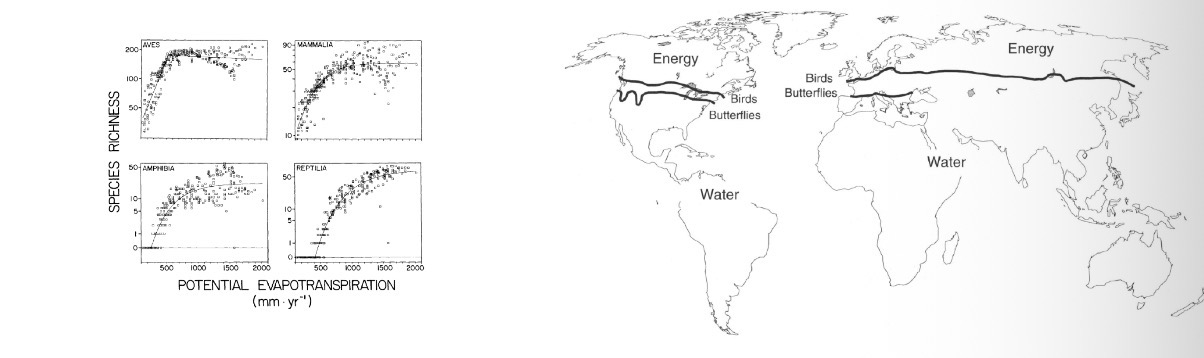
What is the Productivity hypothesis?
States that greater production results in greater diversity, everything else is equal
(Does not support the diversity gradient)
What is the intermediate disturbance hypothesis?
If population growths are low for all members of a community, the competitive equilibrium is approached so slowly that is is never reached
Species diversity is maintained by periodic disturbance or by environmental fluctuations