Topic 2- The Standard Trade Model
 Call Kai
 Learn
Learn Practice Test
 Spaced Repetition
 Match
Match Flashcards
 Knowt Play
1/14

There's no tags or description
Looks like no tags are added yet.
Name | Mastery | Learn | Test | Matching | Spaced | Call with Kai |
|---|
No analytics yet
Send a link to your students to track their progress
15 Terms
What is the Standard Trade Model?
A general model of trade showing that if relative prices of goods differ between countries in autarky, both countries can gain by trading at any relative price in between their autarky prices. It applies to any source of comparative advantage.
What are the two key assumptions about Relative Demand and Relative Supply in the model?
Relative Demand (Dc/Df): tastes are identical across countries.
Relative Supply (Sc/Sf): HC has comparative advantage in Clothing, FC has comparative advantage in Food — so HC's relative supply of Clothing is higher than FC's at any given price.
What is autarky?
A situation where a country does not trade at all and is entirely self-sufficient.
In autarky, each country's relative goods price is determined solely by its own supply and demand.
Autarky prices differ between countries, which is what creates the incentive to trade.
What is the basic proposition about gains from trade?
If relative prices differ between countries in autarky, both countries can gain by trading at any world relative price that lies between the two autarky prices.
(Pc/Pf)HC < (Pc/Pf)Trade < (Pc/Pf)FC.
What does the PPF show and what is its slope?
The Production Possibilities Frontier shows all combinations of Clothing and Food a country can produce given its technology and factor endowments.
Its slope is the opportunity cost of producing more Clothing in terms of Food sacrificed
(∆QC → ∇QF).
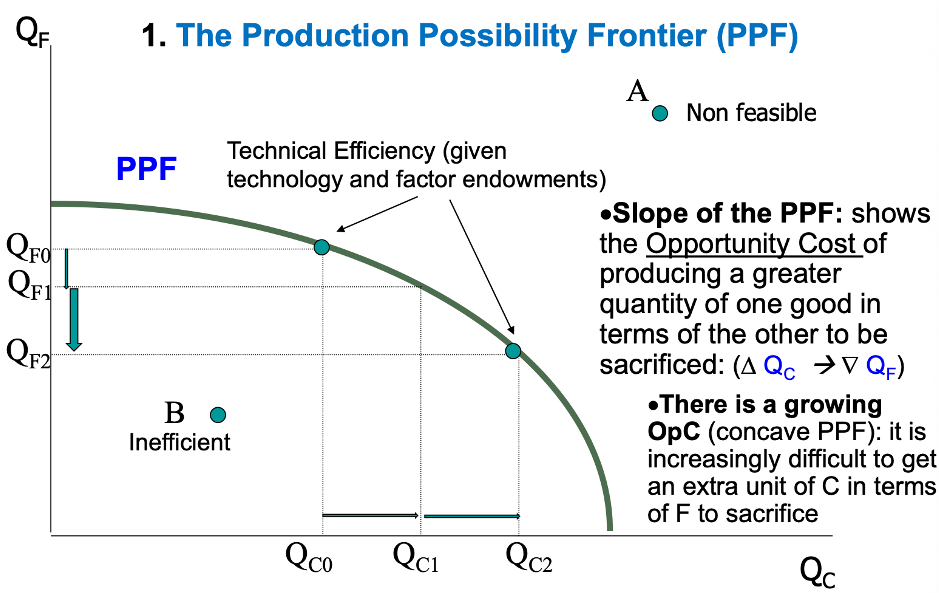
Why is the PPF concave (bowed outward)?
Because opportunity costs are increasing.
It becomes increasingly costly to produce more of one good.
Each extra unit of Clothing requires sacrificing more and more Food, because resources are not equally suited to both goods.
What are isovalue lines and what is their slope?
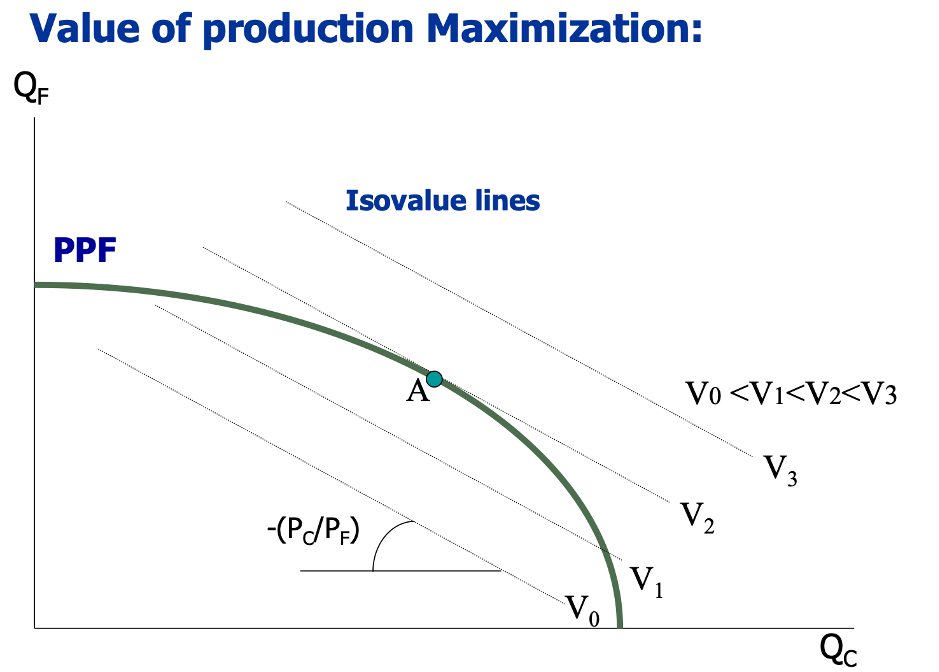
Isovalue lines show all combinations of QC and QF that give the same total value of production V = PF×QF + PC×QC
They are straight lines with slope = -(PC/PF).
Higher isovalue lines (further from origin) represent greater value of production.
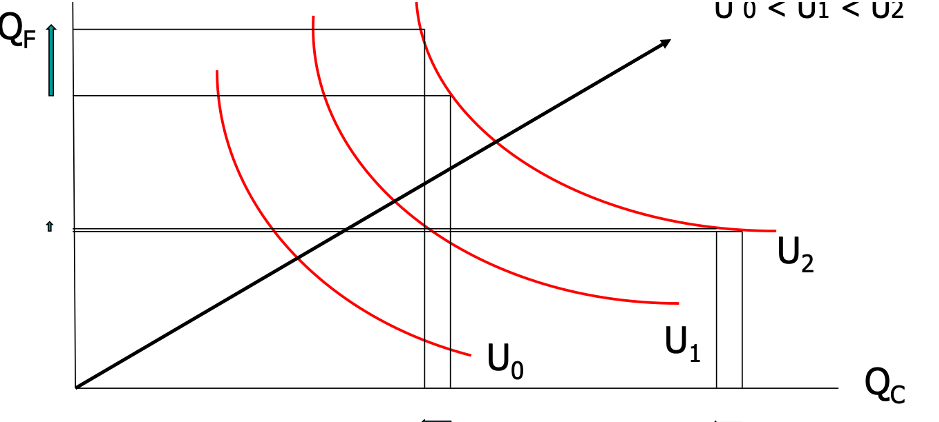
What are indifference curves and what are their properties?
Indifference curves show all bundles of goods giving the same level of utility.
Properties:
(1) Curves further from the origin give higher utility.
(2) Negative slope- less of one good must be compensated with more of the other.
(3) Convex- the less you have of a good, the more of the other you need to compensate for losing one unit.
What happens in autarky — where are the production and consumption points?
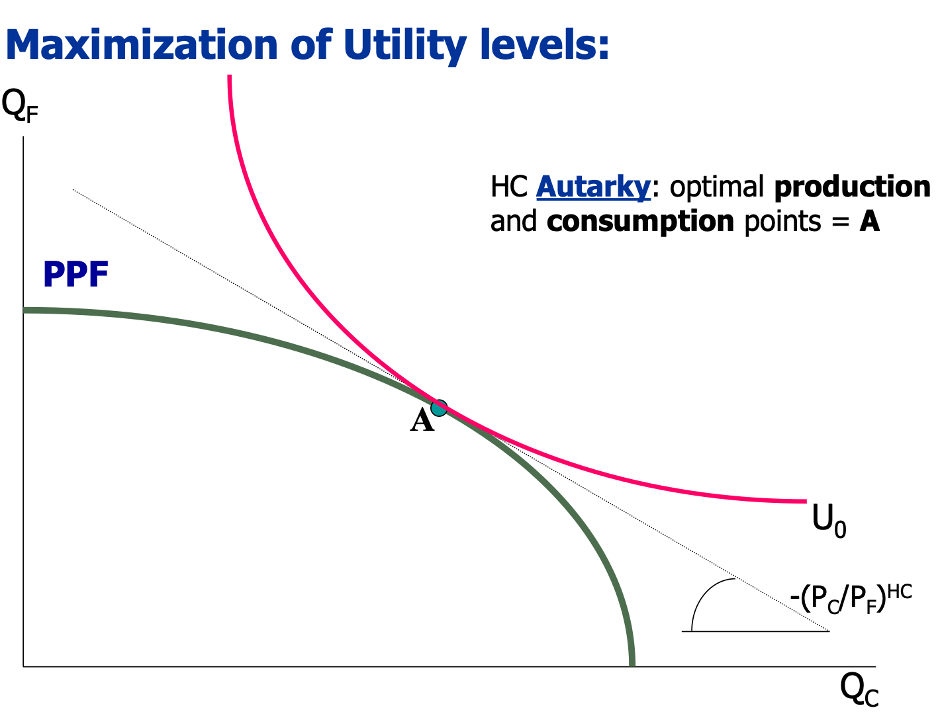
In autarky, the production point and the consumption point are the same (point A).
The country consumes exactly what it produces.
The autarky price ratio (PC/PF)HC is the slope of the isovalue line tangent to the PPF at A.
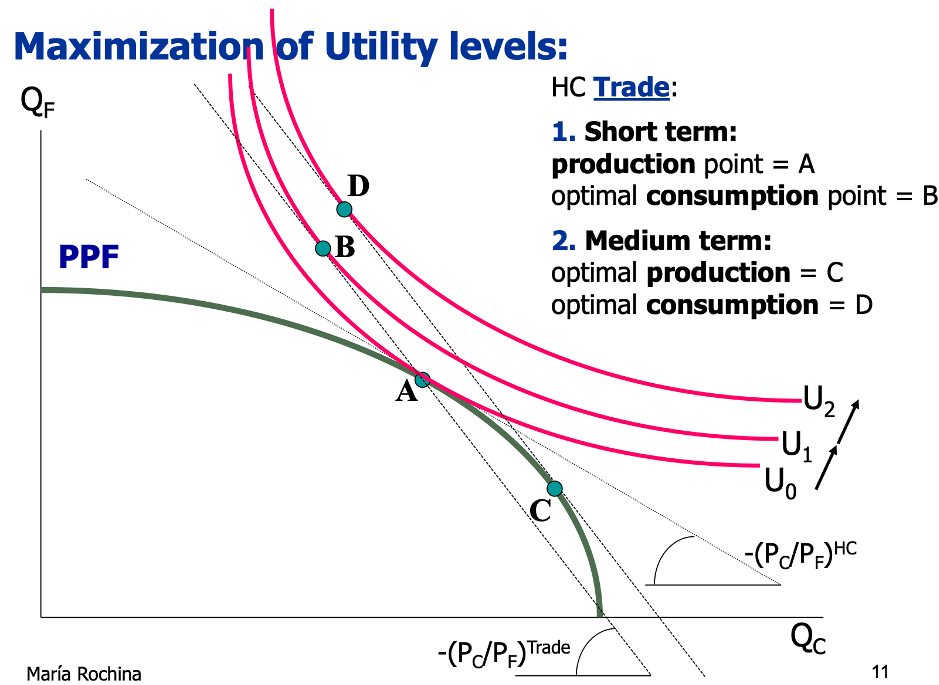
What happens to production and consumption in the short run when trade opens?
Production stays at A (cannot adjust immediately).
The world price (PC/PF)Trade is higher than the autarky price for HC, so consumers face a new budget constraint.
The new optimal consumption point is B, on a higher indifference curve U1 > U0.
HC gains from trade even before production adjusts.
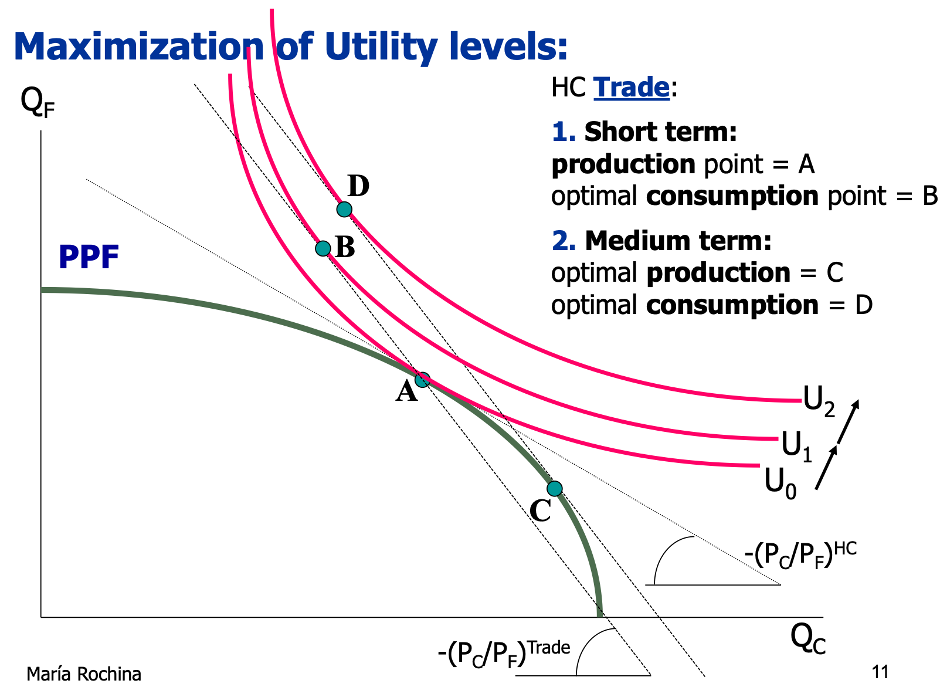
What happens in the medium run when trade opens for HC?
Production shifts to point C (more Clothing, less Food) as producers respond to the higher world price of Clothing.
The new budget line through C is further out.
Consumers reach point D on an even higher indifference curve U2 > U1.
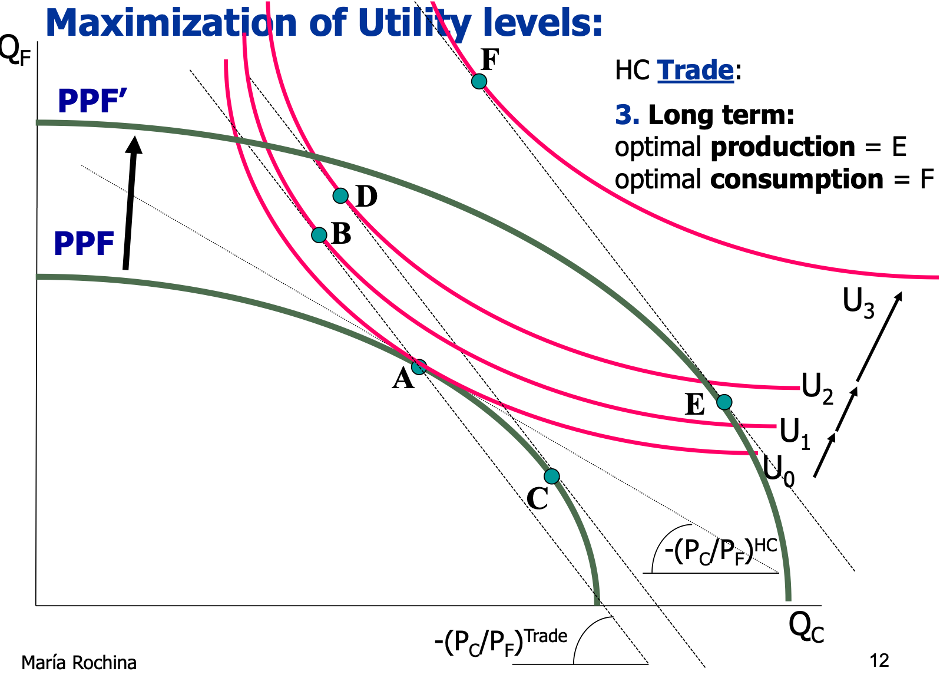
What happens in the long run when trade opens for HC?
The PPF itself shifts outward (PPF') as factor reallocation fully adjusts.
Production moves to point E, consumption to point F, reaching the highest indifference curve U3.
Long-run gains from trade are greater than short-run gains.
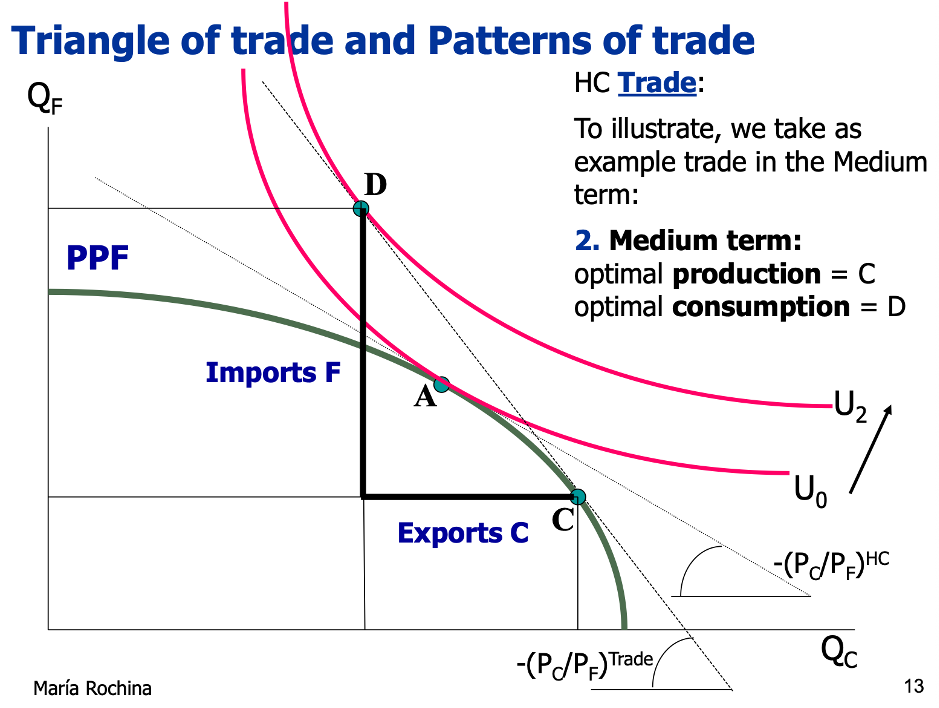
What is the triangle of trade?
The triangle formed between the production point (C) and the consumption point (D) on the isovalue line.
The horizontal distance shows exports of Clothing; the vertical distance shows imports of Food.
Exports = QC produced - QC consumed
Imports = QF consumed - QF produced.
What does it mean that HC exports Clothing and imports Food?
At the world price, HC produces more Clothing than it consumes (surplus → exports) and consumes more Food than it produces (deficit → imports).
The value of exports equals the value of imports at the world price.
How do you prove gains from trade for the Foreign Country?
Draw FC's PPF. In autarky, FC's optimal point is where its PPF is tangent to an isovalue line at the autarky price (PC/PF)FC.
When trade opens at the world price (lower than FC's autarky price of Clothing), FC's production shifts toward more Food and less Clothing, and its consumption reaches a higher indifference curve — proving it gains from trade.