PCC final
 Call Kai
 Learn
Learn Practice Test
 Spaced Repetition
 Match
Match Flashcards
 Knowt Play
1/118

There's no tags or description
Looks like no tags are added yet.
Name | Mastery | Learn | Test | Matching | Spaced | Call with Kai |
|---|
No analytics yet
Send a link to your students to track their progress
119 Terms
adherence
extent to which medication intake behavior corresponds with the recommendations of the provider
compliance
extent to which the patient follows the recommendations of the provider
persistence
length of time between the first + last dose
CMS defines adherence as PDC > _____
80%
PDC formula
(number of days in period "covered") / (number of days in period) x 100%
Medication Possession Ratio (MPR)
(Sum of days' supply for all fills in period) / (Number of days in period) x 100%
STAR ratings are evaluated based on:
• MTM program completion rate for CMR
• Statin use in persons with diabetes
• Adherence to diabetes medication
• Adherence to statins
• Adherence to any ACE-I/ARB
5 dimensions of adherence - social + economic
• low health literacy
• medication cost
• lack of health insurance
5 dimensions of adherence - health care system
• lack of care continuity
• restricted formularies
• long wait times
5 dimensions of adherence -condition related
• lack of symptoms
• depression
• severity of symptoms
5 dimensions of adherence - therapy related
• complexity of regimen
• frequent changes
• actual or perceived side effects
5 dimensions of adherence - patient related
• visual, hearing, cognitive impairment
• perceived risk of disease
• perceived benefit of treatment
medisafe
• virtual pill box
• alarms
• schedules for appointments
• refill reminders
MedHelper
• record keeping
• medication schedules
• notes on care/lifestyle
Dosecast
• medication dose reminders
• tracks doses taken
• refill reminders
T or F: Pharmacists diagnose
false
LOQQSAM strategy for history taking
location, onset, quality, quantity, setting, associated symptoms, modifying factors
Stroke FAST acronym
F: facial droop
A: arm drop
S: slurred speech
T: time to call 911
What is Deep Vein Thrombosis (DVT)?
blood clot in a deep vein (usually leg)
symptoms: redness, swelling, pain
what is hyperglycemia?
elevated blood glucose
symptoms: increased thirst, increased urination, increased hunger, fatigue
what is hypoglycemia?
blood glucose <70 mg/dL
symptoms: sweaty, shaky, dizzy, hungry, blurry vision
what is hypertension?
elevated bp above 120/80 mmHg
symptoms (not common unless severely elevated)- HA, chest pain, chest pressure, blurry vision
orthostatic HTN
- systolic decrease of at least 20 mmHg
OR
- diastolic decrease of at least 10 mmHg
measuring orthostatics
1. patient lays down for 5 min
2. check bp and pulse
3. patient stands
4. check bp and pulse after 1 min
5. check bp and pulse after 3 min
PHQ-9 patient survey
• pt questionnaire for depression
• 9 item question
• separated by DSM-IV Depression Criteria
• 4-point scale (max 27 points)
GAD-7 patient survey
• used for diagnosis, screening, + severity assessment for anxiety
• pt rated
• 7-item questionnaire
• 4-point scale (max 21 points)
5 A's of Smoking Cessation?
1. Ask
2. Advise
3. Assess
4. Assist
5. Arrange
health disparity
differences in the incidence, prevalence, mortality, and burden of diseases and other adverse health conditions that exist among specific population groups
_______% mortality is related to lifestyle
40-50
___ in 5 Americans speaks a language other than English at home
1
culture
a set of learned + shared beliefs and values that are applied to social interactions and to the interpretation of experience
race
a sociopolitical construct, having no scientific or anthropologic bias
ethnicicty
- self defined
- relates to ones identity with a group that shares a history, religion, nationality, and/or cultural patterns
rationale for cultural competence
• societal factors
• ethical standards
• professional practice standards
• legal rationale
societal factors
• changing demographics
• need fore diversity among healthcare providers
ethical standards
• APhA Code of Ethics
• Oath of a Pharmacist
professional practice standards
Culturally and Linguistically Appropriate Services
- 14 standards
Joint Commission
- an independent, not-for-profit org that evaluates + accredits health care organizations + programs in the US
Title VI of the Civil Rights Act of 1964
prohibits discrimination based on race, or national origin
Omnibus Budget Reconciliation Act (OBRA) of 1990
mandated that pharmacists provide the option for counseling
Minority Health and Health Disparities Research and Education Act of 2000
Created to improve minority health and reduce health disparities
Disease
"abnormalities in the structure and function of body organs and systems"
Illness
"... personal, interpersonal and cultural reactions to disease or discomfort... shaped by cultural factors governing perception, labeling, explanation, and evaluation of the discomforting experience"
Disease vs Illness
Disease - physiological phenomenon
Illness - sociological phenomenon
how do some cultures in the southern US describe hypertension?
"hyper-tension"
- disease of the nerves
- caused by stress, worry, anxious personality
- treated by stress reduction and control of excitement
how do some cultures explain high blood?
- blood too rich, hot, or thick
- caused by heredity, poor diet, heat
- predictable and controllable, but capable of resulting in illness/death
- treated by dietary abstention + ingestion of lemon juice, vinegar, garlic water, pickle brine
how do some cultures explain low blood?
- caused by ingestion of acidic or astringent foods
- characterized by fatigue
- treated by eating foods red in color (beets, grapes, red wine, liver, red meat, etc.)
Culture-Bound syndrome definition
"... generally limited to specific societies or cultural areas and are localized, folk, diagnostic categories that frame coherent meanings for certain repetitive, patterned, and troubling sets of experiences and observations"
examples of traditional healing methods
- coin rubbing
- cupping
- treating fever by keeping pt warm + sweat out fever
- acupuncture
- ayurveda
- homeopathy
- shamanism
- traditional healers/providers
inhaled medications delivery to the lungs
• Rapid onset
• limited absorption into pulmonary tissue (10-15%)
Metered Dose Inhaler (MDI)
• Canister contains mixture of both medication and pressurized propellant
• Must press canister into plastic boot to release the medication
• Delivers consistent amount of pressurized medication as a fine mist
Soft Mist Inhaler (SMI)
Produces a mist with slower speed than an MDI
Dry Powder Inhaler (DPI)
• Delivers medication as a fine, dry powder
• Patient provides the energy to mobilize medication through fast breath
Metered Dose Inhaler medications
• Bronchodilators – Ventolin® (albuterol), Atrovent HFA® (ipratropium)
• Corticosteroids
– Qvar® (beclomethasone), Flovent HFA® (fluticasone)
• Combination
– Advair HFA® (fluticasone/salmeterol), Dulera® (mometasone/formoterol)
Metered Dose Inhaler advantages
• Small size, portable
• Relatively inexpensive
• Dose immediately available and quickly administered
• Compression protects against pathogens and moisture
Metered Dose Inhaler limitations
• Requires coordination
• Deposits 10-20% of medication into the lungs
• Localized adverse effects
MDI instructions for use
1. Preparing Dose
• Seat canister into boot
• Shake several times
• Remove cap from mouthpiece
• Prime before initial use and if unused for several days (product specific)
2. Administration
• Exhale completely
• Close lips around mouthpiece with inhaler upright
•Press down once on metal canister with slow deep breath
• Hold breath for 5-10 seconds
• Exhale slowly
3. Post Dose
• If additional puffs needed, wait 15-30 seconds before repeating
• Replace cap when finished
• Rinse mouth if steroid inhaled
how to clean MDI
1. Remove canister and mouthpiece cap
2. Hold actuator under warm water for 30 seconds for each side
3. Shake off excess water and allow to air dry
what is the use of spacers?
Extends distance from actuator to oropharynx and temporarily holds mist
spacer benefits
• Reduces oropharyngeal deposition
• Increases administration to the lungs
• Reduces need for coordination
• Optimizes drug delivery in patients with impaired dexterity such as elderly and pediatric populations
optional features of spacers:
• One way valve – contains mist in spacer
• Whistle – indicates if patient is breathing too rapidly
• Mask – must ensure tight seal against face to prevent medication loss
spacer instructions for use with MDI
1. Preparing Dose
• Seat canister into boot
• Shake several times
• Remove cap from mouthpiece of MDI and spacer
• Prime before initial use and if unused for several days (product specific)
• Insert inhaler into soft opening of spacer
2. Administration
• Exhale completely away from spacer
• Close lips around mouthpiece with inhaler upright
• Press down once on metal canister and take 1-2 slow deep breaths through spacer
• Hold breath for 5-10 seconds
• Exhale slowly
3. Post Dose
• If additional puffs needed, wait 15-30 seconds before repeating
• Replace cap when finished
• Rinse mouth if steroid inhaled
*Children may need 5 to 6 breaths to inhale full dose*
Respimat/Soft mist inhaler
• Delivers medication with slower delivery and longer duration
• Reduces need for precise patient coordination of breath and actuation
• Generates mist independent of patient's inhalation
• Medication release for 1.5 seconds
• Generates soft mist through mechanical energy
• Higher fine particle fraction than MDI and DPI
• Increased medication deposition to the lungs
• Reduced oropharyngeal exposure
Respimat/Soft mist inhaler medications available
Bronchodilators – Combivent Respimat® (ipratropium/albuterol), Spiriva Respimat® (tiotropium), Stiolto Respimat® (tiotropium/olodaterol)
advantages of Respimat/Soft mist inhalers
• Ease of use for elderly and pediatric patients due to less coordination required
• Propellant free
- No shaking needed
- No mist released without medication remaining
disadvantages of Respimat/Soft mist inhalers
• requires assembly of cartridge and device
• Priming necessary
• Increased cost
Respimat/Soft mist inhaler instructions
1. Dose Preparation
• Insert cartridge into actuator
• Record discard date
• Prime by turning base 180° three times
• Press dose release button
2. Administration (TOP)
• Turn base 180° to load one dose and open cap
• Exhale fully
• Close lips around mouthpiece
• Press dose release button
• Inhale slowly and deeply
• Hold breath for 5-10 seconds
3. Post Dose
• Wait 30-60 seconds before giving another dose if needed
• Prime with one dose if unused for one week
• Full priming if unused for 21 days
instructions for cleaning Respimat/Soft mist inhalers
Use damp cloth or tissue to wipe mouthpiece
when should you discard Respimat/Soft mist inhalers?
Discard inhaler 3 months following cartridge insertion
dry powder inhaler
• Dependent upon patient inhalation to carry medication into the respiratory tract
• Doses most often formulated as micronized powder with large inactive carrier powder
dry powder inhaler medications available
• Bronchodilators – Incruse® (umeclidinium), Serevent® (salmeterol)
• Corticosteroids – Pulmicort® (budesonide), Flovent® (fluticasone)
• Combination – Breo® (fluticasone/vilanterol), Advair® (fluticasone/salmeterol)
dry powder inhaler (DPI) advantages
• Coordination of breathing and dose release not required
dry powder inhaler (DPI) limitations
• Diminished dose delivery if you breathe in slowly
• Medication doses may clump with humidity
DPI instructions
1. Dose Preparation
• Open mouthpiece
• Load dose
2. Administration
• Exhale fully away from inhaler
• Place lips around mouthpiece
• Inhale quickly and deeply
3. Post Dose
• Hold breath for 10 seconds or as long as comfortable
• Wait 30-60 seconds before giving another dose if needed
With Spiriva Handihaler, what should you instruct patient not to do?
swallow capsule
how should you hold Diskus® inhaler?
Hold device horizontally with dose counter facing upward
Diskus® medications available
• Flovent® (fluticasone)
• Serevent® (salmeterol)
• Advair® (fluticasone/salmeterol)
Ellipta® medications available
• Breo® (fluticasone/vilanterol),
• Anoro® (umeclidinium/vilanterol),
• Incruse® (umeclidinium),
• Trelegy® (fluticasone/umeclidinium/vilanterol)
DPI instructions for cleaning
• Do not submerge in water
• Wipe mouthpiece with a clean dry cloth
various styles of DPI
• Proair Respiclick®
• Spiriva Handihaler®
• Diskus®
• Ellipta®
• Asmanex Twisthaler®
• Pulmicort Flexhaler®
• Tudorza Pressair®
Small Volume Nebulizer
• Converts liquid medication into a mist for inhalation
• Face masks available for infant and pediatric use
• Preferred for inhaled medications in emergency situations, severe respiratory conditions, or patient inability to use an inhaler due to age or physical disability
what are the 2 technologies available for Small Volume Nebulizer?
• Jet – uses compressed gas to aerosolize medication
• Ultrasonic – uses high-frequency vibrations to aerosolize medication
Small volume nebulizer advantages
• May deliver more than one medication at the same time
• Minimal patient coordination required
• Allows for modification to medication doses and concentrations
• Incorporates normal breathing pattern
Small volume nebulizer limitations
• Longer treatment duration, typically 15-25 min
• Large and bulky device
• Requires access to power source
small volume nebulizer instuctions
1. Dose Preparation
• Open medication cup
• Empty contents of medication vial into cup
• Connect plastic tubing to medication cup and compressor
• Plug device into electrical outlet
• Turn on compressor power
2. Administration
• Sit upright and place mouthpiece into mouth
• Breathe normally
• Occasionally take a deep breath and hold for 5-10 seconds
• Continue until a sputter or rattle is heard
3. Post Dose
• Turn off compressor
• Disassemble nebulizer and rinse medication cup under warm water
• Allow parts to air dry and store properly
small volume nebulizer maintenance specifications
• Wash all nebulizer components (except clear tubing) with mild dish soap at least once weekly
• Disinfect once per week by soaking in 70% isopropyl alcohol, 3% hydrogen peroxide, or white vinegar solution
intranasal medication devices formulation indications
Rhinitis, sinusitis, migraine, smoking cessation, osteoporosis
intranasal medication devices · optimizes drug bioavailability due to large surface area and avoidance of _______________________
first-pass metabolism
intranasal medication devices instructions
• Gently blow nose then wash hands
• Shake nasal spray prior to removing cap
• Insert nozzle tip into one nostril (keeping head upright)
• Hold bottle between index and middle finger with thumb on bottom
• Use right hand to spray left nostril and vice versa
• Administer spray while slowly breathing in through the nose
• Breathe out through the mouth
• Clean nozzle and replace cap
Baqsimi (glucagon) dry powder nasal spray
• Do not remove shrink wrap or open tube until ready to administer
• Insert tip gently into one nostril and firmly push plunger
• Simultaneous inhalation unnecessary
• Disappearance of green line indicates complete dose
• Contains one dose and cannot be reused
prefilled insulin pen injectors
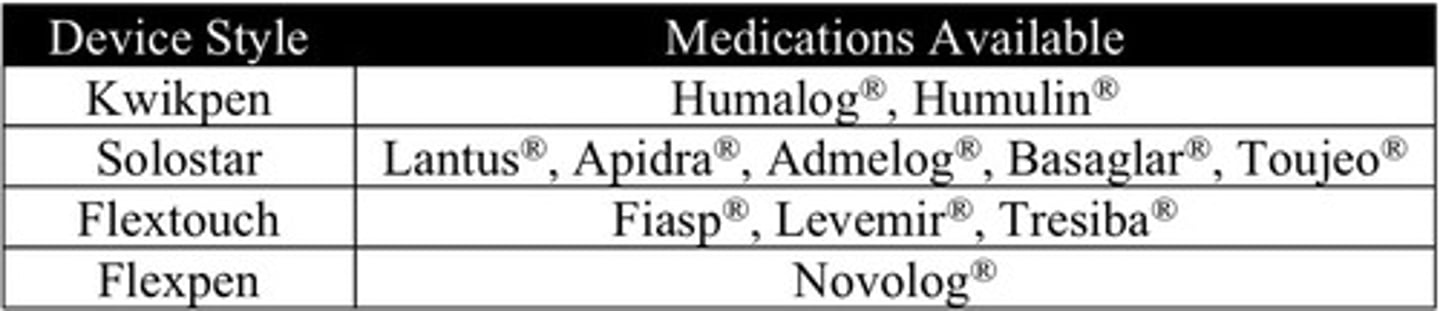
if using needles of >5mm, requires skin to be ...
pinched up
what should you do if a prefilled insulin pen injector is cloudy?
roll pen in between hands to mix suspension
how long should you hold pen at injection position to ensure complete dose administation?
5-10 sec
beyond use dates for pens at room temp:
• 14 days - NPH (Novolog 70/30®, Humalog 75/25®)
• 28 days - Lantus®, Basaglar®, Humalog®, Novolog® or Apidra®
• 42 days - Levemir®, Toujeo®
• 56 days - Tresiba®
volume and units for syringe selection
• 3/10mL (30 units)
• 1/2mL (50 units)
• 1 mL (100 units)
cap colors for U-XXX
U-100 = orange
U-500 = green
victoza and ozempic require the attachment of ____
pen needle
Bydureon BCise® (exenatide)
- rest flat for 15 min at room temp
- mix medication
- hold for 15 seconds
- dispose entire pen in sharps
GLP1 RA storage
• Trulicity® --> 14 days
• Bydureon BCise® --> 28 days
• Victoza® --> 30 days
• Ozempic® --> 56 days
PCSK9-i Reptha® (evolocumab)- SureClick®
- single use prefilled autoinjector
- dosed q2weeks
- injection duration = 15 sec
- let sit 30 min outside fridge before use
- cover made from latex
- window turns yellow when injection finished