Unit 3 HWs
 Call Kai
 Learn
Learn Practice Test
 Spaced Repetition
 Match
Match Flashcards
 Knowt Play
1/29

There's no tags or description
Looks like no tags are added yet.
Name | Mastery | Learn | Test | Matching | Spaced | Call with Kai |
|---|
No analytics yet
Send a link to your students to track their progress
30 Terms
Macrophages arise from which of the following?
monocytes
Mast cells and basophils release which chemical moderator?
histamine
Which cells do not express MHCs?
erythrocytes
Which of the following leukocytes exhibit the highest phagocytosis activity against bacteria?
Neutrophils
Urine and tears serve as a ____ barrier
physical
Which cells produce and secrete mucus?
goblet cells
Which part of the brain controls body temperature, as well as fever.
hypothalamus
The classical pathway of complement activation is initiated by:
antigen-antibody interaction
Which of the following is NOT an example of innate chemical defenses?
reverse transcriptase
One reason that the skin is inhospitable to microbes is that:
The normal microbiota outcompetes other microbes and inhibits their growth.
What is sebum?
an oily substance released from sebaceous glands that contributes to defense
Which MHC class is mostly likely found on macrophages?
class II
A patient comes in for surgery for a heart complication. During recovery, the patient develops and infection and signs and symptoms consistent with a Pseudomonas aeruginosa.
This infection is best characterized as a(n):
nosocomial infection
Which of the following best describes symptoms in a patient?
subjective changes such as pain or loss of appetite, personally experienced by the patient
A patient develops severe symptoms after infection with Escherichia coli O157:H7. The toxin responsible is released from the bacterial cell wall when the bacteria die and is associated with lipopolysaccharide (LPS).
This toxin is best described as a(n):
endotoxin
A patient develops lung cancer related to long-term smoking. The condition does not involve an infectious agent and cannot be spread from person to person.
This disease is best described as a:
noncommunicable disease
Malaria is transferred through insect bites.
This makes it an example of (horizontal/vertical)
horizontal
Malaria is transferred through insect bites.
This makes it an example of (indirect/direct)
direct
A nurse who works in the ________________ would most likely know the STORCH acronym by heart.
NICU
For diseases such as measles and gonorrhea, the infectious agents are maintained only in human populations and are transmitted directly from person to person.
reservoir
Which term refers to the study of the geographic distribution of disease and its transmission?
epidemiology
Malarial disease in Brazil is an example of which type of disease?
endemic
A pandemic is an outbreak of disease occuring:
worldwide
John Snow developed a detailed map (the “ghost map”) to investigate the etiology of which disease?
cholera
COVID-19, caused by coronavirus strains, first occurred in Asia, before spreading to Italy and then the United States, becoming a(n) ___________ disease.
pandemic
Morbidity refers to _____________; while mortality refers to______________.
state of being diseased, death from disease
Listeria monocytogenes, the causative agent of listeriosis, can pass through the blood-placenta barrier to infect a fetus.
This type of transmission to the fetus is known as which of the following?
vertical direct contact
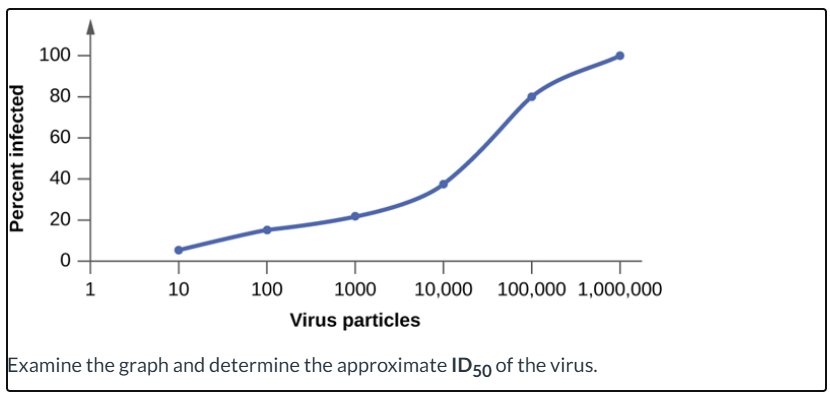
Examine the graph and determine the approximate ID50 of the virus.
13,000 particles
Your lab researches new drugs,
Purpose: You wish to determine if a new drug can cure individuals with colds caused by rhinoviruses.
Method: You invite 50 individuals to participate in the study. Using a double-blind approach, 25 individuals get a sugar pill and 25 get the test drug.
Question: Based on this description, which type of study was conducted?
experimental
You are hired as an epidemiologist for the following study:
Purpose: You wish to determine if potato salad, served at a local farmer’s market a month ago, caused an outbreak of a food-borne illness.
Method: You specifically interview individuals who had eaten potato salad and developed the illness, as well as individuals who ate the potato salad and did not develop illness.
Question: Based on this description, which type of study was conducted?
case-control