Chapters 15 & 16: Toxins in Solution and Acidic Toxins Flashcards
 Call Kai
 Learn
Learn Practice Test
 Spaced Repetition
 Match
Match Flashcards
 Knowt Play
1/35

Earn XP
Description and Tags
This flashcard set covers key vocabulary from chemistry lecture notes on solution types, solubility factors, molarity, dilutions, and acid-base theories and calculations.
Name | Mastery | Learn | Test | Matching | Spaced | Call with Kai |
|---|
No analytics yet
Send a link to your students to track their progress
36 Terms
Triple Point
The condition where the solid, liquid, and gas phases of a substance are all present at once.
Solute
The particles that are being dissolved in a solution.
Solvent
The dissolving medium in a solution.
Aqueous Solution
A homogeneous solution in which the solute is dissolved in water.
Solvation
A process by which individual solute ions break away from the crystal, become surrounded by solvent molecules, and the ionic crystal dissolves.
Electrolyte
A substance that dissolves in water to give a solution that conducts electric current, such as NaCl in water.
Nonelectrolyte
A substance that dissolves in water to give a solution that does not conduct electric current, such as sucrose in water.
Suspension
A mixture where the particles in a solvent are so large that they settle out unless the mixture is constantly stirred or agitated.
Colloid
A mixture that has particles intermediate in size between those in solutions and suspensions, such as milk or mayonnaise.
Tyndall Effect
A property used to distinguish between a solution and a colloid where a beam of light is scattered by colloidal particles, making the beam visible.
Saturated solution
A solution that contains the maximum amount of solute for a given quantity of solvent at a given temperature and pressure.
Unsaturated solution
A solution that contains less solute than a saturated solution at a given temperature and pressure.
Supersaturated solution
A solution that contains more solute than it can theoretically hold at a given temperature.
Seed crystal
A very small crystal of the solute added to a supersaturated solution to initiate crystallization.
Solubility
The amount of solute that dissolves in a given quantity of a solvent at a specified temperature and pressure to produce a saturated solution.
Miscible
A description of two liquids that dissolve in each other in all proportions.
Immiscible
A description of two liquids that are insoluble in each other.
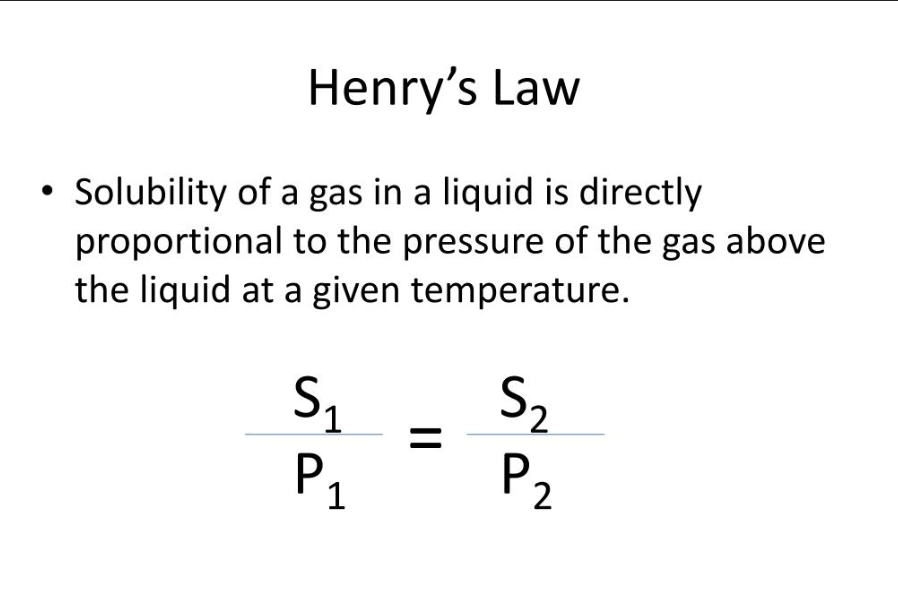
Henry's Law
The principle that the solubility of a gas is directly proportional to the partial pressure of that gas on the surface of the liquid.
Molarity (M)
A measure of concentration defined as the number of moles of solute dissolved in one liter of solution (mol/L).
Dilute solution
A solution that contains a small amount of solute.
Concentrated solution
A solution that contains a large amount of solute.
Alloy
A solid-solid solution, such as brass which is copper in zinc.
Arrhenius Acid
A substance that is an H+ or H3O+ producer in solution.
Arrhenius Base
A substance that is an OH− producer in solution.
Br%f8nsted-Lowry Acid
A substance that acts as a proton (H+) donor.
Br%f8nsted-Lowry Base
A substance that acts as a proton (H+) acceptor.
Lewis Acid
A substance that acts as an electron pair acceptor.
Lewis Base
A substance that acts as an electron pair donor.
Indicator
A substance that turns one color in the presence of acids and another color in the presence of bases.
Conjugate Acid
The particle formed when a base gains a proton (H+).
Conjugate Base
The particle that remains when an acid has donated a proton (H+).
Amphoteric
Compounds that can act as either an acid or a base depending on the situation, such as water.
Ion product constant of water (Kw)
The equilibrium constant for the self-ionization of water, where the product of the molarity of hydronium and hydroxide ions is 1.0×10⁻¹⁴ at 25∘C.
pH scale
A logarithmic scale that describes the concentration of H+ ions in solution, ranging from 0 to 14.
pOH scale
A logarithmic scale that describes the concentration of OH− ions in solution.
Titration
A laboratory procedure used to calculate the concentration of a solution by reacting it against a solution of known concentration.