Geography: climate change
 Call Kai
 Learn
Learn Practice Test
 Spaced Repetition
 Match
Match Flashcards
 Knowt Play
1/72

There's no tags or description
Looks like no tags are added yet.
Name | Mastery | Learn | Test | Matching | Spaced | Call with Kai |
|---|
No analytics yet
Send a link to your students to track their progress
73 Terms
IPCC =
Intergovermental Panel of Climate Change
What is IPCC (funktion)
International body of the UN that summarize scientific knowledge about chlimate change.
Tousand of volunteer scientists review and synthesise all existing peer-viewed literature to provide a “state of art” summary of climate knowledge
Peer-viewed means..
… the research has been double-checked by other experts in that field before the IPCC even looks at it. The scientistes do not do new research themselves; they summarize existing knowledge.
working groups:
Working group I: Focus on physical science (the “how” and “how much”). it provides definitive data on temperature rise, sea-level changes, and greenhouse gas concentrations
Working group II: Focus on how climate change affects humans and nature and how we can adapt to these changes
Working group III: Focus on solutions and methods to stop climate change by cutting greenhouse gas emissions
Who approves IPCC reports, and are individual nations required to follow them?
Reports are signed off by 195 member governments, who review the Summary for Policymakers (SPM) to ensure the information is clear. However, the IPCC acts only as a "manual," and it is up to each individual nation to decide whether to follow the guidance or ignore it.
why does IPCC use possibility language
Because science is rarely 100% certain, the IPCC expresses how sure they are through two methods: “Qualifiers“ and “Likelihood“
“Qualifiers” (Confidence levels):
o very high, high, medium, low, very low
o These levels express how much the researchers agree on their interpretation of the data
“Likelihoods” (Percentages):
o virtually certain (99-100%), very likely (90-100%), likely (66-100%), about as likely as not (33-66%), unlikely (0-33%), very unlikely (0-10%), exceptionally unlikely (0-1%)
o These are specific percentage ranges often calculated by computers to leave less room for debate.
IMPORTANT.
Describe global warming and change since 1850 comprehensively. (Next chapter)
Describe global warming and change since 1850 comprehensively: What are the four points that must be mentioned:
Greenhouse Gases, Temperature, Oceans/Sea Level, and Ice/Nature
Describe global warming and change since 1850 comprehensively: Greenhouse Gases
Increase in greenhouse gases concentrations from 1850: Carbon dioxide; Methane; Nitrous Oxide
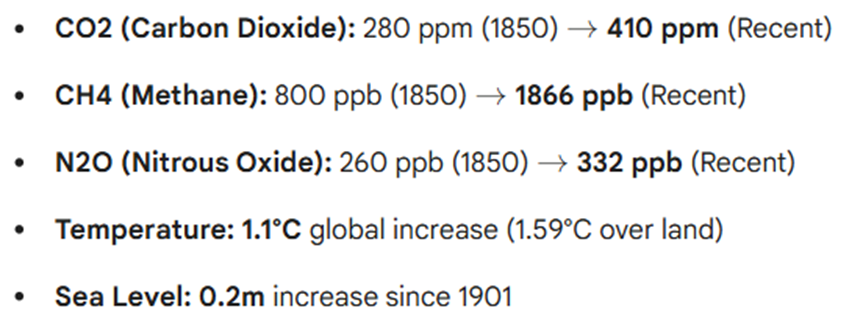
→ CO2 (280ppm → 410ppm), CH4 (800ppb → 1866 ppb), N2O (260ppb → 332ppb).Atmospheric CO2 concentrations in 2019 were higher than at any time in at least 2 million years
Describe global warming and change since 1850 comprehensively: Temperature
The global surface temperature is now about 1.1°C higher than the 1850–1900 average.
The warming is much stronger on land (1.59°C) than over the ocean (0.88°C).
This rate of warming is unprecedented in at least 2,000 years, and it is likely that humans caused almost all of it (0.8°C–1.3°C).
Describe global warming and change since 1850 comprehensively: Ocean/ Sea Level
Warming & Acid: The upper ocean has warmed since the 1970s, and human CO2 emissions are the main driver of ocean acidification.
It is extremely likely that humans influence contributed to near-surface salinity changes.
Sea Level Rise: Global sea levels rose by 0.2m between 1901 and 2018.
Faster Rate: The sea is rising much faster now; the rate jumped from 1.3 mm per year in the early 1900s to 3.7 mm per year recently.
Describe global warming and change since 1850 comprehensively: Ice/Nature
Ice Loss: Human influence is very likely the main driver behind retreating glaciers and the record-low levels of Arctic sea ice. It is very likely that human influence contributed to the decrease in spring snow cover in the northern hemisphere and the melting of the Greenland ice sheet.
The Biosphere: Climate zones are shifting toward the poles, and growing seasons for plants are getting longer.
Weather: There has been a likely increase in rainfall over land and a shift in where big storms happen. Mid-latitude storm tracks have likely shifted poleward in both hemispheres since the 1980s.
ocean acidification =
process where the ocean’s chemistry change → absorbing extra CO2 from the atmosphere
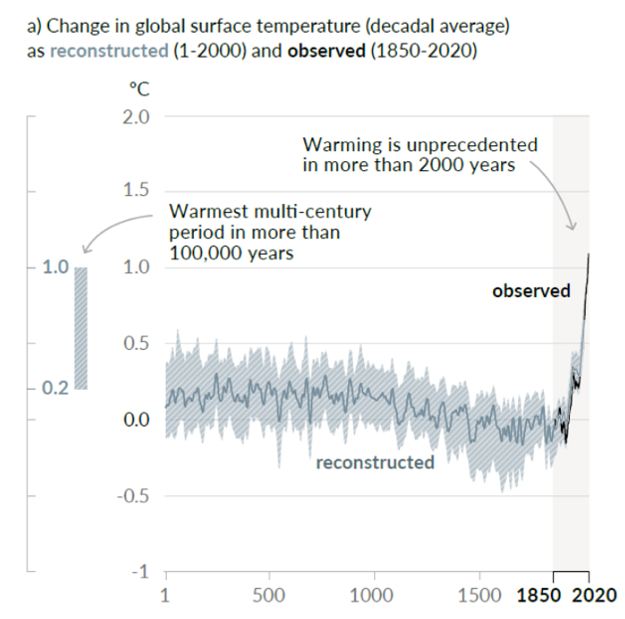
Temperature change over a long time (very 10 years)
observed = measured by inttruments
grey bar: Last decade was warmer than any other warm period in th last 100’000 years
1850-2020: The earth has this spike newly. Something like that didn’t happen in the last 2’000 years
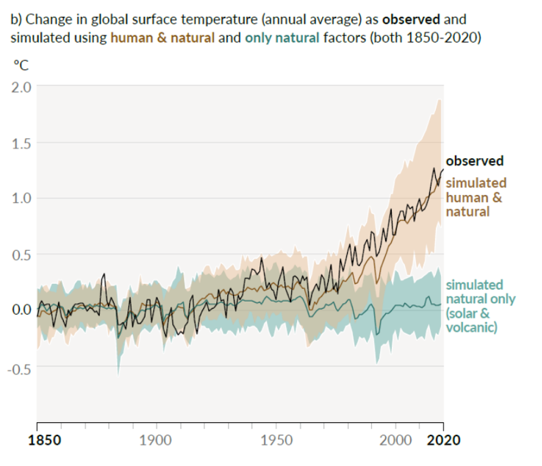
Temperature change every year (from 1850 to 2020)
computer used here for “why“ temperature change
black line = observed: actual temperature changes (meassured)
brown area: include human (e.g. greenhouse gas) and natural factions (by computer)
blue area: shows only what would happen if ONLY natural factors (e.g. sun change, volcanoes)
black line matches the stimulations that include human activities (brown area) → IF human DIDN’T change anything, temperature would have stayed the same!
What is carbon sink? + examples
Carbon sink: absorbs more CO2 than it releases (e.g. forests, oceans, soils)
What is carbon source? + examples
Carbon source: releases more CO2 into the atmosphere than it absorbs (e.g. buring fossil fuels, deforestation, volcanoes)
balance between sources and sinks + role of nature
The balance between sources and sinks determines how much CO2 accumulates in the atmosphere. Nature is currently helping us by soaking up about 56% of human CO2 emissions every year. However, as emissions rise, these natural sinks are projected to become less effective at slowing down the buildup of CO2.
Main anthropogenetic (human-caused) CO2 sources
1. Burning fossil fuels (coal, oil, natural gas, used for electricity heating, transport)
2. Industry (especially cement production à releases CO2 chemically)
3. Transport (cars, planes, ships)
4. Energy production (power plants using fossil fuels)
5. Land-use change (deforestation, agriculture, urbanisation)
Land-use change meaning + example → consequence of this
Land-use refers to humans altering (chaning) land for their needs
e.g. cutting forests, building cities, draining wetlands.
Forest and soils naturally store carbon ( as carbon sink), but when they are destroyed or cleared → that stored carbon is released → turning them into a carbon source.
How heat is distributed?
Heat on Earth is distributed not only by winds, but also by ocean currents.
What is the important system of heat distribution and by which factors is it driven
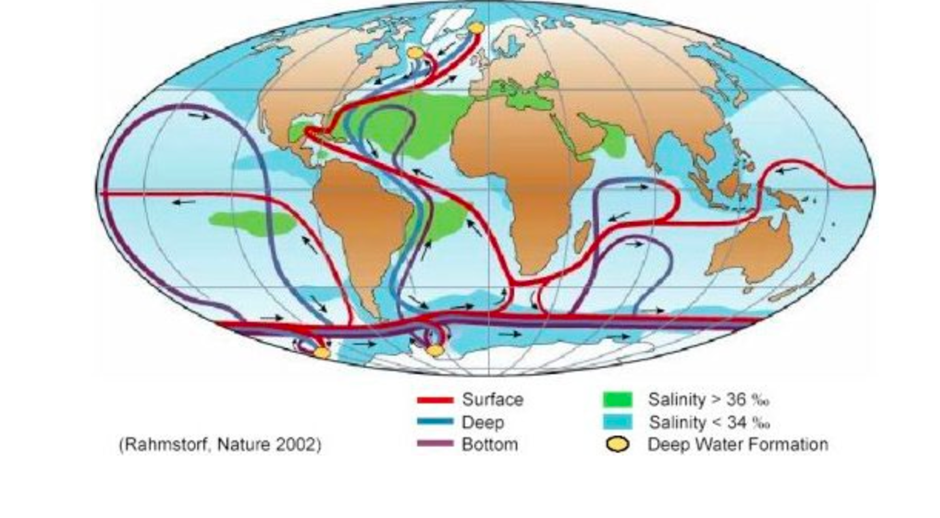
The most important system is the thermohaline circulation, also known as “global conveyer belt”. It is driven by two factors: thermo: temperature (heat), haline: Salinity (saltiness)
How the thermohaline circulation works?
Flow to the North: Warm, salty surface water (like the Gulf Stream) flows from the equator toward the North Atlantic
Sinking: In the North Atlantic, the water cools and becomes denser. As wind evaporates surface water, it leaves the salt behind, making the water even saltier and heavier, which causes it to sink deep into the ocean
The return: This cold, deep water flows back toward the south
Upwelling: Eventually, the water rises back to the surface (upwelling) and warms up again, starting the cycle over, it takes about 1’000 years for the water to complete one full circuit around the globe
Why is the Thermohaline Circulation crucial?
o It moves heat away from the equator toward higher latitudes à keeps Europe about 5°C – 10°C warmer than it would otherwise be
o It mixes different ocean layers, bringing oxygen to the deep sea and nutrients to the surface for marine life
o The ocean stores and transports CO2, which helps slow down climate change.
AMOC =
Atlantic Meridional Overturing Circulation
What is AMOC and does it do?
- This is the Atlantic part of global thermohaline circulation. While the global thermohaline circulation is driven by density, the AMOC also includes surface currents moved by the wind.
- It moves warm, salty surface water northward and cold, deep water southward à crucial for climate regulation in the North Atlantic region
Gulf Stream?
A strong warm ocean current starting in the Florida Strait, flows along the east coast of the US and across the Atlantic toward Europe, key part of the AMOC system.
What are the effects on the AMOC of the climate change
Global warning leads to:
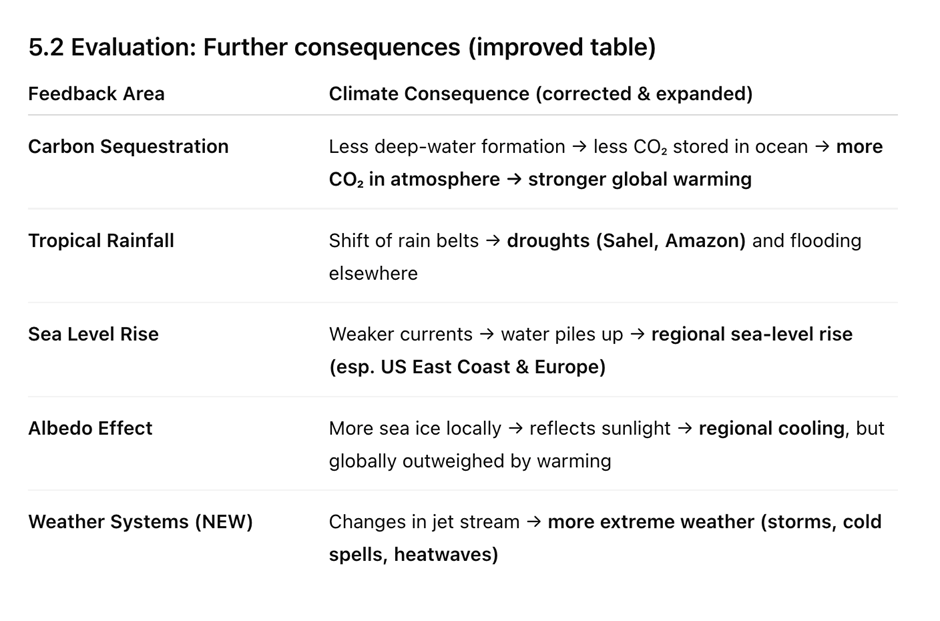
Melting ice (Greenland, Arctic) + more rainfall à more freshwater in the North Atlantic → lower salinity → lower density → less sinking of water (weak deep-water formation) → slowing of AMOC → weaker Gulf Stream → heat transport to Europe decreases → Europe may experience: cooler or less rapidly warming climate, more extreme weather patterns
Further consequences:
Meteorology?
Meteorology = study of atmospheric phenomena, which includes the study of weather and climate
Weather
Weather = state of the atmosphere at a local level, usually on a short timescale of minutes to days, it includes aspects of the atmosphere that affect our daily life, sunshine, clouds, wind, rainfall, humidity, and temperature
Climate?
Climate = Long-term behaviour of the atmosphere in a specific area. It is represented by data of temperature, pressure, wind, precipitation, humidity etc. is used to calculate the average over a period of time, it describes the typical weather conditions in an area over a 30 year period or more
Scales in climatology:
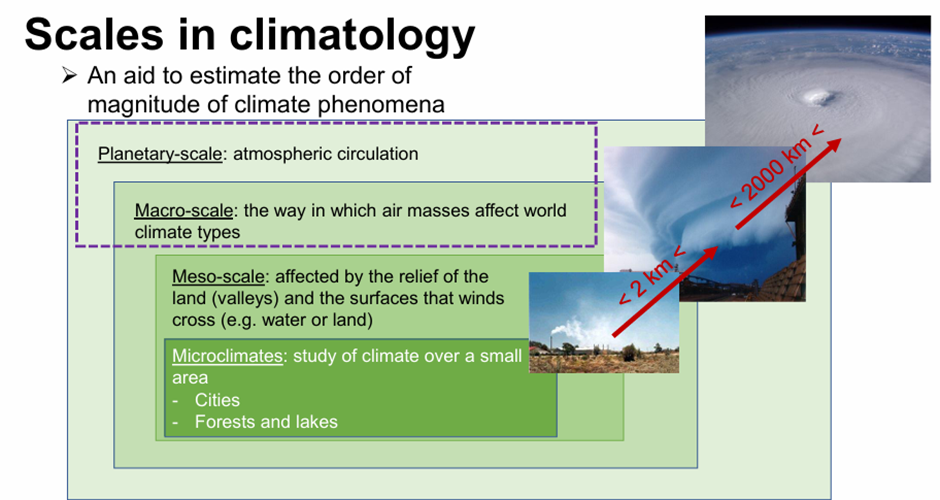
Planetary-scale: entire earth: how air moves around the earth (= atmospheric circulation)
Macro-scale: large regions; e.g. continent; in studies how huge “bubbles” of air (masses) create differnt climate types.
Meso-scale: focus on how shape of land affects weather of a specific area
to whom is climate change an problem?
Global climate change is most likely a problem for us, but not likely for the planet
What is absolutely indispensable for our society?
Stability is absolutely indispensable for our society
Change?
Change = transition from one state to another
According to Luhmann, is a system just an independent object?
No. A system is something that constantly interacts with the world around it and is defined by the difference between itself and its environment.
What does it mean for a system to be “autopoietic”?
It means the system has the ability to reproduce and maintain itself.
What is the main goal of any system, and how does it achieve it?
The main goal is homeostasis (stability). A system will even change itself internally if that is what it takes to stay stable.
What is the difference between an “open” and “closed” system?
Open: Allows energy or materials to flow in and out.
Closed: Does not allow this flow,.
(Note: All ecosystems are open systems,)
Why must a system change if its environment changes?
Because a system only exists because it is different from the environment. This difference makes it impossible for changes in one to leave the other unaffected,.
What is an ecosystem made of?
It is a system consisting of all living organisms (biotic elements) and the physical environment (abiotic elements like rocks and water) with which they interact.
Why are all ecosystems considered "open systems"?
Because they have an ongoing flow of energy and materials (mass) between them and the outside environment.
How do scientists describe the structure and behavior of ecosystems?
hey are complex structures and dynamic entities, meaning they are always moving, changing, and interacting.
What are "ecosystem services" and why do they matter?
These are natural processes that are essential to sustaining healthy human societies. We rely on them for our survival and well-being.
What is the "Geo-ecosystem"?
It is the scientific view of the entire Earth as one single, massive ecosystem
Why do scientists divide the Earth into "spheres" like the Atmosphere or Biosphere?
To reduce the massive complexity of the Geo-ecosystem into smaller, manageable sub-ecosystems for study.
what are those spheres?
Atmosphere: The layer of gases surrounding the planet.
Biosphere: All living organisms.
Hydrosphere: All Earth's water.
Lithosphere: The solid outer shell of the Earth.
Pedosphere: The soil layer.
Morpho-sphere: The shape and structure of the Earth's surface.
Anthroposphere: The part of the environment made or modified by humans.
Natural vs. Cultural Landscape: Scientists also distinguish between natural landscapes (untouched by humans) and cultural landscapes (altered for human needs).
Can you name the main "spheres" and landscape types in the Geo-ecosystem?
Spheres: Atmosphere, Biosphere, Hydrosphere, Morpho-sphere, Lithosphere, Pedosphere, Anthroposphere.
Landscapes: Natural landscape and cultural landscape.
How is the relationship between humans and nature defined in the Holocene?
It was an era of high stability where nature mostly decided (determined/dictated) how humans lived.
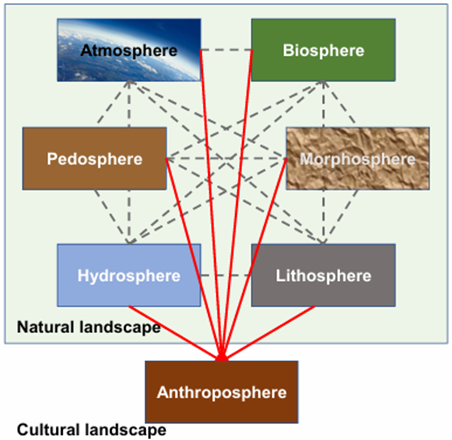
How is the relationship between humans and nature defined in the Anthropocene?
It is the current era where human activity is the main force changing how nature works. Humans now determine how the "natural" spheres interact.
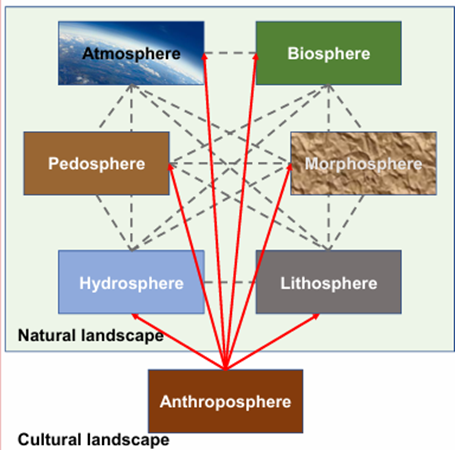
How has the balance of Earth's ecosystem shifted in the Anthropocene?
The balance has shifted to a "human pressure state," which is making the global ecosystem less stable and pushing it toward tipping points.
How does the Earth ecosystem react when human activity (the Anthropocene) puts too much pressure on the system?
It loses homeostasis (stability) and creates dangerous situations that force the system to reorganize. These reactions include feedback loops, tipping points, and points of no return.
Define the three "dangerous situations" for the Earth system: Feedback loops, Tipping points, and the Point of no return.
Feedback loops: Reactions that either speed up (positive) or slow down (negative) changes in the system.
Tipping point: A critical threshold where a small change becomes big enough to cause a massive and permanent shift in the system.
Point of no return: The stage where the system has changed so significantly that it cannot go back to its previous state.
Factors Influencing Global Climate
How does the Sun's activity influence the global climate?
The Sun follows an 11-year cycle where the number of sunspots changes, varying the amount of energy (solar irradiance) sent to Earth.
Explain the difference in how ice and water react to sunlight.
Ice (High Albedo): Reflects about 85% of radiation.
Water: Absorbs about 93%, which turns into heat.
Feedback: Melting ice reveals dark water, which absorbs more heat and accelerates warming.
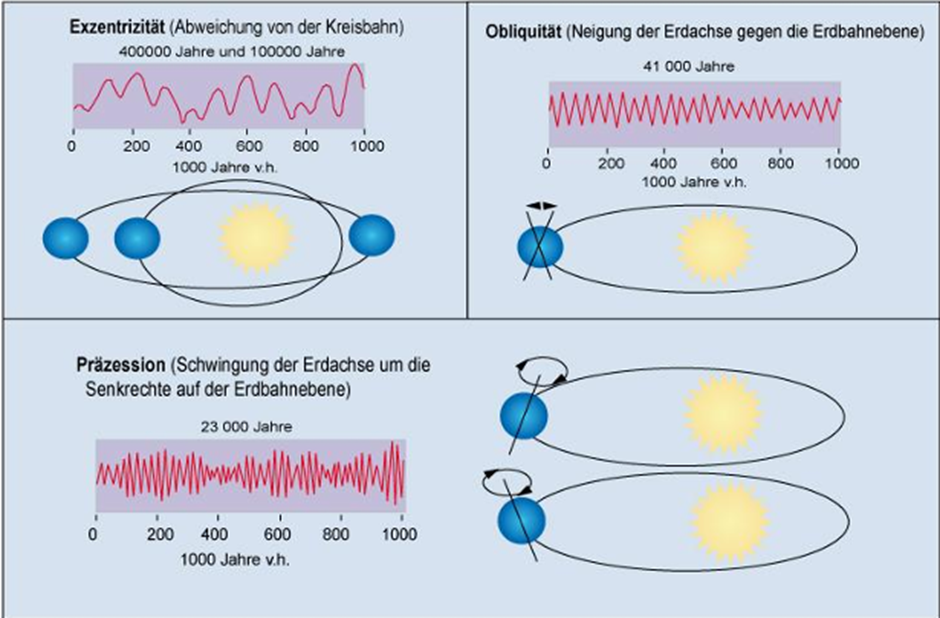
What are the three parts of the Milankovitch Cycles?
Precession: A "wobble" in Earth's axis (every 25,800 years).
Obliquity: Changes in the tilt of the axis (every 41,000 years).
Eccentricity: Changes in the shape of Earth’s orbit from circle to oval (every 100,000 to 405,000 years).
These cycles are a major reason for natural climate change in the past, such as Ice Ages
Why is the Greenhouse Effect the most important factor for current climate change?
Without it, Earth would be a frozen -18°C. Gases like CO2 and Methane act as a filter, letting in shortwave sun radiation but trapping longwave heat (infrared) that the Earth tries to send back to space.
How does gas density affect a planet's temperature?
The more dense/crowded the greenhouse gases are, the hotter the planet. Venus has a very dense CO2 atmosphere (462°C), while Mars has a very thin atmosphere (-60°C)
What caused "Snowball Earth" in the distant past?
Around 600 to 900 million years ago, a massive growth of bacteria and plankton removed so much CO2 from the air that the planet froze almost completely.
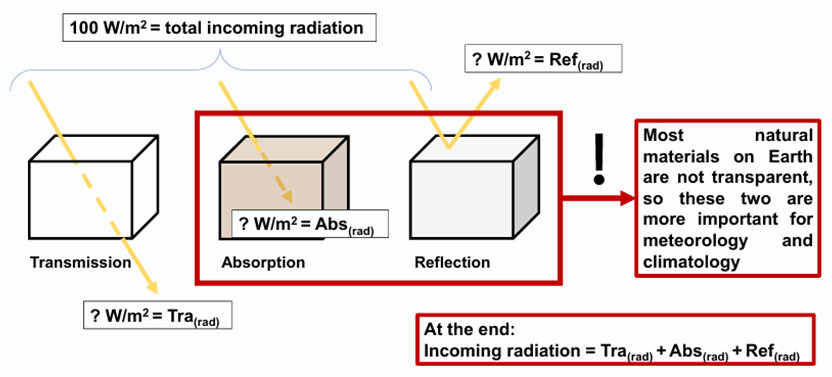
What happens to radiation as soon as it hits the Earth’s surface?
What is the relationship between wavelength, frequency, and energy in radiation?
Shorter wavelengths have higher frequency and higher energy. Conversely, longer wavelengths have lower frequency and lower energy.
Compare the type of radiation sent out by the Sun and the Earth.
Sun: Sends out high-energy shortwave radiation.
Earth: Sends out lower-energy longwave radiation (infrared).
How does shortwave radiation from the Sun interact with the atmosphere?
It easily passes through the atmosphere to reach the surface and warm the ground.
How does longwave radiation (heat) from the Earth interact with the atmosphere?
The Earth tries to send this heat back into space, but greenhouse gases absorb it, trapping the energy in the atmosphere.
Why is the atmosphere described as a "Filter"?
Because it is selective: it lets shortwave energy from the Sun in, but its greenhouse gases block/absorb the longwave energy the Earth tries to send back out.
What is the final result of the atmosphere acting as a filter for different wavelengths?
It traps heat near the surface, which keeps the planet warm enough for life (the Greenhouse Effect).
explain why a 5% human contribution is a problem.
The Upset: Natural sources produce 95% of carbon, while humans produce only 5%; however, this 5% is enough to upset the balance because nature cannot absorb all of the extra production.
What is carbon sequestration, and how can a sink become a source?
Sequestration: The natural process where sinks absorb and store carbon.
Saturation/Destruction: Sinks can become "saturated" (full). If a sink is full or destroyed (like a forest being burned), it stops storing carbon and becomes a carbon source.
Use the "8.9 vs 4" units to explain why scientists say nature is currently helping us.
Human activity releases about 8.9 units (Pg) of carbon per year, but only 4 units actually stay in the atmosphere. This proves nature is helping us by soaking up roughly 56% of our annual emissions.
Key numbers to remember