Describe the clinical features associated with a difficult airway, including those of syndromes and congenital abnormalities such as Pierre Robin, mucopolysaccaridoses and Treacher Collins
 Call Kai
 Learn
Learn Practice Test
 Spaced Repetition
 Match
Match Flashcards
 Knowt Play
1/12

There's no tags or description
Looks like no tags are added yet.
Name | Mastery | Learn | Test | Matching | Spaced | Call with Kai |
|---|
No analytics yet
Send a link to your students to track their progress
13 Terms
Difficult airway
the clinical situation in which a conventionally trained anaesthetist experiences difficulty with facemask ventilation, tracheal intubation or both. Difficult laryngoscopy ~1.35% of paediatric procedures
Most children with difficult aiways are ID preop as most commonly have face malformations
Pierre Robin and Treacher Collins
Klipperl-Feil
Beckwith-wiedeman
Pierre Robin and Treacher Collins
Short mandible
Micrognathia
Ear derformities
Klipperl-Feil
Cervical fusion → limited neck extension
Beckwith-wiedeman
Limited MO
Restricted TMJ
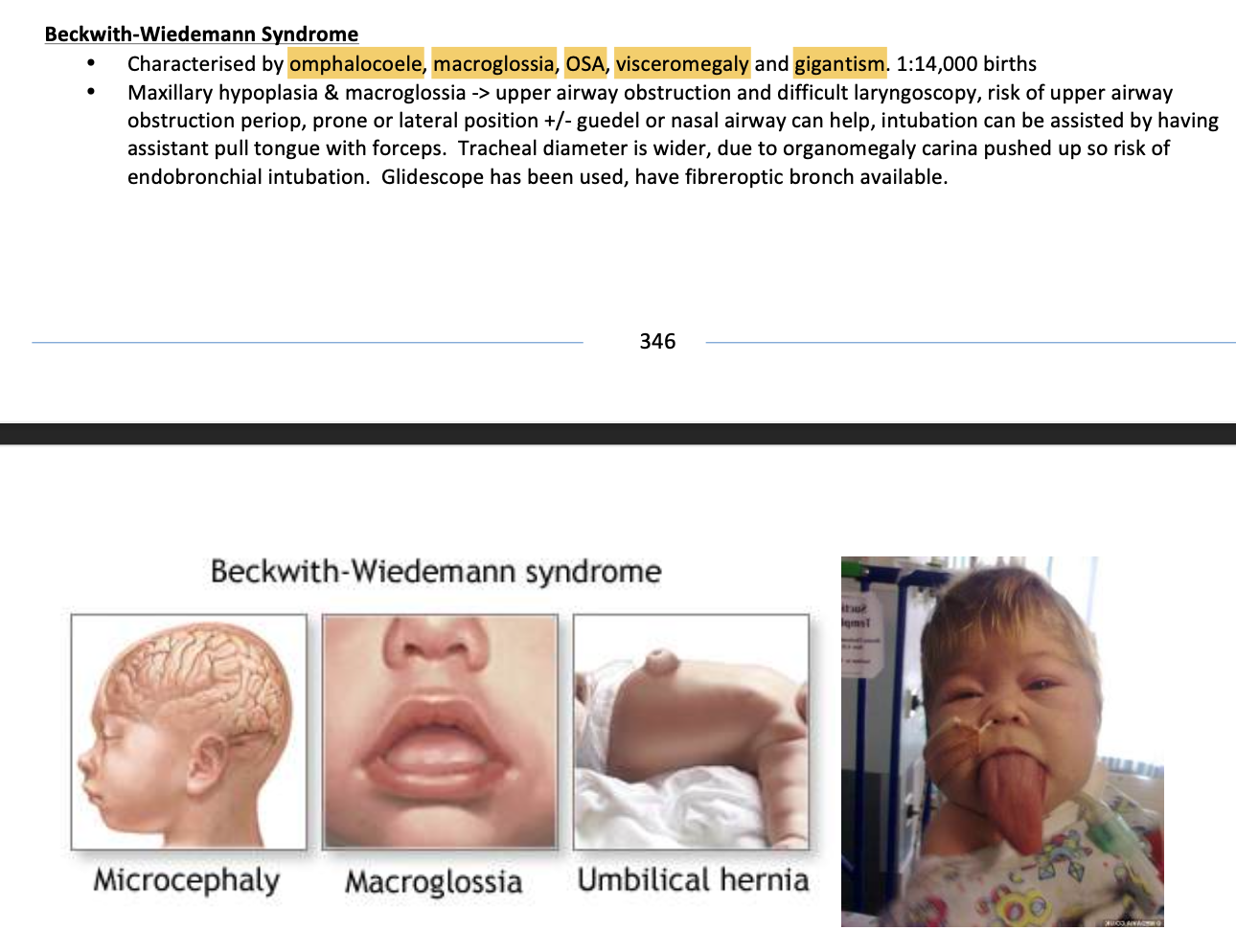
Large tongue
Sx and Si of airway obstruction
Hx
Apnoeic episodes
Daytime tiredness
Irritability
Hyperactivity
Ex
Noisy breathing
Stridor
Snoring
WOB
Side on assess MO
Dentition (overbite)
Syndromes assoc with difficult airway
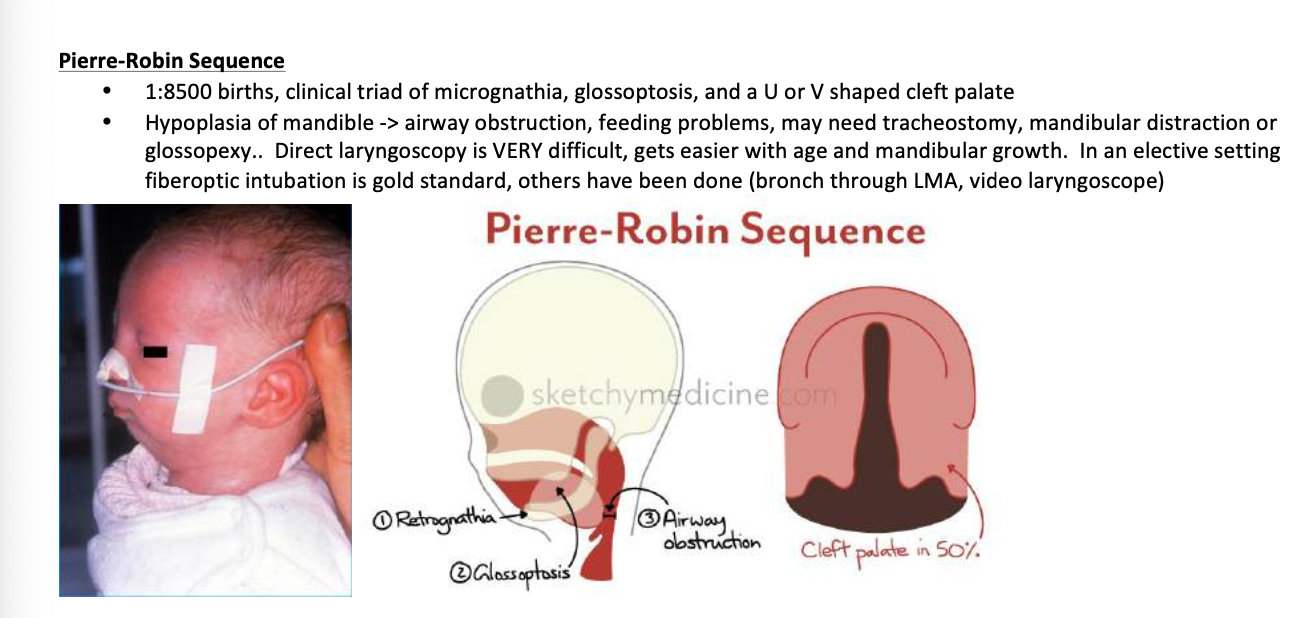
o Pierre Robin sequence
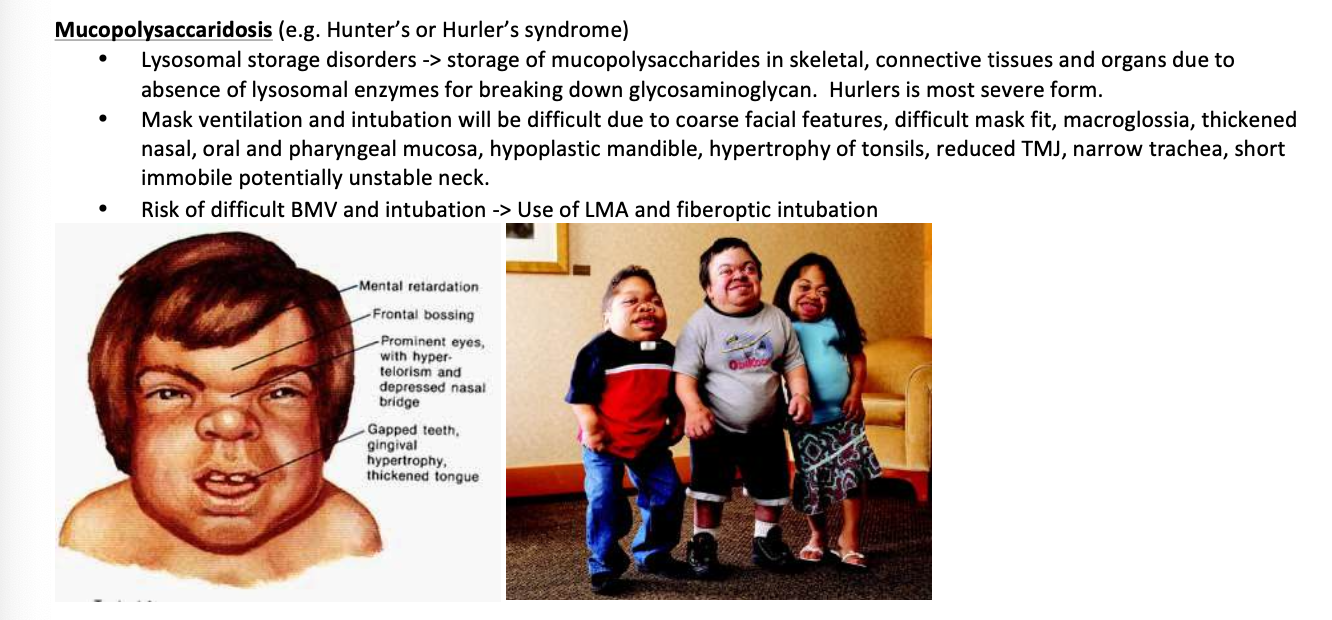
o Mucopolysaccaridoses
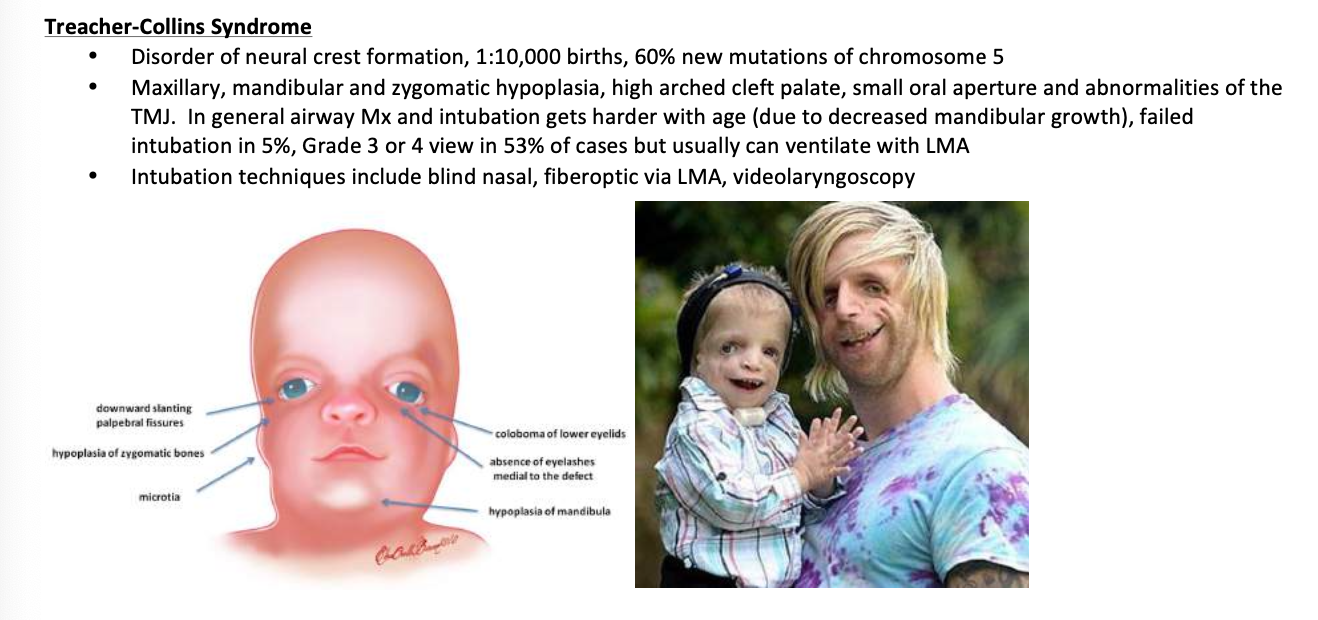
o Treacher Collins
o Down’s syndrome
These sydromes airway improves with age:
Pierre robin – micrognathia (jaw size increases)
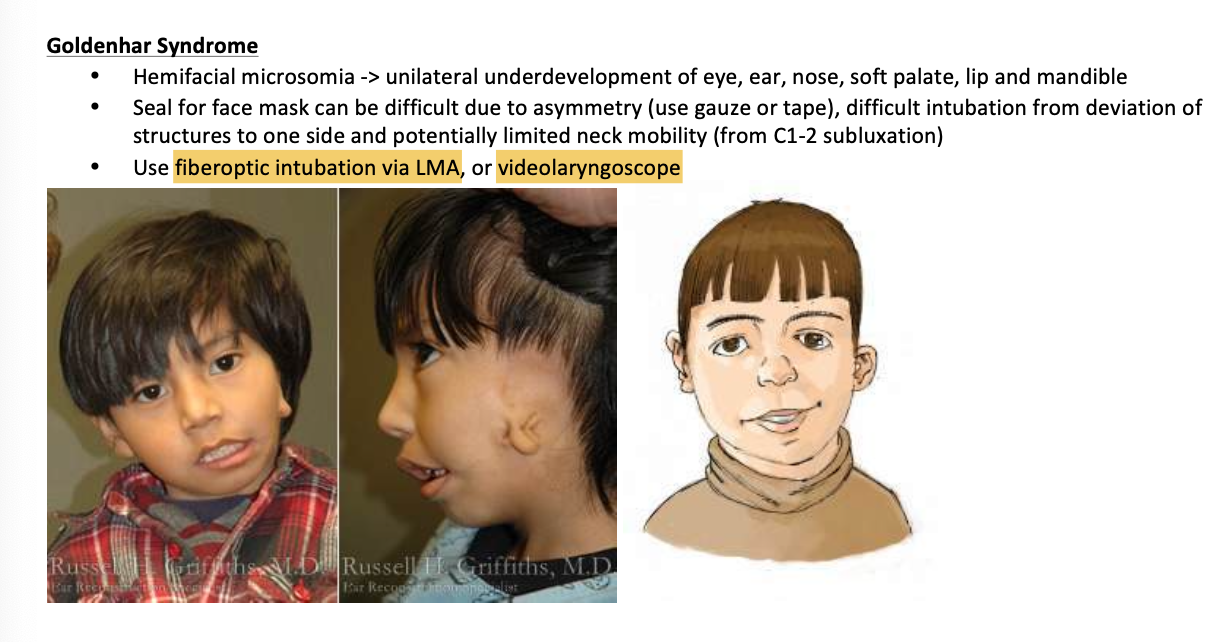
Goldenhar – asymmetrical micrognathia (jaw size increases)
These syndromes worsen with age
o Treacher Collins (micrognathia, small mouth, funnel shaped larynx)
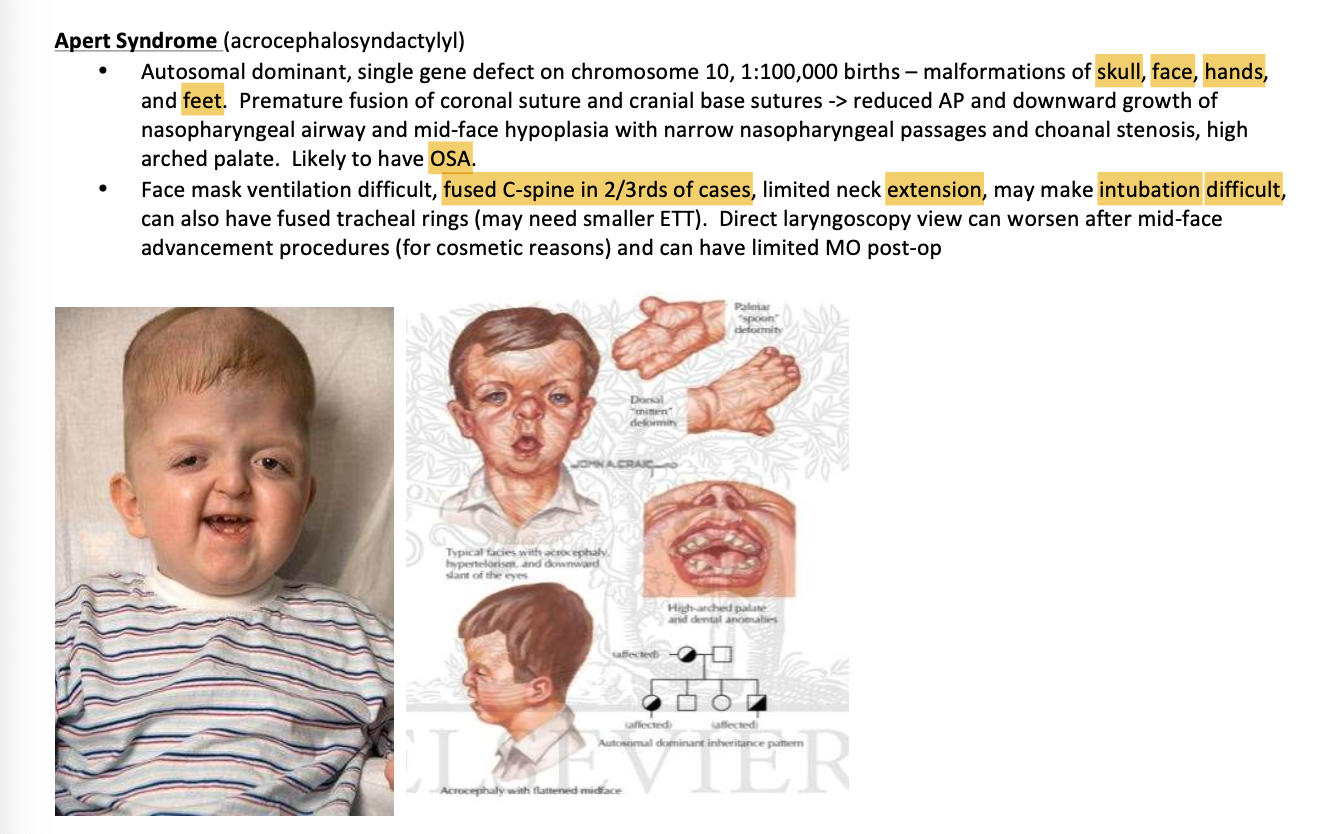
o Apert (midface anomalies, cervical fusion)
o Hunter and Hurler (mucopolysaccharides in tongue and larynx)
o Beckwith-Wiedemann (macroglossia)
o Freeman-Sheldon syndrome (circumoral fibrosis and microstomia)
o Fibrodysplasia ossificans
Pierre Robin
Clinical triad
Intubation technique
Mucopolysaccaridosis (e.g. Hunter’s or Hurler’s syndrome)
In what way is airway mx difficult
Treacher-Collins Syndrome
Goldenhar syndrome
Apert Syndrome
Beckwith-Wiedemann Syndrome
Omphalocoele - organs grow outside the body
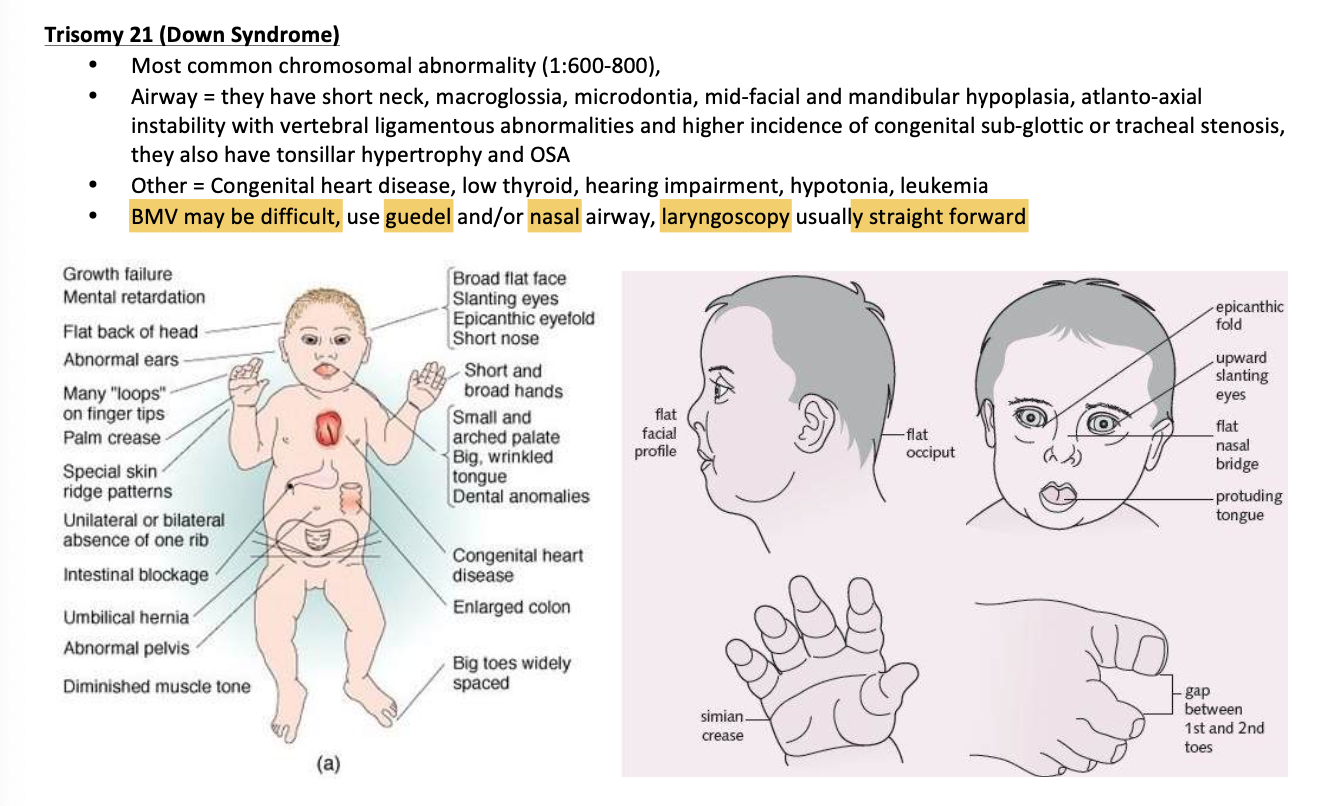
Trisomy 21
Implications for Airway
Most common 1:600-800
Airway
Short neck
Macroglossia
Microdontia
Mid-facial and mandibular hypoplasia (underdeveloped)
Tonsillar hypertrophy
Atlanto-axial instability
Vertebral ligamentous abnormalities
Higher incidence of congenital sib-glottic or tracheal stenosis
OSA too