[L12] Stresses in soils
 Call Kai
 Learn
Learn Practice Test
 Spaced Repetition
 Match
Match Flashcards
 Knowt Play
1/20

There's no tags or description
Looks like no tags are added yet.
Name | Mastery | Learn | Test | Matching | Spaced | Call with Kai |
|---|
No analytics yet
Send a link to your students to track their progress
21 Terms
Soil-structure interaction
development + construction of infrastructure alters the state of soils
Man-made embankment composition example
Overburden
Pindan scree B
Sapprolitic clays
Shale
(from top to bottom)
Pressure
scalar quantity = single parameter
same in all directions
Stress
not a scalar quantity ➞ more than 1 parameter
direction-dependent ➞ diff magnitudes of normal stress in vertical & horizontal
Hydrostatic water pressure (w/ no flow)
scalar
same in all directions
water ➞ cannot sustain shear forces, incompressible
water density (rhow)= 1000 kg/m3
water pressure (u)
u=rhow*g*z=𝛾w*z (specific weight*depth)
Vertical stresses in soils
defined in terms of total & effective stress components
due to self-weight of soil & external loads
𝝈z=total vertical stress component normal to the horizontal plane of a soil element in the ground at depth
𝝈x and 𝝈y = total vertical stress components normal to the vertical planes
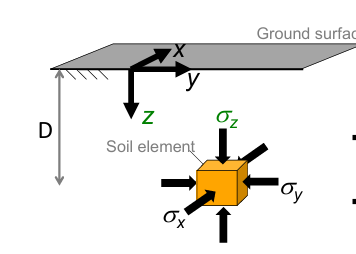
Vertical stress (due to self weight) in dry soil
increases linearly with depth in homogeneous soil deposits
𝝈z=𝛾d*z=𝜌d*g*z
Vertical stress (due to self weight) in saturated soil
increases linearly with depth in homogeneous soil deposits
𝝈z=𝛾sat*z=𝜌sat*g*z
Pore pressure (hydrostatic - no flow/ seepage)
u=𝛾w*z=𝜌w*g*z
u=water pressure
𝛾w=unit weight of water
𝜌w=density of water
increases linearly with depth
Total stress
𝝈
Total stress = Pore water pressure + Effective stress
Pore water pressure
u
= pressure of water filling voids of saturated soil ➞ lifts particles / resists stress
Effective stress
𝝈’
= net stress supported by soil skeleton
effective stress ≠ contact part (is an average)
𝝈’=𝝈-u
all measurable effects resulting from stress changes in the soil such as compression, distortion and shearing resistance variations are solely due to changes in effective stresses (not total stresses)
Stress transfer within soil mass
Average value of stress over a region
2 materials co-exist at each point → solid skeleton + fluid voids
Effective vertical stresses (due to self weight) formula
𝝈’z=𝛾sat*z-𝛾w*z=(𝜌sat-𝜌w)*g*z
𝛾’=effective unit weight of soil=𝛾sat-𝛾w
increase linearly with depth in homogeneous soil deposits
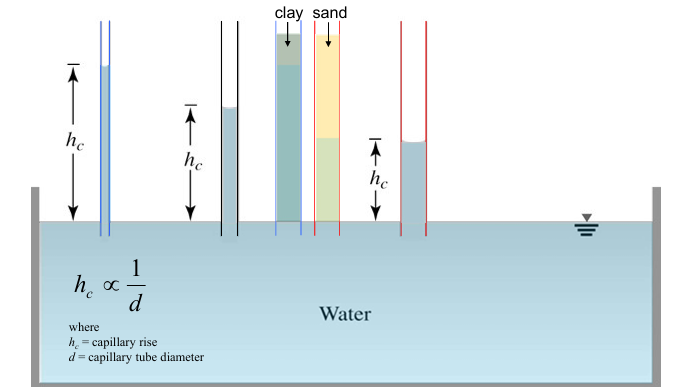
Capillary rise
hc is proportional to 1/d
hc = capillary rise
d = capillary tube diameter
due to capillary pore pressure (becomes negative above water level)
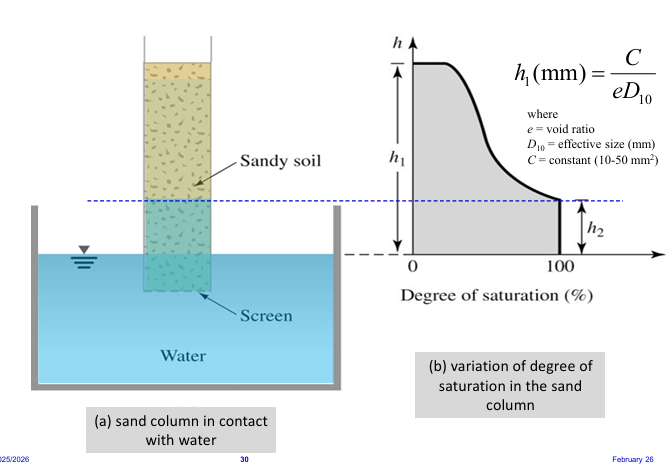
Variation of degree of saturation in sand column
h1=C/(e*D10)
e=void ratio
D10=effective size (mm)
C=constant (10-50mm2)
Pore water pressure in capillary zone in sands
u=-hc*𝛾w*Sr
𝛾w = specific weight of water = 9.81 kN/m³
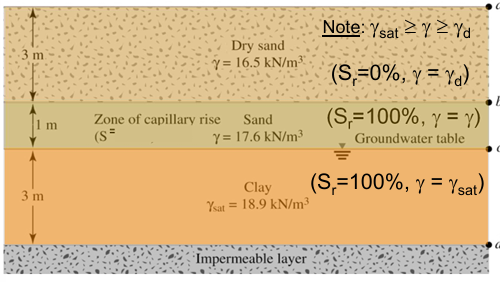
Draw the variation of σz , u, and σ’z with depth for the soil profile shown below. The sand layer within 1 m above the ground water table is fully saturated
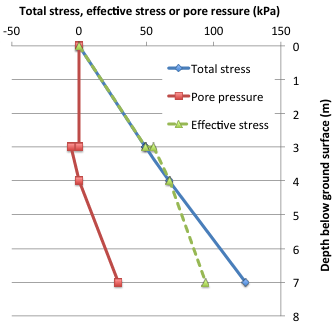
Specific weight of water
9.81 kN/m³
Finding ysat
Find e with ydry then calculate ysat
Effective stress in saturated soils defines
strength
stiffness
deformation