209 with week 4
 Call Kai
 Learn
Learn Practice Test
 Spaced Repetition
 Match
Match Flashcards
 Knowt Play
1/277

There's no tags or description
Looks like no tags are added yet.
Name | Mastery | Learn | Test | Matching | Spaced | Call with Kai |
|---|
No analytics yet
Send a link to your students to track their progress
278 Terms
What is the primary function of motion perception?
To perceive stimuli more accurately and summon attention.
motion perception is crucial for survival because..
it captures attention and predators need to perceive moving prey. moving prey need to be alerted of the presence of predators
What are the two ways of seeing motion?
1. Eye stationary while an object moves across the retina. 2. Smooth tracking of a moving object.
if we have a moving rational image and a moving eye…
no motion is perceived
if we have a moving retinal image but stationary eye
we perceive motion
if we have a stationary retinal image, but a moving eye
we perceive motion as we are tracking an object
motion perception requires the movement of…
either the retinal image, or the eye. but not both.
What does extraretinal information consist of?
Signals from the extraocular muscles.
where is extraretinal information contained?
corollary discharge signal (CDS)
What is a corollary discharge signal (CDS)?
A copy of the motor signal sent to the eyes to move eye muscles.
The retinal image alone can't tell the brain whether
the world moved or the eye moved — extra-retinal information is needed to distinguish the two.
The brain compares the retinal image with feedback signals from
the eye muscles — if the eye moved and the image moved equally, it's just eye movement, not real motion.
When the superior colliculus sends a command to move the eye…
it simultaneously sends a copy of that command (corollary discharge signal) to the motion perception area — which then compares it with the retinal signal to determine if real motion occurred.
the brain cancels out self-caused motion by
forwarding a copy of its own eye movement commands to the motion perception area
What three signals are involved in movement perception according to the Corollary Discharge Theory?
1. Motor signal (MS) 2. Corollary discharge signal (CDS) 3. Image displacement signal (IDS)
what is motor signal
signal sent to eyes to move eye muscles
what is CDS
a copy of the motor signal
what is image displacement signal (IDS)
movement of image across the retina
When is motion perceived if the eyes are stationary?
When an object moves across the retina.
What happens when the eyes track a moving object?
No retinal image motion occurs, but motion is still perceived.
what are neurons in the middle temporal lobe sensitive to
motion upwards and towards the left. this is when it fires the most.
neurons in the middle temporal lobe also encode speed of motion
some are sensitive to slow moving and fast moving objects.
what is MT responsible for
for processing motion
if MT is lesioned what happens?
The world appears as a series of frozen snapshots rather than continuous movement.
What is the aperture problem?
The difficulty in determining the direction of motion due to limited visual information.
apparent motion'?
The perception of motion when two stimuli are presented in quick succession.
What is the motion aftereffect?
A phenomenon where prolonged exposure to motion causes a stationary object to appear to move.
What is induced motion?
When the motion of a larger context causes a stationary object to appear to move.
What is biological motion?
The movement of living organisms, often recognized through point-light displays.
What is the occlusion heuristic in motion perception?
The assumption that an object covered by another continues to exist.
What is the shortest path constraint for apparent motion?
The tendency to perceive motion along the shortest path between two points.
What is the ecological approach to perception?
The view that perception involves extracting invariants in a scene and requires movement.
What is optic flow?
The appearance of objects in the retinal image as the observer moves through an environment.
gradient of flow (optic flow)
the difference in flow as a function of distance from the observer. Provides speed information
What does the focus of expansion indicate?
The point in the visual field towards which an observer is heading.
The parts of the visual field closest to us are moving at what speed?
moving the fastest
What are affordances in the context of perception?
Information provided by an object about its function, influencing perception and action.
optic flow helps keep us
upright because as soon as the visual field shifts, the brain detects it
optic flow neurons can be found
in the medial superior temporal area (MST)
What role does the parietal lobe play in perception for action?
It is involved in the control of eye movement and visually guided actions.
Lateral intraparietal area
control movement of the eye
medial intraparietal area
for visually guided reaching
What are mirror neurons?
Neurons that respond both when an action is performed and when it is observed.
anterior intraparietal area
for visually guided grasping
What is the significance of mirror neurons in understanding actions?
They help in understanding action and intention, and facilitate learning through observation.
How does the brain respond to the intention of drinking compared to cleaning up?
Neurons respond more intensely to the intention of drinking.
What happens when MT (middle temporal area) is lesioned?
It can impair the perception of motion.
What is the role of complex cells in V1?
They are direction-sensitive and help in determining motion direction.
What is the relationship between perception and action according to the Two Visual Systems View?
Perception and action are largely separate with distinct pathways for each.
What is the function of optic flow neurons in the medial superior temporal area (MST)?
They are involved in processing optic flow information.
What is the significance of the gradient of flow?
It provides speed information based on the difference in flow as a function of distance from the observer.
What is inattentional blindness (IB)?
Failure to detect an unexpected, suprathreshold object.
What does implicit perception refer to?
Perception that occurs without conscious awareness.
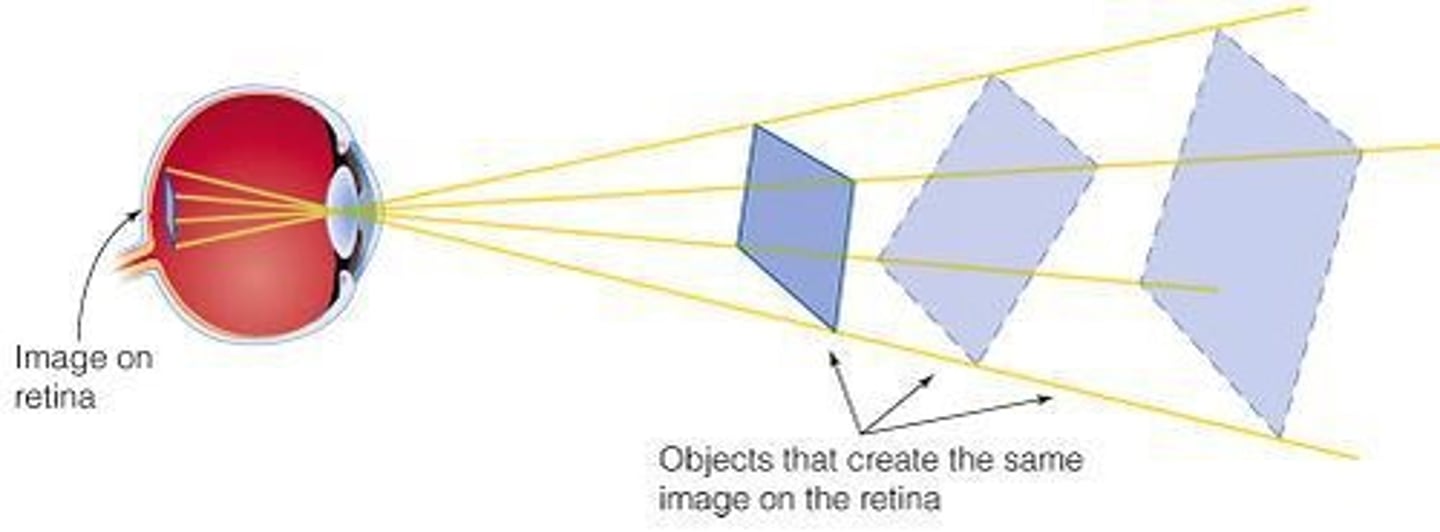
What is the Ponzo illusion?
A visual illusion that demonstrates how context can affect perception, showing the same effect whether inducing lines are consciously seen. an example of inattentional blindness
What is repetition blindness (RB)?
Failure to detect repetitions of words or other visual stimuli in lists presented in rapid serial visual presentation (RSVP). Attention has limits.
When does repetition blindness occur?
When visual stimuli are recognized as types but not as separate instances, and only when report of the first instance is required.
why does repetition blindness occur only to visual phenomena?
Repetition blindness is visual-only because the visual system is built to handle objects constantly disappearing and reappearing behind each other as we move. Treating a repeated object as "same thing again" rather than "new object" is the correct call nearly every time — so the brain automates it.
Hearing doesn't have this problem — sounds don't occlude each other, so no such shortcut exists.
What is Multiple Object Tracking (MOT)?
The ability to track multiple objects over time, typically tracking 4 to 5 items.
How does spatiotemporal continuity relate to MOT?
It mediates the maintenance of object tokens over time.
multiple object tracking is not disrupted by occlusion but
we are poor at identifying which object was successfully tracked
What are the two fundamental questions in understanding a visual scene?
1. Which regions are parts of the same surface or object? 2. Which regions represent figure and which are part of the background?
What do Gestalt Principles of Perceptual Grouping state?
The perception of the whole is more than simply the sum of the individual parts.
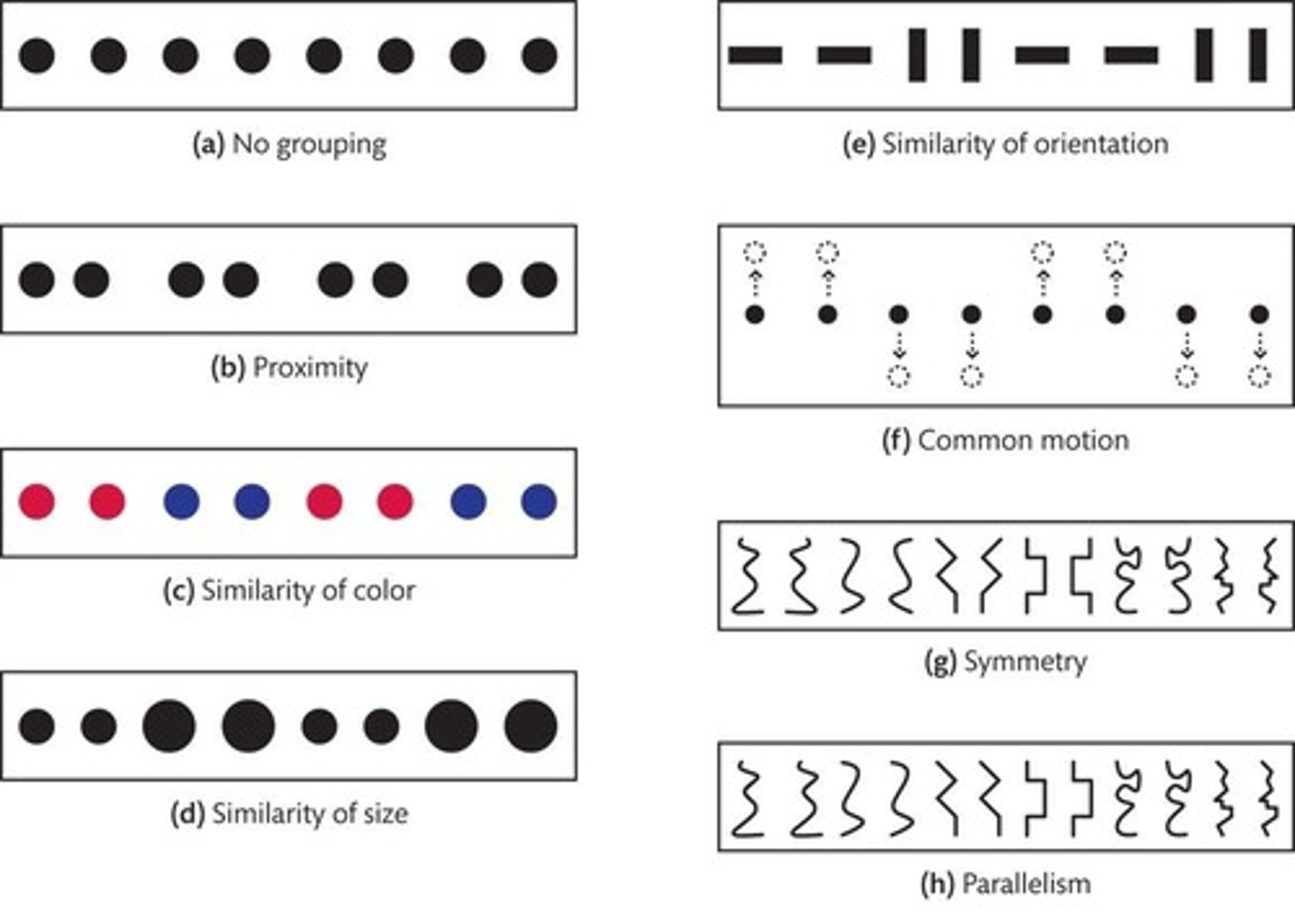
What is the principle of good continuation in Gestalt theory?
Regions that appear to follow the same contours are grouped together.
What factors influence figure-ground segmentation?
Location, symmetry, size, orientation, and meaning of elements.
recent grouping principles (3)
connectedness, common region, synchrony
How does location affect figure-ground segmentation?
Elements located in the lower part of displays tend to be seen as figure.
why do we think of the ground being the figure
due to our reality, the sky is up and the ground is below. the way the horizon works
F-G segregation
doesn’t have to occur before we can recognise objects. more likely to see the meaningful part as the figure.
What is boundary extension?
A memory phenomenon where a close-up picture of a scene contains more information than was actually viewed.
object recognition
we recognise objects automatically and without effort
viewpoint variance
same object can be viewed from many different angle, different viewpoints -> each resulting in different visual input. different lighting conditions can also create ambiguity
What is the image-based object recognition approach?
Objects are stored as templates and are view-specific.
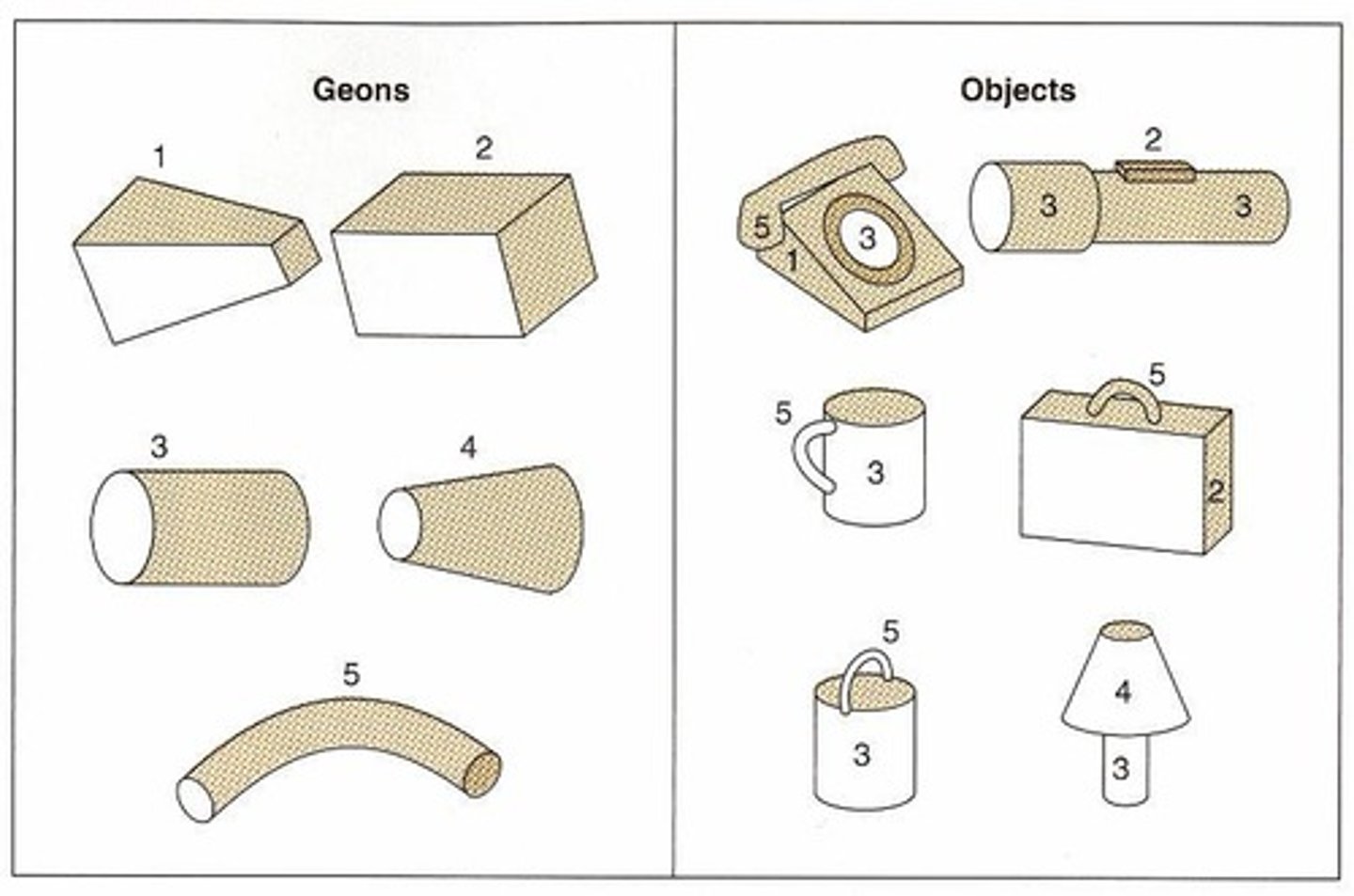
What is the parts-based object recognition approach?
The brain deconstructs viewed objects into a collection of parts (geons), making it view-invariant.
What is the effect of context on target identification?
Congruent context leads to 80% identification success, while incongruent context leads to only 40% success.
What does neural evidence for figure-ground segregation indicate?
V1 neurons in the monkey cortex respond to areas that are figure, but not to areas that are ground.
What is the significance of occlusion in MOT?
MOT is not disrupted by occlusion, but identifying the successfully tracked object is challenging.
What does the term 'meaning' refer to in figure-ground segmentation?
Elements that have meaning tend to be seen as figure.
What are the main functions of eye movements?
Fixation and tracking.
What are the types of eye movements?
Physiological nystagmus, saccadic eye movements, and smooth pursuit movements.
What is physiological nystagmus?
Tiny involuntary movements caused by tremors in the extraocular muscles.
examples of saccadic movements
fast, rapid, used to shift the point of focus from one object to another e.g quickly looking at a flashing light
How long does it take to plan and execute saccadic movements?
About 150 to 200 milliseconds.
What characterizes smooth pursuit movements?
They are smooth and continuous, requiring constant correction based on feedback.
both saccards and smooth movements are what
selective because they pick certain objects that we want to focus our attention on
What is overt orienting in attention?
Attention with eye movements that allows us to take in details from different parts of a scene.
What is covert orienting in attention?
Attention without eye movements, akin to an internal eye that can shift independently of the external eye.
What is saccadic suppression?
A type of visual masking that attenuates perception during saccades.
What is the perceptual consequence of attention?
Attention can affect how quickly a stimulus is seen, demonstrating space-based attention.
What does Posner's cueing paradigm demonstrate?
Enhanced processing at the cued location.
What is object-based attention?
Attention that focuses on specific objects rather than locations.
How can attention create motion illusions?
Attention can alter the perception of motion, as demonstrated by the line-motion illusion.
binding in attention
process by which features are combined to create perception of coherent objects
What is the binding problem in attention?
The challenge of combining different features of an object processed in separate brain areas.
What is feature search in visual attention?
A search that does not require binding and is efficient, with no set size effect.
What is conjunction search in visual attention?
A search that typically requires binding, has a set size effect, and is inefficient.
What happens if focused attention is prevented?
Balint's syndrome occurs, where individuals can only attend to one object at a time.
What is visual neglect?
A condition where individuals cannot attend to the left half of space, usually due to right parietal lobe damage.
Can perception occur without attention?
Yes, perception can occur with little attention for the gist of scenes.
What is the attentional blink?
A phenomenon where a stimulus is not detected because attentional resources are depleted by processing another stimulus.