Cell membrane and viruses
 Call Kai
 Learn
Learn Practice Test
 Spaced Repetition
 Match
Match Flashcards
 Knowt Play
1/29

There's no tags or description
Looks like no tags are added yet.
Name | Mastery | Learn | Test | Matching | Spaced | Call with Kai |
|---|
No analytics yet
Send a link to your students to track their progress
30 Terms
Why is the cell membrane is a fluid mosaic model
Fluid= individual phospholipids can move independently
Mosaic= embedded with proteins and many molecules
Draw cell surface membrane
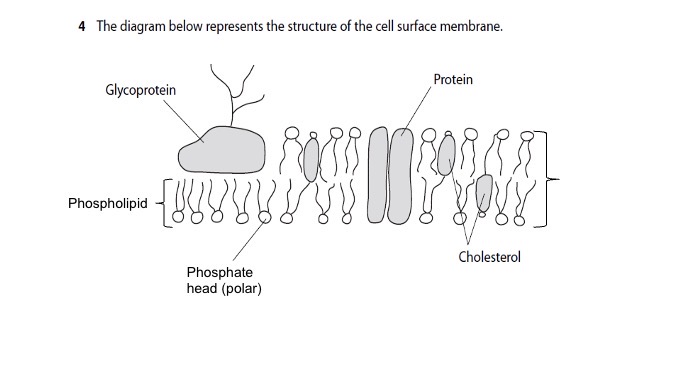
Intrinsic proteins
Act as transport IN and OUT of the cell e.g.
Channel proteins and carrier proteins
They act as receptors to identify cells and allow them to attach to each other
Extrinsic proteins
Mostly found on the outside of phospholipid bilayer e.g. glycoproteins
These allow cells to communicate with other cells and to be recognised by the immune system and to act as receptors for hormones to enable cells to attach to each other to form tissues
Glycolipids
Made of carbohydrate covalent bonded to a lipid.
The carbohydrate section extends into the tissue fluid and acts as a receptors for chemicals, recognition sites, maintains the stability of the membrane and can attach to other cells forming tissues
Aquaporin
Instrinsic protein which allows the transport of water in and out the cell by osmosis
Cholesterol
Maintains integrity of the phospholipid bilayer
Reduces lateral movement of molecules in cell membrane and makes membrane less fluid and more rigid at warm temperatures.
Prevents the leakage of water and dissolved ions from the cell
Why do phospholipids form a bilayer
Fatty acid tails are hydrophobic and non polar so orientate themselves as far away from polar environment of tissue fluid and cytoplasm. Phosphate heads are polar so interact with polar environment of tissue fluid and cytoplasm
Why do phospholipids form a bilayer but not triglycerides
Trilglyerciees are entirely hydrophobic / non polar
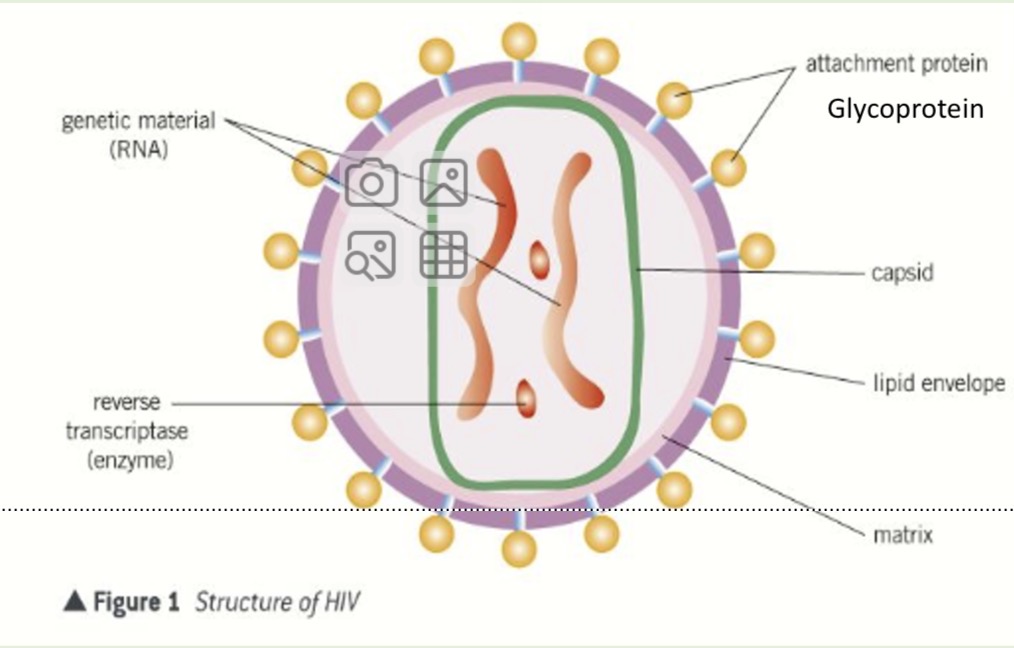
What are all the 5 structures of a virus
RNA strand
Capsid
Lipid envelope
Attachment protein
Reverse transcriptase
Function of RNA strand
Template for DNA formation
Function of the capsid
Protects the RNA
Function of the lipid envelope
Fuses with host cell membrane
Function of attachment protein
Identify host cell so enables virus to attach to the host cell
Function of reverse transcriptase
Makes DNA from RNA template
Viral replication
Attachment proteins attach to receptors on host cell
Viruses inject (DNA/ RNA) nucleic acid into host cell
Host cell replicates viral nucleic acid (DNA/ RNA)
Host cell produces viral protein/capsid/ enzymes
Viruses are assembled and released from the cell
What does HIV and AIDs stand for
HIV = human immunodeficiency virus
AIDs = acquired immune deficiency syndrome
What is HIV host cell
T helper cell
Labelled diagram of HIV
Process of HIV replication
Attachment proteins of HIV bind to a protein receptor on a helper T cell surface membrane
Lipid envelope and protein capsid fuses with the cell surface membrane.
This enables RNA and enzymes of HIV to enter T helper cell
The HIV reverse transcriptase concerts the viruses RNA into DNA
The HIV DNA is moved into the helper T cells nucleus and is inserted into the cells DNA
HIV DNA in nucleus is transcribed into mRNA ( contains instructions for making new viral proteins and RNA go into a new HIV)
The mRNA passes out the nucleus through a nuclear pore and uses the cells ribosomes to be translated into HIV proteins
New HIV viruses are assembled into new viruses and released from the t helper cell
How is HIV transmitted and what are the symptoms of HIV
Transmitted by bodily fluids like semen, blood and vaginal secretions through unprotected sex and direct blood to blood contact
Symptoms are flu like but virus can remain dormant in DNA for years so can go undetected
When does a person have aids
when the immune system deteriorates and fails so critically low number of T helper cells
Less then 200 cells/mm3
Individuals become more susceptible to infection which leads to death
How to diagnose HiV
Blood sample then elisa test to detect HIV antibodies
How to diagnose aids
Blood sample taken then number of T helper cells is counted and have aids when count below 200cells/mm3
How does HIV/ AIDs impact the immune system
HIV host cell are T helper cell and replication of HIV virus kills the T helper cell
Reduction in number of T helper cells means it cannot release cytokines and cannot activate B plasma cells
Therefore cannot make antibodies
T killer cells cannot kill cells infected with pathogens
AIDs and secondary infections
AIDs weakens the immune system so sufferers can develop secondary diseases due to opportunistic infections and the opportunistic infections kill individual
Why can we use antibiotics to treat bacterial infections
Antibiotics inhibit enzymes that make murein in the cell wall so bacteria cannot make cell wall or cell wall is weakened so more water can enter by osmosis causing the cell to burst killing bacteria
Why are antibiotics Ineffective against viral disease
Virus has a capsid not a murein cell wall so no sites where antibiotics work
virus is inside host cell so antibiotics cannot reach them
No metabolism so cannot disrupt metabolic mechanisms
Give the three structural features found in all virus
RNA
Capsid
Attatchment protein
Explain why viruses are described as acellular and non living
Acellular as no cell surface membrane and not made up of cells
Non living as have no metabolism/metabolic reactions so cannot independently respire