M2C Unit 2 Lesson 1 and 2
 Call Kai
 Learn
Learn Practice Test
 Spaced Repetition
 Match
Match Flashcards
 Knowt Play
1/71

There's no tags or description
Looks like no tags are added yet.
Name | Mastery | Learn | Test | Matching | Spaced | Call with Kai |
|---|
No analytics yet
Send a link to your students to track their progress
72 Terms
Where is starch found?
Plants and fungi
Where is glycogen found?
animals
Starch is a mixture of what?
amylose (unbranched) and amylopectin (branched)
What is Maltose?
Glucose + Glucose
What is Amylose?
Unbranched glucose polymer
What is amylopectin?
Branched glucose polymer
What is glycogen?
highly branched glucose polymer
What is lactose?
Galactose + Glucose
What is cellobiose?
Unbranched glucose polymer (glucose + glucose)
What is the result of Deficiency of disaccharidases?
Passage of undigested carbohydrates into the large intestine
What are the two effects of disaccharidase deficiency?
Osmotically active, brings water, causes bloating and diarrhea
Bacterial fermentation leads to accumulation of CO2 and H2 Flatulence
How can abnormal degradation of disaccharides be diagnosed?
Measure H2 gas in the breath
A newborn shows symptoms of failure to thrive and develops osmotic diarrhea after being fed a standard infant formula. If a disorder in carbohydrate digestion is suspected, which of the following tests would most effectively identify the underlying issue?
A.
What does a Clinitest help with?
A urine test for Reducing Sugars. A positive result is indicative of an underlying pathology because sugars are not normally present in urine and can be followed up by more specific tests to identify the reducing sugar.
What is the role of GLUT1?
Basal glucose uptake in erythrocytes and brain
Provides constant glucose uptake even when blood glucose is low
high affinity
What is the role of GLUT2?
In the pancreas, it plays a role in the regulation of insulin.
In the liver, it removes excess glucose from the blood. It transports glucose, galactose, and fructose
Low affinity, high capacity
Moves glucose in or out, depending on concentration, and helps pancreatic β-cells sense blood glucose
active after a meal (fed state)
What is the role of GLUT3?
Basal glucose uptake in neurons
Very high affinity
Ensures neurons receive glucose even during hypoglycemia (low glucose)
What is the role of GLUT4?
The amount of muscle plasma membrane increases with endurance training
Insulin-responsive transporter
Insulin causes GLUT4 vesicles to move to the membrane
Exercise also stimulates GLUT4 insertion independently of insulin
What is the role of GLUT5?
Primarily transports fructose
What is the role of SGLT1?
sodium-glucose cotransporter that absorbs glucose and galactose together with sodium (Na⁺) using secondary active transport.
Intestinal glucose/galactose absorption
What is the role of SGLT2?
responsible for reabsorbing most filtered glucose in the kidney
Renal glucose reabsorption in proximal tubule
What does Lactase breake lactose down into?
Glucose and Galactose
What does Sucrase break Sucrose into?
Fructose and Glucose
When is Glucagon released?
fasting state
What does glucagon do?
Maintains blood glucose levels by increasing blood glucose secretion by liver
Glycolysis of Net Reaction
Glucose + 2 ADP + 2 NAD+ + 2 Pi → 2 Pyruvate + 2 ATP + 2 NADH + 2 H+ + 2 H2O
What steps contain the Four kinases in glycolysis?
Steps 1,3,7,10
Which isozyme of Hexokinase is active at higher glucose levels?
Hexokinase IV (Glucokinase)
What is the rate limiting step for glycolysis?
Phosphofructokinase-1 (PFK-1) |
Fructose-6-phosphate → Fructose-1,6-bisphosphate |
Step 3
What are the three enzymes for the irreversible steps of glycolysis?
Hexokinase
Phosphofructokinase -1 (PFK-1)
Pyruvate Kinase (PK)
How does Arsenate (AsO4 -3) poisoning occur?
Arsenate can replace Pi as a substrate for G3PDH
What is the fate of pyruvate in Aerobic conditions?
acetyl-CoA then TCA
What is the fate of pyruvate in Anaerobic conditions?
ethanol or lactate
What enzyme can reconvert lactate to pyruvate?
lactate dehydrogenase
Net reaction for glucose degradation to lactate?
Glucose + 2 Pi 2- + 2 ADP3- → 2 Lactate- + 2 ATP4- + 2 H2O
Glucose 6-phosphate serves as an inhiitor for what?
Hexokinase
Where is Hexokinase mainly found?
in all tissues
Where is Glucokinase mainly found?
In the liver (insulin induced)
Fructose 2,6-bisphosphate which is made by PFK2, is an allosteric activator for what?
PFK-1
Insulin _______PFK-2 via _______
activates; dephosphorylation
Glucagon _______ PFK-2 via ________
inhibits ; phosphorylation
Lactic acidosis can result from what?
insufficient oxygen (an increase in lactic acid and decrease in blood pH)
Lactate formed in skeletal muscles during exercise is transported where to do what?
to the liver to be reconverted to pyruvate
What enzyme reconverts lactate to pyruvate?
lactate dehydrogenase
What are the three regulatory enzymes in glycolysis?
1. Hexokinase/Glucokinase 2. Phosphofructokinase 3. Pyruvate kinase
Phosphofructokinase-1 (PFK-1) functions in the muscle when?
there is a need for ATP
2,3-biphosphoglycerate is an (inhibotor/activator) for Phosphofructokinase-1.
activator
Fructose 1,6- bisphosphate is an (activator/inhibitor) for pyruvate kinase.
activator
How do AMP and fructose 2,6-bisphosphate (F2,6BP) active PFK-1?
relieve the inhibition of PFK-1 by ATP
When ATP levels are sufficient, PFK-1 is?
inhibited by ATP and citrate
When there is excess glucose-6-phosphate, what is inhibited?
Hexokinase
What type of molecule is GLUT?
hexose transporters
Which GLUT transporter is stimulated by insulin?
GLUT4
Glucose 1-phosphate is used to convert Glycogen to what?
Glucose-6-phosphate
In the Pentose Phosphate pathway, Glucose 6-phosphate is converted to what?
Ribose 5-phosphate + NADPH
Glucose 6-phosphate is converted to what for export in blood?
Glucose
Glucose 6-phosphate is converted to Glucose for export in blood by what enzyme?
Glucose 6-phosphatase
Elevated levels of citrate (activate/inhibit) PFK-1.
inhibit
F2,6BP is formed from F6P by what enzyme?
phosphofructokinase-2 (PFK-2)
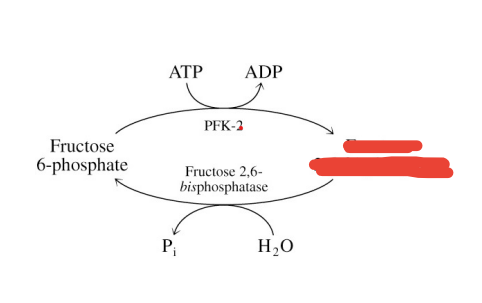
fructose 2,6-biphosphate
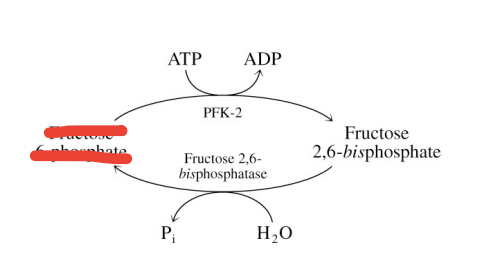
Fructose 6-phosphate
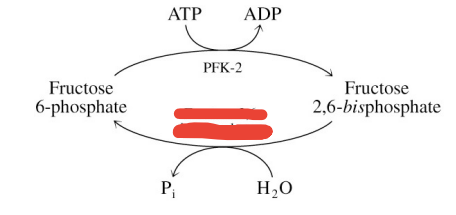
fructose 2,6-biphosphatase
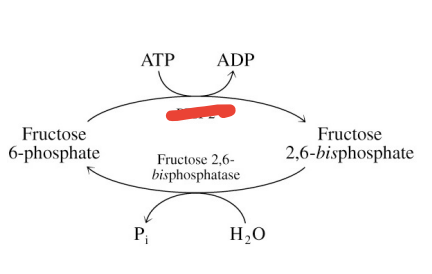
PFK-2
PK is allosterically (activated/inhibited) by F1,6BP
activated
What stimulates protein kinase A which phosphorylates PK converting it to a less active form (liver and intestinal cells)?
Glucagon
Glucagon stimulates protein kinase A which phosphorylates what converting it to a less active form (liver and intestinal cells)?
Pyruvate Kinase (PK)
Under anaerobic conditions the conversion of glucose to pyruvate is much higher/lower than under aerobic conditions (yeast cells produce more ethanol and muscle cells accumulate lactate)?
higher
What is The Pasteur Effect?
the slowing of glycolysis in the presence of oxygen
More ATP is produced under (aerobic/anaerobic) conditions than under anaerobic conditions, therefore less glucose is consumed aerobically
aerobic
Other sugars can also be made into sugars (diff types)
Fructose → DHAP or G3P
What is mannose converted to in the fructose sugar pathway?
Fructose 6-phospjhate
Erythrocytes contain bisphosphoglycerate mutase, which forms what from what?
2,3BPG from 1,3BPG