Charter of Rights
 Call Kai
 Learn
Learn Practice Test
 Spaced Repetition
 Match
Match Flashcards
 Knowt Play
1/30

There's no tags or description
Looks like no tags are added yet.
Name | Mastery | Learn | Test | Matching | Spaced | Call with Kai |
|---|
No analytics yet
Send a link to your students to track their progress
31 Terms
Why do we have rights?
inherent values of liberty and equality (help accomplish these goals)
What are the two sources of rights?
natural law: “god-given”, reasoning from dignity, moral worth, and autonomy of individuals (there is something intrinsic to people that gives them a set of rights)
social norms/rules: consequences of rights (need for us to live together/cooperate , consequentialist theory
Are rights absolute?
there is a conflict of rights, rights and interests
Why do we have a charter of rights?
“an instrument of national unity: charter canadians”
failures of previous rights protections, ie. bill of rights 1960, forerunner of the charter, seen as a failure (at the time)
not part of constitution, just law passed by parliament
didn’t provide for judicial review
rights activism of 1950s, 1960s
Role of Pierre Trudeau (1968-79, 80-84)
What do Canadians argue keeps Canada united?
25% say that the Charter of Rights (highest)
Where is the Charter of Rights and Freedoms?
first part of the Constitution Act, 1982 (ss.1-33)
What are the 3 sections of the Charter of Rights and Freedoms?
interpretive: how to understand and make decisions about potential Charter rights violations
procedural: when and how charter claims can be brought and resolved
substantive: enumeration of rights and freedoms
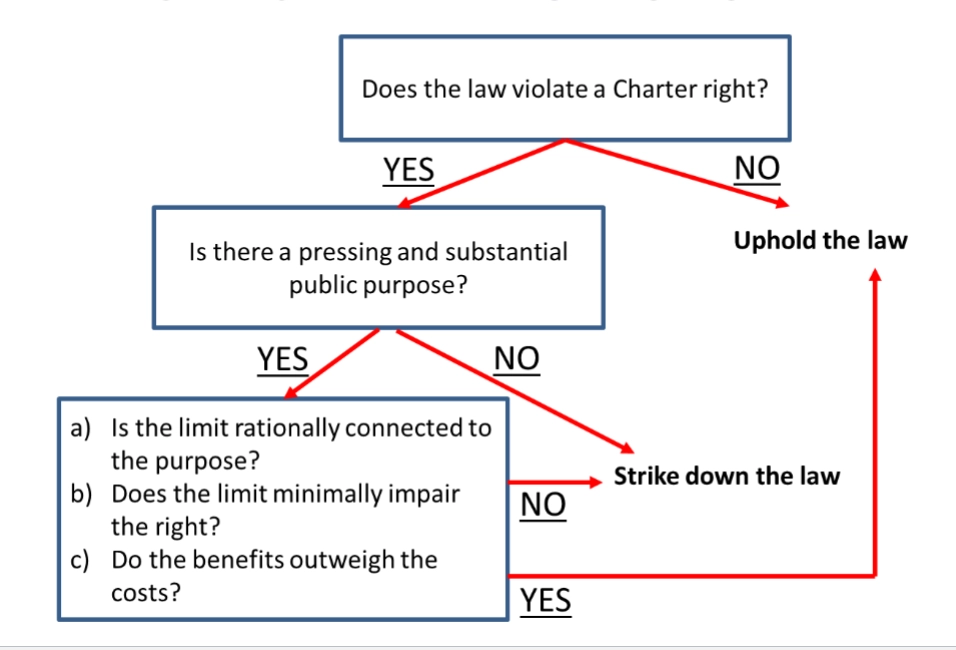
What is the s,1: “reasonable limits” clause?
governments may violate Charter rights if they can justify it as a reasonable rights
What is the Oakes Test?
determining when the government is justified in infringing a Charter rights
What are sections 25—28 of the Charter?
instructions for how to read the charter
What is s.25 ?
indigenous rights shield
The Charter should not be used to undermine existing Indigenous rights (including aspects of self-government).
ie. Dickson v. Vuntut Gwitchin First Nation (2024): s. 15 equality challenge to a residency requirement for elected officials; SCC held s. 25 shields Indigenous rights/self-government from being undermined by Charter interpretation, so the residency requirement was upheld
What is s.26?
charter not exhaustive list
The Charter should not be interpreted to deny other rights just because they are not written in the Charter.
What is s.27?
multiculturalism
Charter rights should be interpreted in a way that is consistent with preserving and enhancing multiculturalism.
What is s.28
gender equality guarantee
Charter rights are guaranteed equally to men and women.
What is s.33
“Notwithstanding Clause”
parliament or provincial legislatures may pass a law declaring it valid despite s.2 (fundamental freedoms) and ss. 7-15 (legal equality and rights)
immune to judicial review for 5 years
controversial, but historically had minimal effect on Charter protection of rights
What is s.2 of the charter?
fundamental freedoms
protects the rights to freedom of conscience and religion, thought, belief, opinion, and expression, including freedom of the press and other media of communication.
shown by:
R v. Keegstra (1990) → validity of hate speech laws
Ford v. Quebec (1988) → constitutionality of Bill 101’s French-only sign clause
What are s.7-15 of the charter?
legal rights and equality guarantees
include the right to life, liberty, and security of the person; protection against unreasonable search and seizure; rights upon arrest and detention; and the right to not be discriminated against.
What is s.24 of the charter?
provides remedies for rights violations
allows individuals to seek a court remedy if their rights and freedoms, as outlined in the Charter, are infringed.
What is s.7 of the charter?
guarantees the right to life, liberty, and security of the person, and protection against arbitrary detention.
R.V Morgentaler (1988): strikes down restrictions on abortion based on security of the person (s. 7)
What is s.15 of the charter?
guarantees equality before and under the law and equal protection and benefit of the law without discrimination; prohibits discrimination based on race, national or ethnic origin, colour, religion, sex, age, or mental or physical disability.
Egan v. Canada (1995): discrimination based on sexual orientation violates s. 15 equality protection, but is relevant and justifiable
Violating the s.15
does the law create a distinction based on an enumerate or analogous ground?
does the distinction impose or perpetuate disadvantage based on stereotyping?
M v. H (1999): opposite-sex definition of spouse in Ontario’s Family Law Act violates s. 15 and cannot be saved under s.1
What is R v. Keegstra (1990)?
Upheld Criminal Code hate speech limits. The Court treated hate speech as expression, but found the restriction could be justified under s.1.
s.2(b) + s.1
What is Ford v. Quebec (1988)?
Struck down parts of Quebec’s French-only commercial sign law as violating freedom of expression. The government’s s.1 justification failed on proportionality.
s.2(b) + s.1
What is Sauvé v. Canada (2002)?
Struck down the federal law denying prisoners the right to vote. Voting is a core democratic right, and the limit was not justified under s.1.
s.3 + s.1
What is R v. Morgentaler (1988)?
Struck down Canada’s abortion law because the process (therapeutic abortion committees, delays, uneven access) violated security of the person and fundamental justice.
s.7
What is Carter v. Canada (2015)?
Found the blanket ban on medical assistance in dying violated s.7 (life, liberty, security). Protecting vulnerable people was a valid goal, but a total ban was not minimally impairing.
s.7 + s.1
What is Canada (AG) v. PHS Community Services Society (Insite) (2011)?
The federal minister’s refusal to grant an exemption for Insite was unconstitutional because it threatened clients’ life and security of the person. The Court required an exemption.
s.7
What is Egan v. Canada (1995)?
Recognized sexual orientation as an analogous ground under equality rights. In this case, the specific benefit exclusion was ultimately upheld (the limit was treated as justifiable at the time).
s.15 + s.1
What is Vriend v. Alberta (1998)?
Alberta’s human rights law was unconstitutional for excluding sexual orientation. The Court “read in” sexual orientation as a remedy.
s.15 + s.24
What is M v. H (1999)?
Ontario’s definition of “spouse” (opposite-sex only) for certain benefits violated equality rights and could not be justified under s.1.
s.15 + s.1
What is Dickson v. Vuntut Gwitchin First Nation (2024)?
A residency rule for First Nation elected office was challenged as unequal. The SCC held s.25 can protect Indigenous self-government from being undermined by Charter equality claims, so the rule was upheld.
claim under s.15, but key shield is s.25