(Lecture 3) (L3_iPSC) iPSC and ECM
 Call Kai
 Learn
Learn Practice Test
 Spaced Repetition
 Match
Match Flashcards
 Knowt Play
1/29

There's no tags or description
Looks like no tags are added yet.
Name | Mastery | Learn | Test | Matching | Spaced | Call with Kai |
|---|
No analytics yet
Send a link to your students to track their progress
30 Terms
What are the two main roles of bioreactors?
Improve mass transport: oxygen, nutrients, waste removal
Provide physical stimuli to guide cell/tissue development
What is the main diffusion limit in tissue culture?
Diffusion becomes limiting beyond about 200 µm from the medium/tissue interface.
Why is Volvox used as a transport example?
It shows that diffusion alone only works at small sizes; larger systems need enhanced transport.
What does a high Péclet number mean?
Pe » 1 means advection dominates diffusion
What properties should bioreactor vessel materials have?
They should be inert, non-cytotoxic, and preferably biocompatible.
Why is tubing choice important in bioreactors?
Because it affects: leachables, gas permeability, flow precision / rigidity
What pumps are commonly used in bioreactors?
Peristaltic, Piston, Syringe, Pressure-driven
What do bioreactor sensors usually monitor?
Temperature, CO₂, Dissolved O₂, pH
What is the main advantage of a spinner flask bioreactor?
Stirring improves convection and external mass transfer.
What is the main disadvantage of a spinner flask?
It can create turbulent eddies that damage delicate tissues.
What is a rotating wall bioreactor good for?
Creating a low-shear, microgravity-like environment for delicate 3D tissues and organoids.
What is the key feature of direct perfusion bioreactors?
Medium flows through scaffold pores, improving:
seeding uniformity
internal mass transport
Why are perfusion bioreactors useful for bone engineering?
They provide both:
mass transport
shear stress that can support osteogenic differentiation
What are the main advantages of microfluidic bioreactors?
They are:
small-scale
high-throughput
need few cells/reagents
allow precise control of gradients and perfusion
What materials are often used in microfluidic systems?
PDMS
ECM-like hydrogels
How can microfluidics create oxygen gradients?
Using gas channels with different gases and exploiting PDMS gas permeability.
What is aerotaxis?
Directed cell movement along an oxygen concentration gradient.
Why combine microfluidics with hydrogels?
To mimic:
3D ECM
blood flow
nutrient/oxygen gradients
Why are physical stimuli important in bioreactors?
Because cells respond to cues like:
shear
pressure
stretch
which affect maturation and function.
What does a compression bioreactor do?
It applies controlled compressive loading to engineered tissues to improve maturation.
What is the main advantage of organ-on-a-chip systems?
They better mimic the in vivo microenvironment with controlled cells, ECM, flow, and imaging
What mechanical cues are important in a lung alveolus-on-a-chip?
Cyclic strain
Hydrostatic pressure
Shear stress from air and blood flow
What does strain do in a lung alveolus-on-a-chip?
increases surfactant production
decreases proliferation
enhances ECM deposition and immune response
What cells are found in the alveolus-on-a-chip model?
Back:
AT1 cells
AT2 cells
alveolar macrophages
endothelial cells
stromal cells such as fibroblasts / MSCs / pericytes
How is the lung alveolar-capillary interface recreated on a chip?
With two PDMS chambers separated by a porous ECM-coated membrane, plus stretch to mimic breathing.
What is a human-on-a-chip?
A system linking multiple organ chips to study organ-organ interactions.
What was the key idea of the engineered trachea case study?
A decellularized donor trachea was seeded with the patient’s own cells in a bioreactor before transplantation.
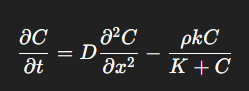
What equation describes nutrient transport with uptake?
This combines diffusion and Michaelis-Menten uptake.
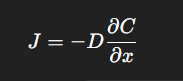
What is Fick’s law for nutrient flux?
Flux goes down the concentration gradient.
How are bioreactor designs matched to tissues?
Different designs mimic different cues:
perfusion → flow / transport
compression → joint loading
stretch → muscle/tendon loading
electrical stimulation → excitable tissues